Abu Dhabi Site Lighting for Safer Night Work
When a concrete pour, fit-out handover, or external works package runs past sunset, Abu Dhabi site lighting becomes a direct construction-control issue. Poorly lit access routes slow material handling, obscure trip hazards, and make quality checks unreliable. Over-lighting without a plan creates different problems: glare, generator load, cable congestion, and complaints from neighboring properties.
For contractors and procurement teams, the right approach is not simply ordering more floodlights. It is designing a temporary lighting setup around work zones, access, power availability, equipment durability, and the actual shift schedule. A practical lighting plan protects productivity while helping site teams meet safety and inspection requirements.
Start With the Work, Not the Light Fixture
Every active area has a different visual requirement. A perimeter road needs consistent orientation and hazard visibility. A steel-fixing or MEP installation area needs enough directed light for accurate work. Store yards and loading bays need broad coverage for vehicle movement, while escape routes and welfare areas need dependable illumination even if temporary power is interrupted.
Before selecting equipment, walk the site at the hours the work will take place. Identify lifting zones, scaffold access points, excavation edges, temporary stairs, material-storage areas, security boundaries, and vehicle-pedestrian crossings. These are the areas where lighting gaps turn into incidents or delays.
The target level of illumination depends on the task, the surface condition, and the site risk assessment. Fine finishing work requires more controlled visibility than general circulation. Dust, wet surfaces, reflective cladding, and open excavation can change how light performs on site. A lighting arrangement that appears acceptable during a daytime test may produce shadows or glare after dark.
Build Abu Dhabi Site Lighting Around Zones
A zoning plan gives supervisors control over both safety and operating cost. Rather than powering every fixture across the entire site for the full shift, separate the installation into work zones with clear switching and distribution points.
Access, circulation, and emergency routes
Site entrances, pedestrian walkways, stairs, ramps, and emergency egress paths should remain clearly visible throughout occupied hours. Position lights to reveal level changes, barriers, directional signs, and cable crossings. Avoid mounting fixtures where they shine straight into the eyes of drivers, security staff, or workers descending stairs.
Emergency provisions should not rely solely on the main temporary power source. Battery-backed emergency lights and clearly visible exit signs are necessary where the site layout, enclosed work areas, or project safety plan requires them. Verify that emergency units are tested, accessible, and not blocked by stored materials.
Active construction and installation areas
Portable LED work lights are useful for localized tasks such as shuttering, rebar work, ceiling installations, cable pulling, testing, and finishing. Their strength is flexibility, but they must be positioned properly. A single light behind a worker often creates a shadow exactly where the work needs to be seen.
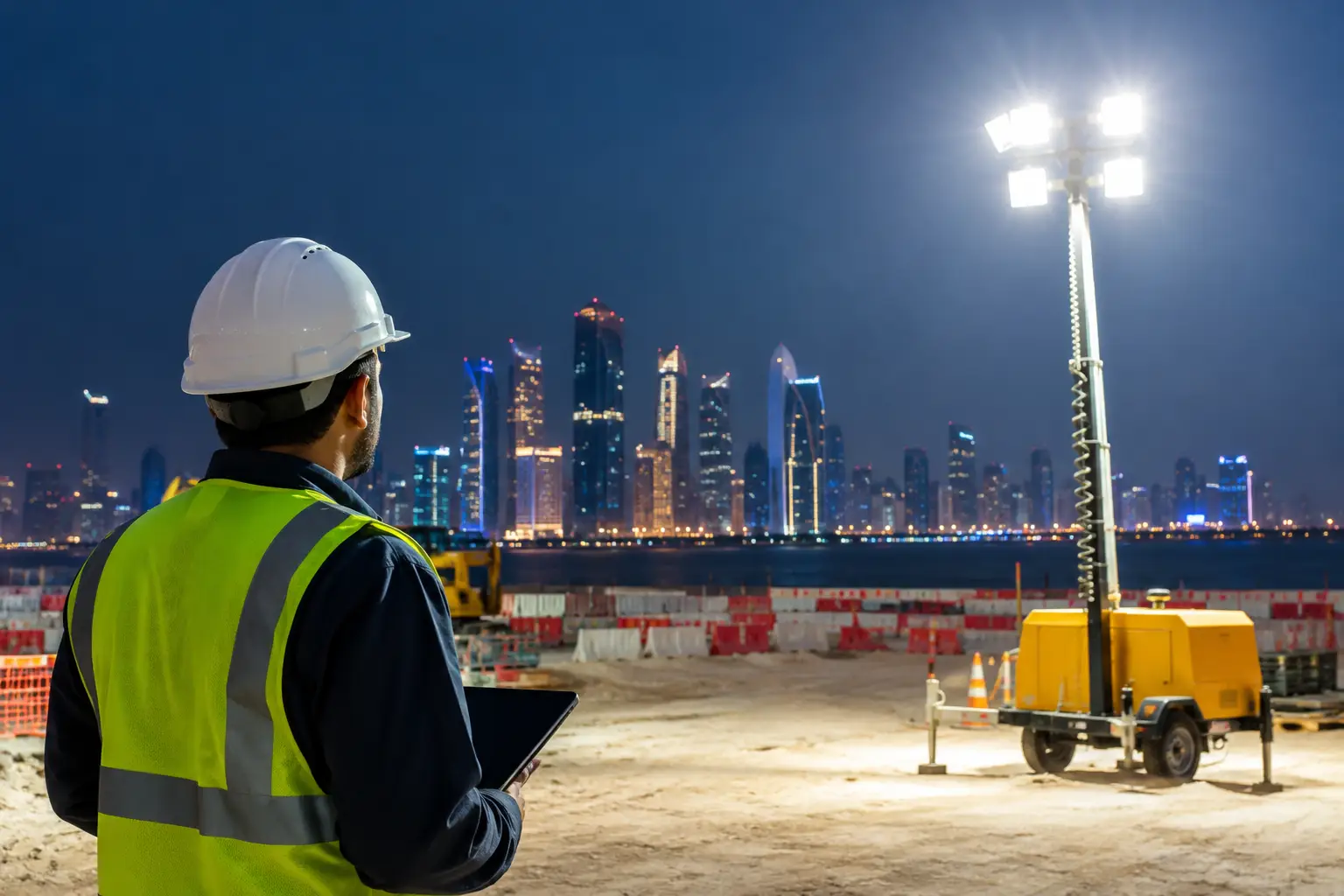
For larger areas, LED floodlights on stands or temporary lighting towers can provide broad coverage. Lighting towers suit external works, yards, road works, and large structural zones, particularly where fixed temporary infrastructure is not yet available. They can be effective, but placement must account for wind exposure, equipment traffic, refueling access, and the risk of glare beyond the project boundary.
Storage yards, loading areas, and security boundaries
Materials do not stop moving after office hours. Cable drums, steel sections, pipe bundles, power tools, and fittings must be loaded and received safely, with clear visibility for forklift operators and banksmen. Use wide-angle lighting to cover the loading face and travel path, then add task lighting where labels, delivery notes, or lifting connections must be checked.
Security lighting should cover entry points and vulnerable storage zones without sending uncontrolled light into adjacent roads or occupied buildings. Motion-activated units may save energy in low-traffic areas, but they are not a substitute for continuous lighting where workers, vehicles, or guards require dependable visibility.
Select Equipment That Can Handle a Jobsite
Construction lighting is exposed to dust, impact, vibration, moisture, heat, and frequent relocation. Low-cost domestic fixtures may work briefly, but their housings, cables, connectors, and mounting points are rarely designed for site conditions. Failure at night can stop work immediately and introduce a safety risk.
Specify LED lighting with a suitable ingress-protection rating for the installation environment. External and wet-area installations require stronger protection than dry, enclosed fit-out zones. Choose housings with durable lenses, stable stands, guarded cables, and mounting hardware that will not shift under normal site movement.
Color temperature also affects usability. Very cool light can make a large work zone feel brighter, but it may create discomfort or make color-sensitive finishing checks less accurate. Neutral to cool-white lighting is often practical for general construction tasks, while the final selection should reflect the work type, fixture output, mounting height, and surrounding surfaces.
Do not assess fixtures by wattage alone. Lumen output, beam angle, beam control, mounting height, and spacing determine what workers actually see. A high-output floodlight with a narrow beam can leave dark edges, while several well-positioned lower-output units may produce better working conditions with less glare.
Treat Temporary Power as Part of the Lighting Package
A lighting plan is only as reliable as the temporary electrical system behind it. Floodlights, towers, extension cords, plugs, distribution boards, and generators must be selected as one coordinated package. Improvised connections are a common source of tripping, overloads, damaged cables, and outages during critical work.
Use correctly rated distribution boards with appropriate circuit protection and earth leakage protection. Keep cable runs as short and protected as practical, particularly at access routes and vehicle crossings. Where cables must cross a route, use suitable cable protectors rather than loose boards or temporary tape.
Generator-powered lighting needs load planning. Add the expected lighting demand to other temporary loads such as pumps, welding machines, tools, welfare facilities, and charging stations. Allow a sensible operating margin rather than running a generator continuously at its limit. The most economical choice depends on the project duration: a lighting tower can reduce setup time on a short external works package, while a planned temporary distribution network may offer better control on a long-term building project.
Routine inspection matters as much as initial installation. Supervisors should check for cracked lenses, damaged plugs, exposed conductors, unstable tripods, water ingress, and overheated connections before night work begins. Remove defective equipment from service immediately. A quick pre-shift inspection is far less disruptive than a mid-pour power failure.
Control Glare, Shadows, and Spill Light
More light does not automatically mean safer work. Glare reduces contrast and can temporarily impair a worker's vision, especially when moving from a bright area into a darker one. It is particularly hazardous near vehicle routes, elevated work platforms, and reflective surfaces.
Aim fixtures downward and across the work face rather than directly toward people. Raise lights where possible to widen coverage, then adjust their angle to avoid creating sharp shadows behind plant, formwork, and stored materials. For crane operations and lifting zones, coordinate lighting locations with the lifting supervisor so fixtures do not interfere with operator sight lines or banksman signals.
Light spill requires equal attention on projects near roads, residences, hotels, or operational facilities. Shielding, careful beam direction, timers, and zone switching can reduce unnecessary disturbance without compromising site security. This is also where a site-specific plan is better than adding floodlights wherever darkness appears.
Procure for Continuity, Not Just Unit Price
Night work rarely fails because one item was expensive. It fails when a missing connector, damaged extension lead, unavailable replacement lamp, or delayed delivery leaves part of the site dark. Procurement teams should standardize compatible plugs, cable sizes, replacement fixtures, and mounting accessories across active projects where practical.
A complete request for quotation should state the work area dimensions, mounting method, power source, operating hours, environmental exposure, and required delivery date. Include accessories from the start: extension cords, industrial plugs and sockets, cable protectors, distribution boards, mounting stands, brackets, and emergency lighting. Ordering only the main fixture creates avoidable follow-up purchases and dispatch delays.
For projects in Abu Dhabi and across the UAE, Yasu Trading Co. LLC can support contractors with jobsite-ready electrical components, work lighting, cables, accessories, and safety-related materials through coordinated wholesale supply and site delivery. Product selection should always be checked against the project specification, consultant requirements, and applicable authority standards.
The best lighting setup is the one crews barely have to think about: every route is visible, every task area is usable, cables are controlled, and the next shift starts without waiting for a replacement fixture. Plan it early, inspect it daily, and procure it as a complete temporary-power system rather than a collection of lights.