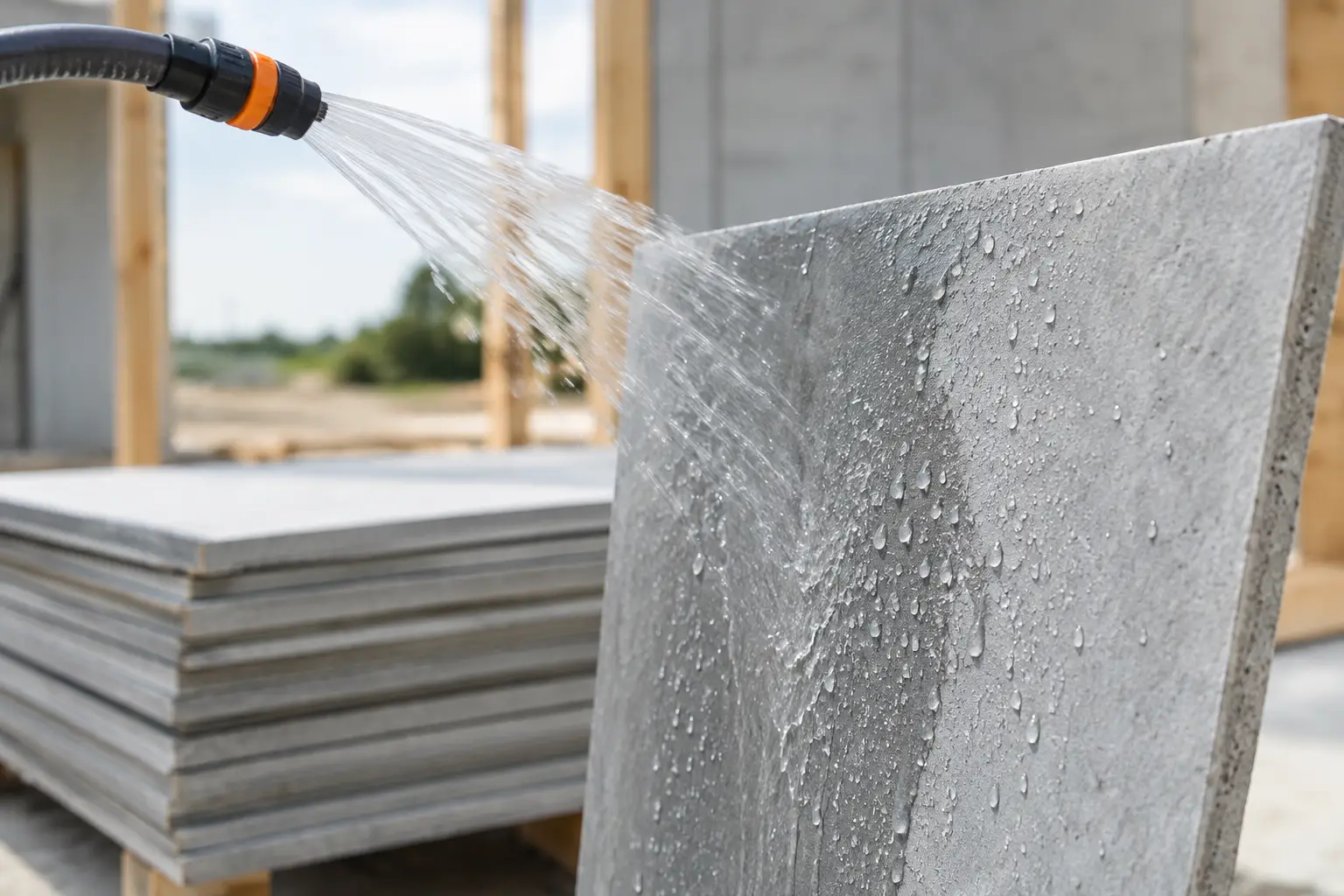
Are Cement Boards Waterproof? What Contractors Need
A shower wall can look finished, tiled, and properly grouted while moisture is already moving behind the surface. That is why the question, are cement boards waterproof, needs a precise answer before a wet-area package is ordered or installed. Most cement boards are highly moisture-resistant and will not break down like standard gypsum board when exposed to water. But moisture resistance is not the same as a waterproof wall assembly.
For contractors, fit-out teams, and procurement managers, that distinction affects material quantities, labor sequencing, inspection readiness, and long-term defect risk. Cement board may be the correct substrate, but it does not automatically eliminate the need for a waterproofing membrane, approved joint treatment, or correctly detailed penetrations.
Are Cement Boards Waterproof in Wet Areas?
In most cases, no. Cement boards are generally water-resistant, not fully waterproof. They are made from cementitious material reinforced with fibers or faced with a cement-based surface. This construction gives them strong resistance to swelling, softening, mold damage, and loss of structural integrity after incidental moisture exposure.
Unlike regular drywall, a quality cement backer board can remain stable behind tile in bathrooms, kitchens, wash areas, and other damp locations. However, water can still pass through the board, particularly through cut edges, joints, fastener holes, and service penetrations. Moisture can then reach framing, insulation, blockwork, or adjacent finishes if the rest of the assembly is not correctly protected.
The practical specification is simple: use cement board as a durable tile substrate, then use a waterproofing system where the area is exposed to direct water or sustained moisture. A tiled shower enclosure, for example, should not rely on cement board and grout alone.
Water-Resistant Board vs. a Waterproof Assembly
The confusion usually starts when individual product performance is treated as the performance of the entire wall or floor system. A cement board can withstand water exposure without deteriorating, yet the finished installation can still leak.
Tile and grout are decorative, cleanable surface layers. They reduce water entry but are not a permanent waterproof barrier. Grout is porous to varying degrees, and even well-sealed grout requires maintenance. Movement at corners, changes in plane, drains, mixer valves, shower arms, and floor-wall junctions creates further points where water can travel behind the finish.
A properly waterproofed assembly accounts for those routes. Depending on the system, this may include a liquid-applied membrane, sheet membrane, waterproof tape at joints, preformed corner components, compatible sealant, and properly detailed collars around pipes and fixtures. The membrane must be installed according to the manufacturer’s coverage, curing, overlap, and compatibility requirements.
For a project team, this is not a minor technical preference. It is the difference between a substrate that survives moisture and an installation designed to stop moisture from reaching the structure.
Where Cement Board Can Be Used Without Full Waterproofing
Not every cement board installation needs a membrane. The exposure level determines the specification.
In dry interior areas receiving tile, such as certain feature walls or low-moisture service spaces, cement board may be selected for impact resistance, substrate stability, or tile adhesion without additional waterproofing. In a kitchen backsplash, for example, the board may provide a reliable base, while the risk of sustained water exposure is limited.
Areas subject to occasional splashing need more judgment. A wall behind a vanity, a utility-room splash zone, or a commercial pantry may require moisture-resistant materials and sealed joints, but not necessarily the same full membrane system used for a shower. The final decision should follow project drawings, local requirements, the tile system manufacturer’s instructions, and the expected cleaning and use conditions.
Direct wet zones are different. Showers, steam rooms, communal washrooms, wet kitchens, poolside changing areas, and walls around floor drains should be treated as waterproofing applications. For these locations, cement board is only one component in a complete system.
What Happens at Joints, Fasteners, and Penetrations
The field details are where otherwise sound material selections fail. A cement board panel has a uniform face, but an installed wall contains dozens of interruptions.
Board joints should be treated using the tape and cementitious or membrane-compatible compound specified for the selected system. Ordinary paper drywall tape is not suitable for this purpose. Fastener heads must be installed at the correct spacing and depth without damaging the board face, and their treatment must align with the waterproofing manufacturer’s requirements.
Pipe penetrations need particular attention in MEP-intensive spaces. Water supply lines, drain connections, floor traps, mixer valves, electrical points, and access panels all interrupt the protective layer. Use compatible sealing accessories and flexible sealant where required. Leaving an oversized hole around a pipe and depending on an escutcheon plate to stop water is not an acceptable wet-area detail.
At internal corners and wall-to-floor transitions, movement is expected. These locations need flexible, system-approved treatment rather than rigid grout alone. The same principle applies where cement board meets a different substrate, such as blockwork, concrete, metal framing, or an existing plastered wall.
Selecting the Right Cement Board for the Scope
“Cement board” is often used as a broad category, but boards differ in composition, thickness, weight, edge profile, approved applications, and fastening requirements. Procurement should not substitute one board for another solely because both are described as cementitious.
For wall applications, the board must suit the stud spacing, tile weight, and anticipated impact. For floors, verify that the product is approved for underlayment use and that the subfloor preparation, bedding layer, fastener pattern, and movement joints follow the system instructions. A wall board is not automatically suitable beneath floor tile.
Exterior work requires another level of review. Fiber-cement panels and cement backer boards may be appropriate in certain cladding or render systems, but exterior exposure involves rain management, vapor control, corrosion-resistant fixings, wind loading, and façade detailing. A board that performs well behind interior shower tile is not automatically an exterior weather barrier.
When ordering for larger projects, confirm the board brand, thickness, edge treatment, installation accessories, waterproofing membrane, tape, sealant, and tile adhesive as a coordinated package. Mixing unrelated products can create warranty gaps or application conflicts, especially where membrane adhesion or curing conditions are involved.
A Procurement Checklist That Prevents Rework
Before releasing a wet-area material order, the project team should confirm the substrate type, the intended exposure level, and the waterproofing method shown in the approved detail. This avoids a common site issue: cement boards arrive, tile work begins, and the waterproofing scope is later identified as missing.
For shower rooms and other direct-water applications, procure the complete assembly at the same time: cement board, approved screws, joint tape, compatible waterproofing membrane, corner and penetration accessories, sealant, tile adhesive, grout, and movement-joint materials. Consolidating these materials under one approved system helps site teams maintain sequence and reduces last-minute substitutions.
Check storage requirements as well. Cement boards should be kept dry before installation, stored flat and supported to avoid edge damage, and protected from site contamination. Membranes, adhesives, and sealants have temperature, shelf-life, and curing requirements that must be managed before they reach the work face.
For UAE projects, approved material submittals and manufacturer data should be reviewed before bulk delivery. This is particularly valuable on hospitality, residential tower, healthcare, and high-traffic commercial work, where wet-area defects can trigger costly access work after handover. A dependable supplier should be able to support specification alignment, authentic product supply, and site-direct delivery without splitting critical system components across multiple vendors.
Common Installation Assumptions to Avoid
The first incorrect assumption is that cement board alone makes a shower waterproof. It does not. The second is that tile adhesive, grout, or silicone applied at the visible surface can correct missing waterproofing behind the tile. Those materials serve specific roles but cannot replace a continuous approved membrane.
Another risk is treating every wet area the same. A private bathroom vanity wall, a hotel shower, a commercial washroom, and a steam room have very different exposure conditions. Steam rooms, in particular, often require a vapor-control approach with strict attention to membrane rating, laps, seams, and ceiling treatment.
Finally, do not ignore compatibility. A liquid membrane may require a specific primer, minimum dry-film thickness, reinforcement at corners, or a defined cure time before tiling. Skipping these steps to accelerate handover can delay the project later through tile failure, water staining, or remedial work.
Cement board is a dependable part of a wet-area build, but it is not a shortcut around waterproofing design. Specify the complete assembly early, verify every transition before tile installation, and keep the materials package aligned with the approved system so the finished space performs as well as it looks.