Binding Wire Supplier in UAE: Types, Specs and Sourcing
A coil of tie wire lands on a villa job in Dubai and the steel fixers say it feels wrong in the hand. The delivery note reads 18 gauge. Nobody has put a micrometer on it. By the second pour the wire is snapping at the twist, intersections are opening under the vibrator, and the site is back on the phone asking for a different brand.
That scene repeats because binding wire gets bought as a consumable and specified like one. The volumes behind it are not small. UAE construction output reached a record USD 107.2 billion in 2024, according to Knight Frank's 2025 UAE Construction Landscape Review, and Dubai issued 5,076 new-building permits in 2023 covering 4,966,519 square metres of licensed area, per Dubai's official construction statistics. Every reinforced-concrete frame in that pipeline consumes tie wire at a steady rate.
The cheapest coil is rarely the cheapest outcome. Wire that fails a twist test, or arrives without the batch record a consultant asks for, costs more in rework, rejected submittals and delayed pours than the gap in price per kilogram.
Table of Contents
- Binding Wire Types, Gauges and Finishes
- Why Binding Wire Is a Fixing Accessory
- Matching Binding Wire to Site Exposure
- Specifications to Write Into Every Purchase Order
- Vetting Suppliers and Stock Risk
- Confirm Your Specification and Request a Quote
Binding Wire Types, Gauges and Finishes
A site engineer rings for tie wire on a Dubai villa job, takes a pallet of coils that look identical to the last delivery, and finds out at the first pour that the wire is finer than the bar spacing needs. The confusion comes from a gauge system that runs backwards: the higher the gauge number, the thinner the wire. An 18 gauge coil is finer than a 16 gauge coil, and the labels say nothing about that.
18 gauge, about 1.2 mm, is the everyday tie for standard rebar cages. 16 gauge, about 1.6 mm, takes the heavier work on larger bars and dense column cages where the wire has to hold real tension during alignment. 20 gauge, about 0.9 mm, suits light ties on mesh, spacers and small elements. Buy 18 gauge for everything and you'll either fight thin wire on heavy cages or burn money on wire you didn't need.
Finish matters as much as thickness. Annealed black wire is soft, twists cleanly and is the default for rebar that will sit fully inside concrete. Galvanized wire carries a zinc coating for humid storage and exposed ties. Stainless steel handles chloride-heavy and coastal work where the premium is justified.
| Wire type | Finish | Typical use |
|---|---|---|
| Annealed black tie wire, 18 gauge (about 1.2 mm) | Soft black, uncoated | Standard ties for fully embedded rebar |
| Annealed black tie wire, 16 gauge (about 1.6 mm) | Soft black, uncoated | Heavier ties on larger bars |
| Annealed black tie wire, 20 gauge (about 0.9 mm) | Soft black, uncoated | Light ties on mesh and small elements |
| Galvanized tie wire, 18 gauge (about 1.2 mm) | Zinc coating | Exposed, humid or outdoor-stored ties |
| Stainless steel tie wire, 18 gauge (about 1.2 mm) | Stainless finish | Coastal or chloride-heavy exposure |
Treat the table as a starting point. The exposure your wire will see and the specification your consultant writes decide which row you buy.
Why Binding Wire Is a Fixing Accessory
Think of a tailor basting a garment before final stitching. The basting thread holds the panels in position so the seams can be sewn, and nobody expects it to carry the coat. Binding wire does that job in a reinforced-concrete frame. The rebar carries the designed tensile capacity; the tie keeps bars at their spacing and cover until the concrete sets.
Dubai Municipality's technical guidance is explicit on the distinction: binding wire is a fixing accessory, not a structural reinforcement product, and the reinforcement itself must satisfy the applicable requirements under ISO 6935-2 or BS 4449. That means mill certificates for the rebar and a separate record for the wire covering material, diameter, coil weight and batch traceability.
What goes wrong on site is predictable. Wire that is too hard snaps mid-twist and leaves loose intersections the vibrator opens up. Wire that is too soft or undersized twists neatly and then eats coil after coil, so consumption and labour both climb. Check diameter with a micrometer, confirm coils are free of oil and heavy scale, and twist a sample before the first large delivery.
Practical rule: the tie belongs in the method statement as part of the installation, never in the rebar schedule as structural steel.
The tie also holds the cage at the cover the design assumes, which is why wire and concrete spacers that keep correct cover are bought as a pair rather than separately.
Matching Binding Wire to Site Exposure
Corrosion protection earns its price only where the tie stays exposed or unprotected. Take a Sharjah villa podium poured the same week the bars are tied: annealed black wire is fine there, because every tie finishes up buried under compliant cover. The same project leaves ties sitting on a rooftop staging area for six weeks, and those need galvanized wire before the first sign of rust staining.
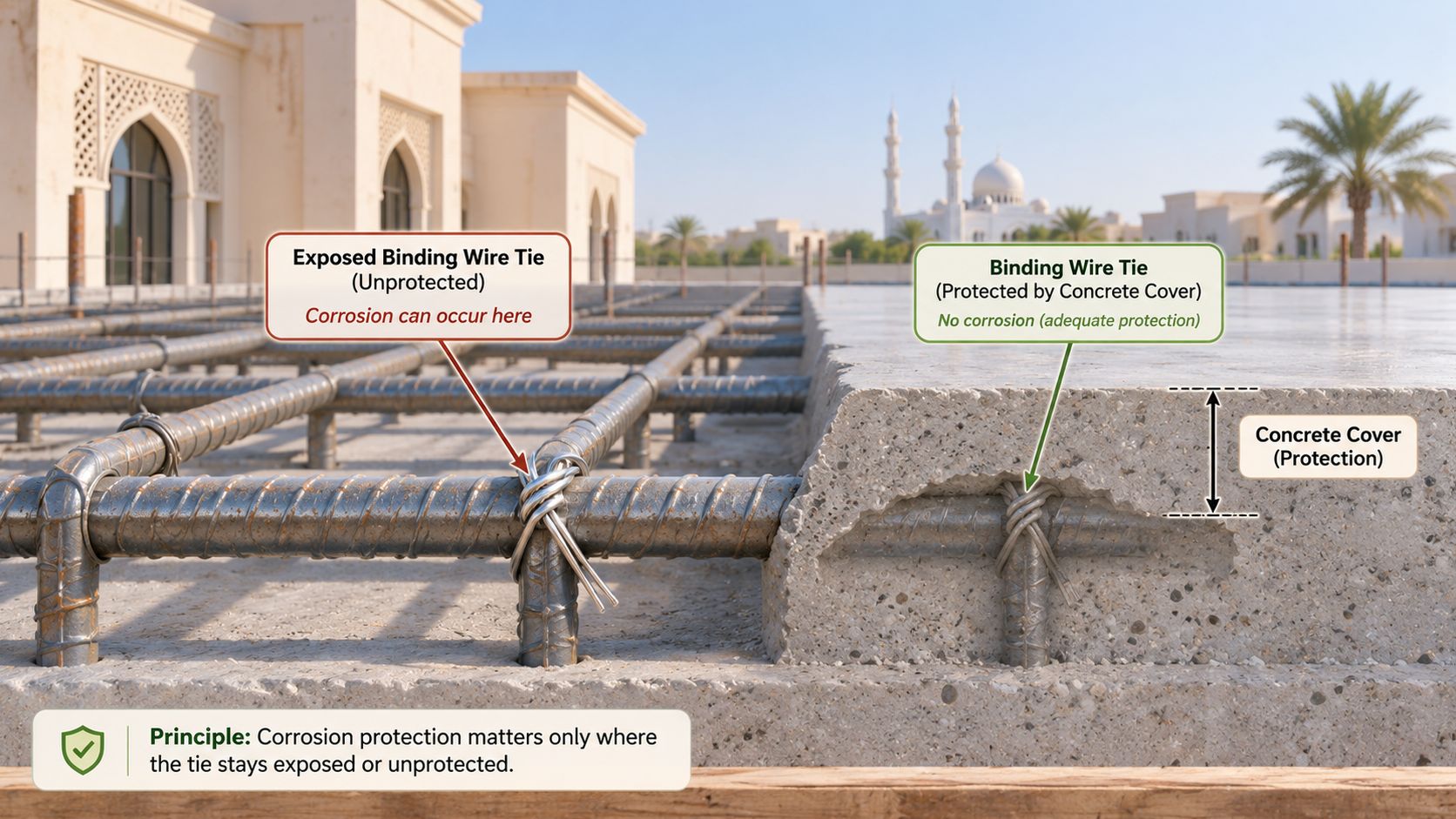
Read down the left column to the condition that matches your job, then across to the wire and the reason behind it.
| Exposure condition | Suggested wire | Main reason |
|---|---|---|
| Rebar fully embedded under compliant concrete cover | Annealed black | Protected by cover and lowest cost |
| Coils stored outdoors for several weeks | Galvanized | Limits rust on coils and cut ends |
| Prefabrication or staging where ties stay exposed | Galvanized | Exposed to humidity and handling |
| Coastal or saltwater spray exposure | Stainless or galvanized, as the consultant specifies | Chlorides attack plain steel |
| Humid basements and wet-cement areas | Galvanized | Condensation and moisture contact |
| Façade and infrastructure with corrosion requirements | Per consultant specification | Requirement set by project documents |
Façade and infrastructure packages follow the consultant's corrosion specification, so your enquiry should name the coating requirement instead of saying "binding wire" and hoping. The Dubai Building Code requires affected anchors, fasteners and structures to be corrosion-resistant, and its material provisions are the language a consultant will hold you to.
Plain annealed wire is acceptable for ordinary internal reinforcement only when it is fully embedded and protected by compliant cover.
Specifications should also demand consistent coating coverage, clean surfaces and packaging that keeps salt and condensation off the coils in UAE transport. Store stock off the ground, under shade, away from wet cement, chlorides and incompatible metals. Extra protection buys nothing on a short internal tie, and poor storage will corrode premium wire before it ever reaches the deck.
Specifications to Write Into Every Purchase Order
A purchase order that says only "binding wire, 18 gauge" invites whatever sits on the supplier's rack. Here is the checklist to paste into the enquiry so every quote comes back comparable.
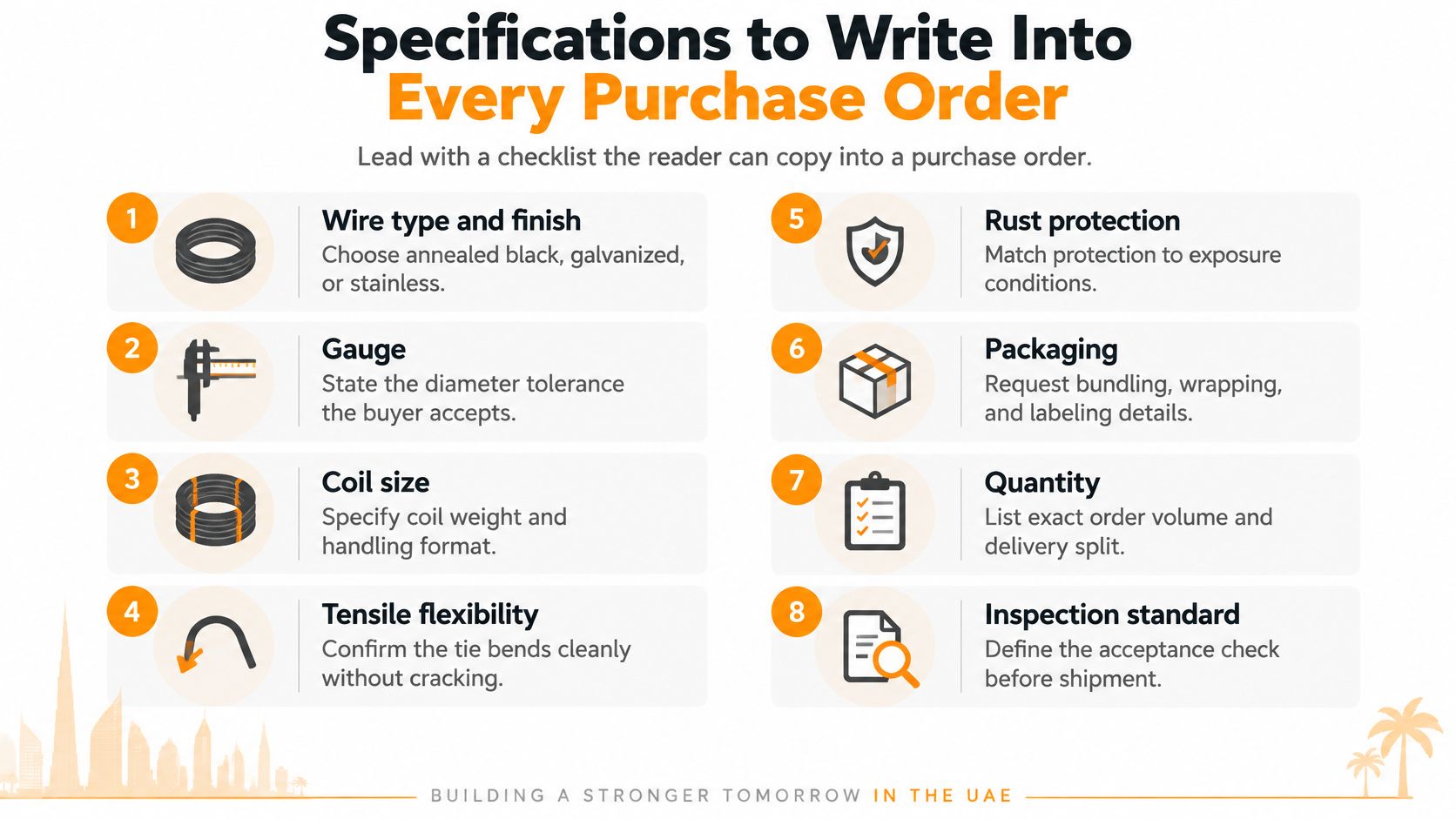
- Wire type and finish. Annealed black, galvanized or stainless, written as a requirement. Vague lines get substituted.
- Gauge with a diameter tolerance you will verify with a micrometer on arrival. A coil that runs thin under its nominal size raises consumption and tying time.
- Annealed condition, confirmed by a twist test on a sample. Hard-drawn wire cracks at the twist and leaves intersections that open during vibration.
- Coil weight and format, whether hand coil, pre-cut length or machine-compatible coil. Format sets tying speed, wastage and how many fixers you put on the deck.
- Mill or batch certificate naming material and diameter. Emirates don't share one universal reinforcement standard, and Ras Al Khaimah's 2025 structural regulations require reinforcing steel to meet BS 4449 Grade 460 or an equivalent ASTM or ISO standard, so expect the traceable file to be asked for.
- Packaging that resists salt and condensation. Damp wrapping rusts coils in the store before they reach site.
- Country of origin and batch identification on the coil label and delivery note, so a coil in the rack traces back to a shipment when an inspector asks.
- Quantity with a scheduled replenishment date, not a one-off order sized from memory.
Leave these lines out and you invite silent substitution. The coil that arrives is the one the supplier had, and the first person to notice is the steel fixer. Size line eight from the bar schedule in the bill of quantities and keep a running figure for tie wire consumed per tonne of rebar, so the next enquiry starts from your own number.
The short walkthrough below covers the same ground before you draft the enquiry.
Vetting Suppliers and Stock Risk
Six checks separate a supplier who can hold a project schedule from one who can fill a single order.
- Match stock to the bill of quantities by type, gauge and finish. A listing that says "binding wire" hasn't answered the question. The common slip is accepting the generic listing because the price looks right.
- Send the eight purchase-order lines and ask for a quote against them exactly. Then compare like for like. Quotes written against different specifications can't be compared at all.
- Test sample coils before the first large order, using the micrometer and the twist test, and test more than the top coil on the pallet. A coil that snaps early shows up in loose intersections two pours later.
- Ask how the supplier sources across origins. In 2023 the UAE imported about 170.65 million kilograms of iron or non-alloy steel wire, valued at roughly US$117.41 million, with China, India, Oman and Tanzania supplying about 98.6% of reported volume, according to the Dubai Statistics Center's 2023 trade report. That classification is broader than binding wire, but it shows how concentrated the supply base is, and how quickly freight, customs clearance and mill prices reach your site rate. Assuming one origin will always be available is the slip.
- Hold buffer stock for critical gauges and agree replenishment time in writing. Ordering only when the deck runs short turns a stock decision into an emergency.
- Confirm the commercial basis. Pricing in AED, VAT included or added, delivery in or out of the quote, and whether the supplier delivers to site in Dubai, Abu Dhabi, Sharjah and the Northern Emirates. Yasu Trading Co. LLC ensures site-direct delivery anywhere in the UAE, which removes the collection trip from the comparison. Pair the wire enquiry with your steel rebar manufacturers in UAE sourcing so wire and bar arrive on the same schedule.
Watch the basis of the quote: one supplier excluding delivery and another including it is not a price difference, it's an accounting error waiting to be discovered at invoice stage.
Confirm Your Specification and Request a Quote
Three actions close this out. First, pick the wire type and gauge from the first table and the exposure row that matches your site, then write both into the enquiry. Second, paste the eight purchase-order lines into the request so every supplier prices the same specification, including certificates, coating and delivery format. Third, ask for mill or batch certificates and a sample coil before you commit to the first large order.
Compare the returns line by line and reject any quote that drops the certificates, the coating requirement or the delivery format. A missing certificate isn't a saving, it's a submittal problem arriving in three weeks.
Yasu Trading Co. LLC has supplied contractors in the UAE since 2002 and serves contractors, builders and businesses across the country from its Deira base. To confirm stock, gauge and specification against your enquiry, call the shop on +971 4 2327655, message the Call/WhatsApp number on +971 56 416 5775, or send the specification through the website for a quote.
Binding wire is the smallest line on a rebar package and one of the fastest ways to lose a pour, which is why Yasu Trading Co. LLC treats it as a specified item rather than a generic consumable. Send your gauge, finish, coil format and exposure condition, and the team will confirm stock and specification, quote in AED, and arrange site-direct delivery to your project. Visit Yasu Trading Co. LLC to start the enquiry.