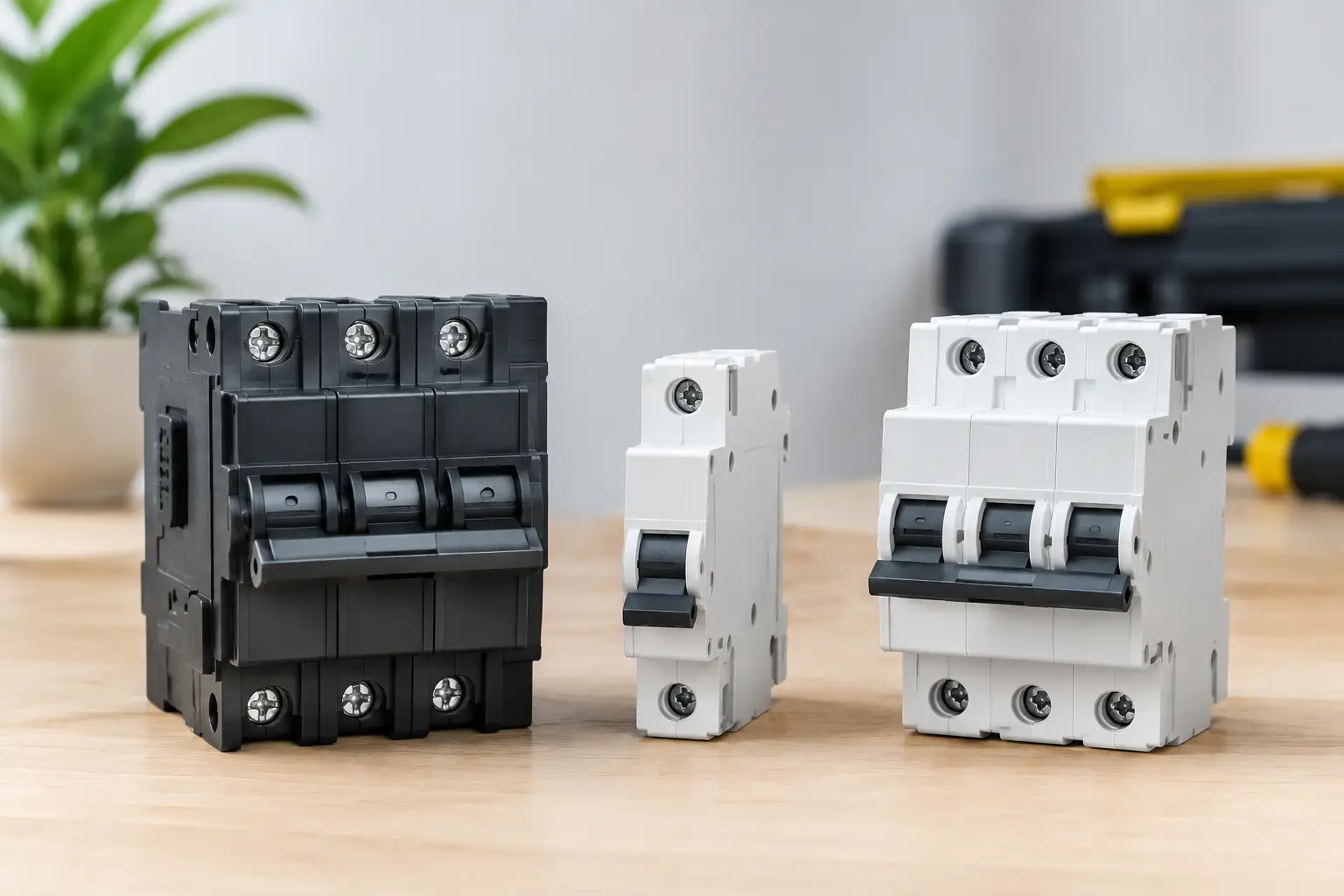
Branded Unbranded Breakers for Projects
A failed breaker is not a minor replacement item when it stops a handover, trips an essential circuit, or raises questions during an electrical inspection. Searches for “branded unbranded breakers” often start as a price comparison, but for contractors and MEP procurement teams, the decision is really about safety, compatibility, traceability, and the cost of avoiding site disruption.
A lower unit price can be attractive when a project has dozens of distribution boards to complete. Yet a breaker is a protective device, not a generic accessory. Its performance must match the installed system, the available fault level, the panelboard arrangement, and the project specification. The right buying decision depends on where the breaker will be used and what documentation the consultant, authority, and client require.
Branded Unbranded Breakers: The Practical Difference
A branded breaker is supplied under an established manufacturer name with identifiable product markings, published technical data, defined product ranges, and a stated warranty process. In professional procurement, the value is not just the logo. It is the ability to verify the breaker’s rating, poles, trip curve, breaking capacity, standard compliance, and compatibility with its intended enclosure or distribution board.
The term unbranded can mean several different things. It may describe a value-range product with limited manufacturer visibility, a product with incomplete documentation, or an item carrying markings that cannot be independently verified. These are not identical risks, but they should be treated differently from an approved branded product that has a clear supply chain and technical support.
For a temporary, low-risk application, a contractor may consider a lower-cost option if the product is correctly rated, compliant with the project requirement, and accepted by the responsible engineer. For permanent installations, critical loads, occupied buildings, and projects with formal inspection requirements, the tolerance for uncertainty is much lower.
Why Price Per Breaker Is Not the Full Cost
Procurement teams should compare the total installed and operating cost, not only the invoice line. A breaker that costs less but creates a delay can quickly become the expensive choice. Replacing a questionable unit after ceiling closure, after commissioning, or during a client snagging period involves labor, access, shutdown coordination, retesting, and potential schedule penalties.
Branded products also tend to provide more predictable continuity across a project. When additional units are needed for variations, future phases, or maintenance stock, a recognized product range is easier to identify and reorder. That matters for facilities teams that may need a matching replacement years after practical completion.
Warranty handling is another operational factor. A clear manufacturer-backed channel gives the buyer a defined route for technical review or a genuine defect claim. With products that lack traceability, the contractor may carry the risk alone if a failure occurs or a site team challenges the origin of the item.
Start With the Electrical Specification, Not the Shelf Price
The correct breaker is determined by the circuit and installation, not by visual similarity. Two miniature circuit breakers can look nearly identical while having different breaking capacities, trip characteristics, terminal arrangements, or compatibility requirements.
Confirm the protection requirement
Before requesting a quote, verify the breaker type required by the single-line diagram and panel schedule. This may include MCBs for final circuits, MCCBs for larger feeders, RCBOs where overcurrent and residual-current protection are required, or RCCBs for earth-leakage protection. Each serves a different function, and substitution without engineering approval can create a compliance or safety issue.
Check the rated current, number of poles, voltage rating, and trip curve. A B, C, or D curve responds differently to inrush current and fault conditions. Selecting a curve only because it is available can lead to nuisance tripping or inadequate protection for the connected load.
Verify breaking capacity and fault level
Breaking capacity is one of the most critical details in the branded versus unbranded discussion. The breaker must be capable of safely interrupting the prospective short-circuit current at its installation point. A device with an insufficient interrupting rating can fail under fault conditions, regardless of whether it fits the rail or panel.
The required value should come from the approved electrical design, short-circuit study, or consultant instruction. Do not assume that a common rating used on another floor, another building, or a previous project is suitable for every board.
Match the breaker to the board
Breakers are not universally interchangeable. Busbar interfaces, physical dimensions, terminal positions, accessories, and manufacturer system approvals can vary. Installing a different make inside a board designed around another system may affect fitment, labeling, warranty, or the assembly’s approval status.
This is where technical product guidance protects the project. Provide the panelboard make, existing breaker reference, required ratings, and photographs of the installation when necessary. A proper review before delivery is faster than resolving a mismatch after the electrical team is on site.
Documentation That Protects the Contractor
For specification-driven projects, ask for documents before goods are dispatched. The depth of documentation should match the project’s risk level and approval process. A basic maintenance replacement may need a clear product reference and data sheet, while a major commercial installation may require compliance certificates, test information, country of origin details, and consultant submittal support.
The key is traceability. Packaging, product labels, batch references where available, technical data, and an authorized supply route help establish what was installed. This record is useful during inspections, commissioning, warranty discussions, and future maintenance.
Municipality-compliant materials should be treated as a project requirement, not a marketing phrase. Approval requirements can differ by project type, client standard, consultant specification, and local authority. The procurement team should confirm the exact required standard rather than relying on a general claim that a breaker is “approved.”
When an Unbranded Option May Be Considered
There are cases where cost control is legitimate. A contractor may evaluate a non-premium or less familiar product for temporary works, noncritical applications, or a project where the consultant has specifically approved an equivalent. But “equivalent” must be supported by matching technical ratings, verified compliance documentation, compatible installation, and acceptance by the responsible party.
It is not enough for the amp rating and pole count to match. The breaker must also satisfy the required breaking capacity, protection characteristic, enclosure arrangement, and documentation standard. If any of those points are unclear, the apparent saving should be treated as a risk allowance, not a confirmed saving.
For life-safety circuits, critical equipment, high-fault-level locations, healthcare environments, data-sensitive operations, and client-facing commercial handovers, branded and fully traceable products are generally the more defensible procurement position.
A Better Purchasing Process for Breakers
The most reliable approach is to issue a complete request rather than asking only for “32A breakers” or “main breaker.” Include the breaker type, rated current, poles, curve where applicable, breaking capacity, quantity, panelboard make, project approval requirement, and delivery deadline. If replacing an installed unit, provide its full catalog reference and clear photographs of the label and connection side.
For bulk requirements, ask the supplier to confirm stock availability by exact reference, not by a broadly similar description. This prevents partial deliveries that leave distribution boards incomplete and helps the site team plan installation labor. For urgent maintenance requirements, confirm whether the proposed substitute is technically compatible before sending it to site.
A B2B supplier should be able to support this process with inventory checks, product identification, project-based quotations, and coordinated site delivery. For UAE contractors managing multiple locations, this reduces the back-and-forth between electrical teams, procurement, and individual market vendors. Yasu Trading Co. LLC can support approved electrical component requirements with practical specification checks and delivery planning aligned to the site schedule.
Keep a Maintenance Stock Strategy
Projects often finish with little thought given to future replacements. Keeping a controlled spare stock of commonly used breakers can reduce downtime for facilities teams, especially where the installed range uses specific frame sizes or accessories. The spare list should be based on the actual installed schedule, not an assortment of visually similar devices.
Record the manufacturer, catalog number, rating, location, and quantity held. Store breakers in dry, protected conditions with packaging and labels intact. This makes it easier to verify the correct item during an urgent callout and avoids installing an unknown leftover device simply because it is available.
The best breaker purchase is the one that fits the approved design, arrives when the electrical team needs it, and can be defended with clear technical evidence. When price pressure is high, protect the project by comparing the full requirement - not just the number printed on the quotation.