A Guide to Building Materials Abu Dhabi
When you're building in Abu Dhabi, getting the right materials isn't just a box to tick—it's the bedrock of your entire project. The city's ambitious skyline and unique climate mean every choice, from structural steel to the smallest MEP component, has massive implications for durability, compliance, and your bottom line. Success here means knowing exactly what the local environment demands and having a supply chain you can count on.
Riding the Wave of Abu Dhabi's Construction Boom
One look at Abu Dhabi's ever-changing skyline tells you everything you need to know about its ambition. Megaprojects are constantly reshaping the Emirate, driven by a clear, forward-thinking vision. This relentless growth creates a huge, ongoing appetite for high-quality building materials, turning procurement from a simple task into a strategic part of any successful project.
This construction surge isn't happening by accident. It's a powerful combination of government-led initiatives and a booming luxury residential market that keeps the pace frantic. For any contractor or builder trying to keep up, just finding materials isn't enough; you need a smart, strategic approach to sourcing them.
The Sheer Scale of It All
The numbers behind Abu Dhabi's development are genuinely mind-boggling. The boom has sent demand for both foundational and finishing materials through the roof across thousands of active sites. Just to put it in perspective, in 2024 alone, the completion of over 2,400 residential units shows the incredible volume of concrete, glass, steel, and finishing products needed. And that’s before you even consider massive undertakings like the Zayed International Airport expansion, Etihad Rail, or the pioneering sustainable community, Masdar City.
Choosing the right materials isn't just about logistics. It's the foundational pillar that guarantees a project's longevity, safety, and compliance in one of the world's most competitive markets.
Projects of Every Shape and Size
The sheer variety of projects here creates a fascinatingly complex list of material requirements. We're not just talking about shiny new residential towers and sprawling commercial hubs. The boom includes highly specialised infrastructure, too—things like advanced roadway and parking lighting that require very specific electrical components, such as surge protection devices for roadway lighting projects in Abu Dhabi. This is where a supplier's inventory and expertise are truly tested.
In an environment this demanding, you need more than just a vendor; you need a genuine partner. That’s where a supplier like Yasu Trading Co. comes in. We become an extension of your team, ensuring your project's success by:
- Guaranteeing Quality: We provide materials that meet—and often exceed—the strict local and international standards required here.
- Keeping You on Schedule: Our robust supply chain ensures that deliveries arrive on time, every time, preventing costly delays.
- Sharing Our Expertise: We help you navigate the tricky process of selecting the perfect materials for your specific application, taking the guesswork out of it.
At the end of the day, every landmark structure in Abu Dhabi is built on a foundation of quality materials, reliable delivery, and a truly strategic partnership.
The Essential Materials That Build the Emirate
Look at any iconic structure in Abu Dhabi's skyline—from the sweeping Etihad Towers to the magnificent Louvre—and you're seeing more than just architecture. You're seeing a symphony of essential materials, each playing a critical role. Getting a handle on these core components is the first step to understanding just how much ingenuity goes into modern construction here. These aren't just commodities; they are the very building blocks of vision and strength.
Think of a building like the human body. Some elements form the unyielding skeleton, others create the protective skin, and a whole network of systems brings it all to life. By breaking down the key categories of building materials in Abu Dhabi, we can see how each part contributes to the success of the whole project.
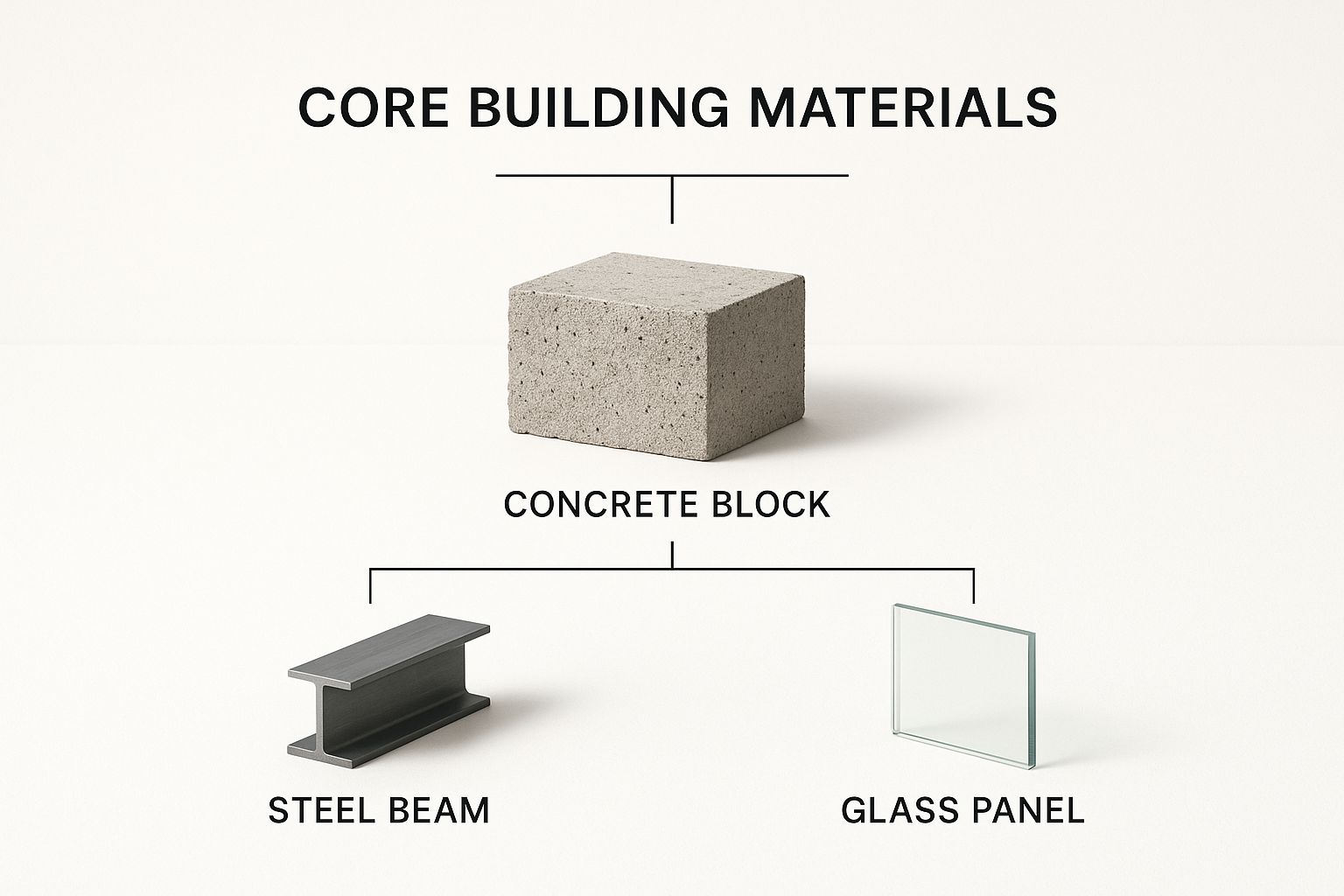
This image captures the fundamental trio of modern construction: concrete, steel, and glass. They form the backbone of nearly every major project you see in the Emirate.
The interplay between these materials is everything. Structural integrity, functional enclosure, and aesthetic beauty all depend on the quality and combination of these core components.
Before we dive into the specific materials, this table gives a quick overview of the main categories and where you’ll typically find them being used across Abu Dhabi.
Key Building Material Categories and Their Applications
| Material Category | Primary Components | Common Applications in Abu Dhabi |
|---|---|---|
| Structural & Foundational | Reinforced Concrete, Structural Steel | High-rise foundations, building frames, bridges, parking structures |
| Façade & Cladding | Glass & Glazing, Aluminium Panels, Natural Stone | Curtain walls, exterior panelling, decorative finishes, rainscreens |
| MEP & Finishing | HVAC Ducting, Electrical Cables, Plumbing Pipes | Air conditioning systems, power distribution, water supply, sanitation |
Each category serves a unique purpose, but they all have to work together seamlessly to create a structure that is both beautiful and built to last.
The Skeleton: Structural and Foundational Materials
At the very core of any building is its skeleton—the structural frame that carries the load, stands up to the elements, and gives the project its shape and strength. In Abu Dhabi, this framework is almost always built from two titans of industry: concrete and steel.
- Reinforced Concrete: This is, without a doubt, the workhorse of construction in the region. It's a composite of cement, aggregates (sand and gravel), and water, but its real power is unlocked when you add steel reinforcement bars, or "rebar." This partnership is brilliant—the concrete handles immense compressive forces while the steel takes care of tensile stress. It's perfect for everything from deep foundations to soaring support columns.
- Structural Steel: When a project needs wide open spaces, a lighter frame, or has a tight timeline, structural steel is the answer. Its incredible strength-to-weight ratio lets architects design massive atriums and complex shapes that would be impossible with concrete alone. Because steel beams and columns are made off-site, they arrive with precision, ready for faster assembly.
Concrete and steel have a symbiotic relationship. One brings the mass and compressive strength; the other brings flexibility and tensile resistance. Together, they form the resilient skeletons that allow Abu Dhabi's boldest architectural visions to become reality.
The Skin: Façade and Cladding Systems
If concrete and steel are the skeleton, then the façade is the building’s skin. This outer layer does two jobs at once: it gives the building its aesthetic identity and acts as the front line of defence against Abu Dhabi's challenging climate.
This protective skin is a complex assembly of materials chosen for both performance and looks.
- Glass and Glazing: In the Emirate, high-performance glazing isn't a luxury; it's a necessity. Modern curtain walls use double or even triple-glazed units with special Low-E coatings to reflect the sun's heat, cut down on glare, and slash the energy needed for cooling. The result? A stunning, transparent façade that keeps the interior comfortable and efficient.
- Aluminium Panels: Lightweight, tough, and incredibly versatile, aluminium composite panels (ACPs) are a go-to choice for cladding. They come in a huge range of colours and finishes, giving architects total creative freedom. Just as importantly, they are naturally corrosion-resistant, which is a massive advantage in our coastal environment. To see how these choices are changing, check out our guide on understanding UAE building materials for a deeper dive into current trends.
The Vital Systems: MEP and Finishing Materials
Finally, we get to the building's circulatory and nervous systems. These are the intricate networks of Mechanical, Electrical, and Plumbing (MEP) components that are hidden away but absolutely essential for making a structure liveable and functional.
These systems are incredibly complex and rely on a huge range of specialised materials.
- Mechanical: This covers all things HVAC (Heating, Ventilation, and Air Conditioning). Think high-grade ductwork, powerful chillers, air handling units, and specialised insulation—all working together to manage the indoor climate efficiently, a non-negotiable in Abu Dhabi.
- Electrical: The electrical system is the building's power grid. It requires a massive inventory of components like armoured cables, circuit breakers, transformers, and advanced lighting. Safety and reliability are everything here, so materials must meet incredibly strict standards.
- Plumbing: This is all about water supply and sanitation. The materials range from durable pipes made of copper or PPR (polypropylene random copolymer) to top-quality fixtures, pumps, and water heaters. The main goals are preventing corrosion and ensuring a leak-proof system.
From the concrete poured deep into the ground to the sophisticated MEP systems running through the walls, every building is a complex ecosystem of materials. Sourcing these diverse components from a single, trusted supplier like Yasu Trading Co. isn't just about making life easier—it’s a strategic move that ensures quality, consistency, and smooth coordination for the entire project.
How to Select Climate-Resistant Materials
Anyone who has built in Abu Dhabi knows you’re in a constant fight with the elements. We’re up against a unique combination of intense sun, year-round humidity, and salty coastal air that creates one of the toughest construction environments you’ll find anywhere.
Choosing the right building materials in Abu Dhabi isn't about what looks good—it's about survival. It's a fundamental decision that dictates a building’s entire lifecycle, from its energy bills to its maintenance budget.
Think of it like gearing up for an extreme expedition. You wouldn't wear a parka in the desert, right? By the same token, you can’t just grab standard materials off the shelf and expect them to hold up here. The climate relentlessly punishes every single component, from the foundations buried deep in the ground to the finishes on the roof. Materials that perform beautifully in London or New York can crack, corrode, or just plain fail in a fraction of the time under Abu Dhabi’s sun and salt.
This means every choice has to be deliberate, backed by a deep understanding of our local conditions. The mission is to 'climate-proof' your project from the very start, ensuring it stays safe, functional, and looking sharp for years to come.
Combatting Heat and Solar Gain
The most obvious enemy is the sun. Day in and day out, solar heat gain is what sends cooling costs through the roof and puts an incredible strain on a building's HVAC systems. The only way to win is to choose materials that can manage, reflect, or block that thermal energy before it ever has a chance to get inside.
- High-Performance Glazing: Modern glass is nothing short of a miracle. Double or even triple-glazed units with Low-Emissivity (Low-E) coatings are like a smart filter. They let all the beautiful natural light pour in but reflect a huge chunk of the sun's heat-carrying infrared rays right back out.
- Reflective Roofing Materials: Your roof takes the biggest beating from the sun. Using materials with a high Solar Reflectance Index (SRI)—think white membranes or specially coated tiles—can bounce sunlight away and slash heat absorption by up to 70%. That simple switch makes a world of difference to the cooling load on the floors below.
- Ventilated Façades: This is a seriously clever design. It involves creating an air gap between the building’s main wall and its outer cladding. This channel lets air circulate, whisking away absorbed heat before it can penetrate the structure. It’s a natural thermal buffer. For anyone looking at modular construction, this principle is key; this fantastic guide to shipping container insulation explains the core concepts of thermal management really well.
Selecting materials that actively combat heat gain isn't just an energy-saving move; it's the only way to create genuinely comfortable and sustainable spaces to live and work in Abu Dhabi.
Resisting Corrosion from Humidity and Salinity
Being so close to the Arabian Gulf brings another relentless opponent: corrosion. The air here is thick with moisture and salt, a chemical cocktail that loves to eat away at metal and can even threaten the integrity of concrete over the long haul.
This salty air demands a proactive defence strategy that starts with your material specification sheet.
Choosing Corrosion-Resistant Metals
Standard steel or iron doesn't stand a chance; they'll rust out in no time. That’s why getting the metals and protective coatings right is non-negotiable for any exposed elements.
- Hot-Dip Galvanised Steel: This process gives steel a tough zinc coating that acts as a sacrificial shield against corrosion. It's a reliable, cost-effective workhorse for everything from rebar to structural supports and fasteners.
- Stainless Steel: When you need top-tier performance or for highly visible architectural features, alloys like Grade 316 stainless steel are the answer. The molybdenum content gives it superior resistance to rust.
- Aluminium: Aluminium is a champion in coastal environments. It naturally forms its own protective oxide layer, making it an excellent choice for window frames, curtain walls, and cladding systems.
It’s not just the metals, either. The concrete itself needs to be armoured. Specialised mixes with corrosion inhibitors or additives like fly ash create a much denser, less permeable structure. This makes it far tougher for those corrosive salt chlorides to worm their way in and attack the steel rebar hidden inside. We dive deeper into how these factors play out across the region in our post on choosing the right construction materials for Dubai’s climate.
Working with an expert supplier like Yasu Trading ensures you’re not guessing. You’re getting materials specifically engineered to thrive in these demanding coastal conditions.
Navigating Green Building Regulations
In Abu Dhabi, going green isn’t just a nice-to-have; it's baked right into the building code. Sustainability is a mandatory requirement that steers every decision, especially when it comes to choosing building materials in Abu Dhabi. For any contractor or developer on the ground, getting a handle on these rules is make-or-break for project approvals.
Think of it less as a trend and more as a fundamental shift in the city's construction DNA. These regulations are here to cut down the environmental footprint of new buildings, boost energy efficiency, and create healthier spaces for people to live and work in.
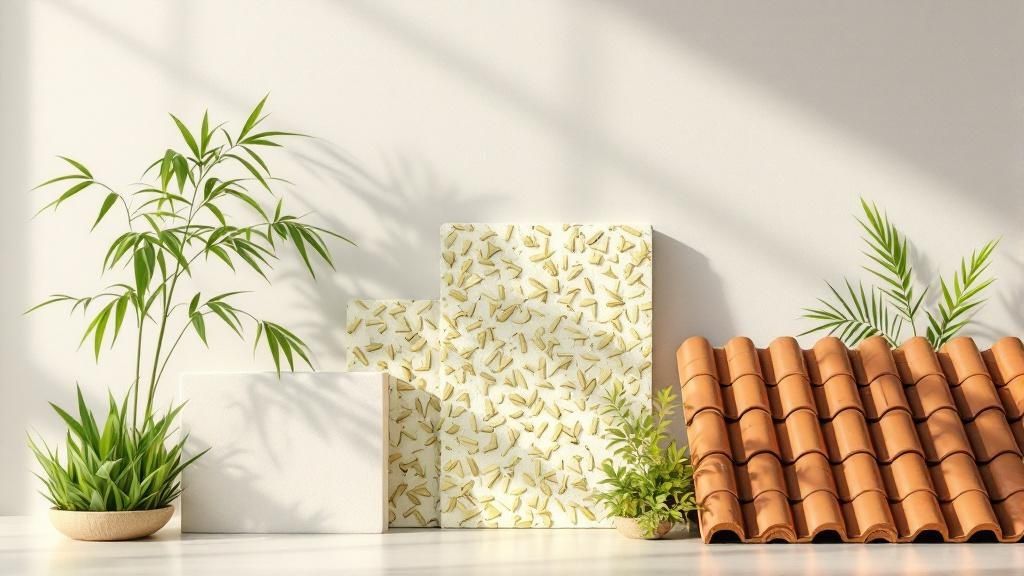
What does this mean for you? It means every material choice is now under the microscope. From the steel frame to the final coat of paint, each product plays a part in your project's final sustainability score and its ability to get the green light from authorities.
Understanding Estidama and LEED
When you talk about green building in Abu Dhabi, two names always come up: Estidama and LEED. They're aiming for the same target, but they take different routes to get there, which directly affects how you source materials.
- Estidama (The Pearl Rating System): This is Abu Dhabi’s own system—the name even means 'sustainability' in Arabic. It's not optional; it's a must for all new builds. The Estidama Pearl Rating System (PRS) grades projects from one to five Pearls, looking at everything from water conservation to the very materials you use.
- LEED (Leadership in Energy and Environmental Design): As the global benchmark, LEED is often the goal for high-profile projects or those driven by international firms. It offers a well-known framework for creating efficient, cost-effective, and healthy green buildings.
Complying with Estidama isn’t optional; it's a core requirement for project approval. The system directly incentivises the use of specific types of sustainable building materials by awarding points that contribute to a project's final Pearl rating.
Key Material Requirements Under Green Codes
These regulations are pushing the industry towards a whole new palette of eco-friendly materials. Your procurement strategy has to be laser-focused on products that will help you hit those green targets.
This is where a supplier who knows the ropes becomes invaluable. They can help you sift through the complex paperwork needed to prove you’re compliant. As Abu Dhabi continues to embrace standards like Estidama and LEED, the market for innovative, green construction tech is only going to grow.
Sourcing Compliant Materials Effectively
Meeting these standards means being incredibly deliberate about your material choices. The focus has shifted to a product's entire life story—from where it was made to how it affects the air inside a finished building.
- Recycled Content: Materials made with post-consumer or post-industrial waste are big winners here. Think certain types of steel, aluminium, and insulation. Using them reduces the drain on brand-new resources.
- Regional Sourcing: Estidama really pushes for using materials sourced and made locally, usually within a 500 km radius. This slashes the carbon footprint from transportation and pumps money back into the local economy.
- Low-VOC Products: Volatile Organic Compounds (VOCs) are nasty chemicals found in many paints, glues, and sealants. The rules now demand low-VOC or zero-VOC products to ensure the air inside buildings is clean and safe for everyone.
Getting your head around these details can be a real challenge, which is why we put together a full guide. For a deeper dive, check out our article on navigating the regulations for building materials in the UAE.
Partnering with a supplier like Yasu Trading Co. takes the headache out of this process. We stock a wide range of Estidama and LEED-compliant materials and provide all the documentation you need to prove it. We’re here to help you get your project over the line and build a greener future for Abu Dhabi.
Mastering Your Procurement Strategy
Knowing what materials you need is one thing. Getting them to your site on time and on budget? That's a whole different ball game. A solid procurement strategy is the blueprint that guides you through the complex world of building materials in Abu Dhabi, helping you dodge common pitfalls like sudden price hikes and supply chain nightmares.
Think of procurement as the operational heart of your construction project. When it's pumping efficiently, information flows, materials show up just when you need them, and every phase of the build is properly supplied. But if it falters, the whole project can seize up, leading to eye-watering delays and compromises on quality.
Navigating Market Volatility and Supply Chains
The construction market is never a calm sea, and Abu Dhabi is no different. Global events can send the price of essentials like steel and cement on a rollercoaster, while logistical logjams can throw your delivery schedules into chaos. These aren't just small hiccups; they're major risks that can sink a project's finances and timeline.
The UAE's construction sector is booming, with projections suggesting the market could hit AED 189.59 billion by 2025. But this growth comes with its own headaches, namely inflation and supply chain bottlenecks that have pushed material costs up in recent years. You can get a deeper look into these market dynamics in the UAE construction industry. This is exactly where a reliable supply partner goes from being a "nice-to-have" to a non-negotiable asset.
A truly effective procurement strategy doesn't just react to fires—it prevents them from starting. By working with a supplier who has their finger on the market's pulse and a rock-solid logistics network, you can turn potential disasters into manageable challenges.
The Real Value of a Strategic Supply Partner
Let's paint a picture. Imagine you're managing a new mid-rise residential tower on Al Reem Island. The deadline is tight. You need a steady stream of climate-resistant glazing, Estidama-approved insulation, and top-tier plumbing fittings.
Instead of trying to herd cats by coordinating with a dozen different vendors, you make one call to Yasu Trading Co. That single move simplifies everything. We tap into our extensive network and use our bulk purchasing power to lock in competitive, stable prices, insulating your project from nasty market surprises.
But our job goes way beyond just taking your order. We become a core part of your project's success by:
- Handling the Logistics: We schedule just-in-time deliveries, so materials arrive precisely when your crew is ready for them. This slashes on-site storage needs and cuts the risk of theft or damage.
- Guaranteeing Quality: Every single item, from the massive steel beams down to the smallest electrical switch, is thoroughly checked to make sure it meets your specs and Abu Dhabi's demanding regulations.
- Being Your Single Point of Contact: We source a huge range of materials under one roof. This means less paperwork, clearer communication, and zero worries about whether different components will work together.
By partnering with us, that project manager turns a messy procurement puzzle into a streamlined, predictable process. The tower project stays on track, the budget holds firm, and the final building is constructed with materials you can trust. That's the tangible, real-world value of a procurement strategy done right.
Your Partner in Building Abu Dhabi's Future
Putting up a building in Abu Dhabi isn't just about mixing concrete and raising steel. It's about being part of a bigger story—the Emirate's incredible vision for the future. To do that right, you need a solid grasp of the local landscape: the intense climate, the specific regulations, and the constant pace of growth. Every single choice, from the foundational rebar to the complex MEP systems, plays a crucial role.
Think of this guide as your blueprint for making those decisions with confidence. We've walked through the essential materials that give the city its strength, looked at how to choose products that can handle the regional climate, and touched on the vital green building codes like Estidama. Nailing each of these steps is what makes a project stand the test of time.
A project's strength is ultimately determined by the quality of its components and the reliability of its supply chain. In Abu Dhabi, these two factors are inseparable from achieving excellence.
Your Roadmap to Success
Turning an architect's dream into a tangible landmark really comes down to mastering material selection and procurement. It’s a journey with a few critical stops along the way:
- Climate-Proofing: This means deliberately choosing materials built to endure relentless heat, high humidity, and salty air.
- Regulatory Compliance: You have to ensure every item, big or small, lines up with the tough sustainability standards set by local authorities.
- Strategic Sourcing: It's about creating a smart procurement plan that protects you from surprise price jumps and frustrating delays.
Getting through this process takes experience, a bit of foresight, and a partner you know you can count on.
Build with Confidence
At Yasu Trading Co., we don't just sell building materials in Abu Dhabi; we offer certainty. With our huge inventory, sharp logistics, and unwavering focus on quality, we make sure your project is built on a foundation of reliability.
Let’s build the future of Abu Dhabi together. Get in touch with our team today to talk about your project's needs and see how we can help bring your vision to life.
Frequently Asked Questions
When you're dealing with building materials in Abu Dhabi, a lot of questions come up. Whether you’re a contractor on the ground, a developer with a vision, or a project manager trying to keep everything on track, getting the right answers is non-negotiable.
We've heard them all. Here are the answers to the most common queries we get, designed to give you clarity and help you build with confidence.
What Are The Most Critical Factors When Choosing Building Materials In Abu Dhabi?
It really boils down to three things: climate resilience, regulatory compliance, and a reliable supply chain. Forget one, and you're asking for trouble.
First, materials here have to be tough enough for the climate—scorching heat, relentless humidity, and salty coastal air are a given. The wrong choice will degrade faster than you can imagine, leading to expensive headaches down the line.
Second, everything you use must meet Abu Dhabi's strict building codes and green building standards like Estidama. This isn't just a suggestion; it's a requirement for getting your project signed off. Finally, you need a supplier who can actually get the materials to your site on time and on budget. Delays cost money, plain and simple.
"The success of any construction project in Abu Dhabi hinges on a triangle of considerations: climate suitability, regulatory adherence, and logistical certainty. Excelling in all three is the only path to a durable and successful build."
How Do Sustainability Rules Like Estidama Affect Material Selection?
Estidama isn't just a piece of paper; its Pearl Rating System actively shapes your shopping list. The system awards points for using sustainable products, pushing developers to pick materials that align with the Emirate’s green vision.
In practice, this means you'll be looking for materials with specific qualities:
- High recycled content: Think steel alloys or insulation made from recycled goods. These are big point-winners.
- Regional sourcing: Using locally made materials cuts down on transport emissions and is a major plus.
- Low environmental impact: This covers everything from timber sourced from managed forests to concrete mixes that are more water-efficient.
- Low-VOC formulas: Paints, adhesives, and sealants need to have low Volatile Organic Compounds to ensure better indoor air quality.
Ignoring these guidelines from the start is a huge mistake. It can stall your approvals indefinitely, so it’s something you have to factor in from day one.
What Are The Biggest Procurement Challenges In Abu Dhabi?
The biggest headaches are almost always the same: wild price swings for global commodities like steel and copper, logistical nightmares that throw your schedule into chaos, and getting consistent quality across the board. These are the risks that keep project managers up at night.
The only way to handle this is with a smart, proactive procurement strategy. Partnering with a large, experienced supplier is a huge advantage here. Their buying power can absorb sudden price hikes, their logistics are already sorted out for predictable deliveries, and their quality control is rigorous. They make sure all building materials in Abu Dhabi meet not just your specs, but the local standards, too. It turns a potential mess into a smooth operation.
At Yasu Trading Co. LLC, we deliver the quality materials and dependable service you need to tackle these challenges head-on. Take a look at our extensive product range and request a quote today at https://yasutrading.com to lay a foundation of excellence for your next project.