Choosing Building Materials Suppliers in the UAE
Choosing the right building materials supplier in the UAE isn't just a box-ticking exercise. It’s a make-or-break decision that can define the success of your entire project. This isn't just about getting a good price; it's about finding a genuine partner who understands that quality materials, delivered on time, are the real foundation of your build.
Navigating the UAE Construction Supply Market
Let's face it: the UAE construction scene is relentless. We're talking about iconic skylines and projects with deadlines that feel impossibly tight. In this high-stakes environment, your supplier relationship is everything. A great one becomes a seamless extension of your team, but a poor one? That’s where you run into nightmare scenarios of delays, quality problems, and budget blowouts that can sink even the best-laid plans.
The market itself is booming. The construction materials sector in the Middle East and Africa was valued at around $28.43 billion in 2024 and is on a steep upward trajectory, fuelled by all the massive developments you see around you. This growth is exciting, but it also means more noise, making it crucial to have a smart way to vet potential partners.
Setting a Framework for Your Search
Before you even think about requesting quotes or flipping through catalogues, you need a solid game plan. The UAE market is diverse, ranging from huge distributors with global reach to smaller, specialised local outfits. Your first job is to figure out which type fits your project's specific needs.
This means looking past the glossy brochures and really digging into their capabilities. A clear evaluation framework is your best tool here. Think about:
- Product Specialisation: Do they actually know their stuff when it comes to the materials you need? Whether it’s structural steel, high-performance concrete, or niche finishing products, expertise matters.
- Logistical Muscle: Can they actually get the materials to your site when you need them? Look at their fleet, their warehousing capacity, and their real-world track record for on-time delivery.
- Regulatory Know-How: This is a big one. A supplier who's on top of local building codes is invaluable. After all, navigating the regulations for building materials in the UAE is a complex task that a good partner should make easier, not harder.
Remember, the aim isn’t just to buy supplies. It's to build a partnership. The best suppliers become problem-solvers, offering technical advice and logistical flexibility that add value far beyond the price tag.
By setting these criteria from the start, you shift from simply buying things to making a strategic choice—one that protects your project from common headaches and sets you up for a smoother run.
Key Supplier Evaluation Criteria at a Glance
To simplify this process, here’s a quick-glance table summarising what you should be looking for when creating your supplier shortlist.
| Evaluation Criterion | Why It Matters for Your Project | Initial Red Flags |
|---|---|---|
| Product Quality & Certifications | Ensures structural integrity, safety, and compliance with project specifications. Poor quality leads to rework and liability. | Vague or missing certification details; reluctance to provide material test reports. |
| Delivery & Logistics Record | On-time delivery is crucial for maintaining project schedules. Delays have a domino effect on all subsequent phases. | Inconsistent delivery times mentioned in reviews; a small or poorly maintained vehicle fleet. |
| Industry Reputation & References | A proven track record with similar projects indicates reliability and experience in handling your specific needs. | Unwillingness to provide client references; negative feedback on industry forums or from peers. |
| Technical Support & Expertise | Access to knowledgeable staff can help solve on-site challenges and ensure proper material application. | Sales team unable to answer technical questions; no dedicated support contact. |
| Compliance & Documentation | Proper adherence to UAE regulations avoids legal issues and ensures all materials meet local standards. | Lack of familiarity with Dubai Municipality or other local authority requirements. |
This table acts as a solid checklist. If a potential supplier raises red flags in more than one of these areas, it’s probably wise to proceed with caution.
Nail Down Your Exact Material Requirements
If you send a vague request to a building materials supplier, you can bet you’ll get a vague quote back. Even worse, it can lead to the wrong materials showing up on site, which means costly delays and frustrating rework. Before you even think about drafting that first email, you need to create a rock-solid material specification document. It has to be airtight, leaving zero room for guesswork.
This document, or brief, needs to be about much more than just quantities. It’s all about precision. For every single item on your list, from the rebar in the foundation to the last screw in the drywall, you must define the exact technical requirements your project demands. Think of it as your project's DNA on paper. It's the only way to guarantee every supplier is quoting for the exact same thing.
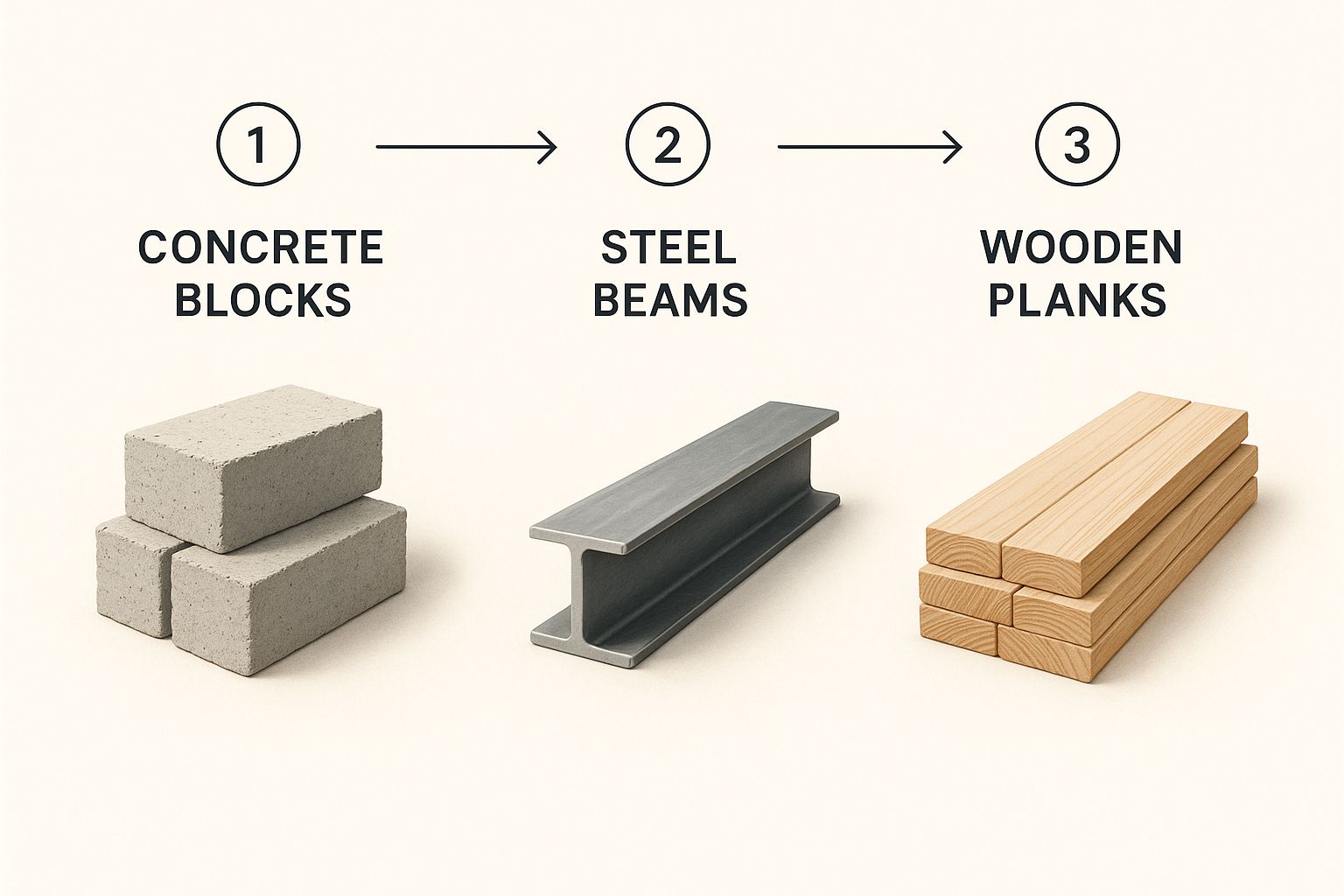
This infographic gives you a sense of the sheer variety of materials that a detailed brief needs to cover, making sure nothing gets missed.
When you see all the distinct categories laid out—from structural elements to finishing fixtures—it really drives home why you need to be so specific for each and every one.
Get Granular on Performance and Compliance Standards
Just asking for "structural steel" is a classic mistake. It's not nearly enough information. Your specification needs to be meticulous. Is it a specific grade, like S355JR? Does it need to meet BS EN 10025 standards? Any ambiguity here is a recipe for disaster down the line. That same level of detail applies to everything.
Take concrete, for example. Instead of just requesting "C40 concrete," your brief should spell out:
- Compressive Strength: C40/50 (MPa) at 28 days.
- Slump Class: S3 for standard pumpability.
- Aggregate Size: 20mm maximum.
- Cement Type: Specify if you need Sulphate-resisting Portland cement based on the soil conditions.
- Admixtures: List any plasticisers or retarders required.
This level of detail forces building materials suppliers to actually confirm they can meet your engineering needs. It immediately weeds out the ones who can't, and it means the quotes you get back are accurate and, most importantly, comparable.
A detailed brief does more than get you a better price; it acts as a quality control document from the very beginning. It protects your project by ensuring every material that arrives on-site has been specified, quoted, and ordered correctly.
Don't Forget Sustainability and Certification Needs
In the UAE, sustainability isn't just a buzzword anymore; it's a core requirement. If your project is aiming for green building certifications like Estidama or LEED, those needs have to be in your initial brief. This could mean specifying materials with high recycled content, low VOC paints, or timber from FSC-certified sources.
For instance, your document should clearly state if you need Environmental Product Declarations (EPDs) for key materials. When you put these criteria in writing from day one, you're telling suppliers that sustainability is a non-negotiable part of your project. This allows them to source and price these specific products properly, preventing nasty surprises later and making sure your project’s green credentials are met without a hitch. It's a proactive step that makes finding the right partner a much smoother process.
Investigating a Supplier's True Reputation
A flashy website and a glossy brochure are one thing. They’re the curated highlight reel a supplier wants you to see. But to really get a feel for who you're about to partner with, you've got to peel back the marketing layer and look at their actual track record. The truth is always in their real-world performance.
This isn’t just about ticking boxes. It’s about creating a practical playbook for digging into a supplier's reputation, and it starts with a few non-negotiables. First up, always verify their trade license. It’s a simple check, but it confirms they're a legitimate, legally operating business in the UAE and can save you from a world of trouble down the line.

Once that's sorted, dive into their project portfolio. Don't just get mesmerised by photos of impressive skyscrapers. Ask for the nitty-gritty details on projects that mirror your own in scale and complexity. This is how you gauge whether their experience is actually relevant to your needs.
Getting Honest Feedback from Past Clients
References are your secret weapon for getting unfiltered intel, but only if you ask the right questions. Any supplier can hand you a curated list of their happiest clients. Your job is to dig for the real story of what it’s like working with them when the pressure is on.
So, when you get a reference on the phone, skip the generic "Were you happy with them?" and get tactical.
- On-Time Delivery: "What was their on-time delivery rate like throughout your project? Can you walk me through an instance where they faced a delay and how they handled it?"
- Material Consistency: "Did you ever run into issues with quality or consistency between different batches of materials? How did they resolve it?"
- Problem Resolution: "Projects never go perfectly. Tell me about a time an order went sideways. How did their team step up to fix the problem?"
The answers you get here will tell you more about their operational integrity than any sales pitch ever could. Looking beyond these initial checks, adopting effective vendor management strategies provides a solid framework for these ongoing evaluations.
A supplier's true character isn't shown when everything is running smoothly. It's revealed when things go wrong. How they communicate and proactively solve problems is the real test of a strong partner.
The Essential Site Visit
Finally, whatever you do, don't skip the site visit. An email or a phone call is no substitute for seeing their operation with your own two eyes. A trip to their warehouse or storage yard is where the rubber meets the road.
Pay attention to their inventory levels. Check out how their stock is organised. Take a look at the condition of their delivery fleet. This isn't just a tour; it’s a crucial opportunity to see if the reality on the ground matches the promises made on paper by potential building materials suppliers. A well-run, organised facility is almost always the sign of a well-run company.
Getting Serious About Material Quality and Sourcing
In the UAE, the quality of your building materials isn't just a box to tick—it’s the backbone of your project. With our demanding climate, cutting corners here can lead to anything from costly repairs down the line to catastrophic structural failures. It’s why a deep dive into material quality and sourcing is a non-negotiable step before you sign with any building materials suppliers.
We're talking about ensuring every single component, from the rebar in your foundation to the cladding on the exterior, is up to spec.
The easiest way to cut through the sales talk? Ask for the paperwork. Don’t settle for a simple "yes, our materials are high quality." You need proof.
- Technical Data Sheets (TDS): This is where you find the hard numbers—compressive strength, fire ratings, thermal resistance, and all the other performance specs.
- Material Test Certificates (MTCs): For foundational materials like steel or cement, insist on MTCs from accredited third-party labs. This confirms the specific batch you're getting actually meets the standards.
- Certificates of Origin: Knowing where your materials come from is a huge part of quality control. This document tells you exactly that.
Getting this documentation forces an objective, apples-to-apples comparison. It moves the conversation from vague promises to concrete facts.
Are They Aligned with Green Building Standards?
Sustainability isn't just a buzzword anymore; it's a core requirement. With initiatives like the UAE Net Zero 2050 strategy, the push for energy-efficient and advanced building materials is stronger than ever.
The best suppliers get this. They don't just stock the basics; they actively source products that will help you hit your green building targets. When you’re vetting potential partners, ask them directly about their experience with sustainable sourcing.
A truly valuable supplier can guide you toward materials with superior thermal efficiency and long-term durability—two things that are absolutely critical in this region. This is where you can explore the kind of essential building materials for construction projects in Dubai that hit the mark on both performance and sustainability.
A supplier's commitment to quality isn't just about what’s on their shelves. It’s about their ability to source materials that meet today’s environmental and performance benchmarks. That kind of expertise is what separates the good from the great.
Don't Forget Safety and Compliance
Beyond performance, you need to be certain your materials are safe. This means confirming they are free of hazardous substances and fully compliant with local health and safety regulations.
For certain projects, particularly renovations of older structures, this might mean going a step further. It's crucial to ensure all materials are safe, which could involve specific checks like testing for asbestos in building materials.
A reputable supplier will have no problem providing documentation to prove their products are safe and compliant. If they hesitate, that's a major red flag. This isn’t a step you can afford to skip in your due diligence.
Take a Hard Look at Their Logistics and Supply Chain
Let's be blunt: the best materials in the world are completely useless if they’re stuck in a warehouse or on the back of a broken-down truck. A supplier’s logistical muscle is the unsung hero of any successful project. It's what keeps your site humming and your timeline intact.
This is where you really need to put on your detective hat. You’re looking for evidence of a smooth, well-oiled machine, not a company that will leave your crew standing around, burning through your budget.
Start with the basics—their physical setup. Get specific with your questions. Don't just ask if they deliver; ask how. Do they run their own fleet of trucks, or are they relying on third-party contractors? A supplier with their own dedicated, well-maintained vehicles has infinitely more control over scheduling and can react faster when things go sideways.
Then, take a look at their warehousing. A massive, organised warehouse isn't just for show. It tells you they have the capacity to hold enough stock to ride out unexpected spikes in demand, meaning you're less likely to get a dreaded "out of stock" call.

How They Handle the Day-to-Day
Beyond trucks and warehouses, you need to dig into their processes. How are they actually managing all that inventory? Modern building materials suppliers are moving beyond simple spreadsheets. The smart ones are embracing tech like Building Information Modelling (BIM) to make their supply chains more accurate and efficient.
These advancements are becoming standard practice for top-tier suppliers in the UAE, allowing for better quality control and much faster distribution. If a potential supplier isn't talking about their tech stack, they might be behind the curve. For even deeper insights, you can even explore using supply chain analytics tools to evaluate their performance.
A supplier who can’t clearly explain their process for handling urgent requests or what happens when a shipment is delayed likely doesn’t have a solid plan. Their hesitation is your red flag.
Put them on the spot with a few real-world scenarios:
- What’s the real lead time for a standard order of rebar versus a custom-fabricated steel component?
- Can you show me how you track deliveries in real-time? What system do you use?
- Your truck gets a flat tyre on Sheikh Zayed Road during peak traffic. What’s your backup plan to get my materials to the site today?
Your "Urgent" vs. Their "Urgent"
It’s also crucial to get on the same page about what "urgent" really means. In construction, plans can change in an instant, and your project’s momentum often depends on getting a last-minute order fulfilled.
Ask them point-blank: Do you have a separate, dedicated process for expedited orders? What are the extra costs? A supplier with a clear protocol for emergencies is one that understands the realities of a construction site. They're a partner, not just a vendor.
Getting clear answers here tells you everything you need to know about the resilience of their entire operation. For more on this, we've put together some practical tips on ensuring timely delivery of construction materials.
Ultimately, choosing a supplier with a robust, proven logistical backbone isn't just about convenience. It’s a direct investment in keeping your project on track and avoiding the disastrous financial domino effect of downtime.
Finalising the Partnership Agreement
You've done the legwork, vetted your options, and you're ready to pick a winner. But hold on—this isn't the finish line. Think of it as the starting line for what should be a long and fruitful relationship. This is where you move from evaluation to negotiation, and it's all about hammering out an agreement that safeguards your project and makes sure everyone is on the same page.
It’s easy to get tunnel vision and focus only on the price per unit. I've seen countless contractors fall into this trap. The cheapest quote rarely translates to the best value, especially in the long run. A smart negotiation is about the whole picture.
For instance, what are their credit terms? A supplier who can offer a 90-day credit facility can be a game-changer for your project's cash flow, especially compared to another who wants payment on delivery. That flexibility is often worth more than a few dirhams shaved off the initial price.
Look Beyond the Price Tag
The real value often lies in the services bundled with the materials. These are the things that can save your skin when you’re up against a tight deadline.
- Warranties and Guarantees: What’s the plan if a shipment of steel fails your quality inspection? A supplier who backs their products with a rock-solid warranty isn't just selling you materials; they're selling you confidence.
- After-Sales Support: Can you get a technical expert on the phone—or better yet, on-site—when your crew hits a snag? That kind of hands-on support is priceless when you're trying to solve a problem quickly.
- Return Policies: Let's face it, projects change. A supplier with a no-fuss return policy for standard, unused materials can save you a fortune in waste.
These aren't just bonus features; they are crucial negotiation points. They show you whether a company sees you as a partner or just another invoice. A great agreement with reliable building materials suppliers should feel like a true collaboration, not a one-sided transaction.
Getting the Key Clauses Right in Your Supply Agreement
Your supply agreement is the bedrock of the partnership. It needs to be crystal clear, leaving zero room for interpretation. Don't be shy about insisting on specific language for every critical detail.
A handshake is good, but a well-defined contract is better. It ensures that both you and your supplier are operating from the same playbook, which is the best way to prevent costly disputes down the line.
At a minimum, your agreement needs to nail down these three areas:
- Delivery Schedules: Don't settle for vague promises like "prompt delivery." Specify exact delivery windows, name a site contact person, and agree on penalties for delays.
- Quality Control Procedures: How will you inspect materials on arrival? What’s the process for rejecting a delivery that doesn’t meet spec? Get it all in writing.
- Dispute Resolution: Lay out a clear, step-by-step process for handling disagreements, whether it's a simple mix-up or a more significant contract issue.
Taking the time to finalise a strong, detailed agreement is the single best thing you can do to ensure a smooth project. It aligns expectations from day one and builds the foundation for a relationship that lasts.
Got Questions About Building Materials Suppliers? We've Got Answers
When you're trying to lock in the right building materials supplier, a few key questions always pop up. Over the years, we've heard them all. Here’s the straight talk on what project managers really want to know.
What's a Realistic Lead Time?
This is the big one, and the honest answer is: it depends entirely on what you're ordering.
If you need standard, off-the-shelf items like common rebar sizes or standard blockwork, a good supplier can often get them to your site within 24 to 48 hours.
But if your project calls for something more specific—think custom-fabricated steel, unique architectural finishes, or high-spec imported materials—you need to plan much further ahead. For these items, you could be looking at lead times anywhere from 4 to 12 weeks, sometimes even longer.
My advice? Pin down the delivery timelines for your critical path materials right at the start. Don't leave it to chance.
How Do Payments Usually Work?
Cash flow is king in construction, so understanding payment terms is non-negotiable.
Most established suppliers in the UAE will offer credit facilities to contractors with a solid track record. The typical terms you'll see are 30 to 90 days post-delivery.
However, if you're a new customer or you’re placing a large, custom order, don't be surprised if they ask for an upfront deposit. This is standard practice and usually falls between 30-50% of the total order value. Getting these terms right is a crucial part of sealing the deal.