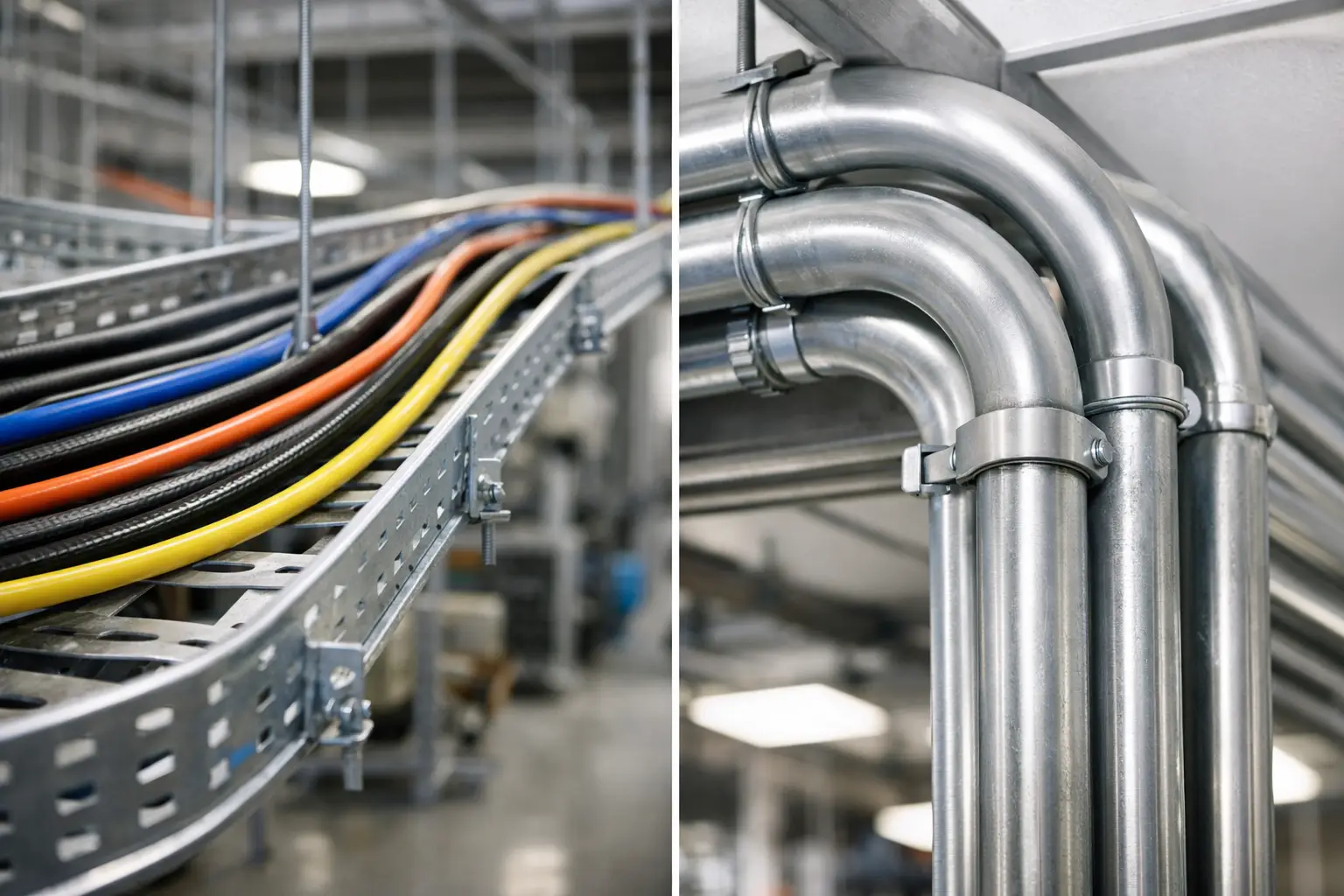
Cable Tray Versus Conduit: Which Fits?
A rushed electrical package usually shows its problems late - during inspection, during expansion, or when maintenance teams need access and find none. That is why the cable tray versus conduit decision matters early. For contractors and procurement teams, this is not only a design preference. It affects labor hours, material movement, future access, code alignment, and how quickly a site can stay on schedule.
In commercial and industrial work, both systems have a clear place. The mistake is treating one as the default for every run. A cable tray system can reduce installation time and simplify cable management across long routes. Conduit can deliver stronger mechanical protection and tighter control in exposed or higher-risk areas. The right choice depends on the environment, the cable type, the building use, and the level of flexibility the project will need after handover.
Cable tray versus conduit: the real difference
At the simplest level, cable tray is a support system. It carries and organizes insulated cables along a defined path, usually in ladder, perforated, wire mesh, or solid-bottom formats. The cables are visible and accessible, which makes tray attractive for large power and control runs in plants, commercial buildings, and service corridors.
Conduit is an enclosed raceway. It protects conductors inside metal or nonmetallic piping, with fittings, bends, couplings, and boxes used to complete the system. Because the conductors are enclosed, conduit offers a higher degree of physical protection and environmental isolation.
That basic distinction changes nearly everything downstream. Tray is often faster to install over long distances and easier to modify. Conduit is often slower and more labor-intensive but better suited where cables need shielding from impact, moisture, contaminants, or tampering.
Where cable tray makes more sense
Cable tray is usually the practical answer when a project has a high volume of cables running through accessible zones. In data-heavy buildings, industrial facilities, and large commercial services, tray gives installers a cleaner route with less repetitive bending and pulling than conduit. On long straight runs, that can save meaningful installation time.
Tray also helps when future changes are likely. If a facility will add circuits, controls, or low-voltage systems later, an open support system is easier for maintenance teams to work with. They can identify runs quickly, separate services more clearly, and add or replace cables without opening a closed raceway system section by section.
This matters in phased projects and fit-outs where electrical scope can shift after initial installation. It also matters in facilities where uptime is critical and maintenance access needs to be practical, not theoretical.
There is a cost angle as well. Material cost can vary by tray type and support requirements, but on many large runs, the labor reduction is the bigger advantage. Fewer bends, fewer fittings, and faster cable laying can improve productivity. For procurement teams balancing delivery schedules and labor pressure, that is a serious benefit.
Still, cable tray is not automatically the low-cost answer. If the environment is dirty, wet, corrosive, or exposed to damage, you may need special finishes, covers, or more robust support spacing. Those additions can narrow the gap.
Where conduit is the better choice
Conduit remains the stronger option where protection is non-negotiable. In plant rooms, exterior exposed areas, parking structures, service yards, and locations with higher risk of impact, conduit gives conductors a harder shell. That can be essential for safety, compliance, and long-term durability.
Conduit is also preferred where the installation needs tighter containment. If cables pass through walls, slabs, or concealed spaces, an enclosed raceway is often the more appropriate method. In some applications, it may also support fire-resistance strategies, grounding requirements, or electromagnetic shielding objectives, depending on the system design and material selected.
For smaller branch circuits, conduit can be more orderly than tray. A tray system for a limited number of conductors may be unnecessary overhead. In those cases, EMT, GI conduit, PVC conduit, flexible conduit, and the right fittings can create a more compact and protected installation.
Conduit also helps when site conditions are rough during construction. Open cable systems can be more exposed to accidental damage before final handover. Enclosed raceways reduce that risk.
Installation speed, labor, and project pressure
If the project is on a compressed timeline, labor availability matters as much as material selection. This is where cable tray often has the edge. Long horizontal runs in basements, riser corridors, utility decks, and industrial areas can move faster with tray than with a fully enclosed conduit network.
Conduit takes more fieldwork. Installers need to measure, cut, bend, thread or join, set supports, pull conductors, and complete terminations through boxes and fittings. None of that is a problem when the application needs it. But on labor-heavy jobs, those hours add up.
Tray simplifies the route, but it still needs proper supports, cable segregation, loading review, bend accessories, and disciplined installation. Poorly planned tray layouts create sagging, overcrowding, and service conflicts. Fast installation is only useful if it stays compliant and serviceable.
For procurement managers, this means the product package must be aligned before material hits the site. Cable tray width, depth, finish, cover needs, support hardware, couplers, and accessories should be quoted as a complete system. The same applies to conduit, where fittings, boxes, straps, and inspection-friendly layouts matter as much as the pipe itself.
Compliance is not the same as convenience
The cable tray versus conduit choice should never be made on speed alone. Local code requirements, project specifications, and authority approvals all shape the final answer. Some applications permit tray readily. Others require conduit for all or part of the route.
This is especially relevant on projects where inspection delays are expensive. A system that looked cheaper at tender stage can become costly if it fails compliance review or forces rework. That is why approved materials, correct support intervals, proper cable fill, grounding provisions, and manufacturer-backed components matter from the beginning.
For UAE contractors working across commercial and MEP packages, the safest approach is to match the system to the actual use case instead of forcing a one-size-fits-all standard. In practice, many successful projects use both. Tray handles the main distribution routes in accessible service zones, while conduit protects final drops, exposed sections, penetrations, and sensitive areas.
Cable tray versus conduit in maintenance and expansion
Operations teams usually prefer what they can inspect and modify without disruption. That gives cable tray an advantage in buildings with evolving loads, tenant changes, or future technology upgrades. When circuits need tracing or additions are planned, visible cable routing reduces guesswork.
Conduit is less convenient for future changes, especially if spare capacity was not planned properly. Pulling additional conductors later can be difficult once bends, fill limits, and existing occupancy are in play. If expansion is likely, that limitation should be considered before the first order is placed.
But maintenance access is not the only concern. If the site environment is harsh enough to shorten cable life without enclosure, conduit may still be the better long-term decision. Easy access is valuable, but so is protection that prevents failure in the first place.
How to choose without overcomplicating it
A practical selection process starts with four questions. How exposed is the cable route to damage or contaminants? How likely is future expansion? What does the specification or authority require? And where will labor efficiency make the biggest difference to the schedule?
If the route is long, accessible, and likely to change, tray deserves strong consideration. If the route is exposed, concealed in critical areas, or needs stronger mechanical protection, conduit is usually the safer answer. If the project includes both conditions, then a mixed system is often the most efficient and compliant solution.
This is also where sourcing matters. Contractors do not need separate suppliers for electrical containment, support hardware, fittings, fasteners, sealants, and site tools to complete the package. A consolidated supply approach reduces coordination loss and helps keep installation crews productive. For buyers managing multiple active jobs, ready stock and jobsite delivery are often just as valuable as the unit rate.
Yasu Trading Co. LLC supports this kind of procurement by supplying municipality-compliant electrical materials, accessories, and jobsite-ready construction hardware for contractors who need reliable fulfillment without supplier gaps.
The best electrical containment choice is rarely about picking a winner between two systems. It is about selecting the method that protects the cable, satisfies the inspector, suits the installation team, and still makes sense when the building is in use five years later.