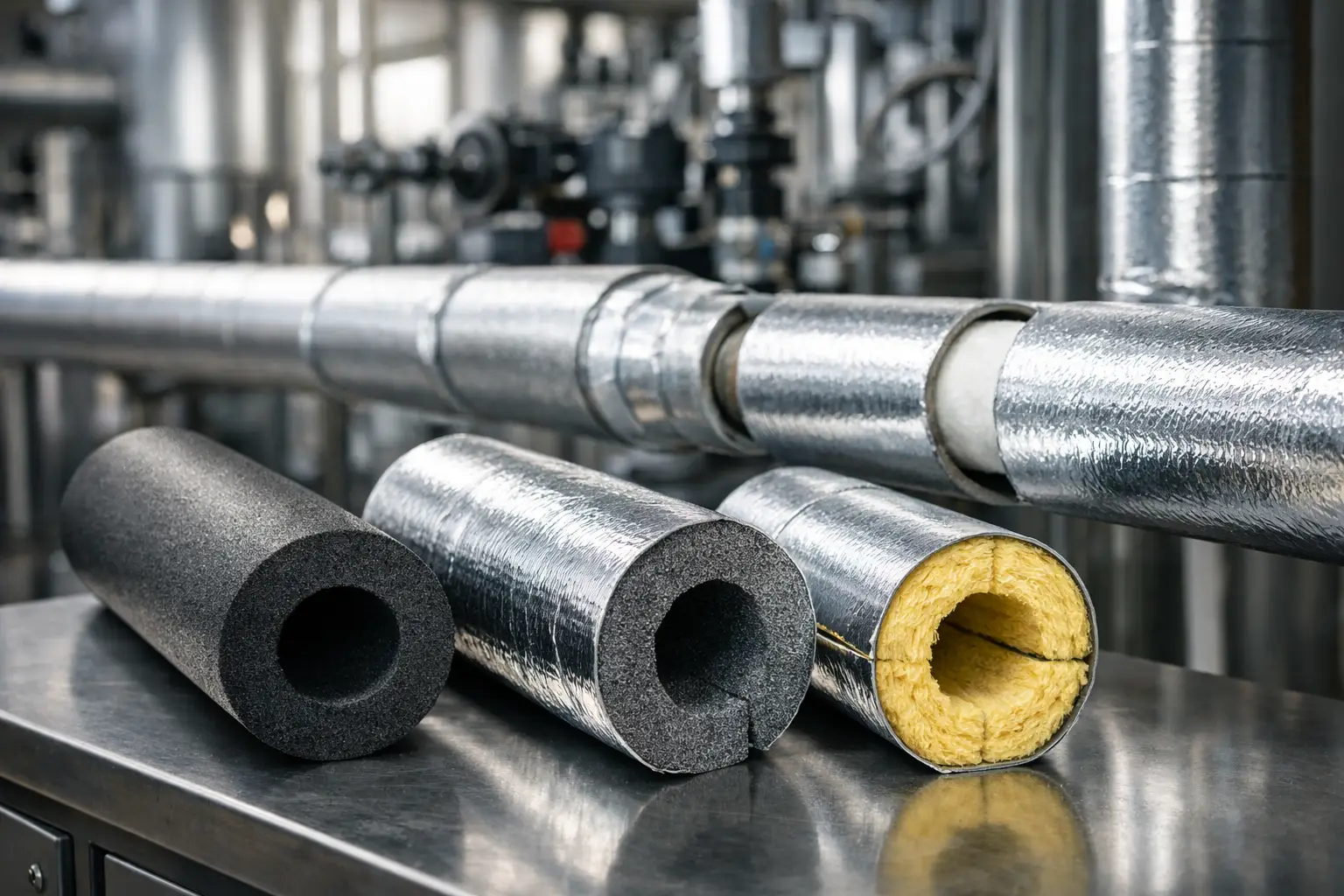
How to Choose Industrial Pipe Insulation
A pipe insulation decision can affect far more than energy consumption. On a chilled-water line, the wrong vapor barrier can lead to sweating, ceiling damage, corrosion, and costly rework. On hot-water, steam, or process lines, insufficient thickness can create heat loss, unsafe surface temperatures, and failed performance testing. To choose industrial pipe insulation correctly, procurement teams need to match material, thickness, facing, and installation method to the actual service conditions - not simply select the lowest price per roll or meter.
For contractors and MEP subcontractors, this is a specification and delivery decision. Materials must meet consultant requirements, support inspection approvals, arrive in the required quantities, and remain available when variations or maintenance requirements arise.
Start With the Pipe Service, Not the Insulation Brand
The first question is simple: what is moving through the pipe, at what temperature, and where is the line installed? Industrial pipe insulation is not a single product category. A chilled-water line in a humid plant room has different requirements from a domestic hot-water riser, a condenser-water line, or a high-temperature process pipe.
For cold services, condensation control is usually the primary concern. The insulation needs low thermal conductivity, a continuous vapor-retarder system, and properly sealed joints. Even a small break in the vapor barrier can allow humid air to reach the cold pipe surface. Once moisture enters the insulation, thermal performance drops and corrosion under insulation becomes a long-term risk.
For hot services, heat retention and safe surface temperature are often the main drivers. The selected insulation must tolerate the operating temperature without shrinking, degrading, or losing its shape. In plant rooms, boiler connections, and high-temperature mechanical systems, fire performance and mechanical protection may also be part of the specification.
Outdoor exposure changes the decision again. Insulation installed externally needs suitable cladding or weather protection against ultraviolet exposure, wind-driven dust, moisture, and accidental impact. An indoor product may perform well initially outdoors but fail early if it is not protected correctly.
Match the Material to the Application
Several insulation materials are common on MEP and industrial projects. Each has a valid use case, but no single option is right for every pipe network.
Elastomeric Foam for Chilled and Cold Services
Closed-cell elastomeric foam is widely used for chilled water, refrigeration, condensate lines, and air-conditioning pipework. Its built-in vapor resistance helps control condensation when seams, ends, fittings, and joints are sealed correctly.
This material is practical for complex pipe routes because it can be installed around elbows, valves, and branch connections with less cutting than rigid sections. It is especially useful where vapor integrity is critical. However, it must be protected from physical damage and ultraviolet exposure where required. Thickness should never be selected by habit; it needs to match pipe size, operating temperature, ambient conditions, and humidity level.
Fiberglass and Mineral Wool for Hot Services
Fiberglass and mineral wool pipe sections are commonly specified for domestic hot water, heating lines, steam-related applications, and higher-temperature mechanical systems. They offer good thermal resistance and are available in a range of densities and thicknesses.
Mineral wool is often selected where enhanced fire performance or higher temperature resistance is required. Fiberglass can be a cost-effective choice for many hot-water applications. Both generally require an appropriate jacket, facing, or cladding depending on the location and service. They are not interchangeable with closed-cell insulation for cold systems that demand a continuous vapor barrier.
Rigid Insulation for Specific Plant and Process Conditions
Rigid insulation systems may be specified for industrial equipment, large-diameter pipework, or services requiring higher compressive strength. Their performance depends heavily on proper joint treatment, vapor control where applicable, and compatible protective finishes.
The trade-off is installation complexity. Rigid materials can perform very well in the correct system, but poor cutting, open joints, or incomplete protection can undermine the design. Confirm the full assembly, not only the insulation core.
Choose the Correct Thickness Through Calculation
Insulation thickness is one of the most visible cost items in a BOQ, which makes it a frequent target for value engineering. Reducing thickness without a technical review may save on initial material cost while increasing energy loss, condensation exposure, or noncompliance risk.
Thickness should be determined using the project specification and thermal calculation criteria. Key inputs include operating temperature, ambient temperature, relative humidity, pipe diameter, insulation thermal conductivity, required surface temperature, and whether the line is indoors, outdoors, or in a conditioned space.
For chilled-water systems in humid conditions, the calculation must demonstrate that the outer insulation surface remains above the dew point. This is why the same pipe can require different thicknesses in an air-conditioned corridor, a roof area, and an unconditioned plant room.
For hot services, the calculation may focus on limiting heat loss, maintaining process temperature, or keeping the external surface safe for personnel. A line that carries hot water intermittently may have different needs from a continuously operating steam or process line.
When reviewing a quotation, verify that thickness is stated clearly by pipe diameter range. A vague description such as “insulation as required” leaves too much room for supply and installation disputes later.
Check Compliance Before Material Reaches Site
Approved materials protect schedules. Before purchasing, confirm the project’s approved material submittal, consultant requirements, fire-rating criteria, and any applicable local authority conditions. Do not assume that a familiar product is automatically accepted on every project.
The supporting documentation should match the product being supplied. This can include technical data sheets, test reports, fire-performance information, country of origin details, and manufacturer warranty terms where required. Product substitutions should be reviewed before delivery, particularly on projects with consultant-approved brands or strict fire and life-safety requirements.
For UAE projects, municipal and Civil Defense requirements can influence the specified insulation system, especially where pipework passes through shafts, plant rooms, service corridors, and fire-rated assemblies. Insulation alone does not solve every fire-stopping requirement. Coordinate pipe insulation with penetration seals, supports, cladding, and the full approved MEP detail.
Do Not Ignore Fittings, Supports, and Vapor Sealing
Straight pipe lengths are the easy part. Performance is often lost at elbows, tees, valves, flanges, pipe hangers, and terminations. These areas need matching accessories and trained installation practices.
On cold systems, vapor sealing around fittings and supports is essential. Insulation inserts or load-bearing support systems may be required so the pipe does not compress the insulation at hanger locations. Compression creates thermal bridges and can become a condensation point.
On hot systems, removable insulation pads may be appropriate around valves, strainers, and equipment requiring regular access. This improves maintenance without leaving exposed, heat-losing sections of pipework. Where metal cladding is specified, confirm the finish, thickness, banding method, and corrosion resistance for the installation environment.
A lower-priced insulation package can become expensive if it excludes adhesive, tapes, vapor sealant, fitting covers, support inserts, cladding, or accessories needed to complete the specified system.
Buy by Installed System Cost, Not Unit Price
Procurement teams should compare like for like. Ask whether the quotation includes the exact density, thickness, facing, accessories, and documentation required by the specification. Also assess pack sizes, minimum order quantities, lead times, and the supplier’s ability to replenish material during installation.
This matters on phased projects. A contractor may need an initial bulk delivery for risers and plant rooms, followed by scheduled quantities for floor-by-floor fit-out. A supplier with ready inventory and site-delivery capability reduces the risk of crews waiting for basic insulation sections, adhesive, cladding, or related plumbing pipes and fittings.
Yasu Trading Co. LLC supports project procurement with municipality-compliant materials, technical product guidance, wholesale pricing, and site-directed delivery for contractors managing active MEP works. For urgent requirements, confirm stock by thickness, pipe-size range, and accessory type before issuing the purchase order.
A Practical Pre-Order Check
Before releasing an insulation order, make sure the technical and commercial team can answer these questions:
- What is the pipe service temperature and installation environment?
- Is the primary requirement condensation control, heat conservation, personnel protection, fire performance, or a combination?
- Has the required thickness been calculated and approved for each pipe size?
- Are vapor barriers, jackets, cladding, adhesives, tapes, and fitting accessories included?
- Does the supplied product match the approved submittal and required documentation?
- Can the supplier deliver the required quantities in line with the installation sequence?
The right insulation selection is rarely the cheapest material on the first quote. It is the system that reaches site on time, installs without improvisation, passes inspection, and keeps performing after ceilings are closed and plant rooms are handed over.