Construction Cost Management Strategies in UAE
Think of cost management as the financial backbone of any construction project. It’s not just about pinching pennies or tracking what you've already spent; it's the entire discipline of forecasting, budgeting, and actively controlling every dirham from the first blueprint sketch to the final handover.
Why Construction Cost Management Is Not Negotiable
Can you imagine building one of Dubai's iconic skyscrapers without a detailed financial plan? It's a recipe for disaster. That’s what taking on a construction project without a solid cost management strategy looks like—a massive gamble that almost guarantees you’ll go over budget and miss your deadlines.
This discipline is your project's navigation system, making sure every dirham is spent wisely and accounted for. It's a strategic process that touches every single stage of the project lifecycle, starting with the very first budget estimates and continuing long after the last worker has packed up their tools. The end goal is simple: keep the project profitable and viable.
The Strategic Advantage of Financial Control
In a market as fiercely competitive as the UAE's, where efficiency and precision are everything, mastering cost management isn't just a "nice-to-have." It’s a core requirement for survival. It gives you a clear framework for making smart decisions, heading off financial risks, and keeping your clients and investors happy. Without it, you're flying blind, only spotting budget blowouts when the damage is already done.
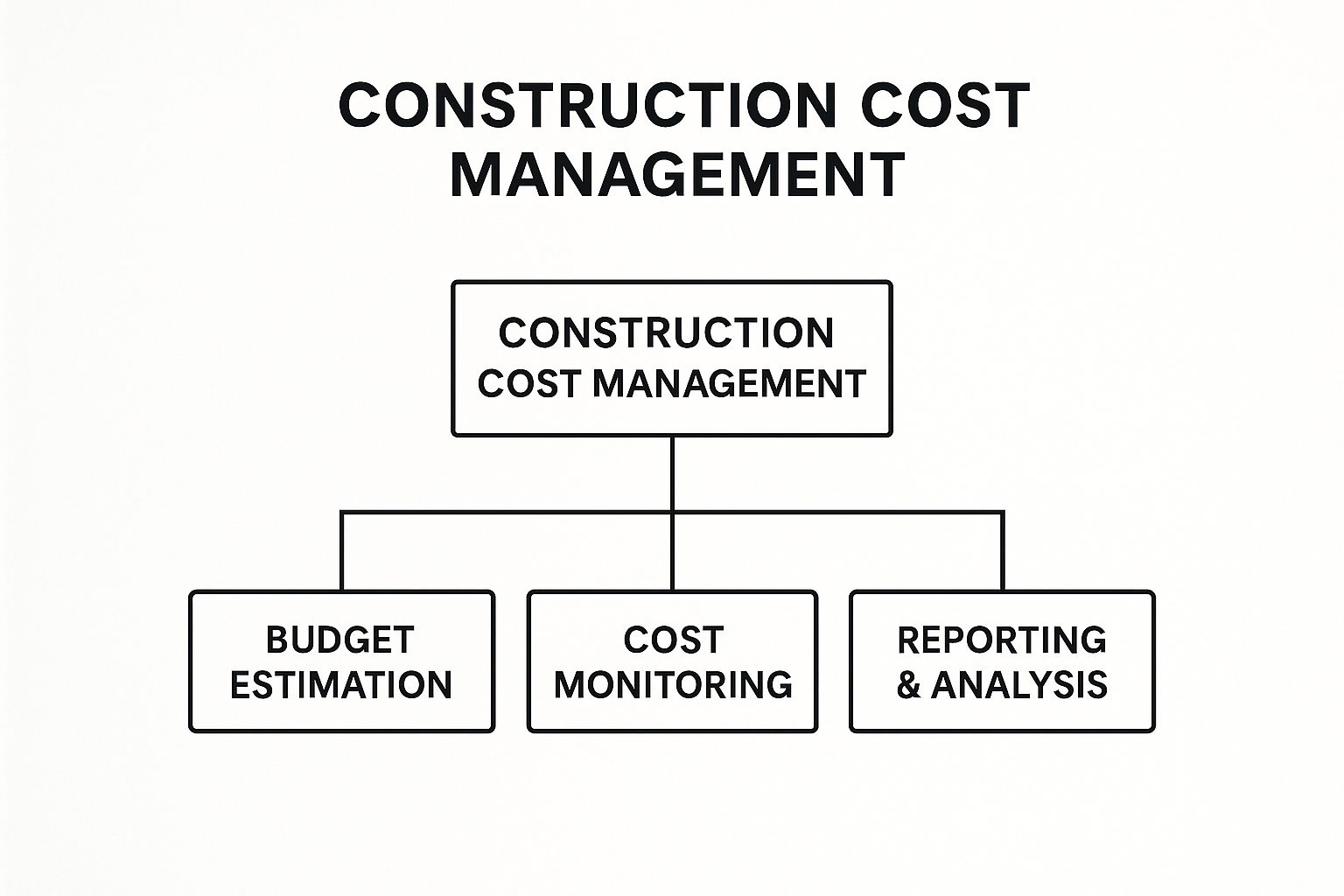
This whole process can be broken down into a few core components, each one feeding into the next. It’s a continuous loop of planning, checking your progress, and making adjustments along the way.
This structure really highlights how cost management isn't a one-off task but a cycle that keeps your project on the right financial track from start to finish.
A solid cost management strategy is built on four key pillars. Each one has a specific job to do, but they all work together to support the project's financial health.
The Four Pillars of Construction Cost Management
| Pillar | Objective | Key Activity |
|---|---|---|
| Cost Estimating | To predict the total financial resources needed. | Creating detailed, data-driven cost breakdowns. |
| Cost Budgeting | To set a firm financial baseline for the project. | Allocating the total estimated cost across project tasks. |
| Cost Control | To manage and influence changes to the budget. | Monitoring actual spending against the plan and making adjustments. |
| Cost Reporting | To provide clear visibility to all stakeholders. | Generating regular updates on financial performance and forecasts. |
Getting these four pillars right creates a powerful system for financial oversight, giving you the control needed to navigate the complexities of any construction project.
Responding to Market Pressures
The need for tight financial control is even more critical when you look at what's happening in the market right now. With material prices climbing and skilled labour in short supply, there's very little room for error. In fact, forecasts suggest the UAE's construction industry could see cost hikes between 2% and 5% in 2025 alone. This is being driven by intense demand and a squeeze on both skilled workers and essential materials. You can dig deeper into this trend in a recent report on GCC market conditions.
Key Takeaway: When you shift your thinking, cost management stops being a reactive, damage-control exercise and becomes one of your most powerful strategic tools. It lets you get ahead of challenges, steer financial outcomes, and cement your reputation for delivering on your promises.
Ultimately, this kind of proactive financial oversight delivers some serious benefits that hit your bottom line and boost your reputation:
- Enhanced Profitability: By cutting out waste and stopping budget overruns before they happen, you directly protect your profit margins.
- Improved Decision-Making: With accurate, real-time cost data at your fingertips, you and your project managers can make much smarter calls.
- Increased Stakeholder Trust: Nothing builds credibility with clients and investors like bringing a project in on or under budget.
- Better Risk Management: It helps you spot potential financial threats early on, so you can deal with them before they spiral into major crises.
Building Your Financial Foundation
Before a single shovel ever breaks ground, the real heavy lifting in construction cost management is already underway. This vital first stage is all about two sides of the same coin: cost estimating and cost budgeting.
Think of it like planning a cross-country road trip. Your estimate is the quick calculation of how much fuel you think you’ll need for the entire journey. The budget, on the other hand, is your detailed route map—pinpointing every city, every stop for petrol, and allocating funds for each leg of the trip.
An estimate is far more than a wild guess. It's a calculated forecast of what it will take, financially, to bring a project to life. The budget then takes that forecast and turns it into a practical, actionable plan, breaking down the total cost by task, timeframe, and resource. This document becomes the single source of truth for your project's financial health.
From Educated Guess to Strategic Plan
The strength of your entire financial plan hinges on how well you estimate from the get-go. In the earliest days of a project, when you’re working with more questions than answers, a high-level conceptual estimate often does the trick. But as the blueprints get more detailed, your estimating has to become sharper and more granular.
Contractors have a few proven methods for building this financial picture, each best suited for a different stage of the project:
- Conceptual Estimating: This is your back-of-the-napkin calculation, perfect for the initial feasibility phase. It's fast and broad, typically drawing on data from similar past projects to give a ballpark figure.
- Parametric Estimating: A step up in detail, this technique uses statistical relationships to forecast costs. A classic example in the UAE is calculating the total cost based on a known cost-per-square-metre for a specific type of building.
- Detailed (Unit-Cost) Estimating: This is the most meticulous and accurate method, reserved for final bids and budgeting. It involves breaking the entire project down into individual work items and pricing out every single material, labour hour, and piece of equipment.
It's during this shift—from a rough concept to a detailed budget—that a project’s financial viability is truly tested and confirmed. This is where an idea transforms into a strategically planned investment.
A well-structured budget is the single most important tool for effective construction cost management. It’s not a restrictive document meant to be filed away; it is a living guide that provides the baseline against which all future performance is measured.
Building a Realistic UAE Project Budget
Crafting a budget that can withstand the real-world pressures of a construction site requires more than just good maths. It demands an intimate knowledge of local market conditions and access to solid, reliable data.
The best budgets are always built on a foundation of historical cost data. When detailed plans aren't yet available, methods like conceptual or parametric estimating are invaluable. They rely on past project metrics—like cost per square metre of a villa or per kilometre of road—to make accurate predictions. You can explore more about these practical estimating guides on Scribd.
But here’s the crucial part: you can't just copy and paste numbers from an old project. That's a surefire way to blow your budget. You have to carefully adjust historical data to reflect today's realities in the UAE market.
This means taking several key steps:
- Gather Historical Data: Start by collecting cost information from your own completed projects. This internal data is gold because it reflects your company’s unique workflows, efficiencies, and cost structures.
- Adjust for Inflation: Account for the current rate of inflation. A project costed out in 2022 will have a very different price tag in today's economic climate.
- Factor in Market Conditions: Look at supply and demand. Are specific materials like steel or specialised glass in high demand for projects in Dubai or Abu Dhabi right now? This will directly affect their price and lead times.
- Analyse Supply Chain Variables: What's happening with your suppliers? Evaluate potential logistical hurdles or price volatility from key partners.
By meticulously gathering and adjusting this data, you move beyond guesswork and create a truly realistic project budget. This document is your financial blueprint, giving you a reliable benchmark for the entire project and paving the way for a profitable completion.
Keeping Your Project on Budget in Real Time

Let’s be honest. A detailed project budget is a fantastic starting point, but it's worthless if it just sits in a folder collecting dust. Real, effective construction cost management isn't about looking back at last month's receipts; it happens right now, in the thick of the project. It’s an active, daily process of steering the ship through the unpredictable waters of site operations.
Think of it like this: the project manager is the captain and the budget is the charted course. A good captain doesn't just point the ship in the right direction and hope for the best. They’re constantly checking the compass, reading the winds, and adjusting the sails to navigate changing currents. The same goes for your project costs. You have to actively track and control them in real time to make sure you arrive at a profitable destination.
This means getting beyond sluggish monthly reports and embracing systems that give you instant feedback. A small leak in the budget can turn into a project-sinking flood if you don't spot it and patch it up immediately.
Tracking Costs as They Happen
The entire foundation of real-time control is built on one thing: accurate, timely data. To make smart decisions on the fly, you need a crystal-clear picture of what you’re spending today, not what you spent last week. This takes a disciplined approach to monitoring every single expense as it occurs.
A few key areas demand constant, eagle-eyed oversight:
- Labour Hours: You need to know the actual hours being worked versus what you budgeted for each task. This is your frontline defence, revealing productivity issues or scope creep long before payroll is even processed.
- Material Purchases: Every purchase order and delivery note must be logged against its budget line item. This is how you spot sudden price hikes or catch over-ordering the moment it happens.
- Subcontractor Payments: Make sure every invoice matches the agreed-upon scope and progress perfectly. It’s the only way to prevent surprise claims down the road.
- Equipment Costs: Fuel, maintenance, and rental periods are the silent budget killers. Monitoring these closely keeps those often-overlooked expenses from spiralling out of control.
Without a system that provides this data in real time, project managers are flying blind, making crucial decisions with outdated information. It's no surprise that studies show over 90% of projects struggle to stay within their original budget—often because cost blowouts aren't identified until it's far too late.
Key Insight: The goal is to shrink the time between an expense being incurred and it showing up on your project's financial dashboard. A delay of even a few days can hide a developing problem, allowing a minor variance to snowball into a major overrun.
The Power of Variance Analysis
Once that live data is flowing in, the next step is to immediately compare it to your plan. This is variance analysis—the beautifully simple but incredibly powerful process of measuring the gap between your budgeted cost and your actual cost. It's the "check engine" light for your project's financial health.
But just spotting a variance isn't enough. The real magic happens when you dig in and understand the why. Was the initial estimate off? Did rebar prices suddenly spike? Is one of your crews working less efficiently than you planned?
Implementing Proactive Control Measures
Answering those questions is what allows you to take proactive control measures instead of constantly reacting to fires. A solid cost control system doesn't just report problems; it helps you anticipate and squash them before they do serious damage to your bottom line.
Think about these practical control actions:
- Issue Early Warnings: Your system should automatically flag any line item that creeps over its budget by a set percentage, sending an immediate alert to the project manager.
- Trigger Corrective Actions: When a variance is flagged, you need a clear, established process for dealing with it. This could mean getting back on the phone with a supplier, reallocating a crew, or tweaking the work schedule.
- Refine Future Forecasts: Every variance is a lesson learned. That new information should be used to update your cost-to-complete forecasts, giving everyone from the site foreman to the stakeholders a much more realistic picture of the final project cost.
At its core, great construction cost management is about creating a tight, fast feedback loop. By tracking costs as they happen, analysing variances the moment they appear, and taking decisive action, you transform your budget from a static document into a dynamic tool for guaranteeing project profitability.
Turning Cost Data into Strategic Decisions
All the raw data you collect from your cost tracking systems is, at the end of the day, just a pile of numbers. It’s essential, yes, but those numbers only become truly valuable when you can translate them into clear, actionable insights for your stakeholders, clients, and internal teams.
This is where sharp cost reporting makes all the difference. It’s not about dumping endless spreadsheets on someone's desk; it’s about telling a clear story about the project's financial health. It answers the questions that matter: Are we on budget? If not, why? And most importantly, what are we going to do about it?
Mastering Key Performance Indicators
To tell this financial story properly, everyone needs to speak the same language. In construction, that language is built around a few Key Performance Indicators (KPIs) that give a standard, easy-to-read snapshot of how a project is really doing.
These metrics go way beyond a simple "budget vs. actual" comparison. They give you a much deeper feel for efficiency, both in terms of cost and schedule. The gold standard framework for this is Earned Value Analysis (EVA), which brilliantly merges the project’s scope, schedule, and costs into one unified system.
From EVA, we get three critical metrics:
- Cost Performance Index (CPI): This is your most direct measure of cost efficiency. A CPI over 1.0 means you’re under budget for the work you've done. A CPI under 1.0 means you're over budget. Simple.
- Schedule Performance Index (SPI): This tells you how you're doing on time. An SPI above 1.0 means you're ahead of schedule, while anything less shows you're falling behind.
- Estimate at Completion (EAC): This is your crystal ball. It forecasts the most likely total cost of the project based on how you’re performing right now.
These KPIs strip out the emotion and guesswork, giving you a purely data-driven look at your project’s health.
From Reporting to Forecasting
Just reporting on past performance is like driving a car while only looking in the rearview mirror. It shows you where you’ve been, but it’s useless for seeing the road ahead. The real power comes from cost forecasting—using today's data to predict where you'll end up.
Think of it like a weather forecast. Meteorologists take current data—wind speed, pressure, temperature—to predict tomorrow's weather. A project manager does the same thing, using current CPI and SPI data to predict the project's final cost.
A cost forecast is a strategic tool that allows project teams to make proactive, course-correcting decisions rather than reactive, damage-control fixes. It turns cost management from a historical accounting exercise into a forward-looking leadership function.
This shift in perspective is everything. For instance, if your CPI is hovering around 0.95, your forecast will clearly show a budget overrun is coming. Seeing that trend early gives you the runway to figure out why—maybe it's a spike in material prices or a crew that isn't working efficiently—and fix it before your profit margin is gone for good.
Understanding the complexity of material costs is a huge piece of this puzzle. Getting a handle on the regulations for building materials in the UAE is a must, as these rules can directly impact your bottom line.
Communicating Insights Effectively
Presenting this data in a way that everyone can understand is a crucial skill. A project owner might not get the finer points of a CPI calculation, but they will absolutely understand a clear chart showing a forecasted overrun.
Your cost reports need to be:
- Visual: Use graphs and dashboards. Show trends in CPI and SPI. A simple colour-coded system (green for good, red for bad) can tell the story in a split second.
- Concise: Get straight to the point. What's the overall financial health? What are the biggest risks? What's the plan?
- Regular: Consistency is key. Weekly or bi-weekly reports build trust and ensure everyone is on the same page, working with the latest info.
By turning dense data into clear reports and predictive forecasts, you empower your entire team. You change the conversation from, "What did we spend?" to, "How can we spend smarter to guarantee a successful finish?" This is the final, essential link in a powerful cost management system.
Leveraging Technology for Smarter Cost Control
 Let's be honest. Trying to manage construction costs with manual spreadsheets today is like navigating Dubai’s spaghetti junctions with a tattered old paper map. You might eventually get there, but it's going to be slow, stressful, and full of wrong turns. Modern construction demands better.
Thankfully, technology gives us a much smarter, more precise way to handle project finances. By moving away from clunky, disconnected systems, we can shift cost management from a reactive chore into a proactive, strategic advantage. The goal is to have one single source of truth, eliminating the guesswork and communication breakdowns that kill budgets.
The Rise of Integrated Platforms
The biggest game-changer has been the shift towards fully integrated project management platforms. Think of them as the central nervous system for your entire project, connecting every single financial action—from the initial tender to the final payment—into one seamless ecosystem.
This integration is where the magic happens. When your estimating software talks directly to your procurement system, and both are feeding live data into your project accounts, the benefits are immediate. You slash the amount of manual data entry, which is where so many costly mistakes creep in.
This frees up your project managers from being bogged down in admin. Instead, they can focus their brainpower on what really matters: analysing the numbers and making sharp, informed decisions.
Revolutionising Estimates with BIM
One of the most powerful tools in our modern arsenal is Building Information Modelling (BIM). While most people associate BIM with flashy 3D models, its real power for us is in cost management. This is where 5D BIM enters the picture, adding the crucial dimension of cost to the 3D model and the 4D (time) schedule.
With 5D BIM, every single element in the digital plan—from a structural steel beam down to a single light switch—is directly linked to its cost data. This turns your budget into a dynamic, living document.
- Automatic Quantity Takeoffs: The model instantly calculates the precise amount of every material required. No more manual measurements, no more human error.
- Real-Time Cost Adjustments: If an architect swaps a block wall for a glass partition in the model, the project budget updates automatically to reflect the new material and labour costs.
- Enhanced Visualisation: You can show a client exactly how their design choices impact the bottom line. This fosters smarter, more collaborative decisions right from the start.
This level of transparency and accuracy from day one is simply unparalleled.
By directly connecting the design to the cost, 5D BIM transforms estimating from a static guess into a dynamic, interactive process. It dramatically reduces the risk of nasty budget surprises down the road.
Cloud-Based Tools and Real-Time Data
The cloud is what truly unlocks the power of this software. Cloud-based platforms guarantee that everyone, from the PM in the main office to the site supervisor in Ras Al Khaimah, is working with the exact same up-to-the-minute information.
A foreman can log labour hours on his tablet, and the accounts team sees it instantly. A procurement manager approves a purchase order on her phone while on the go, and it immediately reflects in the overall project budget. This constant, seamless flow of information is what makes genuine real-time control possible.
This live data prevents the costly delays and poor decisions that happen when people rely on outdated reports. It also has a positive impact on sustainability; precise tracking helps minimise waste, a crucial part of what we discuss in our guide to eco-friendly construction. By giving teams immediate visibility into every dirham spent, these tools empower you to keep projects on track and on budget with a level of precision we could only dream of just a decade ago.
Managing Financial Risks Before They Happen
Let's be honest: every construction project is a gamble. From the price of steel suddenly shooting up to discovering unexpected rock formations during excavation, uncertainty is just part of the job. True construction cost management isn't just about counting dirhams after they're spent; it's about getting ahead of these financial risks before they have a chance to blow up your budget.
The key is a shift in mindset. Instead of seeing risk as some unavoidable force of nature, you need to treat it as another variable you can manage. This lets you build a financial safety net right into your project plan, creating a budget that can take a few punches without collapsing. It’s the difference between being prepared and just being reactive.
This whole process starts right at the beginning, in the earliest planning stages. It means looking at your project, identifying every potential threat you can think of, and then putting a number on it. This isn't about pulling figures out of thin air; it’s a structured analysis of what could go wrong and exactly how much it would cost if it did.
Creating Budgets That Bend, Not Break
A solid budget is one that admits things won’t always go perfectly. To handle this reality, experienced project managers build in two very different kinds of financial cushions. Each has a specific job.
Contingency Budgets: This is money set aside for the known unknowns. You know something will likely happen, you just don't know what. Think minor design tweaks from the client, a few days of bad weather stalling work, or small fluctuations in material costs. A typical contingency budget sits around 5% to 10% of the total project cost, depending on how complex the job is.
Management Reserves: This pot of money is for the real curveballs—the unknown unknowns that nobody could have seen coming. We're talking about a major global event disrupting your entire supply chain or digging up significant archaeological finds on site. This reserve isn't for covering simple mistakes or overspends; it's controlled at a much higher level for true emergencies.
By building in these buffers, you create a structured way to absorb shocks. It prevents every little hiccup from spiralling into a full-blown financial crisis that puts the entire project’s profitability on the line.
Practical Strategies for Mitigating Risk
Putting money aside is one thing, but you can also take direct action to lower your financial exposure right from the get-go. These steps are your budget's first line of defence.
For a more detailed look at this, our complete guide to construction risk management explores even more strategies.
Here are some of the most effective tactics we see used every day:
Secure Fixed-Price Contracts: Whenever you can, lock in prices with your key suppliers and subcontractors. This is one of the simplest ways to shield your project from market volatility. You're essentially transferring the risk of a price hike from your books to theirs, giving you that all-important cost certainty.
Diversify Your Supply Chain: Putting all your eggs in one basket by relying on a single supplier for a critical material is a huge risk. If your go-to source for specialised cladding or HVAC units has a problem, you have a problem. Building relationships with several suppliers in different regions gives you options if one runs into delays or suddenly jacks up their prices.
Conduct Thorough Site Investigations: Don't be tempted to cut corners on your geotechnical and site surveys. The upfront cost of a proper, deep-dive investigation is pocket change compared to the crippling expense of discovering foundation issues or contaminated soil halfway through the project.
Key Takeaway: Proactive risk management isn't about trying to eliminate every single risk—that’s impossible. It’s about identifying them, sizing them up, and having a plan to deal with them. You control the risks; they don't control your project's financial destiny.
Ultimately, a project that is well-managed is a project that has been de-risked. When you weave risk management directly into your cost management framework, you create more than just an estimate. You build a resilient financial plan that can handle the inevitable storms of construction, ensuring you can deliver for your client while protecting your own bottom line.
Getting Ahead of Common Questions
Even with the best-laid plans, the reality of the job site always throws up a few curveballs. When it comes to managing project costs, a few questions pop up time and time again. Getting these sorted from the get-go can help you fine-tune your approach and keep your projects financially healthy.
What’s the Single Biggest Mistake You See in Cost Management?
Hands down, the most common pitfall is letting cost tracking slide. A lot of contractors fall into the trap of only checking the books at the end of the month or when a major phase is complete. The problem? By that point, the damage is already done. A small overspend has already snowballed, and it's too late to reverse it.
True cost control is an active, ongoing process. You need to be tracking expenses in real-time, or as close to it as possible. This isn't about micromanagement; it's about spotting a problem the second it appears. It gives you the power to step in and make a correction before a tiny variance becomes a budget-busting disaster.
How Can Smaller Contractors Manage Costs Without Breaking the Bank on Software?
You don't need a fancy, expensive system to get started. Honestly, the most important thing isn't the tool—it's the discipline. A well-structured set of spreadsheets can work wonders for a smaller operation.
The secret is consistency. You need a solid system for coding every single dirham spent to a specific line item in your budget. Then, hold a weekly meeting to go over those numbers. It might be manual, but a disciplined manual system will always beat having no system at all.
Start with templates for your initial budget, a sheet for tracking actuals against that budget, and another for calculating the variance. It’s a powerful first step.
How Much Should I Actually Put Aside for Contingency?
There’s no magic number here, but a good rule of thumb is to budget a contingency fund of 5% to 10% of the total project cost. The specific amount shouldn't be a guess; it should be directly linked to your project's risk profile.
Think of it this way: for a straightforward build with few surprises, 5% might be perfectly adequate. But if you're taking on a complex renovation with a lot of unknowns—like volatile material costs or tricky ground conditions—you’ll want to lean closer to 10% or even more. The key is to be able to justify that number based on real, identified risks, not just use it as a slush fund to cover up sloppy planning.
For all your project needs, from foundational materials to the finishing touches, Yasu Trading Co. LLC provides a comprehensive inventory of high-quality construction supplies. Simplify your procurement and ensure your project stays on schedule with our reliable service. Request a quote today.