Your Guide to Construction Waste Disposal in the UAE
Proper construction waste disposal isn't just about hauling debris off-site anymore. It's a thoughtful process of managing everything that comes off a building site, with a laser focus on reduction, reuse, and recycling long before anything ever sees a landfill. Think of it less as a cleanup chore and more as a core pillar of modern, sustainable construction in the UAE. Getting this right is absolutely essential for staying compliant and being a responsible player in the industry.
Why Smart Waste Management Is a Game-Changer
With the sheer volume of construction and development happening across the UAE, the old "dump it and forget it" approach is dead. It's not just unsustainable; it's bad business. A smart, forward-thinking waste strategy is no longer a "nice-to-have"—it's a fundamental part of any project, from a small villa renovation to a massive high-rise.
This isn't just a local trend. The entire Middle East waste management market is set to grow by more than 7% annually between 2024 and 2029, largely driven by this boom in urbanisation and economic activity. In response, the UAE government has rolled out stricter environmental laws and specialised waste zones to handle industrial and construction materials properly. You can get a deeper look at these market forces in this detailed analysis from Bonafide Research.
The Bedrock of Modern Disposal
Before you can build an effective waste plan, you need to grasp the foundational concepts that guide it. These aren't just buzzwords; they are practical principles that form a clear hierarchy, telling you what to prioritise.
To make these ideas easy to digest, let's break them down into a simple framework. Think of this table as your cheat sheet for building a smarter waste strategy on any project.
Here’s a quick overview of the core principles that should guide every decision you make about on-site waste.
Core Principles for Effective Waste Management
| Principle | Objective | On-Site Action Example |
|---|---|---|
| Reduction | Generate less waste from the start. | Order materials with precise measurements; use prefabricated components to minimise offcuts. |
| Reuse | Find a second life for materials on-site. | Salvage undamaged doors, windows, or fixtures for use in another part of the project or a future one. |
| Recycling | Convert waste into new materials. | Segregate scrap metal, crushed concrete, and cardboard into dedicated bins for collection by a recycling partner. |
| Disposal | Send only the absolute minimum to landfill. | After all other options are exhausted, send non-recyclable, non-reusable materials to an approved landfill. |
Getting these principles right goes far beyond just feeling good about your environmental footprint.
It has a direct, measurable impact on your project's profitability. You cut down on material purchasing and disposal fees, you make your site run more efficiently, and you build a powerful reputation as a green, forward-thinking builder in an incredibly competitive market.
A truly successful strategy weaves these ideas into every single phase of your project. From the first design sketches and material orders to the final demolition and site clean-up, thinking about waste proactively transforms it from a headache into a genuine opportunity for savings and a clear mark of corporate responsibility. This guide will show you exactly how to put these principles into action on your projects right here in the UAE.
Creating a Practical Site Waste Management Plan
A Site Waste Management Plan (SWMP) shouldn't be a document that just gathers dust in the site office. I've seen it happen too many times. A properly thought-out SWMP is your project's operational blueprint for saving money and running a tighter ship.
It’s what transforms construction waste disposal from a reactive headache into a proactive strategy. You start seeing waste not just as an expense, but as a resource. It's the difference between guessing where your money is going and knowing.
To get started, you need a realistic estimate of your waste streams. This goes way beyond a simple tonnage guess. You need to break it down. What types and volumes of materials will your project actually generate? Think about everything—the big stuff like concrete and steel, but also the smaller, often-overlooked waste like plastic wrapping, timber offcuts, and any hazardous materials.
A detailed plan, mapped out before the first shovel even hits the ground, is your best defence against runaway costs and logistical nightmares. It allows you to set achievable reduction goals and bake waste management right into the project's core operations.
Conducting an Initial Site Audit
Before you even think about writing the plan, get your boots on the ground. A thorough site audit is about more than just measuring the perimeter; it's about seeing the future challenges.
Walk the site. Where will you actually put the segregated waste bins? Is there enough clearance for a large roll-on/roll-off container and the truck that needs to access it? I’ve seen projects where this simple step was skipped, leading to major access issues later on.
This initial walk-through helps you spot potential waste hotspots before they become expensive problems. For example, a tight urban site in Downtown Dubai might need smaller, more frequent collections. A sprawling development out in the desert, on the other hand, could benefit from an on-site compactor. Pinpointing these logistical realities from the get-go is critical for a smooth operation.
A proactive site audit turns your SWMP from a theoretical exercise into a practical, ground-level tool. It ensures your plan reflects the real-world conditions of your site, not just an idealised version on paper.
Understanding these constraints allows you to design a waste flow that just makes sense for your crew, making proper segregation and disposal the path of least resistance.
Integrating Waste Management into Your Budget
Waste management can't be an afterthought in your budget. By weaving the SWMP into your project's financial planning from day one, you gain an incredible amount of control over your spending. This proactive approach to construction cost management is a tell-tale sign of a highly efficient, well-run project.
To do this right, you need to forecast more than just disposal fees. Think about the potential revenue from selling recycled materials like scrap metal. Factor in the costs of different container types, how often they'll need collecting, and any specialised handling required for hazardous materials.
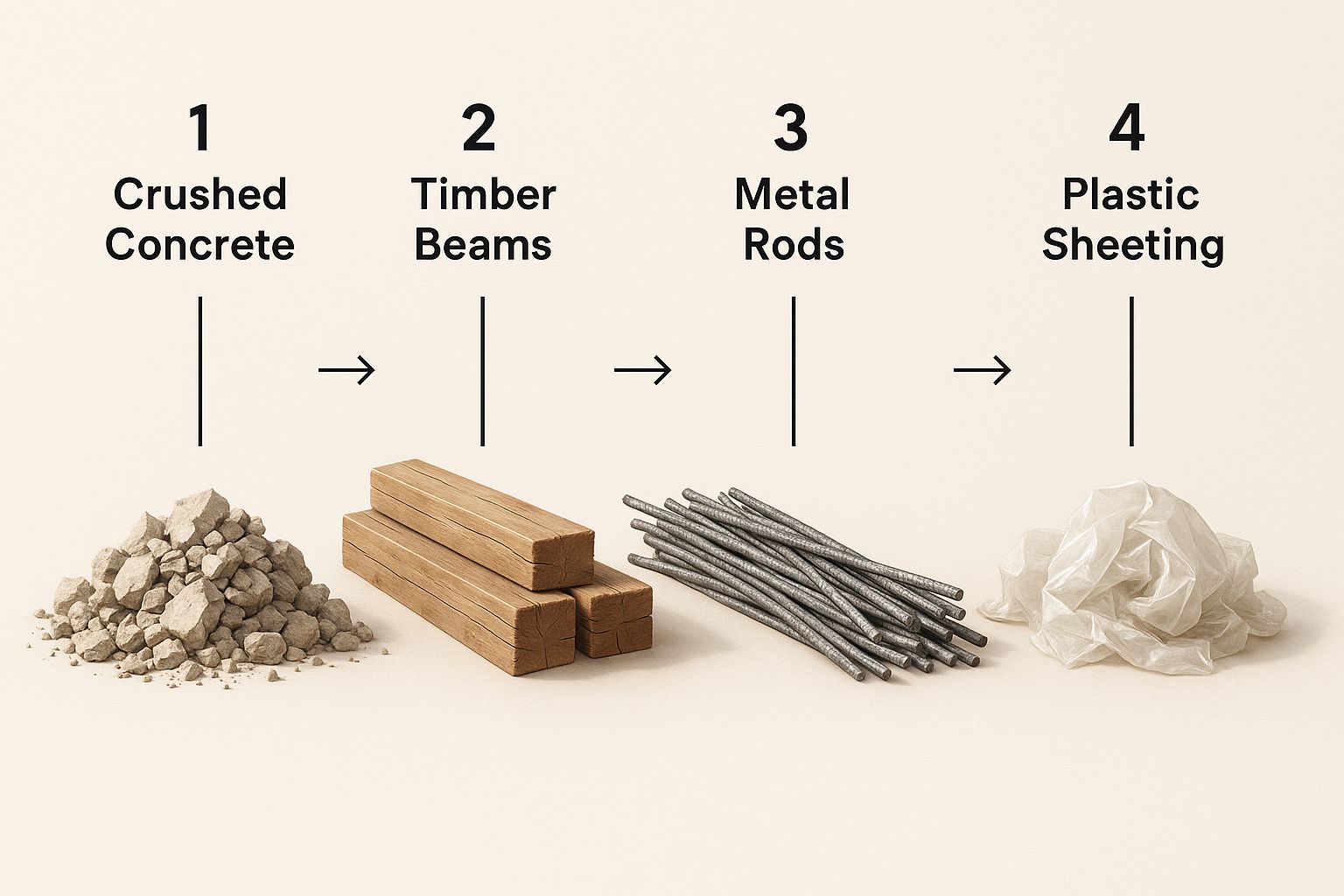
This image shows just how simple it can be to visualise the different waste streams on-site, a key first step in any effective management plan.
When you see it laid out like this, it underscores the importance of on-site segregation. Each of those piles represents a different recycling or disposal route, and each has its own unique cost.
Setting Actionable Goals
Your SWMP needs clear, measurable goals. Vague ambitions like "reduce waste" are useless. You need to set specific targets that give your team something concrete to aim for.
Here are a few examples of what real, actionable goals look like:
- Reduction Target: Aim to cut overall waste generation by a specific figure, say 15%, compared to your last similar project. This forces smarter material ordering and use on site.
- Recycling Rate: Set a hard target to recycle at least 50% of all waste generated. This is only possible with excellent on-site segregation and a reliable recycling partner.
- Material-Specific Goals: Zero in on your high-volume materials. A great target is reusing 90% of excavated soil right there on-site for backfilling or landscaping.
- Packaging Waste: This is a big one. Mandate that suppliers use returnable packaging or that you buy in bulk to slash cardboard and plastic waste, which can easily account for over 10% of a project's entire waste footprint.
By setting these clear benchmarks, you create accountability. You give your team tangible objectives, and at the end of the project, you have clear metrics to measure how successful your construction waste disposal efforts really were. This data is gold—it becomes invaluable for refining your approach on the next build, creating a powerful cycle of continuous improvement.
Mastering Waste Segregation on Your Construction Site
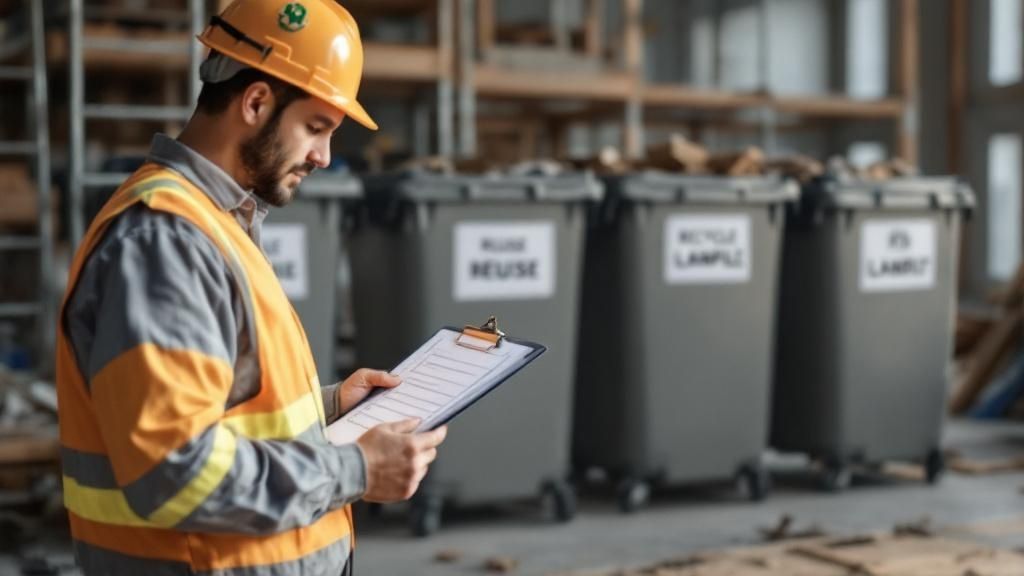
Effective construction waste disposal isn't something you think about at the end of a project. It starts the very second a piece of debris hits the ground. That image above? It’s the waste hierarchy, and it’s the golden rule for smart construction. Prevention is always better than cure, and proper on-site segregation is how you put that rule into action.
This isn’t just about ticking an environmental box; it's a critical part of running a tight ship. Without a clear system for sorting materials as they’re created, you're looking at a chaotic, expensive mess. Once you cross-contaminate materials, you’ve just turned a pile of valuable recyclables into a costly trip to the landfill.
A smart segregation strategy is what powers an efficient and compliant waste plan. It directly impacts your bottom line and your project's reputation.
Set Up a Multi-Bin System
The foundation of good on-site sorting is a simple, easy-to-use multi-bin system. Forget the old "one big skip for everything" approach. It's time to create organised streams right at the source.
The best systems are the most straightforward. I’ve found that starting with three main categories covers most of what you'll generate on a typical site:
- Inert Materials: This is your heavy stuff—concrete, bricks, soil, and rock. These can often be crushed and reused as aggregate, sometimes right on the same site.
- Non-Hazardous Materials: Think of this as your general recyclables bin. It's for untreated timber, scrap metals like steel and aluminium, cardboard, and certain plastics.
- Hazardous Waste: This needs special attention and handling. It includes things like paint tins, solvents, asbestos, and some treated woods. You must keep these separate to prevent contamination and stay on the right side of the law.
When you set up clearly marked zones for each, you make it easy for your crew to do the right thing. The goal is to make correct sorting the path of least resistance.
Train Your Crew and Use Clear Signs
Having the bins is one thing, but your team on the ground needs to know what goes where—and more importantly, why. One misplaced item from an untrained worker can sabotage your entire waste strategy.
Training can't be a one-and-done deal at induction. It needs to be a constant conversation. Bring it up in regular toolbox talks. Visuals are your best friend here. I always recommend using large, durable, colour-coded signs with simple graphics. If your workforce is diverse, use multiple languages. Place these signs right on or above the bins so there's zero guesswork.
Let's be honest, the MENA region has a long way to go. Studies have shown that roughly 74% of construction stakeholders send their waste straight to landfill, with a mere 7% actively recycling. The main "sorting" methods are just basic containers (35%) or relying on the contractor (24%), which shows a massive gap in how we handle this on-site.
A well-trained crew, guided by clear visual cues, transforms waste segregation from a chore into a seamless part of the daily workflow. It builds a culture of responsibility where everyone knows their role.
Place Your Bins for Maximum Impact
Where you put your containers can make or break your whole system. It's all about thinking through the site's workflow. Place bins as close as possible to where the waste is actually being generated.
For instance, put a dedicated bin for timber offcuts right beside the cutting station. Position a skip for concrete and brick rubble near demolition zones. It’s simple logic, but it dramatically cuts down on the effort required from your crew and reduces the temptation to just toss everything in the nearest bin.
I know this gets tricky on tight urban sites. You might need to use smaller, more specialised containers that get emptied more often. The trick is to adapt the system to your site's unique challenges, not the other way around.
When your system is intuitive and convenient, proper segregation becomes second nature. And remember, this is just one piece of the puzzle. Focusing on reusing materials is just as vital. You can learn more about the best options in our guide to sustainable construction materials.
How to Select the Right Waste Management Partner
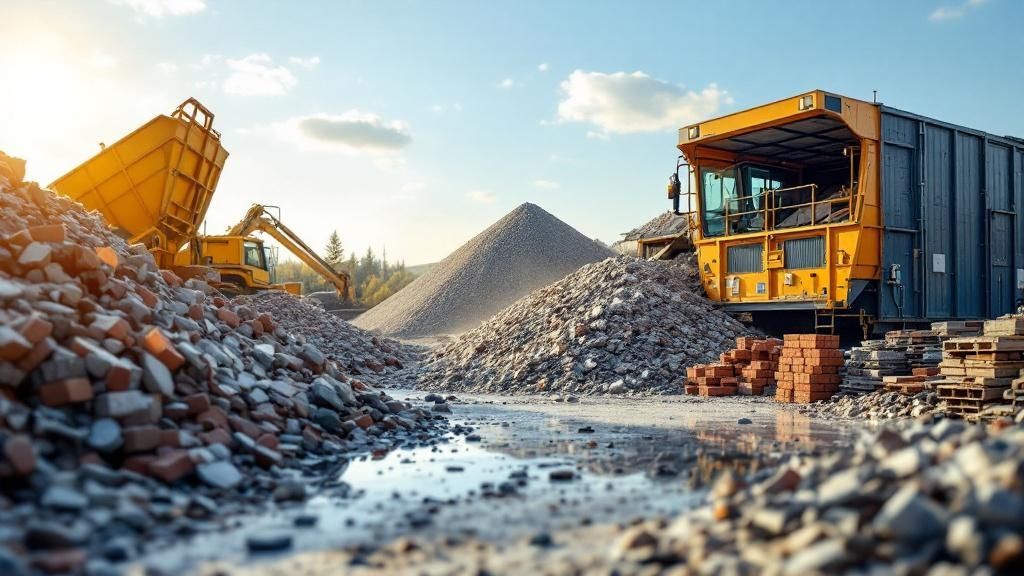
Choosing a partner for your construction waste disposal is a make-or-break decision for your project. This isn’t just about finding the cheapest guys to haul away your debris. It's about finding a reliable, compliant, and efficient team that understands the specific pressures of your site and can help you hit your sustainability goals.
Get this choice wrong, and you're looking at potential budget blowouts, frustrating delays, and even serious legal trouble. The right partner, on the other hand, acts like an extension of your own team, ensuring every piece of waste is handled correctly from the moment it's created to its final, responsible destination. Let's break down how you can properly vet potential companies to find one that's a genuine fit for your UAE project.
Start With the Essential Paperwork
Before you even think about pricing or skip sizes, you need to see their credentials. This is your first line of defence, a non-negotiable step that protects you from major liability down the road. Any legitimate waste management company in the UAE will have this paperwork ready to go.
Here's what you need to ask for:
- A Valid Trade Licence: This is basic, but crucial. It confirms they are a legally registered business in the UAE. Check that it's current and that their listed activities specifically include waste collection and transport.
- Municipality Permits: Every emirate has its own rules. Your partner needs the right permits from the local authority, whether it's Dubai Municipality, Tadweer in Abu Dhabi, or another body.
- Hazardous Waste Handling Certificate: This is a big one. If your site might produce anything hazardous – think paints, solvents, certain treated timbers – your partner must have a special permit to handle and transport it. Ask for this certificate by name.
Don't just take their word for it. Insist on seeing the actual documents, whether digital or physical copies. This simple bit of due diligence can save you from partnering with an unqualified, and potentially illegal, operator.
A company's speed and willingness to provide their licences and permits is a huge tell. If they give you the runaround or make excuses, consider it a major red flag and walk away.
Assess Their Experience and Capability
Let's be clear: not all waste management companies are the same. A provider that's great at collecting residential rubbish might be completely out of its depth on a major construction site. You need to dig into their actual track record.
Ask them direct questions about their experience with projects similar to yours in both scale and type. The logistics for a high-rise tower in Business Bay are worlds away from a sprawling villa development in a newer community.
Here’s what to look for when sizing up their capabilities:
- Fleet and Equipment: Do they have a good range of container sizes? A solid partner should offer everything from smaller skips for tight access sites to massive roll-on/roll-off (RoRo) containers needed for high-volume demolition waste.
- Project Portfolio: Ask them for case studies or references from projects like yours. A company with a history of success on complex construction sites will already understand the challenges you're about to face.
- Disposal and Recycling Network: Find out where your waste actually goes. A top-tier partner will have strong relationships with certified recycling centres and approved landfills. They should be able to give you documentation—like waste transfer notes and recycling certificates—to prove your waste is being handled responsibly.
Deciphering the Contract and Pricing
Once you've shortlisted a few partners based on their credentials and experience, it's time to get into the fine print of the contract and pricing. The last thing you want is to be locked into an agreement you don't fully understand.
You'll likely see two main pricing models: per-haul or per-tonne. A per-haul model is a flat rate you pay every time they empty a container, no matter how heavy it is. A per-tonne model bills you based on the actual weight of the materials. For projects with heavy debris like concrete and blockwork, a predictable per-haul fee can often be the smarter financial choice.
When you're negotiating, get specific. Are there hidden charges for sorting mixed waste? What are the penalties for going over a weight limit? A transparent partner will lay out all their pricing clearly. Make sure the contract spells out collection frequency, what materials are accepted, and the responsibilities of both parties. It will save you a lot of headaches later.
Getting to Grips with UAE Environmental Rules and Permits
Let's be blunt: when it comes to construction in the UAE, you don’t just try to follow the rules. You live by them. Getting waste disposal wrong isn't a minor hiccup; it can trigger massive fines, shut down your project, and do serious harm to your company's name. The entire process of construction waste disposal hinges on a deep understanding of the regulations set by both national and local authorities.
You’ll be dealing primarily with the local Municipality for your emirate—like Dubai Municipality or Abu Dhabi's Tadweer—and the federal Ministry of Climate Change and Environment. They’re the ones who define exactly how waste needs to be segregated, transported, and disposed of. Don't see them as roadblocks. Think of their guidelines as the essential blueprint for building sustainably in a region that’s developing at a breakneck pace.
This isn't just talk, either. The money is flowing in the right direction. The Middle East's waste management market was valued at USD 6.86 billion in 2023 and is on track to nearly double to USD 12.67 billion by 2030. You can see this commitment in massive projects like Dubai's USD 1.9 billion waste-to-energy plant that opened in 2023. While collection and transport costs are still a real challenge, the trend is crystal clear: the UAE is serious about getting this right. You can dig deeper into these numbers in this detailed report on the Middle East waste management market.
Securing Your Permits and NOCs
Before a single skip leaves your site, you absolutely must have your paperwork in order. The most critical piece of this puzzle is the No Objection Certificate (NOC) for waste disposal. This is your official green light from the local municipality, authorising you to move and dispose of waste from a specific project.
To get an NOC, you'll need to submit a detailed plan. This includes what kind of waste you expect, how much of it there will be, and who your licensed waste management partner is. This isn't just bureaucracy; it's about creating a transparent and accountable system from day one, ensuring your disposal methods meet all the required standards.
Key Takeaway: Treat the NOC as your project's official licence to manage waste. Working without one is a fast track to a work stoppage order, throwing your timeline and budget into chaos.
To give you a clearer picture, here’s a quick checklist of the typical permits and documents you'll need to have sorted.
UAE Waste Disposal Permit Checklist
| Document or Permit | Issuing Authority | Core Purpose |
|---|---|---|
| Waste Disposal NOC | Local Municipality (e.g., Dubai Municipality) | Project-specific approval to transport and dispose of waste. |
| Waste Transport Permit | Local Municipality | Licence for the transport company to legally move waste. |
| Environmental Permit for Facility | Ministry of Climate Change and Environment / Tadweer | Certifies that the final disposal/recycling site is approved. |
| Hazardous Waste Permit | Relevant Environmental Authority | Specialised permit for handling and transporting hazardous materials. |
| Waste Manifest Documents | Required by All Authorities | A tracking document providing a "cradle-to-grave" record for each waste load. |
Having these documents organised and readily available isn't just for compliance; it's about running a smooth, professional operation without unnecessary delays.
The Power of the Waste Manifest
Your job isn't done once the truck drives away. The UAE mandates a strict waste manifest tracking system for a reason. It's a "cradle-to-grave" chain of custody that follows every single load from your site (the cradle) to the approved disposal facility (the grave).
This multi-part document needs signatures from you (the generator), your driver, and the receiving facility. It's a legally binding record that proves you disposed of your waste responsibly. Authorities can and do audit these manifests, and any gaps or mistakes can result in serious penalties. This system is the backbone of preventing illegal dumping and ensuring every material ends up where it belongs. This level of diligence mirrors the importance of following all local construction standards, which we cover in our guide to the Dubai building codes.
Handling Hazardous Materials with Extreme Care
When you’re dealing with hazardous materials, the rules get even tighter. Things like asbestos, chemical solvents, lead-based paint, and certain treated woods can't just be tossed in with general rubble. They demand special handling, their own dedicated containers, and disposal at a facility that is specifically licensed to process them.
It's your responsibility to identify these materials, segregate them immediately, and bring in a waste management partner who holds the specific permits for hazardous waste. Failing to do so carries the harshest penalties, and for good reason—the risk to public health and the environment is just too high. A clear, compliant plan is your best insurance against these dangers.
Common Questions on Construction Waste Disposal
No matter how meticulous your Site Waste Management Plan is, a busy construction site always throws a few curveballs. The world of construction waste disposal has its own set of rules and quirks, and getting quick, straight answers to common problems can save you a world of hassle, time, and money.
I've seen project managers and contractors across the UAE bump up against the same issues time and again. Whether it's dealing with a surprise find during demolition or trying to get a handle on costs, it’s all part of the job. Here are some of the most frequent questions we get, with practical advice you can use on the ground.
How Do We Handle Unexpected Waste Types?
It’s a story as old as construction itself. You're in the middle of a demolition or excavation, and you uncover something that wasn't on the plans. Maybe it’s old asbestos sheeting in a villa reno or a patch of oily, contaminated soil. Whatever it is, the rule is simple: stop and assess, don't just dispose.
Your first move is to make sure your crew knows to halt work in that area immediately and flag it to their supervisor. The material has to be isolated to stop it from contaminating your other, standard waste streams. Your very next call should be to your waste management partner. A good one has the know-how to help identify the material on the spot and walk you through the proper protocol for handling and disposal.
This is non-negotiable for anything potentially hazardous. You’ll almost certainly need a specialist team to come in for testing and removal, which will need its own separate waste manifest for tracking. Trust me, trying to hide it or mix it in with general waste is a surefire way to face serious legal and financial heat.
Think of unexpected waste not as a setback, but as a real-world test of your site's safety and compliance systems. A calm, by-the-book response shows professionalism and shields your project from much bigger headaches down the line.
The cost will fall outside your initial agreement, so you'll need to be ready to approve a variation order. It’s an unplanned expense, for sure, but a critical one for keeping your site safe and on the right side of the law.
What Is the Most Cost-Effective Way to Calculate Disposal Fees?
This is the question that hits the project's bottom line directly. You'll typically run into two pricing models: per-haul (a flat rate every time they collect a container) or per-tonne (a fee based on the weight of the waste). There’s no single "best" option—the right choice really comes down to what you’re throwing away.
Here’s a practical way to think about it:
- Choose Per-Haul For Heavy Materials: If your project involves a lot of demolition, you’re creating tons of dense, heavy waste like concrete, brick, and soil. In this scenario, a predictable flat fee per haul is almost always the smarter financial move. You pay a set price for each full container they take away, whether it’s holding five tonnes or ten. No surprises.
- Consider Per-Tonne For Light, Bulky Materials: If you're generating more lightweight but high-volume waste—think timber, packaging, plastics, and metal studs—then paying by weight can save you money. A big container might look jam-packed, but its actual tonnage could be quite low, leading to a smaller bill than a fixed per-haul rate.
To really nail this down, have an open conversation with your potential waste partners. Walk them through your SWMP and your expected waste streams. An experienced provider can help you crunch the numbers and pick the most economical model for your specific job.
Can We Really Recycle Concrete and Drywall?
Yes, absolutely—and it’s a game-changer. Many contractors are still surprised by how recyclable some of their most common waste materials actually are. This is a massive opportunity to divert huge volumes from the landfill, which is not only a big win for the environment but can also trim your disposal costs.
Concrete is one of the most valuable recyclables you'll produce. Once it's crushed, it can be repurposed into recycled aggregate (RCA). This stuff is perfect as a base layer for new roads, for backfill, or even as an ingredient in new concrete mixes. You’re effectively turning a waste product back into a useful building material.
Drywall (gypsum board) is also recyclable, though the process is a bit more specialised. The gypsum core is separated from its paper backing, and the reclaimed gypsum can be used to improve agricultural soil or to manufacture new drywall. The trick is to keep it clean and dry. Wet or contaminated drywall is much tougher to process.
For both materials, successful recycling comes down to one critical thing: strict on-site segregation. You need dedicated, clearly marked bins for clean concrete rubble and separate ones for drywall offcuts. If they get mixed in with general waste, their recycling value is completely lost.
What Should We Do with Leftover Paint and Solvents?
Any leftover paint, solvents, sealants, or other chemicals are classified as hazardous waste and need to be treated with care. Never, under any circumstances, should this stuff be poured down a drain or chucked into a general waste skip. The environmental damage is immense, and the fines are just as big.
Here’s how to handle it properly:
- Consolidate and Seal: Pour leftover paints of the same type together to reduce the number of containers. Make sure every container is sealed up tight to stop any spills or fumes.
- Designate a Secure Area: Store all your liquid hazardous waste in one designated spot. It should be secure, well-ventilated, and far away from your main work zones and any water sources.
- Use a Specialised Service: Your waste management partner must be licensed to handle hazardous materials. They’ll give you special leak-proof drums or containers and will take care of the compliant transport and disposal at an approved facility.
Following this process ensures you're ticking all the regulatory boxes and protecting your team and the environment from nasty chemicals. It’s a non-negotiable part of any responsible construction waste disposal plan.
For all your project needs, from high-quality building materials and safety equipment to the tools that get the job done, trust Yasu Trading Co. LLC. We provide the reliable essentials that keep your site running efficiently and safely. Request your quote today and build with confidence.