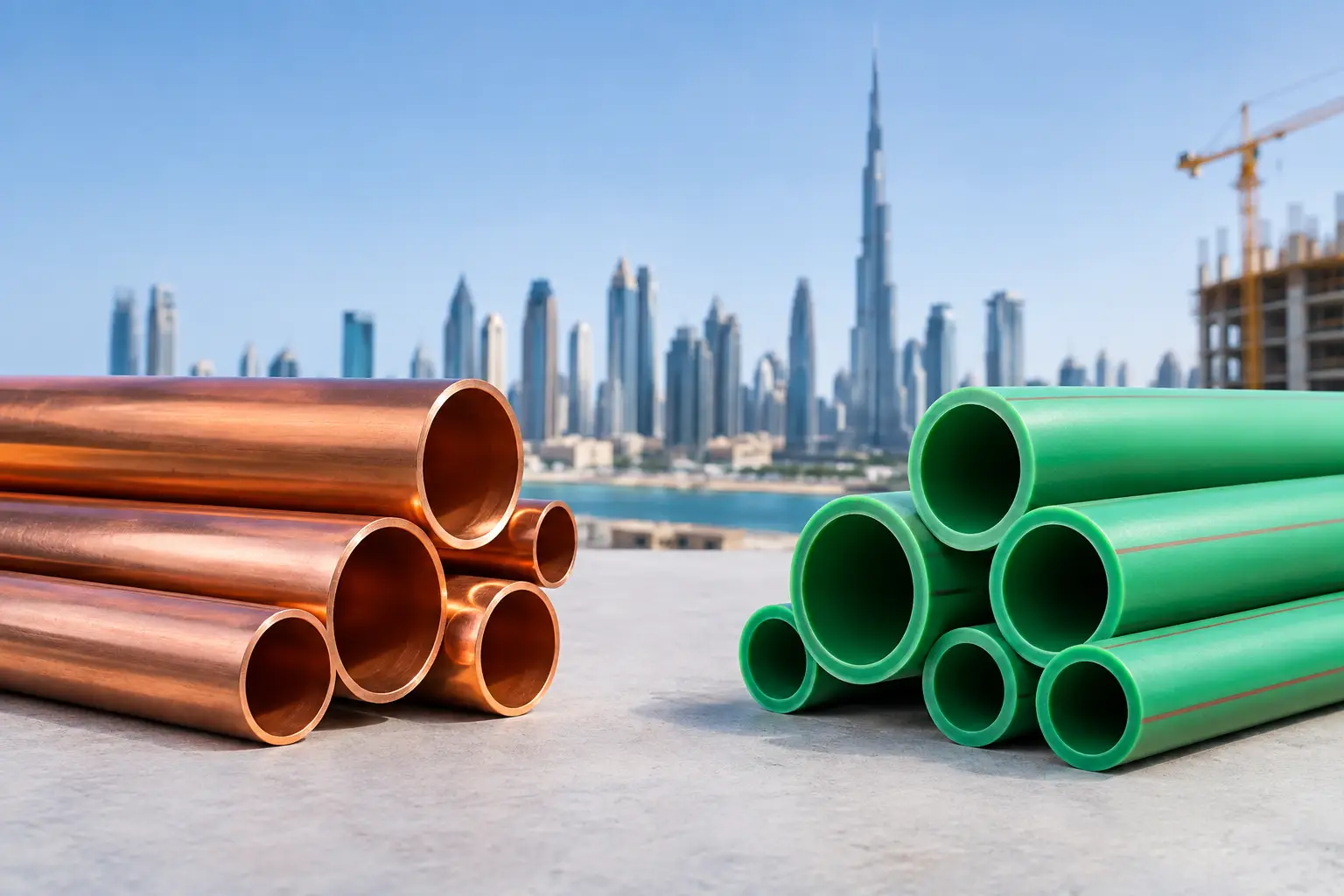
Copper Versus PPR: Which Pipe Fits UAE Projects?
A pipe specification can look settled at tender stage and still create pressure on the jobsite. A late change in water temperature requirements, a concealed-installation detail, or a shortage of approved fittings can affect testing, handover, and the project schedule. The copper versus PPR decision should therefore be made as a system decision, not simply as a price comparison between pipe lengths.
For contractors and MEP buyers, both materials have a valid place in UAE projects. Copper is proven, heat-tolerant, and well suited to demanding services. PPR is lightweight, corrosion-resistant, and efficient to install when the correct pipe class, fusion process, and fittings are used. The right choice depends on the service, operating conditions, specification, installation environment, and the level of quality control available on site.
Copper Versus PPR: Start With the Service Requirement
The first question is not which material costs less. It is what the piping system must carry, at what temperature and pressure, for how long. Domestic cold water, hot water return lines, chilled-water branches, compressed air, and specialized building services do not place the same demands on a pipe.
Copper has a long record in potable water and hot-water applications. It handles elevated temperatures well, has low thermal expansion compared with plastic piping, and provides a rigid installation that many consultants and facilities teams recognize immediately. It can be especially practical where exposed pipework requires a clean, durable finish or where tight service spaces benefit from a smaller outside diameter.
PPR, or polypropylene random copolymer, is commonly specified for hot and cold potable water distribution. Its fused joints form a continuous plastic connection, eliminating the threaded or soldered interface found in other systems. Properly selected PPR can perform well in hot-water systems, but the pipe series, pressure rating, working temperature, insulation design, and support spacing must match the engineer's requirements. A generic PPR selection without these checks is not a specification.
For a project with high-temperature duty, unusual pressure conditions, or strict consultant preference for metallic pipework, copper may be the clearer route. For standard domestic water distribution, particularly concealed runs in large residential or commercial developments, PPR often offers a strong balance of performance and installation speed.
Heat, Expansion, and UAE Jobsite Conditions
High ambient temperatures make storage and installation discipline relevant. PPR expands and contracts more than copper as water temperature changes. This does not make PPR unsuitable, but it requires correct pipe supports, expansion allowances, offsets, anchors, and insulation details. Long straight hot-water runs need particular attention.
Copper's lower expansion rate can simplify routing where movement must be tightly controlled. It also remains stable in exposed plant rooms and service corridors. However, copper pipework needs suitable protection where it may encounter aggressive materials, incompatible metals, or site damage. Insulation and separation details should be treated as part of the pipework package, not as an afterthought.
PPR should not be left exposed to direct sunlight for extended periods unless the product and protection method are approved for that condition. Site teams should keep pipes stored away from prolonged UV exposure, excessive heat, dirt, and physical impact. This is a basic handling requirement, but it is frequently overlooked when materials arrive early and the workfront is delayed.
Installation Speed Is Only an Advantage With Process Control
PPR is often selected because it is fast to handle. The pipe is light, no flame is required, and socket fusion can be efficient for repetitive floor-by-floor distribution. On projects with many apartments, hotel rooms, or washroom groups, those labor advantages can be meaningful.
The condition is straightforward: fusion quality must be controlled. Incorrect heating time, poor alignment, contaminated tools, over-insertion, or moving a joint before it cools can reduce performance. Crews need trained operators, calibrated fusion equipment, correct dies, and a documented procedure for the pipe size and product system being installed. Mixing fittings from different systems simply because they appear compatible is an avoidable risk.
Copper installation demands a different skill set. Soldered, brazed, press-fit, or mechanical joints must be selected in line with the approved method and service requirement. Copper's rigidity may require more careful measuring and forming, while joints demand competent workmanship and inspection. Press systems can improve installation speed, but only when the specified pipe, fitting, tool, and jaw profile are used as one approved system.
Neither material is automatically faster in every building. PPR can reduce handling time on repetitive concealed distribution. Copper may reduce complexity in exposed, high-temperature, or space-constrained services. The productive choice is the one the installation team can execute consistently, test successfully, and hand over without rework.
Cost: Measure the Installed System, Not the Pipe Price
PPR usually has a lower material cost than copper, and its low weight can reduce handling effort. This can make a significant difference on large-volume domestic water packages. Yet a procurement decision based only on pipe price can miss the cost of tools, fittings, supports, insulation, labor productivity, testing, access, and potential repairs.
Copper commonly carries a higher upfront material cost and is subject to commodity-price movement. It may, however, offer value where its durability, compact routing, temperature capability, and facility-management acceptance reduce lifecycle uncertainty. The financial case changes depending on the project type. A residential tower, villa development, hospital, restaurant kitchen, and industrial facility should not be evaluated by the same cost model.
Procurement teams should request a complete takeoff by diameter, pipe class, fitting type, valve connection, support requirement, and insulation interface. Confirm lead times for the full system, not only the main pipe. A site can lose days waiting for a reducer, transition fitting, union, or approved valve adaptor that was not included in the original order.
Water Quality and Corrosion Considerations
PPR does not corrode in the way metal piping can, which is a major benefit for water distribution. Its smooth internal surface can also help limit scale buildup under normal service conditions. It remains essential, however, to manage water quality, disinfection procedures, and operating temperatures according to the approved system guidance.
Copper is naturally durable, but corrosion performance depends on the water chemistry and installation environment. Aggressive water, unsuitable flux residues, stagnant conditions, poor bonding practices, or contact with dissimilar metals can create problems. Where copper is specified, the design team should confirm water analysis requirements and use compatible fittings, valves, and transition materials.
For either material, pipework should be flushed, pressure-tested, disinfected where required, and protected until final connection. The best product cannot compensate for contaminated lines, poor testing records, or damage caused by other trades after installation.
Compliance, Submittals, and Warranty Protection
Municipality-compliant materials and approved submittals matter more than a familiar product name. Before purchase, verify the consultant's specification, applicable local authority requirements, pipe standard, pressure-temperature rating, potable-water suitability, fitting compatibility, and test requirements. If the project calls for a particular brand or approved equivalent, obtain formal confirmation before substituting.
For PPR, confirm that pipes and fittings are from the same approved system and that fusion tools are suitable for the sizes being installed. For copper, confirm wall thickness, temper, joining method, fittings, insulation compatibility, and any fire-stopping requirements at penetrations. Keep batch information, certificates, and delivery records available for inspection and warranty support.
This documentation protects more than compliance. It gives the contractor a clear record when commissioning teams, consultants, or facilities managers ask how the system was selected and installed.
A Practical Selection Route for Contractors
Specify copper when the design requires strong high-temperature performance, low movement, exposed durability, compact routing, or a metallic system preferred by the consultant and end user. Specify PPR when the approved design supports it, the work involves extensive domestic hot and cold water distribution, and the project can maintain disciplined fusion installation and support details.
In many developments, the best answer is not one material everywhere. Copper may suit plant-room connections, visible risers, or specialist zones, while PPR serves apartment or office distribution. Any mixed-material approach needs properly engineered transition connections and a clear responsibility for coordination.
Before releasing a purchase order, align the approved material schedule with the actual work sequence. Confirm stock of pipe, fittings, valves, tools, insulation accessories, and testing items together. A dependable B2B supplier can help verify system completeness, provide technical documentation, and dispatch jobsite-ready materials so the plumbing crew is not stopped by a missing component.
The better choice between copper and PPR is the one that matches the approved design and can be installed, tested, documented, and maintained with confidence. When the pipe package is planned as part of project execution rather than bought as a commodity, it is far less likely to become the reason a handover date moves.