Door Hardware Dubai: Your Ultimate Guide to Quality & Style
Picking the right door hardware in Dubai is about so much more than just finding a good-looking handle. It's a decision that underpins the security, longevity, and even the legal compliance of a project. This choice has a ripple effect, touching everything from a building's first impression to its resilience against the local climate and its adherence to strict safety laws.
Why Your Door Hardware Choice Matters in Dubai
Think of your door hardware as the handshake of a building. It's the first physical point of contact anyone has with your space, and it instantly sends a message about quality, safety, and a commitment to detail. In a city defined by architectural marvels, from Downtown's soaring towers to the lavish villas of Palm Jumeirah, these details aren't minor at all. They're the critical touchpoints that pull a whole design together.
But in Dubai, the stakes are considerably higher. The environment and the regulations here create a unique set of challenges that make hardware selection a task for experts. Get it wrong, and you're looking at rapid wear and tear, potential security gaps, and expensive headaches with compliance.
The Unique Challenges of the Dubai Market
Sourcing door hardware in Dubai means navigating a few local hurdles. Getting a handle on these challenges is the first step to making a smart choice that doesn't compromise on style or substance.
Here's what you're up against:
- Extreme Climate Conditions: The combination of blistering heat, high humidity, and airborne sand and salt is incredibly corrosive. It will eat away at substandard materials in no time. Your hardware needs to be built to resist rust, tarnishing, and mechanical breakdown.
- Strict Building and Fire Safety Codes: Dubai Civil Defence doesn't mess around when it comes to fire-rated doors and emergency exits. Every single component—from the hinges and locks to the door closers—must have the right certifications (like EN or ANSI/BHMA) to keep people safe and get that all-important inspection approval.
- Aesthetic and Luxury Demands: Let's face it, the Dubai property market is all about premium quality and stunning design. Hardware can't just work well; it has to look the part and complement the high-end finishes that are standard here.
- Rapid Urban Development: Construction never stops. The market for door hardware across the Middle East, including Dubai, is on track to hit around $3.609 billion by 2025, fuelled by one massive project after another.
Choosing hardware isn't just a finishing touch; it's a foundational element of a building's integrity. It ensures that the structure is secure, accessible, and resilient against the demanding local environment for years to come. For a deeper dive, check out our guide on choosing the perfect hardware for your building projects. This guide will serve as your roadmap.
Understanding Your Door Hardware Essentials
Think of a complete door system as an orchestra. Every single piece of hardware is an instrument, and for the final performance to be a success, each one has to play its part perfectly. Choosing the right door hardware in Dubai isn't just about picking something that looks good; it's about understanding how all these individual components work in concert to deliver security, smooth function, and a seamless design.
This isn't about getting bogged down in technical jargon. It's about developing a real, practical feel for what makes a door work day in and day out—from the handle you grab every morning to the hidden mechanisms that keep your home or office secure. Let's break down the core components you'll be working with.
The Main Players: Handles and Locks
The most obvious and interactive parts of any door are its handle and lock. These are the primary points of contact that shape how you experience the door, but they play very different, though connected, roles.
Handles are all about operation and style. They give you the leverage you need to pull back the latch and open the door. The main types you’ll come across are:
- Lever Handles: These are the horizontal handles you simply push down. They're incredibly easy to use, which makes them perfect for busy areas and for buildings that need to be accessible for everyone, including children and the elderly.
- Knob Handles: The classic, rounded handle that you twist to open. Knobs are compact and often look great in traditional or vintage-style properties, but they can be a bit tricky for anyone with limited grip strength.
- Pull Handles: These are straightforward bars or recessed grips you’ll find on doors that don't need a latching mechanism, like a sliding pantry door or the fixed panel of a double doorway.
Locks, on the other hand, are the absolute core of your security. Their complexity can range from simple privacy buttons for a bathroom to sophisticated, high-security systems for a main entrance. When you're looking at door hardware in Dubai, you'll often encounter mortice locks. These are fitted into a pocket carved into the door itself, giving them superior strength. We're also seeing a huge rise in smart locks offering keyless or biometric entry, which are quickly becoming standard in new developments.
A great handle and lockset should feel like a single, seamless unit. The handle should operate the latch smoothly, while the lock provides the right level of security for that specific door—whether it's for a bedroom, an office, or your front entrance.
The Unsung Heroes: Hinges and Accessories
While handles and locks get all the glory, the supporting cast of hardware is just as vital for the door's long-term performance. These are the components working tirelessly behind the scenes.
First up are the hinges, the simple pivots that allow the door to swing open and closed. The type of hinge you need—from a standard butt hinge to a concealed or heavy-duty pivot hinge—is dictated entirely by the door's weight, size, and how it’s used. Skimping on hinges is a recipe for sagging doors and alignment headaches later on.
Then you have the accessories that control the door’s behaviour:
- Door Closers: These hydraulic arms automatically and gently pull a door shut after it's been opened. In Dubai, they are a legal requirement for fire-rated doors to maintain fire safety zones, but they're also incredibly handy in commercial spaces for controlling access and maintaining air conditioning.
- Panic Exit Devices: You've seen these as a horizontal bar across emergency exit doors. They're designed to allow a crowd to exit quickly and easily during an emergency with a single push. They are a non-negotiable safety feature in any public building.
When getting to grips with your door hardware essentials, it's also smart to think about the exterior doors themselves. A door's material, thickness, and how exposed it is to the elements will all have a major impact on which hardware components are best suited to guarantee security and a long service life. Every piece has to be the right fit for the door it's on.
Choosing Materials That Beat the Dubai Climate
Picking out door hardware in Dubai isn't just about what looks good; it's a constant fight against the elements. The city's climate is a unique cocktail of intense heat, suffocating humidity, and salty, corrosive air blowing in from the Arabian Gulf. It's one of the toughest environments you can imagine for building materials.
Hardware that can't handle this relentless attack will start to pit, tarnish, and fail much faster than you’d expect. This means you're not just dealing with a door that looks shabby, but you're also facing costly replacements and potential security issues.
Think of your door hardware as armour for your home. It needs to be tough enough to fend off the non-stop assault from Dubai's climate. The material you choose is your first and most important line of defence.
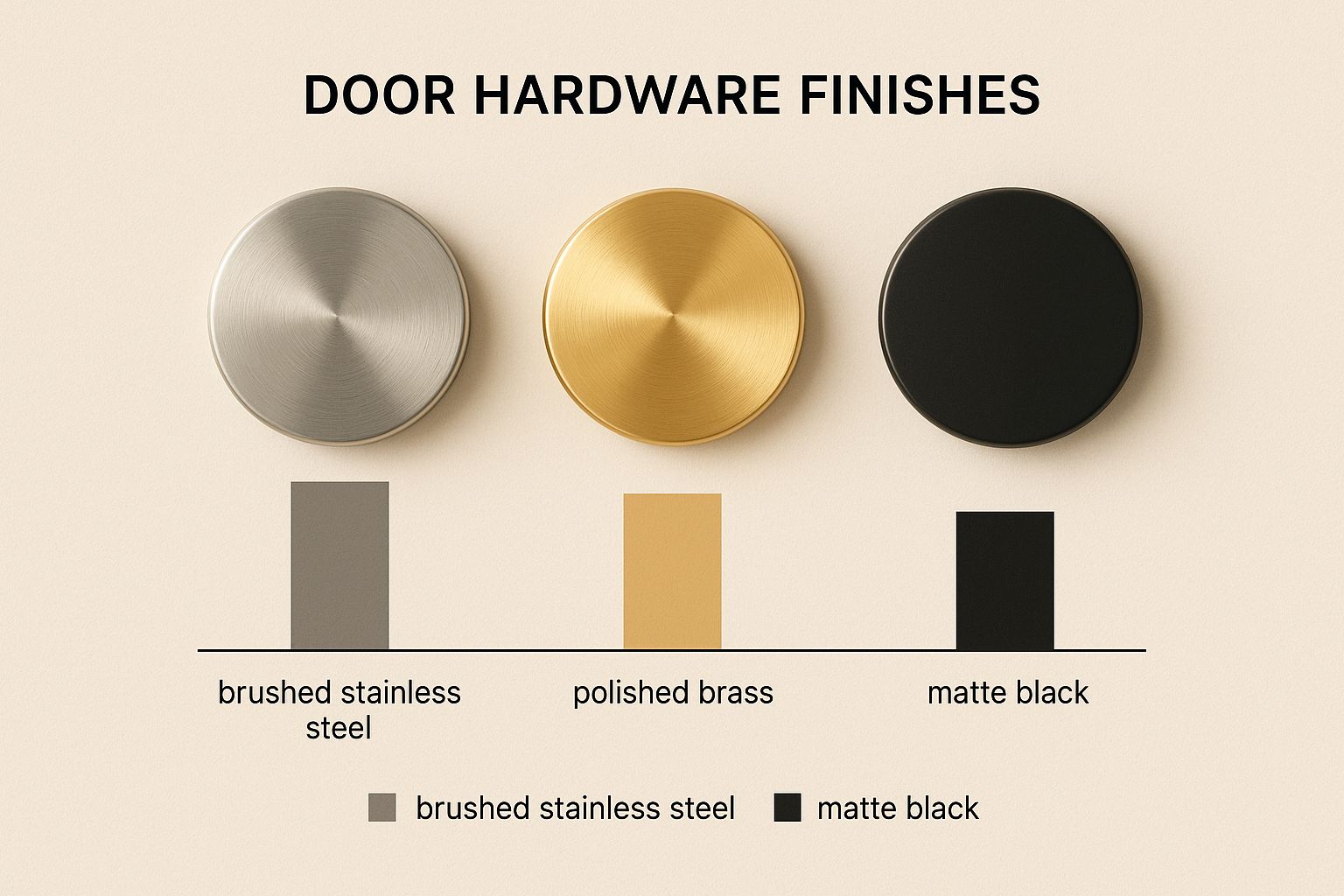
This image gives you a close-up look at three popular finishes—brushed stainless steel, polished brass, and matte black. You can see how the finish alone can completely change the vibe, from the cool, industrial feel of stainless steel to the classic warmth of brass or the modern punch of matte black.
To help you navigate these choices, let's break down the best materials for our unique environment.
Comparing Door Hardware Materials for Dubai's Climate
The table below offers a straightforward comparison of the most common materials, looking at how they stand up to corrosion, their overall durability, and where they work best in a Dubai project.
| Material | Corrosion Resistance | Durability | Best For | Typical Finishes |
|---|---|---|---|---|
| Stainless Steel (316) | Excellent. The molybdenum content makes it ideal for coastal areas. | Very High. Resists scratches, dents, and wear. A true workhorse. | Exterior doors, especially in coastal areas like Dubai Marina and Palm Jumeirah. | Brushed, Polished, Satin, PVD coated (e.g., black, gold) |
| Stainless Steel (304) | Good. Suitable for inland properties but can pit near the coast. | High. Strong and reliable for most applications. | Interior doors or exterior doors away from direct sea spray. | Brushed, Polished, Satin |
| Brass | Good to Excellent. Naturally resistant to rust; can patina over time. | High. A solid, heavy material that feels substantial and lasts for decades. | Both high-end interior and exterior doors for a classic, elegant look. | Polished, Satin, Antique, Lacquered, PVD coated |
| Bronze | Excellent. Forms a protective patina instead of destructive rust. | Very High. Extremely durable and ages gracefully. | Luxury properties, main entrances, and heritage-style projects. | Oil-Rubbed Bronze, Satin Bronze, Polished Bronze |
| Zinc Alloy / Zamak | Moderate to Good. Relies heavily on the quality of its finish. | Moderate. Less robust than steel or brass; better for low-traffic areas. | Budget-conscious interior projects where moisture is not a concern. | Chrome Plated, Satin Nickel, Painted (e.g., matte black) |
| Aluminium | Very Good. Naturally forms a protective oxide layer. | Moderate to High. Lightweight but can be prone to scratching and denting. | Modern and minimalist designs, particularly for internal sliding doors. | Anodised (Silver, Black, Bronze), Powder Coated |
Ultimately, the goal is to match the material's inherent properties with the specific demands of the location. For a beachfront villa, Grade 316 stainless steel is a no-brainer. For a penthouse apartment downtown, high-quality brass or even Grade 304 might be perfect.
The Champion for Coastal Properties: Stainless Steel
When you’re dealing with corrosive, salty air, not all stainless steel is created equal. For any project near the coast—think Dubai Marina, JBR, or Palm Jumeirah—Grade 316 stainless steel is the undisputed king.
What makes it so special? It contains an element called molybdenum, which dramatically boosts its resistance to chlorides (like the salt in sea spray). The more common Grade 304 stainless steel is fine for many places, but in a coastal setting, it will eventually start showing rust spots and pitting. Grade 316, on the other hand, was specifically engineered for these harsh conditions, making it the essential choice for exterior door hardware in Dubai.
For any coastal job, specifying Grade 316 stainless steel is non-negotiable. It’s an investment that ensures your handles, locks, and hinges don’t just look good on day one, but that they maintain their integrity for years to come without failing from corrosion.
The Timeless Elegance of Brass
There's a reason brass has been a top choice for door hardware for centuries—it's beautiful and tough. It brings a classic warmth that can elevate any style, whether it’s a traditional villa in Emirates Hills or a chic apartment in Downtown.
More importantly, high-quality brass is naturally resistant to corrosion. As an alloy of copper and zinc, it simply doesn't rust. Over many years, it might develop a gentle patina, a feature that many designers actually seek out for its authentic character. But if you prefer a look that stays pristine, modern brass hardware is often protected with a tough lacquer or an advanced coating to keep it shining.
Advanced Finishes: The Ultimate Shield
Beyond the metal itself, the finish acts as the final, crucial layer of protection. Today, one of the most impressive technologies is Physical Vapour Deposition (PVD).
Think of PVD as a microscopically thin but incredibly tough suit of armour that's bonded to the hardware at a molecular level. This process creates a surface that's exceptionally hard, making it highly resistant to scratches, fading from the sun's harsh UV rays, and most critically for us here, corrosion.
PVD finishes come in a huge range of colours—like brass, black, and bronze—giving you fantastic design flexibility without sacrificing protection. Pairing a PVD finish with a top-tier base material like Grade 316 stainless steel is the absolute best defence you can get against the Dubai climate.
Of course, choosing the right materials is a principle that applies to your entire project. To learn more, check out our guide on how to choose the reliable construction materials for the UAE climate. It’s all about making sure every single component is built to last.
How to Navigate Dubai Building Codes and Certifications
Choosing beautiful, durable hardware is only half the job when you're working on a project in this city. Here in Dubai, compliance isn’t just a friendly suggestion—it’s the critical gateway to getting your project approved and, more importantly, keeping people safe.
It can feel like you're untangling a web of local building codes and international certifications, but it's a step you simply can't skip.
Think of it this way: building codes are the official rulebook for construction. The certifications on your door hardware in Dubai are the proof that your components have been tested and shown to follow those rules. Without that proof, a project can hit major delays, fail inspections, or even face costly orders to rip out and replace everything. Getting this right from the start empowers you to choose hardware that’s not just stylish, but fundamentally safe and legal.
This intense focus on compliance is a huge factor in the local construction market. The UAE’s doors and windows market, which hardware is a part of, was valued at around USD 3.10 billion in 2023. It’s expected to grow to nearly USD 4.60 billion by 2029, spurred on by policies that demand certified, high-performance building materials. You can get more details on these market trends from industry analysts at TechSci Research.
Decoding Key Hardware Certifications
When you start digging into technical spec sheets, you'll be hit with a lot of acronyms. For door hardware, the two big players you need to know are European Norms (EN) and the American National Standards Institute/Builders Hardware Manufacturers Association (ANSI/BHMA).
- EN (European Norms): This is the standard widely adopted across Europe and fully recognised by Dubai authorities, especially for fire safety. An EN rating tells you the hardware has passed tough tests for performance, durability, and its ability to hold up in a fire for a specific amount of time.
- ANSI/BHMA (American Standards): These standards come from North America but are also highly respected in Dubai. They grade hardware based on use cycles, security, and material strength, giving you a clear picture of its quality and how long it's expected to last in different environments (like a quiet home versus a busy office).
Think of these certifications as a quality guarantee. An EN 1634-1 rating on a lockset, for instance, confirms it has been tested as part of a fire door assembly and will not fail when exposed to extreme heat, preventing the spread of fire and smoke.
Understanding these codes is a fundamental part of sourcing materials in the region. For a deeper look, check out our guide on navigating the regulations for building materials in the UAE, which gives a broader overview.
Dubai Civil Defence Requirements for Fire Safety
The Dubai Civil Defence (DCD) is the final word on fire safety in the emirate. Their regulations are strict, detailed, and enforced without exception—especially when it comes to doors on escape routes and fire separation walls. Getting this wrong is a serious safety violation.
Here are the critical points you need to remember for your hardware selection:
- The Complete Door Assembly: The DCD doesn't just see a door; it sees a complete, certified system. This means every single component—the door leaf, frame, hinges, lock, closer, and even the intumescent seals—must be individually fire-rated and proven to work together.
- Mandatory Door Closers: Every fire-rated door must have a certified door closer. The door has to be self-closing and self-latching to guarantee it stays shut during a fire, keeping the fire compartment intact.
- Panic Exit Devices: On any designated emergency escape route, especially in public buildings, panic bars (or push bars) are mandatory. These devices have to allow the door to be opened from the inside with a single, simple motion—no key, no special knowledge needed.
Specifying the correct, certified door hardware in Dubai isn't just about ticking a box. It’s a core responsibility that ensures escape routes work and fire compartments do their job during an emergency. It's about saving lives and protecting property. Always, always demand the official certification documents from your supplier for every single piece of fire-rated hardware.
Finding a Trusted Door Hardware Supplier in Dubai
Let's be clear: choosing your supplier for door hardware in Dubai is just as important as picking the hardware itself. The right supplier isn't just a box-shifter; they're a partner in your project. They bring expertise, make sure everything is compliant, and offer support long after the invoice is paid. A weak link in that chain can mean project delays, the wrong materials showing up on site, and a final result that just doesn't meet the mark.
In a market as fast-paced as Dubai's, you need more than someone who just takes your order. You need a consultant who can walk you through the maze of local regulations, point you toward materials that can handle the climate, and nail down the technical specs your project demands. This kind of partnership turns a simple purchase into a real asset for your business.
The stakes are high, especially when you look at the sheer scale of development here. The door market in the UAE and Saudi Arabia was valued at a staggering $2.35 billion in 2022 and is expected to climb to $3.29 billion by 2030. This boom, fuelled by mega-projects and ambitious government plans, puts a massive spotlight on quality and reliability. You can dig into the numbers and see the market growth projections and their drivers on Verified Market Research.
What to Look For in a Top-Tier Supplier
When you're vetting potential suppliers, you have to look beyond the catalogue. A truly great partner comes to the table with deep industry knowledge and an unwavering commitment to quality. That expertise alone can save you from expensive mistakes and keep your project moving smoothly from the initial spec right through to installation.
Here’s a practical checklist to help you sort the experts from the amateurs:
- Deep Local Knowledge: Do they really understand Dubai Civil Defence requirements? Can they confidently tell you which certifications (like EN or ANSI/BHMA) you absolutely need for your project?
- Reputable Brand Portfolio: A good supplier is selective. They've curated a collection of established international brands known for standing the test of time.
- Technical Specification Support: Ask them for technical data sheets. A serious supplier will have them for every single product, no questions asked. This is essential for architects and contractors who need to verify compliance and performance.
- Showroom and Product Samples: Nothing beats getting your hands on the actual hardware. A showroom lets you see, feel, and test the products. It’s where you can judge the weight, the finish, and the mechanical feel before you place a huge order.
A great supplier doesn’t just sell you a product; they provide a solution. Their team should be able to look at your architectural drawings and recommend hardware that meets every functional, aesthetic, and regulatory requirement.
Spotting Quality in the Showroom
When you do visit a supplier, pay attention. A clean, well-organised showroom with staff who know their stuff is a great first sign. But the real proof is in the hardware.
Pick up a lever handle. Does it feel solid, or is it light and flimsy? Work the mechanism. Is the movement smooth and confident, or does it feel gritty and loose? Get the finish under good light and look closely for any blemishes, inconsistencies, or signs of cheap plating. These little details tell you everything you need to know about the manufacturer's standards and the supplier's commitment to quality.
At the end of the day, finding the right door hardware Dubai supplier is about finding a partner who is invested in your success. They should be the resource you turn to for expert advice, ensuring every door on your project doesn't just look incredible, but performs perfectly and safely for years to come.
Installation and Maintenance Best Practices
Choosing premium **door hardware in Dubai** is only half the battle. To get the most out of your investment, it needs to be installed correctly and looked after. Think of it this way: you wouldn't buy a high-performance car and then have it serviced by an amateur. The same logic applies here. Even the most robust, high-end hardware will fail if it's fitted poorly or left to fend for itself.A surprising number of hardware issues stem from a shoddy installation job. Little mistakes during fitting can quickly turn into major annoyances—doors that jam, handles that wobble, and locks that just don't feel secure. Professional installation is non-negotiable; it guarantees every component works together seamlessly, just as the manufacturer intended. Following established safety protocols is just as important, and you can learn more about developing practical safe work procedures to make sure every job is done right.
Avoiding Common Installation Pitfalls
When it comes to fitting door hardware, precision is everything. A misalignment of just a few millimetres can put incredible, ongoing stress on locks, latches, and hinges, causing them to wear out years ahead of schedule.
Keep an eye out for these common slip-ups:
- Overtightening Screws: It’s a classic mistake. Cranking down on screws too hard can warp the hardware’s baseplate, cause the internal mechanism to bind up, and even crack the door itself. The result? A stiff, grinding action that feels terrible to use.
- Poor Latch and Strike Plate Alignment: If the latch bolt doesn't slot perfectly into the strike plate on the door frame, you'll never get that satisfying "click." More than just being annoying, this misalignment can seriously compromise the lock's ability to secure the door.
- Incorrect Hinge Placement: Badly spaced or crooked hinges are a recipe for disaster. The door will inevitably start to sag, drag along the floor, or refuse to sit flush in its frame, putting a huge strain on the entire setup.
A properly installed door handle should feel solid and responsive, with a smooth, effortless turn. If you feel any grinding, sticking, or resistance, that's your first clue that something is misaligned or wasn't fitted correctly.
Simple Maintenance for Lasting Performance
Your door hardware is a mechanical system, and just like any other, it needs a little TLC to keep working flawlessly. A few minutes of simple, regular maintenance can add years to its life and keep it looking brand new, even against the harshness of Dubai’s climate.
Here’s a quick maintenance checklist to get you started:
- Clean Gently: Take a soft, damp cloth with a bit of mild soap and water and wipe down all your hardware. Steer clear of abrasive cleaners, chemical solvents, or scratchy scouring pads. They will strip away the protective finish and cause permanent damage.
- Lubricate Moving Parts: Once a year, give the latch bolt and hinge pins a quick spritz of a quality, non-greasy lubricant (a silicone-based spray is perfect for this). This small step keeps everything moving smoothly and quietly.
- Check and Tighten Fixings: Over time and with daily use, screws can work themselves loose. Give all visible screws a quick check every few months and gently tighten any that feel wobbly. Just be careful not to overtighten them.
Your Top Questions About Door Hardware in Dubai Answered
When you get down to the nitty-gritty of choosing door hardware in Dubai, a lot of practical questions pop up. We get them all the time from clients, architects, and homeowners trying to get things right. So, we've put together some quick, clear answers to the most common queries we hear.
Think of this as your go-to guide for making smart, compliant decisions without the headache. We’ll tackle everything from the salty air on the coast to Dubai's specific safety laws, giving you the confidence you need to move your project forward.
What’s the Best Finish for Hardware in Coastal Areas?
If your project is anywhere near the coast—think Palm Jumeirah or Dubai Marina—there's one combination that stands head and shoulders above the rest: a PVD (Physical Vapour Deposition) finish on Grade 316 stainless steel.
PVD isn't just a layer of paint. The process actually bonds the finish to the steel at a molecular level, creating a surface that's incredibly hard and resilient. It stands up to the constant assault of salt spray, humidity, and abrasive sand in a way that traditional finishes simply can't. It’s the undisputed champion for Dubai's demanding coastal climate.
Are Smart Locks a Secure Option for Dubai Homes?
Definitely. A high-quality smart lock is a fantastic and secure choice for homes here, perfectly matching the city's tech-savvy vibe. Top international brands have packed their locks with robust security features that offer genuine peace of mind.
Most reputable models include:
- Encrypted Communication: This scrambles the signal between your phone and the lock, stopping hackers in their tracks.
- Biometric Access: Fingerprint scanners offer a form of entry that’s unique to you and nearly impossible to fake.
- Detailed Activity Logs: The companion app gives you a running record of who opened the door and when.
The crucial thing to remember is to pick a smart lock that also has a top-notch physical deadbolt. This mechanical backbone is your failsafe, giving you the best of both worlds: digital convenience backed by proven, physical strength.
Is Fire-Rated Hardware a Must for My Apartment Door?
Yes, and this is one area where there is zero room for compromise. Dubai Civil Defence regulations are crystal clear: the main entrance doors to apartments in multi-story buildings must be complete fire-rated assemblies. This is a life-safety rule that is strictly enforced.
The key word here is "assembly." It’s not just about the door slab itself. Every single piece of hardware on that door must also be fire-rated and certified to a standard like EN 1634-1.
This includes:
- The hinges
- The lock and latch
- The mandatory door closer
- The intumescent seals that expand in heat
Putting even one non-compliant piece of hardware on a fire door voids its rating and creates a serious safety hazard. It can allow fire and smoke to pour through what should be a protective barrier. Always, always check the certifications for every component.
For expert advice and a complete selection of certified, high-performance door hardware in Dubai, get in touch with Yasu Trading Co. LLC. Our team knows the local requirements inside and out and can help you find the perfect solutions for your project. Explore our range and request a quote today at https://yasutrading.com.