
Mastering Electrical Load Calculation in the UAE
An electrical load calculation is, at its core, the process of figuring out the total power a building's entire electrical system needs to handle. Think of it as creating a power budget. This isn't just a suggestion; it's a critical step that dictates the size of every component, from the main breakers down to the thinnest wire, ensuring everything can manage the demand safely and efficiently.
Why Accurate Electrical Load Calculation Is Critical in the UAE
Before we get into the nitty-gritty of formulas and codes, let's be clear about something: a precise electrical load calculation is the absolute bedrock of any safe, functional building in the UAE. This is far from a simple box-ticking exercise. It has profound, real-world consequences for safety, cost, and long-term reliability.
Get it wrong, and you're heading for trouble one way or another.
If you underestimate the load, you're designing a system that’s constantly pushed to its breaking point. The most common symptom? Breakers that trip all the time. While that's annoying, it’s also a clear warning sign. An undersized system means wiring can overheat—a serious fire hazard—and expensive equipment can fail long before it should.
On the flip side, overestimating the load is a surefire way to waste a lot of money. When you oversize a system, you're paying a premium for bigger cables, a higher-capacity main distribution board (MDB), and beefier components you simply don't need. These upfront costs can bloat a project's budget by thousands of dirhams and often lead to higher energy bills down the road.
The Unique Demands of the UAE Climate
Here in the UAE, with our extreme climate and relentless development, a meticulous load calculation is non-negotiable. The intense summer heat puts an enormous and prolonged strain on electrical infrastructure, mostly because of one thing: air conditioning.
It’s no secret that the UAE has one of the highest per capita electricity consumption rates on the planet. Some data shows consumption reaching approximately 28,000 kWh per capita each year—nearly five times the global average. A huge chunk of that is driven by AC, which can account for up to 70% of a home's total electrical load during the peak summer months.
Expert Insight: I always tell my clients that an accurate load calculation is the system's blueprint for resilience. It’s what ensures a building can handle the punishing demands of a UAE summer without a single hiccup, while also planning for future growth and new technology.
The table below breaks down the key factors you'll be juggling during this process, especially within the context of the UAE.
Key Factors Influencing Electrical Load in the UAE
| Factor | Description | Impact on Load Calculation |
|---|---|---|
| HVAC Systems | Air conditioning is the single largest load in most buildings. | Must be calculated precisely, as it forms the baseline for peak demand, especially from May to September. |
| Building Occupancy | The type and number of occupants (e.g., residential vs. commercial office vs. retail). | Determines the density of outlets, lighting requirements, and specialized equipment loads. |
| Appliance Diversity | The mix of standard and high-power appliances (kitchens, laundry, entertainment systems). | Requires detailed accounting, as not all appliances run simultaneously (demand factors apply). |
| Future Growth | Potential for building expansion or the addition of new high-draw equipment (like EV chargers). | A good calculation includes a buffer (15-25%) to accommodate future needs without requiring a major system overhaul. |
| Regulatory Standards | Specific codes and regulations from authorities like DEWA and ADDC. | These local codes dictate minimum requirements and demand factors that are non-negotiable for project approval. |
Ultimately, a solid load calculation ensures your project is not just built to last, but also built to comply.
Foundational Pillars of a Successful Calculation
A proper calculation is your guarantee of a system that's reliable, safe, and fully compliant with the strict standards set by local authorities like DEWA (Dubai Electricity and Water Authority) and ADDC (Abu Dhabi Distribution Company). Without their approval, your project goes nowhere.
To get started, you need to have a handle on these core components:
- Total Connected Load: This is the simple (but tedious) sum of every single electrical device's power rating in the building. Everything counts.
- Demand Factors: This is where experience comes in. It's the practical understanding that not everything will be running at full power at the same time. Local codes provide percentages to help you build a realistic load estimate instead of an oversized one.
- Appliance and Equipment Ratings: You’ll need to track down the correct wattage or amperage for every single item, from massive HVAC units to the smallest kitchen gadget.
- Local Code Requirements: This means getting familiar with the specific guidelines from DEWA or ADDC for lighting, receptacles, and other special-use areas.
Mastering these elements is the first major step. Of course, the calculation is only as good as the parts you install. Be sure to check out our comprehensive guide to electrical fittings and materials to ensure you're using high-quality, compliant products for your project.
Assembling Your Project's Electrical Blueprint
Any solid electrical load calculation starts with good data, not guesswork. I’ve seen more projects get derailed by rushing this initial data-gathering phase than I can count. Before you even touch a calculator, you need to build a complete electrical blueprint that lists every single thing that will draw power.
Your starting point? The architectural floor plans. These are much more than just drawings; they're your map. They let you walk through the building, room by room, and understand exactly how each space will be used. A residential living room has completely different demands than a commercial kitchen, and the plans give you that critical context.
Compiling a Detailed Load Inventory
With your floor plans in hand, it's time to create a master list of every electrical load. This is a painstaking, detail-oriented task, and there are no shortcuts. You have to account for everything, from the big power-hungry appliances down to the last wall socket.
Your inventory needs to be exhaustive. I'm talking about:
- HVAC Systems: Every air conditioner, whether it's a central unit or an individual split system.
- Major Appliances: Think electric water heaters, cooktops, ovens, dishwashers, and laundry machines.
- Lighting Fixtures: Every single light point. Make a note of its type and wattage.
- General-Use Receptacles: Count every standard power outlet on the plans.
- Specialized Equipment: Don't forget unique items like water pumps, elevator motors, or any specific machinery for commercial spaces.
Think of it like you're taking an electrical census of the entire building. This detailed list is the foundation of your entire calculation.
Finding Accurate Power Ratings
Once your inventory is complete, the next job is to find the exact power rating for each item. This isn't the time for estimates. You need the real numbers, which you can usually find on the manufacturer's nameplate or in the technical spec sheet. You're looking for values in watts (W), kilowatts (kW), or amperes (A).
Here’s a classic mistake I see all the time: using generic estimates instead of the actual nameplate data. Assuming all 3-ton AC units draw the same power is a recipe for disaster. Efficiency ratings vary wildly between models, and that difference can throw off your entire calculation. Always, always use the manufacturer's specific data.
Getting this right is crucial because it eliminates ambiguity. If the manufacturer only gives you an amp rating, you'll use that along with the system voltage to calculate the power in watts. Precision at this stage prevents the kind of compounding errors that lead to a system that's either dangerously undersized or wastefully over-engineered.
I recommend organizing all this data in a simple spreadsheet. Make columns for the item description, its location, the quantity, voltage, and the power rating in watts. This becomes your preliminary load schedule—your single source of truth—and makes the whole process smoother and easier to double-check.
After establishing your electrical blueprint, ensuring accurate cable sizing is paramount for the safety and efficiency of your electrical system. Using correctly sized conductors prevents overheating and ensures the system can safely deliver the calculated load. This is a critical next step that brings your theoretical calculations into the physical world, guaranteeing compliance and reliability.
Calculating General Lighting and Receptacle Loads
Alright, let's get into the real numbers. We'll start with the backbone of any building's electrical system: the general lighting and standard power outlets. These form the foundational load, and thankfully, local authorities provide a standardized way to calculate their demand. This isn't just about making things easier; it ensures safety and consistency from one project to the next.
Instead of the tedious and often inaccurate task of counting every single light bulb, authorities like DEWA have us use a much more practical method based on floor area. It's a smart approach that simplifies the electrical load calculation while still giving us a solid estimate of the power needed.
The go-to method here is the volt-ampere (VA) per square metre approach. It’s a clean, straightforward way to figure out the general lighting load based on what the building will be used for and how big it is.
Mastering the VA Per Square Metre Method
First things first, you need the building's total floor area in square metres. Be precise here. This measurement should cover all habitable spaces but usually leaves out areas like open porches, garages, or unfinished basements—unless, of course, the plans show specific lighting or power for them. A sloppy area measurement will throw off your entire calculation from the get-go.
With that area in hand, you’ll apply a specific VA per square metre value. This isn't a random number; it's dictated by the building's occupancy type as defined in local electrical codes. It makes sense, right? A residential villa has completely different lighting needs and usage patterns than a bustling commercial office or a retail shop.
Let's walk through a common scenario: a residential villa in Dubai.
- Property Type: Residential Villa
- Total Floor Area: 400 square metres
- DEWA Guideline for Villas: 32 VA per square metre
The math is simple multiplication: General Lighting Load = 400 m² x 32 VA/m² = 12,800 VA
So, 12,800 VA is our starting connected load for the villa's general lighting. And speaking of lighting, factoring in modern, energy-efficient LED lights from the start can make a real difference in your final numbers and overall consumption.
A Pro Tip: I can't stress this enough: always check the latest circulars from your local authority, whether it's DEWA or ADDC. These VA/m² values can and do change as technology improves and energy standards get updated. Using an old value is a rookie mistake that can get your plans sent right back to you.
Accounting for Mandatory Circuits
Now, beyond the general lighting calculated by area, codes also mandate fixed loads for certain high-use areas. This is to prevent circuits from tripping every time someone makes breakfast. These aren't optional—you have to add them to your calculation, no matter what the homeowner says they plan to install.
The two big ones are for the kitchen and laundry.
- Small Appliance Branch Circuits: For the kitchen, regulations usually demand at least two dedicated 20-amp circuits. Each one is assigned a load of 1,500 VA, giving us a total of 3,000 VA. This anticipates things like microwaves, toasters, and coffee makers running at the same time.
- Laundry Circuit: The laundry area gets its own dedicated circuit, too. This is also typically assigned a 1,500 VA load to handle the draw from a modern washing machine.
Remember, these are prescribed values, not estimates. So, for our 400 m² villa, we now have to add these mandatory loads to our running total.
Calculating the General Connected Load
Let's pull all these numbers together to find the total connected load for our general lighting and receptacles. This is the figure before we apply any demand factors.
Here’s the breakdown for our example villa:
| Load Type | Calculation | Value (VA) |
|---|---|---|
| General Lighting | 400 m² x 32 VA/m² | 12,800 VA |
| Kitchen Appliances | 2 circuits x 1,500 VA | 3,000 VA |
| Laundry Circuit | 1 circuit x 1,500 VA | 1,500 VA |
| Total Connected Load | Sum of all above | 17,300 VA |
This total of 17,300 VA represents the maximum power that could theoretically be drawn from all general lighting and standard outlets at once. Getting this baseline number right is absolutely critical, as it's the foundation for the rest of our electrical load calculation. Next, we'll build on this by adding heavy appliances and applying demand factors.
Factoring in Heavy Loads: HVAC, Water Heaters, and Kitchens
Now that you’ve got a handle on the general lighting and receptacle loads, it’s time to bring in the heavyweights. I’m talking about the fixed appliances and, most importantly, the HVAC systems. In a place like the UAE, these high-power items are what really define the electrical system's capacity. Get this part wrong, and you’re setting yourself up for failure.
You simply can't afford to underestimate their impact. These appliances pull a serious amount of current, and accounting for them properly is non-negotiable for safety, reliability, and avoiding those dreaded tripped breakers in the middle of a July heatwave.
Unlike general lighting, these loads are calculated using the appliance's specific nameplate rating. This is the manufacturer's official spec for power consumption, usually in watts (W) or kilowatts (kW). It’s the most precise number you can work with for powerful, individual appliances.
Dealing with HVAC Systems and Water Heaters
Here in the UAE, the air conditioning system is almost always the single biggest electrical load in any building. It’s no surprise, given our climate. It's considered a continuous load, which just means it’s expected to run for three hours or more at a time. Local codes rightly put a huge emphasis on this.
For HVAC units, you must take the unit's full nameplate rating (or the combined total if you have multiple units) and treat it as a primary load. The exact same principle applies to other major fixed appliances, like electric water heaters.
Expert Insight: A question I get all the time is whether to use the running wattage or the startup (inrush) current for an AC unit. For your service load calculation, always use the full nameplate power rating listed for normal operation. That brief spike during startup is what the circuit breaker's design is meant to handle, not the overall service sizing.
This focus on heavy loads makes sense when you look at the bigger picture. The UAE's electrical grid is built for a high-demand lifestyle. The country has achieved nearly 100% electrification, but residential consumption has absolutely soared. In Abu Dhabi alone, it reportedly shot up by over 150% between 2000 and 2020, driven by population growth and more appliances in every home. This trend, which you can explore further through global electrification progress on data.worldbank.org, is precisely why your calculations need to be spot-on.
Calculating Loads for Cooking Appliances
Kitchens throw another interesting variable into the mix. They’re often packed with high-power appliances that aren’t all running at full blast simultaneously. A single electric range is calculated at its full nameplate rating, but what if you have a separate cooktop and wall oven?
This is where local codes give us a break with specific demand factors. The code recognizes that it’s highly unlikely you’ll have four burners on high while the oven is preheating to its max temperature. These demand factors let you calculate a realistic load instead of a wildly inflated one.
Let’s walk through a common example for a villa in Dubai.
- AC System: Two 3-tonne split units, each rated at 4,500 VA.
- Electric Range: One freestanding unit with a 12,000 VA (12 kW) nameplate rating.
Here's how that breaks down:
| Appliance | Quantity | Nameplate Rating (VA) | Total Load (VA) |
|---|---|---|---|
| AC Units | 2 | 4,500 | 9,000 |
| Electric Range | 1 | 12,000 | 12,000 |
| Total Heavy Load | 21,000 VA |
This 21,000 VA is then added to the total we already calculated for general lighting and receptacles. Of course, keeping these systems running efficiently is just as important. A well-maintained unit won't exceed its expected power draw, and our essential HVAC maintenance checklist has some great tips for that.
By methodically adding each of these heavy loads, you ensure your final electrical load calculation is both thorough and grounded in reality. This sets the stage for the last step: applying demand factors to the entire system.
Applying Demand Factors to Finalize Your Calculation
After you’ve meticulously tallied up every single load, you're left with what we call the "total connected load." If you stopped right there, you’d end up designing an electrical system that's massively oversized and unnecessarily expensive. This is where the real expertise comes in.
The final, and arguably most critical, step is applying demand factors. This is the point where raw data meets the reality of how buildings actually operate. It’s all based on a simple truth: not all equipment in a building runs at full power, 24/7, all at the same time. This concept, known as diversity, is the secret to an efficient and cost-effective electrical design.
Understanding Demand and Diversity
Think about a typical villa. The air conditioning might be blasting, but it’s incredibly unlikely that the oven, all the kitchen appliances, and the water heater are all pulling their maximum power in the exact same moment. Local electrical codes, like those from DEWA here in Dubai, recognize this.
They provide specific percentages—demand factors—that let you "derate" or reduce certain portions of your total connected load. This isn't just guesswork. It's a standardized method built on years of data about how people actually use electricity. Applying these factors correctly is what separates a professional from an amateur.
This visual gives a great, at-a-glance overview of how demand factors fit into the final calculation.
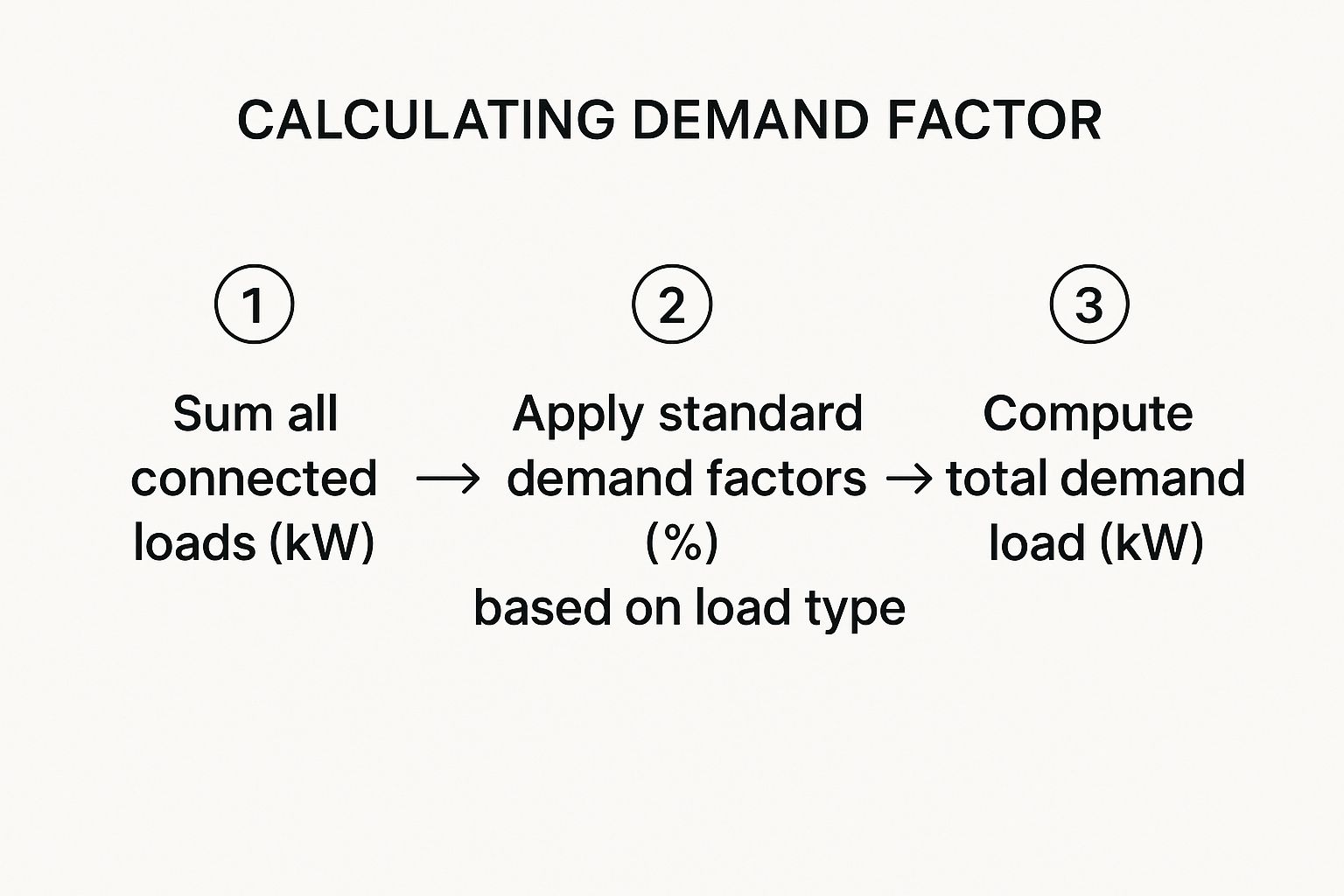
As you can see, the process isn't just about adding everything up. It’s about taking that initial sum, applying these smart factors, and arriving at a final, realistic load. This ensures the system is sized for reality, not for a theoretical peak that will likely never happen.
Applying Demand Factors to Our Villa Example
Let's jump back into our villa example to see how this works on a real project. We’ve already calculated the total connected load, so now it’s time to apply the demand factors as per local authority guidelines.
First up, let's tackle the general lighting and receptacle load. Here's how it typically breaks down:
- The first 3,000 VA of the general load is always taken at 100%. No exceptions.
- Any amount over that, from 3,001 VA up to 120,000 VA, is taken at just 35%.
Now, let's run the numbers for our villa's general load of 17,300 VA.
- First 3,000 VA: 3,000 VA x 100% = 3,000 VA
- Remaining Load: 17,300 VA - 3,000 VA = 14,300 VA
- Apply 35% Factor: 14,300 VA x 35% = 5,005 VA
- Total General Demand Load: 3,000 VA + 5,005 VA = 8,005 VA
See what happened there? The realistic demand load for general lighting and outlets (8,005 VA) is dramatically lower than the connected load of 17,300 VA. This single step prevents huge oversizing and saves the client a significant amount of money on equipment.
Integrating Heavy Loads into the Final Calculation
Next, we need to account for the heavy-hitter appliances. In the UAE climate, HVAC systems are a different beast. They're almost always calculated at 100% of their nameplate rating because of their critical function and long run times. You just can't skimp on cooling.
Other fixed appliances, however, often get their own demand factors.
For something like an electric range over 1,750 W, the codes give us a specific table. For our single 12,000 VA range, the demand factor is a fixed value of 8,000 VA. This accounts for the simple fact that you’ll never have all the burners and the oven cranked to maximum heat all at once.
Let's pull it all together for the final demand load:
| Load Component | Calculated Demand (VA) |
|---|---|
| General Lighting & Receptacles | 8,005 VA |
| HVAC System (at 100%) | 9,000 VA |
| Electric Range (Demand Load) | 8,000 VA |
| Total Calculated Demand Load | 25,005 VA |
That final number, 25,005 VA, is the one that truly matters. This is the realistic peak load that your entire electrical system must be designed to handle safely and efficiently.
From here, the last step is to convert this total VA into amperes, which will tell us how to size the main service. For residential properties in the UAE, we use a standard single-phase voltage of 230V.
Amperage = Total VA / Voltage = 25,005 VA / 230 V = 108.7 Amperes
This means you’ll need a main service rated for at least 109 amps. This single value dictates the size of your main breaker, the service entrance conductors, and the main distribution board. Getting this number right is everything—it ensures the entire installation is compliant, safe, and performs without a hitch. Of course, selecting the right pathways for these conductors is also crucial; our electrical conduit installation guide covers this topic in detail.
After applying these demand factors, you can take your calculations a step further for larger projects by using an industrial energy consumption calculator to forecast long-term energy use.
Common Questions on Electrical Load Calculation

Even with a solid process, an electrical load calculation can throw a few curveballs. Getting straight answers to common questions is the best way to keep your project moving and ensure your design is spot-on. Here are some of the queries I hear most often from clients and fellow professionals across the UAE.
A big one that comes up is about specialized software. While there are powerful tools out there, the truth is, for most residential projects and even many commercial ones, a well-organized spreadsheet does the job perfectly.
The real magic isn't in fancy software; it’s in your methodical approach and a firm grasp of the local codes. At the end of the day, the quality of your result comes down to the accuracy of your input data.
What Is the Difference Between Connected Load and Demand Load
This is one of those fundamental concepts that can trip people up, but it's essential for getting your numbers right. The distinction is actually pretty straightforward.
Total Connected Load: Imagine every single light, appliance, and piece of equipment in the entire building running at its absolute maximum power, all at the same time. That’s your connected load. It’s a purely theoretical number you get by adding up all the nameplate ratings.
Calculated Demand Load: This is the number that really matters. It’s the realistic peak load you expect the system to handle, calculated by applying demand factors to the connected load. It accounts for the simple fact that not everything runs at once.
Think of it like your car’s speedometer. It might go up to 240 km/h (your connected load), but your actual driving speed is almost always far less (your demand load). We design the electrical system for that realistic demand load to ensure safety and efficiency.
How Do You Account for Future Expansion
This is where good planning really shows. Building in extra capacity from the start is always cheaper than a major system overhaul down the road. It's a sign of a truly professional electrical load calculation.
A solid rule of thumb is to add a 15% to 25% buffer to your final calculated demand load. This gives you the headroom to add significant new loads later on—things like an EV charger, a pool pump, or even a small building extension. Without that foresight, you can paint yourself into a corner, making future upgrades a costly headache.
Expert Tip: I always make a point to clearly label this future capacity on the final documents I share with a client. It demonstrates you’re not just solving today's problem but providing a scalable, long-term solution that protects their investment. It's a small detail that builds a lot of trust.
Why Can't I Just Add Up the Breaker Amps
This is a common but dangerous misconception I see all the time. Simply adding up the amperage ratings on all the breakers in a panel will give you a useless, wildly inflated number.
A 20-amp breaker is there to protect a wire that's rated for 20 amps; it says nothing about the actual power the circuit is drawing. You’re ignoring the real-world consumption of the connected devices and, crucially, skipping the demand factors required by code.
The only correct way to do this is to start from the ground up: identify the actual loads (lights, outlets, equipment) and follow the established, code-compliant process we’ve outlined. A proper calculation is systematic and detailed—it's the only way to guarantee a safe, compliant, and efficient electrical system for modern buildings in the UAE.
At Yasu Trading Co. LLC, we provide the high-quality, certified electrical materials you need to bring your meticulously calculated plans to life. From main distribution boards to wiring and fixtures, we supply the components that ensure your project is safe, compliant, and built to last. Explore our comprehensive range of building supplies at https://yasutrading.com and equip your next project for success.