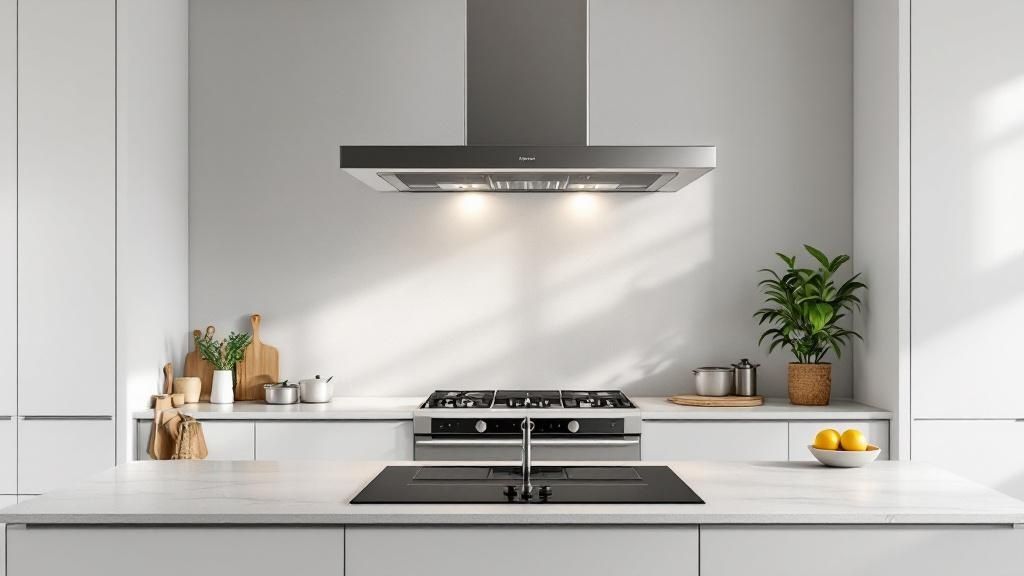
Find the Perfect Exhaust Kitchen Hood for Your Home
An exhaust kitchen hood is more than just another appliance—it's the lungs of your kitchen. It quietly works in the background, capturing all the grease, smoke, and cooking smells before they have a chance to take over your home. Think of it as your first line of defense for keeping your indoor air clean and your living space fresh.
Why Your Kitchen Hood Is More Than an Appliance
When you’re designing a dream kitchen, it's easy to get caught up in the big-ticket items like countertops and cabinets. The exhaust kitchen hood often feels like an afterthought. But trust me, overlooking this powerful device is a mistake. It’s one of the most critical investments you can make for your home and your health.
Without proper ventilation, all those byproducts from searing a steak or frying up some onions have nowhere to go. These aren't just harmless smells; they are airborne particles that settle on every surface, creating a sticky, greasy film that’s a nightmare to clean. Worse, they can impact your family's well-being over time. You can learn more about how dirty air ducts can harm your health, which really highlights why good ventilation is non-negotiable.
A Vital Component in Modern Homes
A quality exhaust kitchen hood does so much more than just clear out unwanted odors. It's constantly working to create a cleaner, safer, and more enjoyable cooking environment.
Here’s what a good hood really does for you:
- Improved Air Quality: It actively pulls grease, smoke, and steam out of the air, stopping them from circulating through your home.
- Reduced Cleaning Time: By trapping grease particles mid-air, it keeps your cabinets, walls, and even your ceiling from getting that grimy buildup.
- Enhanced Safety: A proper hood significantly lowers the risk of a kitchen fire by preventing dangerous grease accumulation in your ductwork.
Here in the United Arab Emirates, we've seen a huge demand for high-quality kitchen ventilation. The residential kitchen hood market in the UAE is actually leading the way across the Middle East and Africa. Market research shows a steady growth rate of about 3.5% projected through 2028. This is largely thanks to new construction projects and homeowners wanting to upgrade their kitchens to meet modern standards.
This guide is designed to walk you through everything you need to know, breaking down the key concepts to help you find the perfect model for your home. For a deeper dive, check out our complete guide on the essentials of an exhaust kitchen hood.
Matching a Hood Type to Your Kitchen Layout
Think of choosing an exhaust kitchen hood like picking the right tool for a specific job. You wouldn't use a sledgehammer to hang a picture frame, right? In the same way, the hood you choose has to make sense for your kitchen's unique layout and your cooking style. It’s all about finding that perfect fit.
The biggest factor in your decision is where your cooktop or range is located. Once you know that, the right type of hood almost presents itself. This ensures it not only works efficiently but also looks like it truly belongs in the space.
Under-Cabinet Hoods for Compact Efficiency
If your kitchen is tight on space, an under-cabinet hood is your best friend. These are workhorses designed for compact or galley-style kitchens where every inch counts. As the name implies, they mount neatly under your existing cabinets, giving you powerful ventilation without sacrificing valuable storage.
They're incredibly popular for a reason. In the Middle East & Africa, the kitchen hood market was valued at a substantial USD 195.7 million in 2023. Under-cabinet models alone accounted for about USD 80.8 million of that, largely because their space-saving and budget-friendly nature is a perfect match for many homes. You can dig into more of this data on the Global Market Insights website.
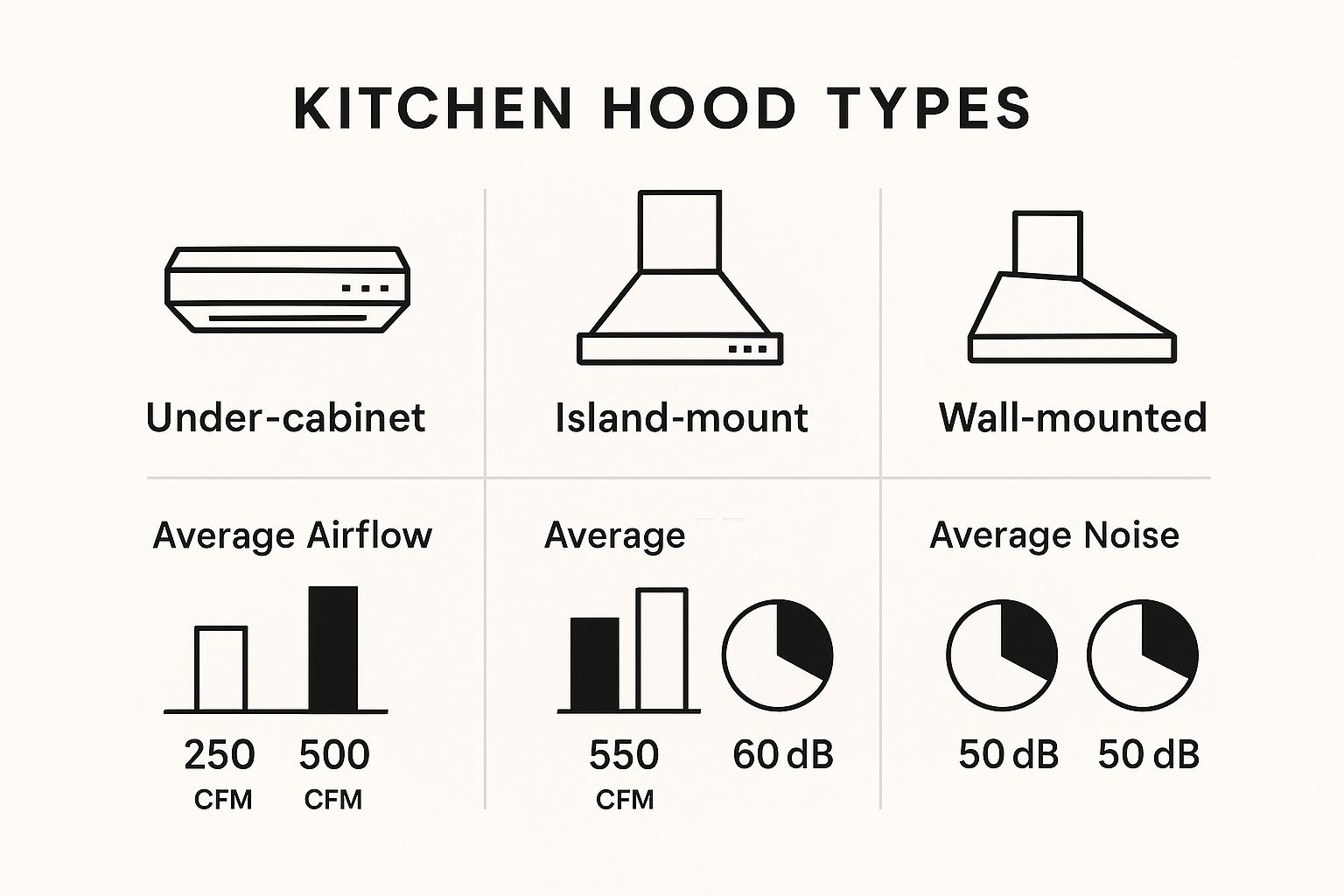
As you can see, the more powerful island and wall-mounted hoods can get a bit louder, while under-cabinet models provide a quieter, more modest performance that's often just right for smaller spaces.
Wall-Mounted Hoods for a Classic Statement
Is your cooktop set against a wall with open space above it? A wall-mounted hood is the natural choice. These models make a real visual impact, often featuring a prominent chimney-style flue that reaches up to the ceiling. They strike a fantastic balance between high-performance ventilation and strong design presence.
A wall-mounted hood can become the defining feature of your kitchen's style. Whether you're after a sleek, modern stainless steel look or a more traditional, decorative canopy, there's a huge variety of designs to complete your vision.
Island Hoods: The Grand Centerpiece
When your kitchen is built around a central cooking island, an island hood isn't just a good idea—it's essential. These units are suspended directly from the ceiling and are meant to be seen from every angle, making them a true showstopper.
Because they're working in open air without any walls to help direct the airflow, island hoods need some serious muscle. They typically have a much higher CFM rating to effectively pull in smoke, steam, and odors from all sides.
Downdraft Systems: The Minimalist's Choice
But what if you don't want to see a hood at all? For those who love clean lines and unobstructed views, a downdraft system is an intriguing option. These vents are built right into the countertop behind or beside the cooktop, popping up only when you need them.
Instead of pulling air up, they pull smoke and steam down and away. While they're brilliant for maintaining an open-concept feel, especially on a kitchen island, they can sometimes struggle to capture steam from tall stockpots as effectively as a traditional overhead hood.
Kitchen Hood Types At a Glance
Feeling a bit overwhelmed by the options? Don't worry. Here’s a quick comparison of the most common exhaust kitchen hood types to help you choose the best fit for your home.
| Hood Type | Best For | Pros | Cons |
|---|---|---|---|
| Under-Cabinet | Compact kitchens with existing cabinetry over the cooktop. | Space-saving, often more affordable, easy installation. | Less powerful than larger models; limited design variety. |
| Wall-Mounted | Kitchens where the cooktop is against a wall with no upper cabinets. | Powerful ventilation, wide range of styles, acts as a design focal point. | Requires open wall space; installation can be more involved. |
| Island | Kitchens with a cooktop on a central island. | Very powerful, makes a bold design statement, designed for 360-degree capture. | Expensive, requires ceiling support and ductwork, can obstruct views. |
| Downdraft | Minimalist kitchens, islands where an overhead hood is undesirable. | Retracts out of sight, preserves open sightlines, sleek and modern. | Less effective at capturing steam from tall pots; can be complex to install. |
Ultimately, the best hood is one that integrates flawlessly with your kitchen's design while clearing the air effectively. By considering your layout first, you're already on the right track to finding the perfect match.
Understanding the Metrics That Actually Matter
So, what separates a truly effective exhaust hood from a noisy, glorified piece of kitchen decor? It all comes down to its performance stats. Forget the marketing fluff for a moment and let's focus on the two numbers that really tell you how well a hood will perform in your home.
Those two key metrics are airflow, measured in Cubic Feet per Minute (CFM), and sound level, measured in sones. Grasping what these two simple numbers mean is the secret to balancing powerful ventilation with a peaceful kitchen. Get this balance right, and you’ll end up with a hood you actually enjoy using.
Breathing Power: The Role of CFM
Think of CFM as the "breathing power" of your exhaust hood. It’s a straightforward measurement of how much air the fan can suck out of your kitchen in a single minute. A higher CFM number means the hood can clear out smoke, steam, and cooking smells much faster.
But more power isn't always the answer—the right amount of power is. An underpowered hood just won’t be able to keep up, leaving your kitchen hazy. On the flip side, an overpowered one can be needlessly noisy and a waste of money. The real goal is to find a perfect match for your specific kitchen and the way you cook.
A simple rule of thumb for figuring out your CFM needs is to consider what kind of cooktop you have. Gas cooktops burn hotter and create more by-products than electric ones, so they naturally need more ventilation power.
For an electric cooktop, a good guideline is to have 100 CFM for every 30 cm of cooktop width. So, if you have a standard 90 cm electric cooktop, you should look for a hood with at least 300 CFM.
For a gas cooktop, the calculation is all about heat output. You just need to add up the total British Thermal Units (BTUs) of all your burners and then divide that number by 100. For instance, if your burners add up to 45,000 BTUs, you’ll want a hood that can deliver at least 450 CFM.
The Sound of Silence: Understanding Sones
While CFM tells you about power, sones tell you about noise. It’s a much more intuitive way to measure sound than decibels because it’s linear—meaning 2 sones sounds exactly twice as loud to our ears as 1 sone. Simple.
So, how quiet is one sone? It's about the same as the soft hum of a quiet refrigerator. A normal conversation hovers around 4 sones. Many of the best hoods on the market operate at just 1 to 3 sones on their lowest setting, which is quiet enough to barely be noticed.
Here’s a quick guide to what sone levels feel like in the real world:
- 1 Sone: The gentle hum of a quiet fridge.
- 2-3 Sones: The level of light background music.
- 4 Sones: About the volume of a normal conversation.
- 7+ Sones: The roar of busy street traffic; way too loud for a kitchen.
The sweet spot is finding a hood that gives you a high CFM rating without making a racket. By checking both the maximum CFM and the sone rating at different fan speeds, you can make a smart choice that keeps your air clean without disrupting your home.
Making Your Final Decision
Alright, let's pull everything together. Choosing the right kitchen exhaust hood isn't just about picking a shiny appliance; it's about matching your kitchen's design, your unique cooking style, and your budget to a single, hard-working piece of equipment. Think of it as the final, practical step that will define your kitchen's air quality for years to come.
First things first: a quick reality check on how you actually use your kitchen. Are you the family's resident stir-fry master, constantly searing steaks or frying up a storm? If that sounds like you, a powerful ducted hood is non-negotiable. It's the only way to effectively pull all that smoke and grease out of your home. On the other hand, if your cooking is more about simmering soups, steaming veggies, or reheating meals, a sleek ductless model could be all the ventilation you really need.
Building Your Selection Checklist
To make this decision easier and avoid any buyer's remorse, let's walk through a quick checklist. This will help you focus on what truly matters for your space.
- Kitchen Layout: Where is your cooktop? Is it sitting against a wall, tucked neatly under cabinets, or is it the star of a kitchen island? Your answer instantly points you toward a wall-mount, under-cabinet, or island hood.
- Ventilation Path: Look around. Is there a clear path to run ductwork outside? If the answer is yes, a ducted hood is hands-down the best choice for clean air. If not, a ductless (or recirculating) model is your go-to solution.
- Cooking Habits: Be honest with yourself. How often do you crank up the heat? Heavy-duty frying and searing create a lot of grease and smoke, demanding a higher CFM and better filtration to keep your kitchen from feeling grimy.
- Noise Level: How much does a quiet kitchen matter to you? If you have an open-concept living area where the kitchen blends into your social space, pay close attention to the sone rating. A loud hood can easily kill a conversation.
Getting these fundamentals right is key. It's also worth noting that more and more people are prioritizing clean kitchen air. In fact, here in Saudi Arabia, the kitchen hoods market is projected to reach USD 706.59 million by 2030. This growth is all about a rising focus on better air quality in both homes and commercial kitchens.
Filter Types and Maintenance
The type of filter inside your hood is directly tied to its day-to-day performance and how often you'll have to clean it. This is where you balance your budget with your willingness to do a bit of maintenance.
Your hood's filter is its first line of defense against grease. A clean filter ensures the fan motor doesn’t have to work overtime, extending the life of your appliance and preventing a serious fire hazard.
You'll generally come across three main types:
- Baffle Filters: These are the pros' choice for a reason. Made from interlocking stainless steel baffles, they are fantastic at trapping grease, incredibly durable, and a breeze to clean—most are completely dishwasher-safe.
- Mesh Filters: Typically made from layers of aluminum mesh, these filters are common in residential hoods. They do a good job of catching grease but can be a real pain to get perfectly clean.
- Charcoal Filters: Remember, these are only for ductless hoods. Their job isn't to catch grease but to absorb cooking odors before the air is pushed back into your kitchen. You can't clean them; they need to be replaced every 3-6 months.
If you want to dive deeper, this detailed Commercial Kitchen Exhaust Hood Guide is a great resource, as many of the core principles apply to home kitchens, too. And for a bigger-picture view, check out our guide on the complete kitchen exhaust system.
Installation and Maintenance That Protects Your Investment
You’ve done the research and picked out the perfect exhaust kitchen hood. That's a huge step, but the job isn't done. Its real-world performance completely depends on a solid installation and consistent upkeep.
Think of it like buying a brand-new sports car. You wouldn't let just anyone tinker with the engine, right? A great hood is only as good as its setup and the care it receives. If you skimp on either, that powerful appliance can quickly become a noisy, ineffective, and even dangerous fixture in your kitchen.
Proper installation ensures it actually captures smoke and grease, while routine maintenance keeps it running quietly and safely for years to come.
Getting the Installation Right
I know the DIY urge can be strong, but installing a kitchen hood—especially a ducted model—is almost always a job for a professional. It’s not just about screwing it to the wall; it involves precise measurements, secure mounting that can handle constant vibration, and often tricky electrical and ductwork.
A professional installer will nail the critical details that make all the difference:
- Correct Mounting Height: The hood has to be at the manufacturer's sweet spot above the cooktop. If it’s too high, it won’t catch the smoke. Too low, and it’s a fire hazard and a nuisance.
- Proper Ducting: For ducted hoods, the rule is simple: keep the duct run as short and straight as you can. Every bend and extra foot of ducting kills airflow, making the motor work harder and generating more noise.
- Secure Electrical Connections: This is non-negotiable. Safe, compliant wiring prevents electrical faults and ensures your hood works reliably when you need it most.
Investing in professional installation isn't just an extra cost—it's an investment in safety, efficiency, and peace of mind. An improperly installed hood can void the warranty, compromise its performance, and create hidden dangers.
A Simple Maintenance Schedule for Peak Performance
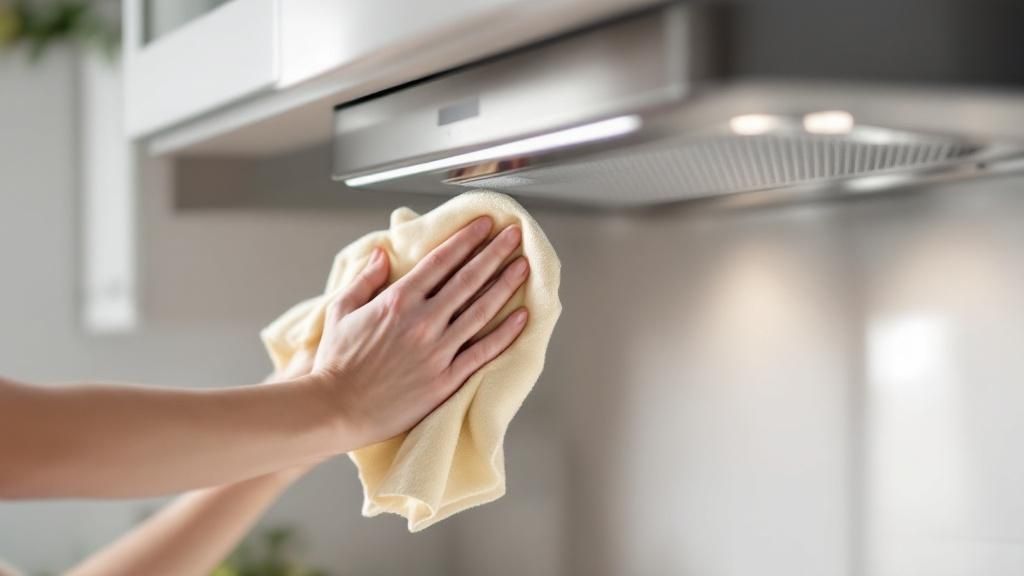
Once your hood is perfectly installed, a little maintenance goes a long way. The single most important task is cleaning the filters. They are your first line of defense against grease buildup, and ignoring them is asking for trouble. This mirrors the importance of regular HVAC maintenance in general—consistent care is key to longevity.
A clogged filter chokes the airflow, forcing the fan motor to strain itself to death. Even worse, a filter saturated with grease is a serious fire risk. A tiny spark from your cooktop can ignite it, leading to a terrifying duct fire. If you want to dive deeper into creating a proactive care plan, check out our guide on what is preventive maintenance.
Your Filter Cleaning Checklist:
- Baffle or Mesh Filters: These metal filters, found in hoods that vent outside, should be cleaned every 1-3 months. If you do a lot of frying or high-heat cooking, make it a monthly habit. The good news? Many are dishwasher-safe.
- Charcoal Filters: Found only in ductless (recirculating) hoods, these can't be cleaned. They need to be replaced every 3-6 months to keep absorbing odors effectively.
By sticking to these simple installation and maintenance tips, you’re ensuring your exhaust kitchen hood stays a powerful, effective, and safe workhorse in your kitchen for its entire lifespan.
Of course. Here is the rewritten section, crafted to sound like it was written by an experienced human expert, following all the provided guidelines.
Common Questions About Kitchen Hoods
Even with all the details laid out, a few questions are probably still bouncing around in your head. That’s completely normal. Picking the right kitchen exhaust hood is a big deal, and you want to be sure you're making a choice you’ll be happy with for years to come.
Think of this as the final piece of the puzzle. We’ll tackle some of the most common questions we get from homeowners, clearing up any lingering doubts so you can move forward with confidence.
What Is the Difference Between a Ducted and a Ductless Hood?
This is probably the most fundamental question, and the answer really boils down to one thing: where does the air go?
A ducted exhaust kitchen hood is the undisputed champion of performance. It grabs all the smoke, grease, and cooking smells and physically vents them outside your home through a dedicated duct system. This process completely removes the pollutants, along with excess heat and steam, leaving your indoor air as fresh as possible.
A ductless hood, sometimes called a recirculating hood, takes a different approach. It sucks in the kitchen air, pulls it through a set of filters (usually a mesh one for grease and a charcoal one for odors), and then pushes the "cleaned" air right back into the room. It’s a lot easier to install since there’s no ductwork involved, but it's a compromise. It can’t get rid of heat or moisture, and it's never quite as effective at capturing every last grease particle.
How Do I Know What CFM My Kitchen Needs?
CFM, which stands for Cubic Feet per Minute, is all about your hood's horsepower. Getting this number right is crucial. A hood that's too weak will struggle to keep up with your cooking, while one that's too powerful can be noisy and waste energy.
The best way to get a quick estimate is to match the CFM to your cooktop. Gas stoves put out way more heat and by-products than electric ones, so they need a lot more ventilation muscle. Here's a pro tip: always aim for a little more power than you think you need. Running a stronger hood on a lower, quieter setting is far more pleasant than cranking a weaker one to its noisy max.
Here are the standard guidelines to follow:
- For Electric Cooktops: You'll want about 100 CFM for every 30cm of your cooktop's width. So for a standard 90cm electric cooktop, you'd need a hood with at least 300 CFM.
- For Gas Cooktops: This calculation is based on heat output. Just take the total BTUs of all your burners and divide by 100. If your stove's total output is 45,000 BTUs, you’ll want a hood with at least 450 CFM.
How Often Should I Clean My Kitchen Hood Filters?
If there's one thing you do to keep your hood working well and safely, it's cleaning the filters. Clogged filters choke the airflow, put a huge strain on the motor, and create a serious fire hazard from all the grease buildup.
How often you clean them depends on the filter type and how you cook.
- Metal Grease Filters (Baffle or Mesh): These need a good cleaning every 1-3 months. If you do a lot of frying or searing, stick to a monthly schedule. The good news is that most modern metal filters can just be popped into the dishwasher.
- Charcoal Filters (Ductless Hoods Only): These filters work by absorbing odors, so they can't be cleaned. You have to replace them completely every 3-6 months to keep them working effectively.
Can I Install an Exhaust Kitchen Hood Myself?
It’s tempting to save a few bucks and try to install a hood yourself, but for most people, we really advise against it. Installing an exhaust kitchen hood, especially a ducted model, is a pretty complex job that's a few steps above your typical weekend DIY project.
You’re dealing with securely mounting a heavy appliance, handling electrical wiring safely, and maybe even cutting holes in your walls or ceiling for the ductwork. A shoddy installation can lead to terrible performance, create a fire or electrical risk, and could even void your warranty. To get the best performance and your own peace of mind, hiring a qualified professional is the smartest move you can make.
At Yasu Trading Co. LLC, we provide the high-quality HVAC components and tools needed to ensure your kitchen ventilation project is a success. Explore our extensive range of building and construction essentials by visiting https://yasutrading.com today.