Expert Facility Management Dubai | Enhance Property Value
When you think of facility management in Dubai, what comes to mind? For many, it might just be cleaning and repairs. But in a city defined by its breathtaking skyscrapers and world-class infrastructure, facility management has become something much more. It's the strategic, behind-the-scenes discipline that ensures these architectural marvels operate safely, efficiently, and sustainably.
Think of it as the central nervous system of a building. It’s the invisible force that keeps everything from the tallest towers to the most luxurious hotels running flawlessly. This practice is absolutely essential for protecting massive asset values and delivering the high-end occupant experiences that Dubai is famous for.
The Evolution of Facility Management in Dubai
Dubai's incredible skyline isn’t just a testament to ambitious design; it’s a living showcase of operational excellence. This is where modern facility management (FM) truly shines. Years ago, FM might have been an afterthought—a janitor's closet and a repairman on call. Today, it’s a core strategic function that underpins the success of every major property in the emirate.
It’s the reason the air conditioning keeps you cool during the intense summer heat, the high-tech security systems run 24/7, and the grand lobbies remain pristine. The shift has been from simply fixing things when they break to proactively managing an entire environment. This change was a direct response to the city’s meteoric growth and its unwavering commitment to the highest international standards.
Driving Forces Behind FM Advancement
The intense demand for professional facility management in Dubai didn't happen by chance. It's been propelled by powerful factors tied directly to the region's unique development path. Grand government visions, like the Dubai Urban Master Plan 2040, set a clear roadmap for sustainable, people-first urban living. This places a huge responsibility on FM providers to deliver on that promise.
This push is fuelling a massive market. The UAE's facility management sector is on track to surge from USD 6.83 billion to an estimated USD 12.33 billion by 2033. This growth is a direct result of incredible infrastructure investment and a real estate market that never seems to slow down. You can dive deeper into these figures in a detailed industry report about the UAE facility management market.
The table below breaks down the key factors accelerating this growth and how they directly impact the work of facility managers on the ground.
Key Drivers of FM Growth in Dubai
| Growth Driver | Impact on Facility Management |
|---|---|
| Government Vision & Regulations | Initiatives like the Dubai Urban Master Plan 2040 mandate higher standards for sustainability, safety, and livability, pushing FM to innovate. |
| Mega-Projects & Construction Boom | Each new tower, mall, or community adds a complex asset that requires sophisticated, long-term management to protect its value. |
| Focus on Occupant Experience | In a competitive market, delivering a premium experience for tenants and visitors is a key differentiator, increasing the importance of "soft" FM services. |
| Push for Sustainability | Strong government focus on green buildings requires FM teams to implement energy-efficient systems and sustainable waste management protocols. |
| Technological Integration | The rise of smart buildings and IoT devices means FM is now a data-driven field focused on predictive maintenance and operational efficiency. |
This rapid market expansion is creating a need for more sophisticated service delivery across the board. Key areas seeing the biggest changes include:
- Smart Technology: Using IoT sensors, building management systems (BMS), and data analytics is no longer a luxury. It's now standard practice for predictive maintenance and optimising energy use.
- Sustainability Mandates: With a strong government push for green building certifications, FM teams are on the front lines, tasked with hitting energy-saving targets and running effective recycling programmes.
- The Experience Factor: In a crowded property market, providing a flawless experience for residents, office tenants, and hotel guests has become a powerful competitive advantage. This makes soft services like security and cleaning more vital than ever.
The core mission of modern facility management is to build an ecosystem where a building’s physical systems, its support services, and the people inside all work together seamlessly. It’s about making sure the building itself helps the organisation achieve its goals.
Ultimately, the story of facility management in Dubai is a mirror of the city’s own incredible journey. As its buildings grew taller, smarter, and more ambitious, the profession responsible for running them has evolved into a high-tech, data-centric field—one that’s indispensable for safeguarding billions in real estate assets.
Understanding Hard and Soft FM Services
In facility management, every single task can be sorted into two main buckets: hard services and soft services.
Imagine one of Dubai’s iconic skyscrapers. Think of the hard services as its core anatomy—the skeleton, the circulatory system, and the nervous system. These are the physical, built-in components that are absolutely essential for the building to even exist.
These are the technical systems, often hidden behind walls and ceilings, that a building simply cannot operate without. If one fails, the whole place can grind to a halt. Maintaining these systems requires skilled technicians and engineers because they're directly tied to the building's safety, structural integrity, and legal compliance.
On the other hand, soft services are all about making that same building a pleasant, safe, and productive place for people to actually be in. In our analogy, these services are like the building's daily grooming and wellness routine. They focus on the occupants and can often be tweaked in scope or frequency without causing a catastrophic failure, though their absence would quickly make the environment unpleasant.
Defining Hard Services
Hard services are physically connected to the building's structure. They are non-negotiable for health and safety and are often regulated by authorities like the Dubai Municipality.
- HVAC Systems: In a climate like Dubai's, air conditioning, heating, and ventilation aren't just comforts; they're necessities.
- Electrical and Mechanical (MEP): This covers all the critical arteries of the building, including wiring, power distribution, plumbing, drainage, and crucial fire safety systems.
- Building Fabric Maintenance: This is the upkeep of the building's "skin and bones"—the roof, walls, windows, and any structural repairs needed to keep it sound.
These systems form the very backbone of any functional property. Keeping them in top shape is a primary mission for any company offering facility management in Dubai.
Defining Soft Services
While hard services keep the lights on and the water running, soft services are what make the building a place where people want to spend their time. They’re absolutely vital for crafting a positive experience for occupants, which in turn affects everything from tenant loyalty and employee productivity to brand image—especially in Dubai’s fiercely competitive commercial and hospitality markets.
- Cleaning and Janitorial Services: Keeping lobbies, offices, and common spaces looking immaculate.
- Security Services: This includes everything from manned guards and access control systems to CCTV monitoring to create a secure environment.
- Landscaping and Pest Control: Managing the building's external appearance and ensuring the interior is hygienic and free of pests.
- Waste Management: Putting efficient and sustainable recycling and disposal systems in place.
Striking the right balance is everything. The most stunning lobby in the world is useless if the air conditioning has died. By the same token, a technically perfect building will quickly lose tenants if it’s dirty or feels unsafe.
The real magic of modern facility management lies in the seamless integration of both hard and soft services. When managed together, they create an environment that is not just functional and compliant, but also comfortable, productive, and welcoming.
This integrated approach is precisely where the industry is heading. The infographic below breaks down the demand for facility management across Dubai's key sectors, each needing its own unique mix of these services.
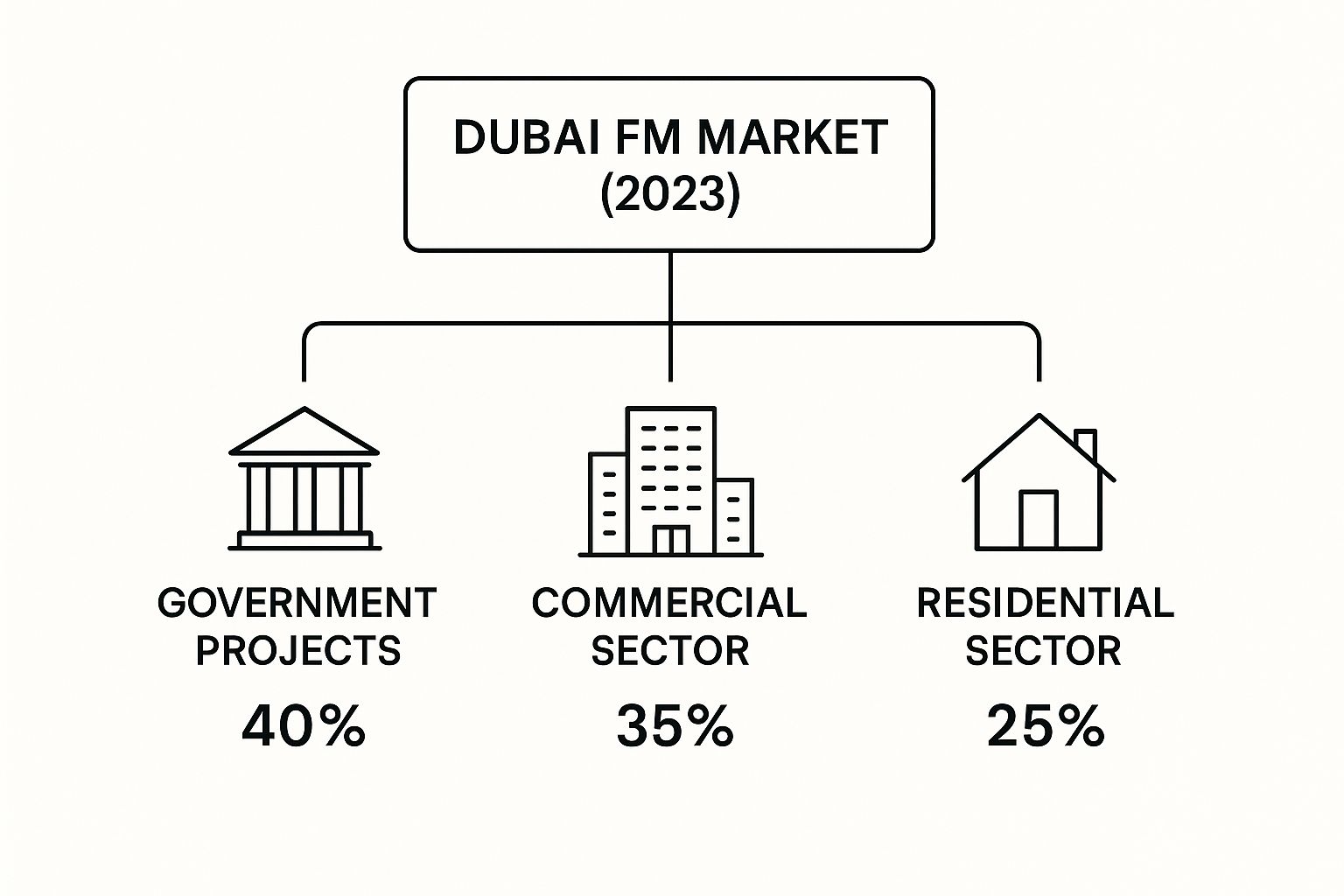
The data makes it clear: while government projects drive a large portion of the demand, the commercial and residential sectors combined account for a massive 60% of the market. This really underlines just how important occupant-focused services have become.
For a deeper dive into mastering this integration, you can check out our detailed guide on facility management best practices. Bundling these services under a single Integrated Facility Management (IFM) contract is the smart move. It creates major efficiencies, gives you one point of contact, and ensures a consistently high standard of service—which is exactly what's needed to manage Dubai's world-class properties.
How Smart Technology Is Revolutionising FM
Welcome to the future of facility management—a future driven not by reaction, but by data and intelligence. The days of simply waiting for a system to break down before fixing it are quickly fading into the past. Today, technology is fundamentally shifting the industry from a reactive model to a proactive, and even predictive, one.
This evolution is at the heart of modern facility management in Dubai, where efficiency and world-class standards are not just goals, but expectations.
Think of a modern skyscraper as a living, breathing organism. Smart technology acts as its central nervous system. Internet of Things (IoT) sensors, sophisticated Building Management Systems (BMS), and Artificial Intelligence (AI) all work in concert, giving the structure a powerful set of digital senses. They are the eyes, ears, and brain of the building, constantly collecting and analysing data on every critical function.
This intricate network of digital senses keeps a close watch on everything, from the energy being used in an individual office to the subtle vibrations of a rooftop HVAC unit. It can track occupancy patterns to optimise lighting and cooling, and it continuously monitors air quality to ensure a healthy, comfortable environment for everyone inside. The result is a building that isn't just managed, but is intelligently self-aware.
From Reactive Repairs to Predictive Solutions
The single greatest benefit of this technological leap is the move towards predictive maintenance. Instead of waiting for an air conditioning unit to give out during a sweltering August afternoon, IoT sensors can spot the early warning signs—like a spike in energy draw or unusual vibrations—weeks in advance.
This data automatically triggers an alert for the facility management team. They can then schedule a repair during quiet, off-peak hours, long before any occupant even senses a problem. It’s the difference between a minor, planned tune-up and a costly, emergency replacement that brings operations to a halt.
It's no surprise that the adoption of sensors and automation for real-time monitoring has become a key driver in the region's FM market. You can explore more about how smart tech is shaping the UAE's FM sector and its profound impact on service delivery.
By forecasting equipment failures before they happen, predictive maintenance transforms facility management from a cost centre focused on repairs into a value driver focused on uptime, efficiency, and asset longevity.
This data-driven approach is already delivering real-world results across Dubai’s diverse properties:
- Energy Optimisation: AI algorithms can analyse historical weather data and current occupancy to adjust HVAC and lighting systems on the fly, slashing energy consumption by up to 20-30% in some buildings.
- Automated Cleaning: In a bustling shopping mall, AI-powered robotic cleaners use sensors to map the highest traffic zones. They optimise their routes to focus where cleaning is needed most, ensuring a consistently pristine environment.
- Enhanced Security: Smart cameras with AI analytics can spot unusual activity, instantly alert security personnel, and even differentiate between a false alarm and a genuine threat. This leads to much faster and more accurate responses.
Aligning with Dubai's Smart City Vision
This tech-forward approach to facility management isn't just about saving money; it’s about building a more sustainable and efficient future. It lines up perfectly with Dubai's ambitious smart city vision and its strict green building codes.
Smart buildings are, by their very nature, more sustainable. They consume less energy, generate less waste, and provide a healthier indoor environment for people to work and live in.
By harnessing the power of data, facility managers can produce detailed reports on energy savings, water consumption, and carbon footprint reduction. This information is vital for achieving and maintaining green building certifications like LEED, which in turn boosts a property's value and appeal. This strategy ensures that the operational reality of a building truly lives up to its architectural ambition, cementing Dubai's status as a global leader in smart urban development.
Staying Ahead of Sustainability and Regulatory Standards
If you're in the world of facility management in Dubai, you know that operating here means working within some of the most ambitious sustainability and regulatory frameworks on the planet. This isn't just about checking boxes for compliance. It's a chance to seriously sharpen your operational edge, enhance your building's value, and play a part in the city's incredible green vision.
Think of these regulations less like roadblocks and more like guardrails. They’re designed to guide every building in the emirate toward a smarter, more sustainable future. Sticking to them isn't just a good idea—it's foundational to modern property management here.
Getting to Grips with Dubai's Green Building Mandates
The heart of Dubai's framework is its set of green building standards. These mandates are a huge influence on the daily life of a facility manager, shaping everything from big-ticket investments down to the smallest operational routines.
Compliance forces you to make conscious choices that look at the long game—prioritising performance and minimising your environmental footprint. This has a direct impact on several key areas of your job:
- Energy Efficiency: Choosing and maintaining energy-smart HVAC systems, intelligent lighting, and high-performance insulation aren't just "nice-to-haves" anymore. They are absolutely essential for hitting energy consumption targets.
- Water Conservation: Installing water-saving fixtures, using smart irrigation for landscaping, and putting greywater recycling systems in place are all critical practices.
- Waste Management: A core responsibility is now developing sophisticated waste segregation and recycling programmes, with the goal of sending as little as possible to the landfill.
To get a much deeper understanding of the specific rules that govern both new builds and ongoing operations, I highly recommend reading our guide on the latest Dubai building codes. Having this knowledge in your back pocket is crucial for making sure every corner of your facility is up to scratch.
Using Technology as Your Compliance Ally
Let's be honest, meeting these high standards would be a massive headache without modern tech. In fact, the regulations themselves practically insist on it. A major push comes from Dubai Municipality’s green building regulations, which not only mandate sustainable standards for new public buildings but also champion the use of IoT and AI in managing them. These systems give you real-time data on everything from energy use and occupancy to system performance, allowing for predictive maintenance and far more efficient operations. You can get a better sense of how IoT and AI are forecasted to enhance efficiency across the UAE market.
In Dubai, sustainability isn't just an initiative; it's woven into the city's identity. For a facility manager, this means every single decision—from the type of cleaning chemical you order to planning a major equipment upgrade—has to be seen through the lens of its environmental and regulatory impact.
At the end of the day, mastering the regulatory landscape isn't optional for anyone in facility management in Dubai. It elevates the job from simply running a building to being a strategic partner in achieving the city’s vision. When you truly embrace these standards, you don’t just stay compliant. You unlock real savings, boost your property's reputation, and create healthier, more desirable spaces for everyone inside.
Sourcing Your Essential Supplies and Hardware
Truly effective facility management in Dubai is where big-picture strategy meets the practical reality on the ground. You can have the smartest tech and the most refined processes, but they’re completely powerless without the right physical tools and supplies. The quality of your service, the safety of your building’s occupants, and its overall operational readiness all hinge on having the right gear on hand.
Think of your FM team like a world-class surgical unit. The surgeon’s skill is non-negotiable, but what good is it without high-quality, sterilised instruments? It’s the same for facility management. Your team can’t maintain a premier property without reliable access to everything from eco-friendly cleaning agents to specialised repair hardware. Your supply chain isn’t just a list of items; it’s the lifeline that keeps the entire operation running.
This is why sourcing from a trusted partner like Yasu Trading isn't just about procurement—it’s a core strategic decision. A dependable supplier ensures your teams are ready for both their daily routines and the inevitable emergencies that pop up in a 24/7 environment.
Creating The Essential FM Toolkit
Building a comprehensive facility management operation means stocking a wide array of tools and supplies. To make sense of it all, let's break down the must-have items into key categories. This toolkit, sourced from a reliable partner, forms the backbone of any successful FM programme.
| Category | Example Items | Why It Matters |
|---|---|---|
| Cleaning & Hygiene | Eco-friendly chemicals, microfiber systems, floor care equipment, waste management bins. | These are the daily workhorses that maintain the property's appearance and hygiene, directly impacting occupant satisfaction and health. |
| Maintenance Hardware | Hand tools (wrenches, screwdrivers), power tools (drills, saws), plumbing and electrical spares. | For everyday repairs and preventative maintenance, having the right hardware on hand minimises downtime and prevents small issues from becoming major problems. |
| Safety & Access | Hard hats, gloves, harnesses (PPE), mobile scaffolding, ladders, aerial work platforms. | Crucial for ensuring worker safety and regulatory compliance, especially when performing tasks at height or handling hazardous materials. |
| Diagnostic Tools | Thermal imaging cameras, vibration analysers, multimeters. | These specialised tools help teams predict and diagnose issues with core systems (HVAC, electrical) before they lead to catastrophic failure. |
Having this full spectrum of supplies readily available means your team is equipped for anything, from a simple clean-up to a critical system repair, keeping your facility safe, pristine, and fully operational.
The Foundation: Your Cleaning and Maintenance Arsenal
The bedrock of any soft services programme is built on top-quality cleaning supplies. In a city like Dubai, where gleaming hotel lobbies and spotless corporate offices are the standard, the tools you use for hygiene and presentation are absolutely critical. This goes far beyond just soap and mops; modern FM demands a much more sophisticated approach.
Some of the key supplies you’ll need include:
- Eco-Friendly Chemicals: Using certified green cleaning products isn't just a trend. It’s essential for meeting sustainability goals and ensuring healthier indoor air quality for everyone in the building.
- Advanced Microfiber Systems: These aren’t your average rags. High-quality microfiber cloths and mops trap dust, dirt, and bacteria far more effectively than old-school cotton, resulting in a demonstrably higher standard of clean.
- Specialised Floor Care Equipment: Think high-speed burnishers to keep marble floors shining and industrial-grade scrubbers to tackle vast commercial spaces efficiently.
- Comprehensive Waste Management Supplies: This means more than just a few bins. You need clearly labelled containers for waste segregation and durable liners to support an effective recycling programme.
Without these foundational items, even the most dedicated staff will find it impossible to meet the sky-high expectations for cleanliness across Dubai’s properties.
The right supplies do more than just clean; they protect the asset. Using the correct, non-abrasive chemical on a high-end surface, for instance, prevents damage and preserves the building's aesthetic value over the long term.
Specialised Hardware for Your Hard Services
While cleaning supplies handle the daily presentation, specialised hardware is what keeps the building's core systems and structure running. This is the world of hard services, and the equipment here represents a significant, yet vital, investment in safety, compliance, and operational uptime.
We're not talking about a basic toolbox from the local shop. This is industrial-grade equipment designed for large-scale maintenance. For a closer look at the kinds of tools needed for major projects, our guide on essential construction hardware in the UAE offers some excellent insights.
Key hardware categories include:
- Personal Protective Equipment (PPE): This is, without a doubt, the most important category. It covers everything from hard hats and safety harnesses for working at height to chemical-resistant gloves and respiratory masks. Compliance with safety standards is mandatory, not a suggestion.
- Scaffolding and Access Equipment: In a city of skyscrapers, facade cleaning and high-level maintenance are a constant reality. Mobile scaffolding, cradles, and aerial work platforms are simply indispensable for getting the job done safely.
- Diagnostic Tools: This is where FM gets proactive. Tools like thermal imaging cameras can spot electrical faults or hidden water leaks, while vibration analysers can predict mechanical failures in critical HVAC systems before they happen.
Ultimately, equipping a team for excellence in facility management in Dubai demands a holistic approach to sourcing. It’s about building a rock-solid supply chain that provides everything from the daily cleaning cart to the heavy-duty hardware needed for urgent repairs, ensuring your property is always safe, immaculate, and running like clockwork.
How to Choose the Right FM Partner in Dubai
Picking a provider for facility management in Dubai isn't just another line item in your procurement budget. It's a crucial strategic move. The partner you choose has a direct hand in your asset's long-term value, its day-to-day resilience, and even its reputation in the market. In a city as competitive as Dubai, you have to look past the initial price tag to find a partner who will deliver real, lasting value.
A good partner does more than just fix things when they break. They should be a strategic advisor, someone who uses their deep expertise to make your property better from the inside out. This means you need to dig deeper when evaluating them. Look at their tech stack, their genuine commitment to sustainability, and their proven grasp of Dubai's complex regulatory landscape. A low-ball offer might look tempting, but it often hides a lack of investment in the very systems that protect your asset in the long run.
Key Questions to Ask Potential Providers
You need to cut through the marketing fluff and get to the core of what a provider can actually do. The best way to do this is with sharp, evidence-based questions. Their answers (or lack thereof) will tell you everything you need to know about their operational philosophy and whether they're truly ready to manage a modern, high-value property.
Here’s a practical checklist to help guide your conversations:
- Technology and Data: "Don't just tell me you do predictive maintenance, show me. Can you walk me through a real-world example where your system prevented a major equipment failure?"
- Sustainability Track Record: "Can you share a case study where you delivered significant energy or water savings for a client? I want to see the exact percentage reductions and the financial savings that came with them."
- Regulatory Knowledge: "How do you keep your teams updated on the latest Dubai Municipality codes and evolving green building standards? What does that training process actually look like?"
- Supply Chain and Sourcing: "What’s your process for sourcing critical supplies and hardware? How do you ensure quality and availability, especially when we need an emergency repair at 3 AM?"
- Staff Training and Retention: "What's your staff turnover rate for key technical roles? How do you invest in upskilling your team to handle new building technologies?"
The right answers here aren't vague promises. They're backed by hard data, detailed case studies, and clear examples. A top-tier provider won't just say they're proactive; they'll pull up the dashboard and show you the proof.
Looking Beyond the Service Level Agreement
When it comes down to it, choosing the right partner for facility management in Dubai is about finding an organisation that's as committed to excellence as you are. A truly great FM company becomes an extension of your own team, protecting your asset as if it were their own. They get that their performance is tied directly to your property’s bottom line and reputation.
By going in armed with the right questions and demanding proof of technical skill and sustainability results, you can confidently choose a partner who won't just maintain your building, but will actively enhance its value for years to come. It’s a thorough process, but it ensures you’re getting more than just a service vendor—you’re gaining a strategic asset.
Your Top Questions About FM in Dubai, Answered
If you're a property owner, investor, or even an aspiring FM professional in Dubai, you've probably got questions. The world of facility management can seem complex, so we've put together some straightforward answers to the queries we hear most often.
What’s the Big Deal with Integrated Facility Management (IFM)?
Think of it this way: instead of hiring one company for cleaning, another for security, a third for AC maintenance, and a fourth for landscaping, Integrated Facility Management (IFM) puts all those jobs under one roof. You have a single, strategic partner managing every support service your building needs—both the technical stuff (hard services) and the people-focused ones (soft services).
This approach is a game-changer for facility management in Dubai, especially with the city's large-scale, complex properties. It cuts through the clutter of managing multiple vendors, which simplifies communication immensely. Bundling services also leads to real cost savings and ensures you get the same high standard of quality across the board. In the end, you have one point of contact responsible for the entire performance of your asset.
How Exactly Does FM Make a Building More Sustainable?
Facility management is where a building's green ambitions become reality. The FM team is on the ground, day in and day out, running the systems that slash energy consumption and meet Dubai's tough environmental targets.
They’re the ones:
- Fine-tuning the energy-guzzling HVAC and lighting systems for maximum efficiency.
- Running the recycling and waste separation programmes that divert trash from landfills.
- Using certified eco-friendly cleaning products that improve indoor air quality.
- Keeping a close eye on water usage and maintaining low-flow fixtures.
A great FM team makes sure a building isn't just sustainable on paper. They provide the hard data to prove it, turning design plans into measurable, real-world performance.
What Are the Toughest Challenges for FM Companies in Dubai?
It’s a demanding field here. The biggest hurdles are a mix of intense competition and the constant need for skilled talent. The market is incredibly crowded, which puts a huge squeeze on pricing and profits. At the same time, finding, training, and keeping technicians who can handle today’s sophisticated building systems is an ongoing struggle.
One of the key challenges is keeping up with technology. To stay relevant and deliver the efficiency clients demand, companies have to constantly invest in new tools like IoT sensors and AI-powered analytics. On top of that, managing large, diverse workforces across sites that run 24/7 is a massive logistical puzzle.
Are Hard Services More Important Than Soft Services?
Not at all. Trying to pick one is like asking if a car's engine is more important than its seats—you need both for a good ride. They're two sides of the same coin.
Hard services are the 'bones' of the building. They keep it standing, safe, and legally compliant. Think MEP systems, structural maintenance, and fire safety. Soft services create the 'experience' inside. They make the space clean, secure, and pleasant for everyone. This includes cleaning, security, and reception services.
A truly world-class Dubai property needs both to be executed flawlessly. The best facility management in Dubai is about weaving them together so seamlessly that one enhances the other, creating a perfect, holistic environment.
No matter the project, having the right supplies is non-negotiable for success. From essential safety gear to maintenance hardware, Yasu Trading delivers the high-quality products that empower top-tier facility management teams across the UAE. Explore our comprehensive catalogue of building and construction essentials today.