A Guide to False Ceiling Tiles in the UAE
So, what exactly are false ceiling tiles? Think of them as a second, lower ceiling that hangs just below your main structural one. Their main job is to hide all the messy but essential stuff—like wiring, pipes, and air conditioning ducts—while giving the room a clean, finished look and boosting its acoustic and thermal performance. In the UAE's world of modern interiors, they're practically a standard feature.
Why False Ceiling Tiles Are a Smart Choice
Imagine your room's main ceiling as a raw, unfinished space. It does its job, but it often leaves structural beams exposed or becomes a messy collection of wires, ductwork, and pipes. A false ceiling is like a sleek cover-up, a secondary layer that hides all that clutter behind a polished, attractive surface. But this suspended grid system is about much more than just looks; it adds serious practical value.
Take the UAE's climate, for example. Keeping interiors cool is a top priority, both for comfort and for managing energy costs. A false ceiling creates a layer of trapped air between the original ceiling and the new tiles, and this air gap is a fantastic insulator. It slows down heat transfer from the roof, meaning your AC unit doesn’t have to work nearly as hard. The result? Lower electricity bills and a more comfortable space.
More Than Just a Pretty Surface
Beyond the clean visuals and better insulation, the practical perks are huge. In a busy office, a quiet clinic, or even a bustling family apartment, noise can be a real issue. This is where false ceiling tiles shine. Many are made from materials like mineral fibre, specifically designed to absorb sound. They cut down on echoes and general background noise, making rooms quieter and more focused.
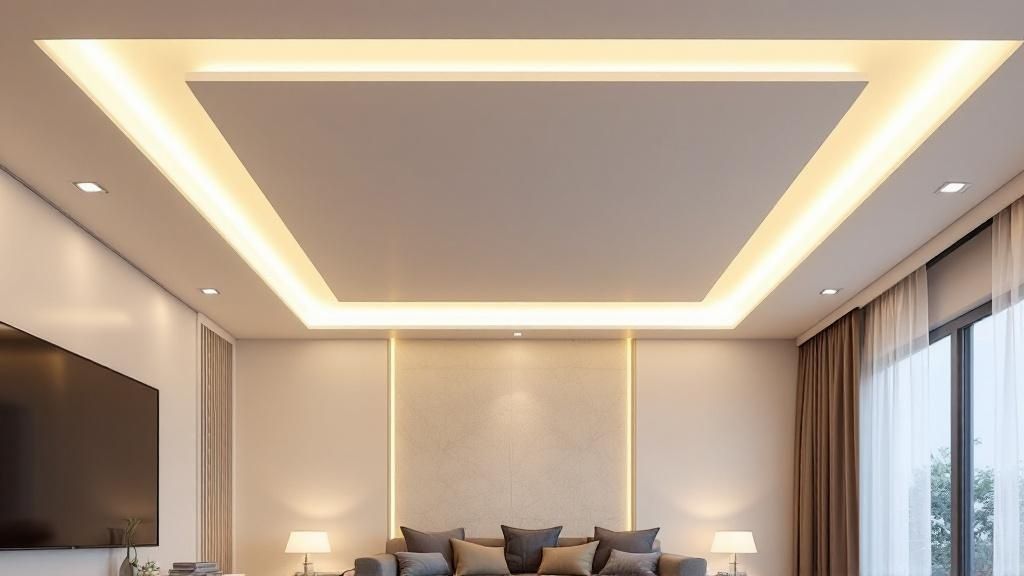
And let's not forget about lighting. A false ceiling gives you a blank canvas to design your perfect lighting setup. It makes it incredibly easy to install recessed lights, elegant cove lighting, or any other fixtures that would be a headache to fit into a solid concrete ceiling.
A well-designed false ceiling isn't just a passive element; it's an active system that makes a room more comfortable, efficient, and atmospheric. It’s a smart upgrade for any modern building.
The Core Advantages Summarised
To make it even clearer, installing false ceiling tiles solves a lot of common problems you see in both homes and commercial spaces. Here’s a quick look at their main benefits.
Key Benefits of Installing False Ceiling Tiles
This table sums up the major advantages you get when you opt for a false ceiling system in your building.
| Benefit | Description | Ideal For |
|---|---|---|
| Aesthetic Enhancement | Delivers a clean, uniform finish and comes in endless designs, textures, and colours to complement any interior décor. | Residential apartments, hotel lobbies, retail stores, and corporate offices. |
| Concealment of Services | Hides all the wiring, AC ducts, and plumbing pipes in the plenum (the space above the tiles), keeping the ceiling looking neat. | Hospitals, IT server rooms, commercial kitchens, and any space with complex M.E.P. (Mechanical, Electrical, and Plumbing) systems. |
| Acoustic Improvement | Absorbs sound and cuts down on echoes, creating a quieter and more peaceful environment. | Open-plan offices, classrooms, recording studios, restaurants, and home theatres. |
| Lighting Flexibility | Simplifies the installation of recessed lights, cove lighting, or dramatic pendant fixtures for sophisticated lighting designs. | Art galleries, showrooms, conference rooms, and modern homes seeking layered lighting effects. |
Ultimately, a false ceiling is a multi-functional solution that enhances a space in nearly every way that matters—from how it looks and feels to how efficiently it runs.
Choosing The Right Material For The UAE Climate
Picking the right material for your false ceiling tiles isn't just about what looks good. It's a huge decision that affects how long your ceiling will last and how well it performs, especially here in the UAE. Our unique climate—with its intense heat and swings in humidity—means some materials will hold up beautifully while others will quickly show their weaknesses. Get this choice right, and you'll have a ceiling that looks fantastic and works perfectly for years.
This focus on climate-appropriate materials is driving serious growth across the region's construction scene. The Middle East and Africa (MEA) ceiling tiles market was valued at around USD 436.5 million and is expected to shoot up to USD 830.2 million by 2033. This boom is fuelled by massive infrastructure projects, especially in Saudi Arabia and the UAE, where making the right material choice is everything.
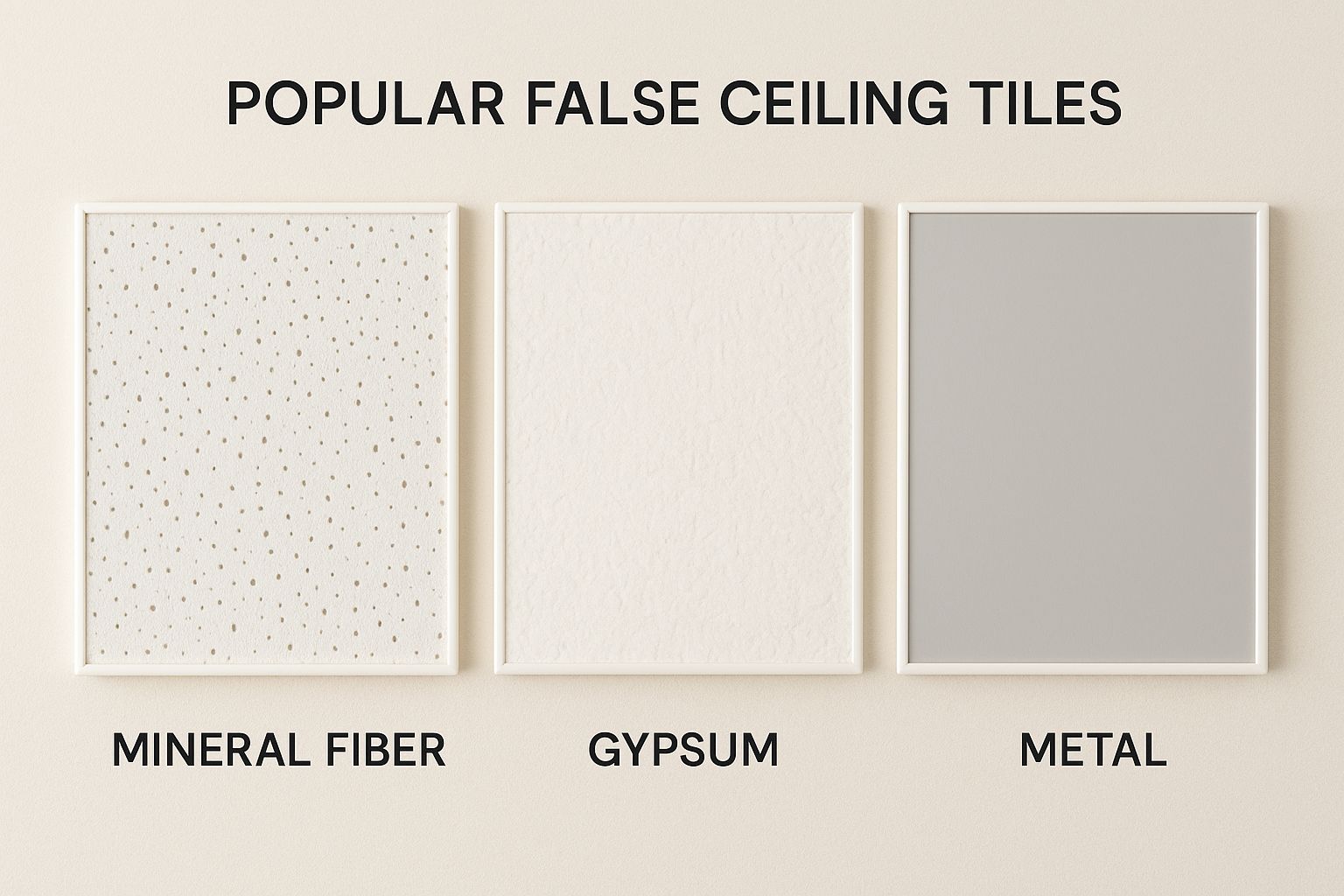
The image below gives you a close-up look at the textures of the three most popular materials you'll come across.
You can really see the difference—the perfectly smooth, paint-ready surface of gypsum, the slightly porous, sound-dampening texture of mineral fibre, and the clean, tough finish of metal. Seeing them side-by-side helps you choose based on both performance and style.
Gypsum: The Versatile Favourite
Gypsum is, without a doubt, the go-to material for false ceilings in homes and offices alike. And for good reason. It’s light, a breeze to install, and gives you that seamless, flawless finish that can be painted to match any decor.
One of gypsum's biggest selling points is its built-in fire resistance. The core of a gypsum board actually contains water molecules (it's chemically known as calcium sulphate dihydrate). When a fire breaks out, this water is released as steam, which helps to slow the fire's spread. This feature makes it a top pick for meeting strict building safety codes.
Gypsum dominates the market here in the MEA region. It's a winning formula of flexibility, fire safety, and affordability that delivers a high-end look without the hefty price tag.
But it has an Achilles' heel: moisture. Standard gypsum boards and humidity do not mix. In damp areas or places with a risk of leaks, gypsum can start to sag, stain, or even grow mould. For any "wet" areas like bathrooms, kitchens, or basements, you absolutely must use a moisture-resistant version, often called "green board," to avoid problems down the line.
Mineral Fibre: For Superior Acoustics
Step into almost any modern office, school, or clinic in the UAE, and the odds are you're standing under a mineral fibre ceiling. These tiles are the industry standard when you need to control sound. Made from a mix of natural and recycled materials, their slightly textured surface is fantastic at absorbing sound, cutting down on echoes, and stopping noise from travelling between floors.
This ability to absorb sound is measured by a Noise Reduction Coefficient (NRC) rating. Simply put, the higher the NRC number, the more sound the tile soaks up. Mineral fibre tiles come with a whole range of NRC ratings, so you can pick the perfect one for your acoustic needs.
They also provide a decent amount of thermal insulation and are typically fire-resistant. Their main weakness, much like gypsum, is moisture, which can cause them to droop and discolour over time. Because of this, they are best kept to climate-controlled indoor spaces. For a deeper look at materials, have a look at our guide on how to choose the right construction materials for Dubai's climate.
Metal Tiles: For Durability And Hygiene
When you absolutely cannot compromise on durability and moisture resistance, metal tiles are in a class of their own. Usually made from aluminium or steel, these panels are built to last. They won't warp, crack, or soak up a drop of water.
This makes them the perfect solution for:
- High-Humidity Areas: Think kitchens, bathrooms, changing rooms, and indoor pool areas.
- Hygienic Environments: Their surface is non-porous and incredibly easy to clean and sanitise, which is a must for hospitals, labs, and food prep facilities.
- High-Traffic Zones: They are tough enough to handle the wear and tear of busy airports, metro stations, and shopping centres.
Metal tiles are available in different finishes, and you can even get perforated versions that help with acoustics. Yes, they cost more upfront than gypsum or mineral fibre, but their incredible lifespan and minimal maintenance mean they often work out cheaper in the long run.
PVC And Wood: Aesthetic Choices With Caveats
For a more unique look, some people opt for PVC (Polyvinyl Chloride) or wood. PVC tiles are very lightweight, totally waterproof, and incredibly easy to maintain. They can be a great, budget-friendly alternative to metal in damp areas, but they don't always offer the same premium feel or level of fire resistance.
Wood, on the other hand, brings a natural warmth and a touch of luxury to a room. It can look absolutely stunning in hotel lobbies, boardrooms, or upscale homes. The big challenge with using wood in the UAE is its reaction to humidity, which can cause it to warp or swell. It needs to be properly treated and sealed, which makes it a more expensive and higher-maintenance choice.
Understanding Different Installation Systems
Choosing the right material for your false ceiling tiles is only half the story. The installation system is just as crucial, defining the final look, function, and ease of maintenance for your entire ceiling. Think of it this way: one is like buying a slick, pre-built shelving unit, and the other is like commissioning custom-fitted cabinetry. Both get the job done, but their appearance and how you interact with them are worlds apart.
Here in the UAE, two primary systems dominate the market: the modular grid system and the seamless system. Each has its own distinct personality and is perfectly suited to different environments, from the high-traffic corridors of a commercial centre to the refined calm of a luxury home. Let’s break down how they work so you can pick the right fit for your project.
The Modular Grid System
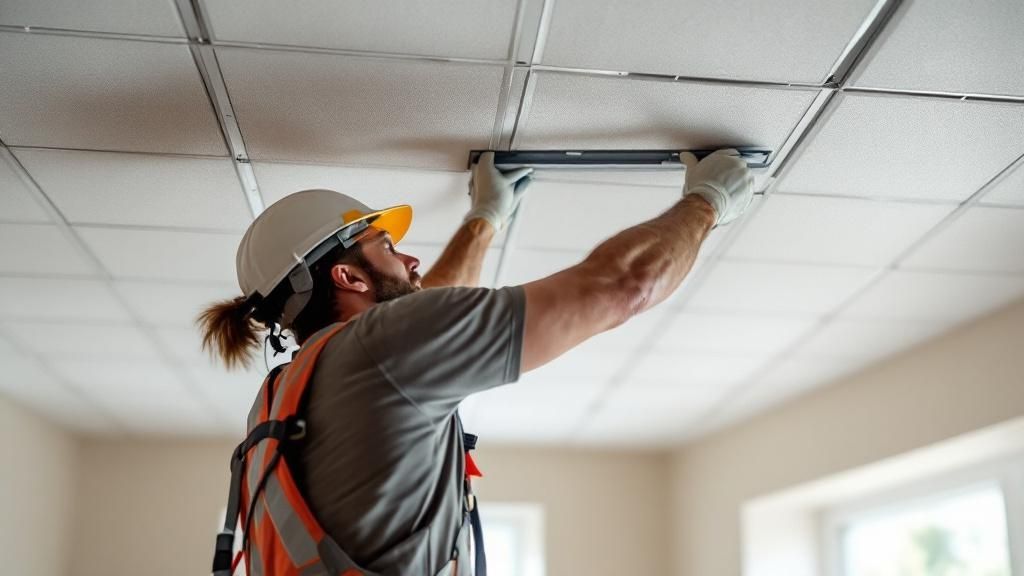
The modular or 'grid' system is the undisputed workhorse of the false ceiling world. You’ve definitely seen it—it’s the standard in countless offices, hospitals, and retail shops. The setup involves a metal framework, usually built from interlocking T-bars, that’s suspended from the main structural ceiling above. This creates a neat grid of standardised squares or rectangles.
Once that framework is up, the false ceiling tiles are simply laid into each opening. This straightforward "drop-in" approach is its greatest asset.
- Unbeatable Accessibility: Got to get to the wiring, plumbing, or an AC unit hidden in the plenum (the space above the ceiling)? Just pop a tile out. This makes maintenance and repairs unbelievably simple and budget-friendly.
- Speed of Installation: Putting the grid together and dropping in the tiles is far quicker than building a seamless ceiling from scratch, which is a massive plus for commercial projects where time is money.
- Flexibility: If a tile gets stained or damaged, you just swap out that one tile. No fuss, no mess, no disruption to the rest of the ceiling.
The grid itself can be either exposed, where you see the metal T-bars, or concealed, where the tiles have clever interlocking edges that hide the framework for a sleeker finish. For any commercial space where practicality and quick access are non-negotiable, the modular grid system is the clear winner.
Think of the modular grid system as a perfectly organised filing cabinet for your ceiling. Everything is neatly compartmentalised and instantly accessible, prioritising function without giving up a clean, professional aesthetic.
The Seamless System
When aesthetics are the number one priority, the seamless system steps into the spotlight. This method delivers a smooth, continuous surface that looks identical to a traditional plastered ceiling—no visible joints, no grid lines, just a flawless finish. It’s the go-to for creating a high-end, monolithic look in luxury homes, hotel lobbies, and executive boardrooms.
This system is most often built using gypsum boards, which are screwed onto a hidden metal frame. The joints between the boards are then meticulously taped, plastered, and sanded down to create that perfect, uniform surface ready for a coat of paint. To get a better sense of this popular approach, check out our in-depth guide on the benefits of a gypsum board ceiling.
Of course, that stunning visual appeal comes with a few trade-offs. Getting into the plenum for maintenance means cutting into the ceiling and patching it up afterwards, which is a more involved and costly affair. The installation is also more labour-intensive, requiring several stages of skilled finishing work to get just right.
Comparing The Systems At A Glance
To make the decision a bit easier, here’s a head-to-head comparison of the two main installation methods for false ceiling tiles.
| Feature | Modular Grid System | Seamless System |
|---|---|---|
| Appearance | Visible grid lines (unless concealed) | Smooth, monolithic, no visible joints |
| Accessibility | Excellent; tiles are easily removable | Poor; requires cutting and patching |
| Best For | Commercial spaces, offices, hospitals | Residential homes, hotels, high-end interiors |
| Installation | Fast and relatively simple | Slower and more labour-intensive |
| Maintenance | Easy; individual tiles can be replaced | More complex and costly to repair |
Ultimately, the choice comes down to balancing beauty with practicality. If you need effortless access to overhead utilities and want a fast, flexible solution, the modular grid system is your best bet. But if your goal is a pristine, high-end look and accessibility can take a back seat, then the seamless system is absolutely the way to go.
Marrying Design With Smart Lighting
It’s easy to think of a false ceiling as just a practical solution, a way to hide pipes and wires. But that’s selling it short. Think of it as your room's "fifth wall"—a blank canvas with enormous design potential. When you get the false ceiling tiles right, you can completely change the feel of a space, turning a simple cover-up into a real statement piece.
Your design journey starts with the basics: texture, colour, and pattern. Imagine a sleek, modern apartment in Downtown Dubai—it would probably benefit from large, smooth gypsum tiles in a brilliant white to make the space feel open and bright. On the other hand, a traditional majlis might call for tiles with delicate, embossed patterns to add a touch of timeless elegance. To keep your space feeling fresh, it’s always a good idea to see how your choices align with the latest home design trends.
A simple rule of thumb? Lighter colours like white, cream, or a soft grey will almost always make a room feel bigger and brighter. This trick is a lifesaver in smaller flats or offices where you want to create a sense of spaciousness.
Strategic Lighting Integration
Here’s where a false ceiling really shines—literally. The hidden space above the tiles, the plenum, is the perfect spot to run all your wiring. This lets you create clean, sophisticated lighting designs that you just can't pull off with a standard concrete ceiling. The fixtures you choose will set the entire mood for the room.
There are three main ways to approach lighting:
- Recessed Downlights: These are the clean, minimalist choice. The fixtures sit flush with the ceiling tiles, giving you a smooth, uncluttered look. They’re fantastic for general, all-over lighting and are a go-to for kitchens, hallways, and offices.
- Cove Lighting: This is all about atmosphere. LED strips are tucked away in a recess around the edge of the ceiling. The light is cast upwards, washing the ceiling in a soft, indirect glow that feels warm and inviting. It’s a perfect touch for living rooms, bedrooms, and high-end hotel lobbies.
- Drop Pendants and Chandeliers: Want to make a statement? A false ceiling gives you a strong, clean anchor for hanging dramatic fixtures. This is how you define a dining area, add a bit of drama to an entryway, or create a show-stopping centrepiece in a boardroom.
By mixing and matching these lighting styles, you can create a truly flexible space—bright and functional when you need to work, soft and relaxing when it's time to unwind.
Using The Ceiling To Define Your Space
In the UAE, open-plan layouts are everywhere, both in homes and offices. A false ceiling is a surprisingly clever tool for creating different "zones" without building a single wall.
Think about dropping the ceiling height just a little bit over a kitchen island or a cosy seating area. That simple change creates a subtle but clear visual boundary, marking that spot as its own distinct zone within the larger room.
You can get the same effect by changing the type or pattern of your false ceiling tiles. You could use slick, minimalist tiles for the main living area and switch to tiles with better sound-dampening qualities over a small home office corner. This is where design gets really smart, enhancing not just the look but the function of each part of the room. When noise control is a priority, it's worth exploring all your options—you can learn more about acoustic ceiling tiles in our detailed guide. This is how a simple ceiling becomes an intelligent, hard-working part of your home's architecture.
The Rise of Sustainable and Smart Ceilings
The world of construction never stands still, and false ceilings are changing right along with it. They're no longer just a passive layer to hide wiring and pipes; the modern false ceiling is fast becoming an active, intelligent part of the building itself. This evolution is being driven by two major forces: a serious push for sustainability and the integration of smart technology.
Here in the UAE, where green building initiatives are more than just a trend, this shift is particularly significant. The conversation has moved beyond simple durability to a focus on environmentally responsible materials. This means we're seeing a huge demand for false ceiling tiles made from recycled content and, just as importantly, those with low Volatile Organic Compound (VOC) emissions. Low-VOC materials are a must for healthy indoor air quality, which is a cornerstone of certifications like LEED or Estidama.
Sustainable Materials for a Greener Future
When we talk about sustainability in ceilings, it's not just about using recycled materials. It's also about a building’s day-to-day energy performance. High-performance tiles with excellent thermal insulation properties are becoming the standard because they create a much more effective barrier against the region's intense heat. This one feature can dramatically reduce the workload on air conditioning systems.
A well-insulated ceiling doesn't just feel more comfortable; it can lead to a noticeable drop in energy consumption. That translates directly into lower electricity bills and a smaller carbon footprint for the whole building.
This is a perfect example of how a smart design choice can deliver both environmental wins and real long-term cost savings. As developers and property owners get more savvy about operational expenses, the appeal of these energy-saving solutions is only going to grow.
Smart Ceilings: The Next Frontier
While sustainability tackles a building's environmental impact, smart technology is completely changing how we interact with our spaces. A 'smart ceiling' isn't just a futuristic concept anymore. It’s a system where the false ceiling tiles and grid are integrated with a network of sensors and connected devices, effectively turning the ceiling into the building's central nervous system.
Imagine a system that can:
- Automate Lighting: Occupancy sensors detect when a room is empty and switch off the lights automatically. No more wasted energy, no more flicking switches.
- Optimise Climate Control: Tiny sensors monitor temperature and humidity, feeding live data to the HVAC system to make constant, subtle adjustments for perfect comfort and peak efficiency.
- Track Occupancy: In big commercial spaces, these sensors can provide incredible data on how different areas are used, helping facility managers make smarter decisions about layouts and resources.
This isn't science fiction; it's happening right now. The market data backs this up, with the MEA ceiling tiles market volume projected to explode from roughly 1009.12 million square metres to nearly 2546.88 million square metres by 2034. A huge driver of this growth is the adoption of smart ceiling solutions that fit perfectly with the UAE's smart city ambitions. You can find more details on this trend in market reports from ExpertMarketResearch.com.
All of this shows that the humble ceiling is transforming into a high-performance component, actively making our buildings more efficient, comfortable, and intelligent. The future of the "fifth wall" isn't just about looking good—it's about working smarter for all of us underneath it.
Common Questions About False Ceiling Tiles
When you're knee-deep in a construction or renovation project, the questions start piling up. And when it comes to false ceiling tiles, practical concerns about cost, durability, and safety are always at the top of the list for property owners and managers across the UAE. Let's clear the air and give you some straightforward answers to the most common queries we hear.
This section tackles the big questions, giving you the confidence to make smart decisions that work for your budget and your project’s future.
What Is The Average Cost Of False Ceiling Tiles In The UAE?
Pinning down the exact price of a false ceiling is a lot like pricing new flooring—it all depends on what you choose. The final cost is a mix of the material, the design's complexity, and the sheer size of the space.
A simple, clean-looking gypsum board ceiling is often the starting point, kicking off at around AED 45 per square metre. It’s a fantastic, budget-friendly option for homes and offices where you just want a smooth, elegant finish.
But if you need more performance, the price tag goes up. High-performance mineral fibre tiles, brilliant for sound absorption, or tough metal tiles for humid areas can easily push the cost past AED 150 per square metre. Throw in some fancy design work, like multi-level drops or integrated cove lighting, and that will add to the final bill, too.
Always ask for a detailed quote that breaks everything down. It shouldn't just list the tiles; it needs to cover the grid system, labour, painting, and any electrical work for your new lights.
It’s also worth remembering that a higher-quality, low-maintenance material often ends up being the better long-term value.
How Long Do False Ceilings Last And What Maintenance Is Needed?
The lifespan of your false ceiling really comes down to two things: the material it's made from and the environment it's in. With a bit of care, it’ll be a lasting feature of your space for years to come.
- Gypsum and Mineral Fibre: In a standard, dry indoor setting, you can easily expect these to last for 15-20 years. Their main weakness is moisture, which can lead to sagging, ugly stains, or even mould.
- Metal and PVC: These are the real heavyweights. They shrug off moisture and corrosion, lasting well over 20-25 years. This makes them the go-to choice for tricky areas like kitchens, bathrooms, and basements.
Maintenance is surprisingly simple. A regular dusting or a quick wipe with a damp cloth is usually all it takes to keep the tiles looking brand new. The most important job is preventing water damage from above. If you fix any leaks in the main ceiling right away, you'll protect your investment and ensure your false ceiling tiles stay perfect for decades.
Can I Install Lights And AC Vents In Any False Ceiling?
Absolutely. In fact, that's one of the main reasons people love false ceilings. They make it incredibly easy to integrate all those essential services—lights, AC vents, speakers, you name it—cleanly and professionally.
That gap between the main ceiling and the suspended grid (we call it the plenum) is designed specifically to hide away all the wiring and ductwork. Whether you choose gypsum, mineral fibre, or metal, the tiles can all be cut easily to fit any fixture.
The key word here, though, is planning. You need to know exactly where every light and vent is going before the installation kicks off. This lets your contractor:
- Strengthen the grid where heavy items like chandeliers will hang.
- Make precise cuts for a flawless finish around every fixture.
- Work smoothly with electricians and HVAC teams, avoiding any last-minute headaches.
A little planning up front guarantees the final result is not just beautiful, but also structurally sound and perfectly functional.
Are Fire-Resistant False Ceiling Tiles Available?
In the UAE, fire safety isn't just a good idea—it's the law. Thankfully, many false ceiling materials come with excellent fire-resistant properties, making it easy to stay compliant with local building codes.
Gypsum is a natural fire-retardant. Its core contains water molecules that, when heated, turn to steam and slow down the spread of fire. For even greater safety, you can get special fire-rated gypsum boards.
Mineral fibre and metal ceilings are also designed with fire safety as a priority.
- Fire-Rated Tiles: You can find both gypsum and mineral fibre tiles with specific fire ratings, some providing protection for up to 120 minutes.
- Non-Combustible Materials: Metal ceilings won't burn at all, making them a top choice for areas where fire safety is the number one concern.
For any commercial or public building in the UAE, you must use products that meet the strict standards set by the Civil Defence authorities. Always double-check the fire rating of your false ceiling tiles to ensure you're fully compliant.
For a comprehensive selection of certified building materials and hardware that meet the highest standards of quality and safety, turn to the experts. Yasu Trading Co. LLC provides a complete range of construction essentials to bring your project to life. Explore our product offerings and request a quote today!