Fire Blanket Versus Extinguisher: Which Fits?
A fire blanket versus extinguisher decision should not be treated as an either-or purchase for most professional sites. The two products control fire in different ways, address different early-stage risks, and require different placement and maintenance plans. For contractors, fit-out teams, facilities managers, and procurement departments, the right question is: which equipment belongs at each risk point, and what approved extinguisher coverage is still required?
Fire Blanket Versus Extinguisher: The Core Difference
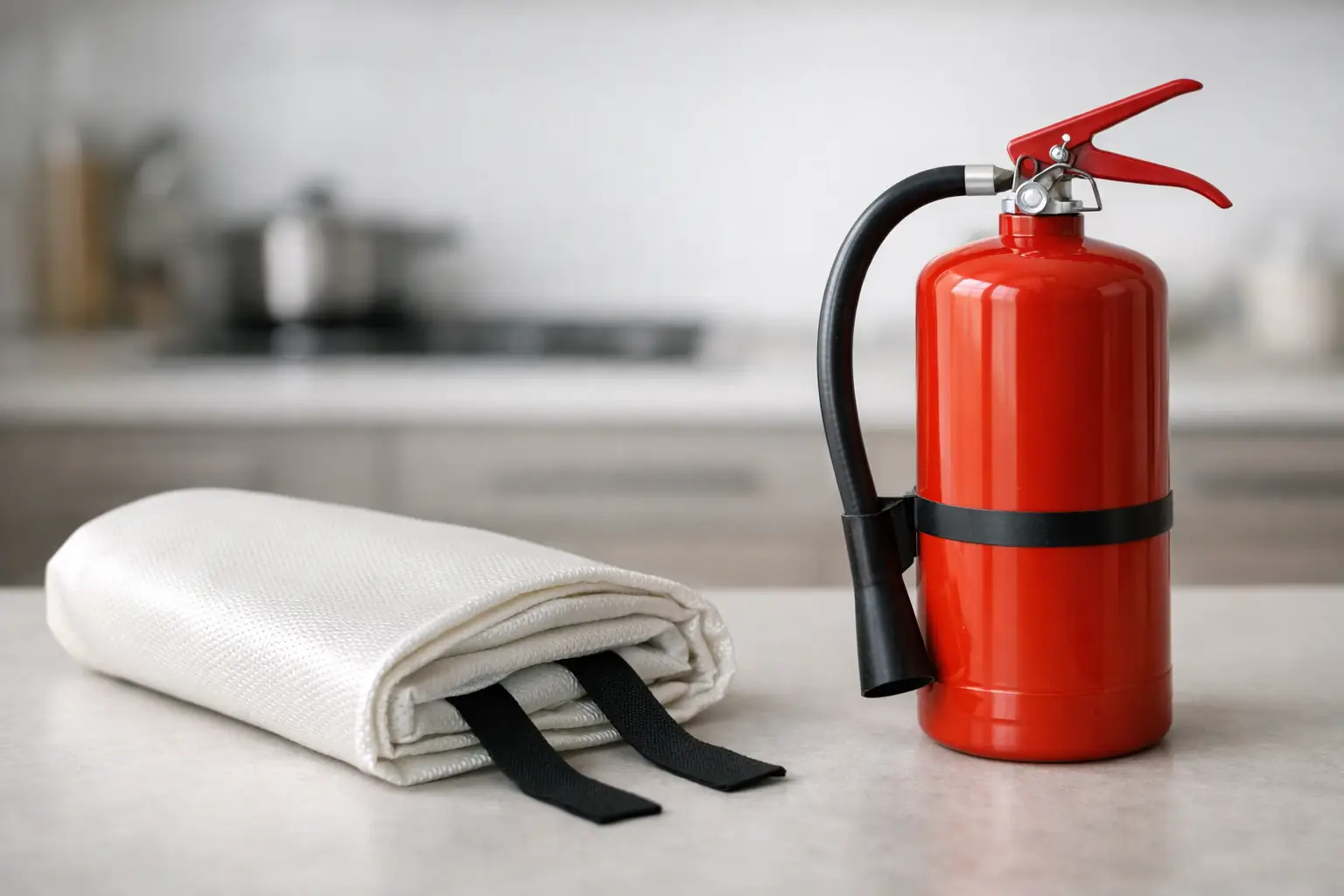
A fire blanket works by covering a small fire and cutting off its oxygen supply. It is a simple, fast option for an incipient fire where the user can safely place the blanket over the source without getting too close. Its strongest application is a small cooking-oil or pan fire in a kitchenette, staff pantry, restaurant preparation area, or temporary welfare unit.
A portable fire extinguisher discharges a fire-suppressing agent. Depending on its type and rating, it can tackle fires involving ordinary combustibles, flammable liquids, energized electrical equipment, metals, or cooking oils. It provides greater reach than a blanket and is generally the primary first-response equipment for broader jobsite and building risks.
This difference matters during specification. A blanket is not a substitute for a compliant extinguisher arrangement in an office, tower floor, workshop, plant room, warehouse, or active construction area. It is a targeted addition where a small contained fire, especially involving cooking oil, is credible.
Where a Fire Blanket Is the Better Tool
A fire blanket has real operational value when the hazard is small, close-range, and predictable. In a pantry, it can be removed from its wall-mounted pouch, held as a shield, and carefully placed over a burning pan. The blanket should remain in place until the pan has cooled fully. Lifting it too early can reintroduce oxygen and cause re-ignition.
The advantages are straightforward: no pressurized cylinder, no discharge residue, minimal training complexity, and no risk of spreading burning liquid through an incorrect extinguisher technique. It is also useful where cleanup from dry chemical powder or foam would create avoidable disruption around food-preparation equipment.
Its limits are equally important. A blanket has to be placed directly over the fire. That means the user must approach the hazard, which is not appropriate where flames are already spreading, smoke is heavy, or the route to exit is compromised. It is not suitable for electrical panels, solvent stores, gas-cylinder areas, welding operations, or general site fire protection.
A fire blanket should be visibly mounted near the escape route from a kitchenette or cooking point, not behind the appliance or inside a cabinet. The user needs to reach it without moving toward the fire.
When an Extinguisher Is Necessary
Extinguishers are selected by fire class, agent, capacity, and the hazards present. For a construction or facilities portfolio, one generic extinguisher type rarely gives adequate coverage. The fire load in a temporary site office is different from the risk in a generator area, electrical room, joinery workshop, kitchen, or fuel storage zone.
For ordinary combustibles such as timber, paper, packaging, and fabrics, water-based units may be appropriate where there is no energized electrical risk. Foam extinguishers are commonly used for certain solid and flammable-liquid risks. Carbon dioxide extinguishers are frequently specified near energized electrical equipment because they leave no residue, although their discharge range and cooling effect are limited.
Dry chemical powder extinguishers can provide broad coverage and are often practical for outdoor or industrial areas. However, powder can impair visibility, contaminate equipment, and create substantial cleanup work. It may not be the best choice for a finished fit-out, data-sensitive environment, or occupied commercial interior unless the risk assessment supports it.
For cooking-oil hazards, a wet chemical extinguisher is the specialized choice. In US terminology, this is associated with Class K fires. In many international specifications, cooking-oil fires are described as Class F. Procurement teams should verify the project’s applicable authority requirements, approved fire strategy, and client specification rather than relying on a label alone.
Match the Equipment to the Risk Point
The practical approach is to map equipment to actual activities, not merely floor area. A temporary office may need extinguisher coverage for paper, electrical devices, and pantry appliances. A kitchen requires its applicable cooking-oil protection, with a fire blanket as a supplementary item for a small pan fire. A welding zone needs controls for hot work, combustible removal, a fire watch where required, and suitable extinguisher access. Extinguishers alone do not make hot work safe.
For equipment rooms, consider the electrical hazard and the consequence of residue. For external work areas, consider heat, dust, weather exposure, vehicle movement, and whether the extinguisher can be reached quickly without crossing the likely fire path. In storage areas, review the goods being stored, pallet and packaging volume, flammable liquids, battery charging, and the distance to exits.
A useful site rule is simple: the first-response equipment must be visible, accessible, correctly signed, and placed along a safe route of travel. Equipment hidden by stored materials, locked in a supervisor’s office, or mounted where a fire would block access does not provide meaningful protection.
Placement and Procurement Mistakes That Create Delays
The most common procurement error is buying a blanket because it is inexpensive and assuming it covers a pantry fire risk. The opposite error is purchasing an extinguisher without confirming the extinguisher agent, rating, bracket, cabinet requirement, signage, inspection tagging, and maintenance arrangement.
Another issue is specifying equipment by price alone. Low-cost units with unclear approvals, missing documentation, or uncertain service support can create inspection problems and replacement costs later. Safety-critical products should be sourced with the same discipline used for electrical protection devices or approved plumbing materials: confirm compliance, authenticity, and suitability before delivery to site.
For multi-site contractors, standardizing a basic schedule helps reduce rushed substitutions. The schedule can identify the hazard area, approved extinguisher type and size, mounting method, signage, inspection interval, and responsible party. It also makes replenishment faster when a unit has been discharged, damaged, or removed for servicing.
Training Decides Whether Either Product Helps
Neither a fire blanket nor an extinguisher should encourage employees to fight a fire beyond its earliest controllable stage. Personnel need a clear instruction: raise the alarm, call emergency services according to site procedure, protect the exit route, and only attempt first response if they are trained, the fire is small, and evacuation remains immediately possible.
For extinguishers, training should cover selecting the correct unit, keeping distance, aiming at the base of the fire where appropriate, and recognizing when to stop. For blankets, staff should understand the pull-tab release, how to shield their hands, and why they must not throw a blanket at a fire from across the room.
Site induction should also cover what not to do. Water must not be used on energized electrical equipment or burning cooking oil. A fire blanket should not be relied on for a spreading fire. And a discharged extinguisher must be removed from service and replaced or serviced promptly, even if it appears partly full.
Build a Compliant, Ready-to-Use Fire Response Plan
For UAE projects, align the final fire equipment schedule with the approved drawings, authority requirements, building management rules, and the project fire and life-safety consultant’s direction. Requirements can differ between a temporary construction setup, a completed commercial unit, a restaurant fit-out, and an industrial facility.
Yasu Trading supports contractors with jobsite-ready fire and safety equipment alongside the wider materials needed to keep work moving. Consolidating the requirement can reduce supplier coordination, but the specification should always lead the purchase. Confirm quantities, extinguisher agents, mounting accessories, signage, and delivery sequence before mobilization.
The most effective fire response setup is rarely the one with the most equipment. It is the one that puts the correct, compliant tool within reach of the real hazard, keeps access clear, and gives the people on site the judgment to leave when the fire is no longer small.