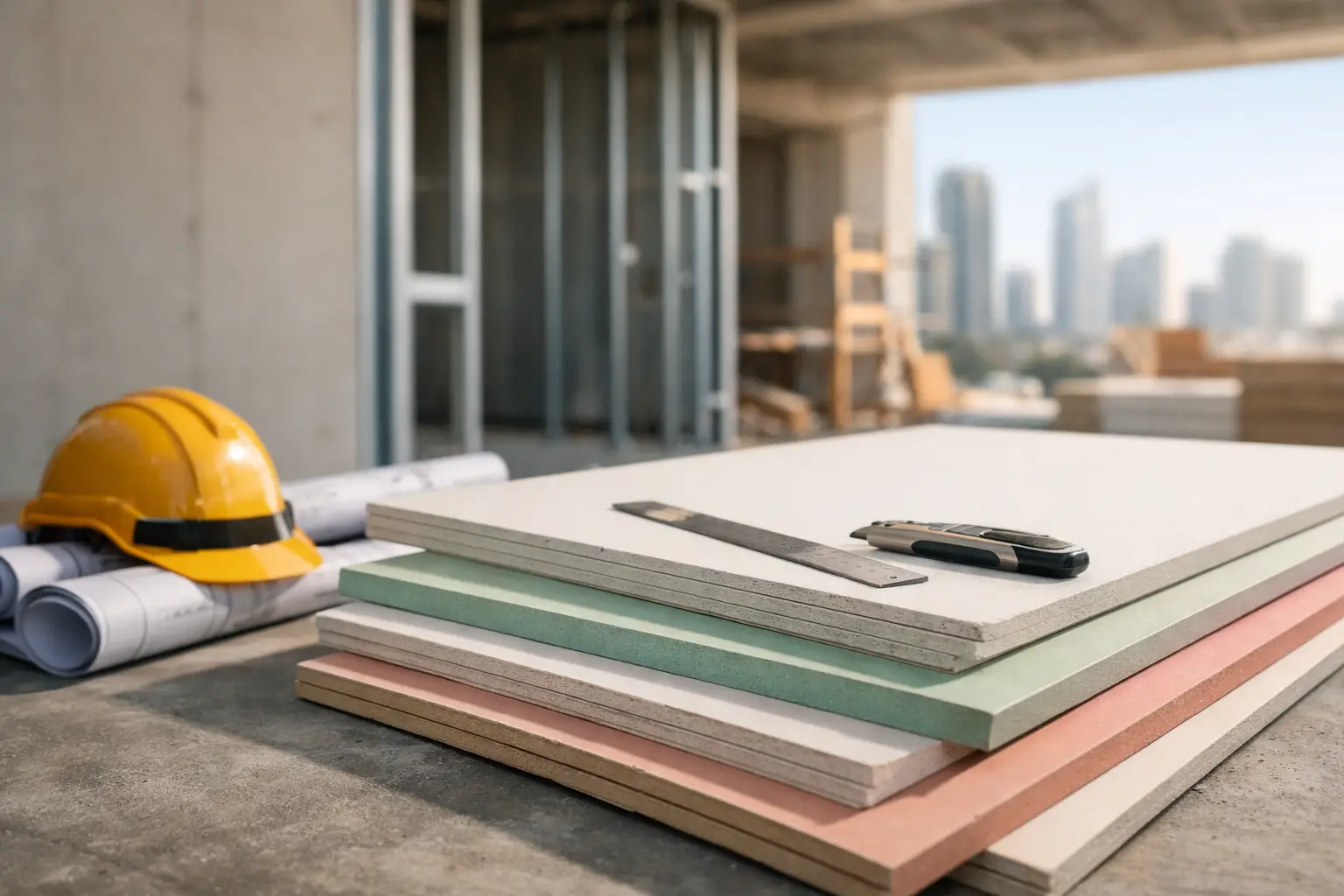
Gypsum Board Selection for UAE Project Sites
A gypsum board package can look straightforward on a material schedule, then become a source of delay when the wrong board type reaches the site. A standard panel installed in a wet-service area, an unverified fire-rated assembly, or mismatched board thickness can trigger rework, slow inspections, and disrupt follow-on trades. For contractors and fit-out teams, gypsum board selection is not only a finishing decision. It is a coordination, compliance, and delivery decision.
The right approach starts with the wall or ceiling system, not the panel alone. Board type, thickness, framing, insulation, fasteners, joint treatment, access requirements, and service penetrations all affect the finished performance. Procurement teams that confirm these details before issuing a bulk order protect both the program and the project budget.
Start With the Required System Performance
Gypsum board is used for partitions, wall linings, suspended ceilings, bulkheads, shaft walls, and decorative details because it provides a practical, dry-construction solution. Yet one board specification cannot serve every application. The drawings, authority requirements, consultant specifications, and manufacturer system data should determine the final selection.
For general internal partitions in dry areas, standard gypsum board may be suitable where no special fire, moisture, impact, or acoustic performance is required. It is cost-effective and widely used, but it should not be treated as a default for every room.
Fire-rated assemblies require more discipline. A fire-resistant board may form part of a tested wall or ceiling system, but the board itself does not establish the full rating. Stud gauge and spacing, number of board layers, screw pattern, insulation, joint treatment, perimeter details, doors, access panels, and penetrations must all align with the approved assembly. Replacing one component without verification can compromise the specified rating.
For bathrooms, kitchens, plant rooms, and other humid spaces, moisture-resistant gypsum board is commonly specified. It is designed to perform better under intermittent humidity and limited moisture exposure than standard board. It is not a substitute for waterproofing in showers, wet rooms, or continuously wet areas. Where tile, membranes, or cementitious backer boards are required, the wall build-up should follow the design and waterproofing system requirements.
Acoustic partitions need a similarly complete view. Board density and layer count matter, but sound control also depends on cavity insulation, sealing, resilient details, door performance, and the management of gaps around MEP services. A high-performing acoustic board will not correct an unsealed perimeter or an open service penetration.
Specify Gypsum Board by Application, Not Appearance
Panels can look almost identical once stacked in a warehouse or delivered to a floor. Procurement requests should therefore state the exact application and performance requirement rather than asking simply for "drywall sheets." This makes quotations more accurate and reduces the risk of substitutions that do not match the approved material schedule.
A clear request should identify board type, thickness, panel dimensions, edge profile, required rating, brand approval where applicable, and quantity by area or floor. It should also confirm whether the board is for walls, ceilings, shafts, curved work, or high-traffic areas. For large projects, separate quantities by release date so materials arrive in sequence with framing and MEP progress.
Thickness is especially relevant. Thinner boards can suit some ceiling applications or curved details, while thicker boards may be necessary for partition stiffness, impact resistance, acoustic performance, or fire-rated systems. Double-layer assemblies may be specified where performance targets cannot be achieved with a single panel. The lowest unit price per sheet is not necessarily the lowest installed cost if the selected board creates extra labor, fails an inspection, or requires replacement.
Impact-resistant options are worth evaluating in corridors, schools, healthcare environments, service areas, loading zones, and spaces exposed to frequent trolley or equipment traffic. They may cost more upfront, but repair work after handover is expensive and disruptive. The same principle applies to abuse-resistant corner details and suitable accessories in high-use areas.
Do Not Separate Board Selection From MEP Coordination
Partition performance is often lost at the point where another trade enters the wall. Electrical back boxes, cable trays, plumbing sleeves, pipe supports, fire dampers, and access panels all need planned details. Late openings cut into completed boards can lead to damaged edges, weak support, acoustic leakage, or unapproved fire-stopping conditions.
Before board closure, coordinate the MEP shop drawings with the partition layout and confirm who is responsible for each penetration. Where a fire-rated or acoustic system is involved, use approved penetration sealing and access solutions that maintain the required performance. This is a small coordination step with a major effect on handover readiness.
Procurement Checks That Prevent Site Delays
Gypsum boards are vulnerable to poor handling. A compliant product can still be unusable if it arrives with crushed corners, water exposure, excessive sagging, or damage from incorrect storage. Delivery planning should be part of the purchase order, particularly for high-rise fit-out work and projects with limited laydown space.
Confirm that boards will be delivered flat, protected from weather, and moved to a dry storage location. Store stacks on level bearers, clear of direct ground moisture, and avoid overloading slabs or placing material where it blocks access routes. If boards are moved by elevator or hoist, verify panel lengths and loading limits before dispatch. A delivery that cannot reach the intended floor becomes an immediate labor issue.
For phased projects, site-direct delivery is usually more effective than receiving the full quantity at once. It reduces damage, protects working space, and keeps cash tied to materials that are ready for installation. It also requires dependable stock visibility and release planning. Contractors should share forecast quantities early, then issue confirmed call-offs based on actual floor progress.
Quality checks at receipt should be simple but consistent. Verify the brand, type, thickness, dimensions, labels, batch information where required, and physical condition before signing the delivery receipt. Compare the materials with the approved submittal, not only the purchase order. If the project requires manufacturer documentation, warranties, or test evidence, collect it before installation begins rather than during closeout.
Installation Quality Begins Before Jointing
A clean finished surface depends on proper framing and board fixing. Studs and channels must be aligned, adequately supported, and installed at the specified spacing. Boards should be fixed with the correct screw type and spacing, with screw heads set correctly without breaking the paper face. Broken paper weakens the hold and creates unnecessary finishing work.
Board joints should be staggered where the system requires it, and horizontal joints should not be placed where they create avoidable weak points or conflict with services. Perimeter gaps, deflection head details, and movement joints need attention, especially in large areas and structures subject to movement. These details are not cosmetic. They help prevent cracking after completion.
Joint compound, tape, corner beads, trims, and sealants should be compatible with the board system and final finish. A rushed jointing sequence, poor drying conditions, or insufficient sanding can show through paint under site lighting. Fit-out teams should plan enough time between coats and coordinate paint works only after surfaces meet the required finish level.
Common Costly Mistakes
The most frequent errors are predictable: using standard board in moisture-prone spaces, assuming a fire board alone creates a fire rating, ordering without confirming panel dimensions and thickness, and accepting damaged boards because the installation crew is waiting. Another common mistake is treating accessories as minor items. Screws, tapes, joint compounds, metal framing, insulation, sealants, and fire-stopping products all influence the system outcome.
Price comparisons should therefore be made on an equivalent system basis. A quote that excludes matching accessories, documentation, or scheduled delivery may look lower until the site team begins chasing missing items. Consolidated procurement can reduce this risk by aligning boards and supporting construction materials under one delivery plan.
Build a Supply Plan Around the Work Front
For contractors managing multiple areas, gypsum board should be ordered against the installation sequence: framing completion, MEP first fix, inspection, board closure, jointing, and final finishes. This avoids sending boards to floors that are not ready while another active work front waits for material.
Yasu Trading Co. LLC supports project buyers with jobsite-ready material coordination, wholesale quoting, and delivery planning for Dubai and wider UAE projects. The practical objective is straightforward: approved materials should reach the work front in the correct type, quantity, and condition when the installation team is ready.
The best gypsum board decision is the one that holds up after the walls are closed - through inspection, finishing, handover, and the daily use of the completed space. Specify the full system, verify the delivery, and keep every trade aligned before the first sheet is fixed.