Gypsum Board Sizes in UAE | Find Your Perfect Fit
If you’ve spent any time on a construction site, you know that some materials are just standard. When it comes to interior walls and ceilings, the go-to size for gypsum board is almost always 1220mm x 2440mm (4ft x 8ft). This isn't by accident; this size has become the industry benchmark across the UAE for a reason. It's simply the most efficient option for transport, handling, and installation.
A Quick Reference for Standard Gypsum Board Sizes
Understanding the common dimensions of gypsum board—often called plasterboard—is fundamental to planning your project right. These sizes are standardized to work seamlessly with typical building frameworks, which helps minimize waste and speed up the installation process. For instance, the universal 1220mm (4ft) width is designed to span perfectly across wall studs spaced at 400mm or 600mm centres.
These common sizes hit the sweet spot between providing good coverage and being manageable. A single 1220mm x 2440mm board covers a decent amount of wall, but it’s still light enough for a two-person crew to handle without needing special lifting equipment. If you're dealing with high ceilings, longer boards are available. Using them is a smart move to reduce the number of horizontal joints, which gives you a much cleaner, more professional finish.
Common Board Dimensions and Applications
Here in the UAE, construction projects run smoothly when materials are standardized. It ensures everyone—from architects to installers—is on the same page. The gypsum boards you'll find here typically follow international sizing to make handling and installation as efficient as possible. If you want to dig deeper into the specifics of the regional market, this analysis from Verified Market Research offers some great insights.
Below is a quick-reference table to help you match the right board dimensions to your job.
Standard Gypsum Board Dimensions and Common Applications
This table outlines the standard gypsum board (plasterboard) dimensions available in the UAE and highlights their most common uses in both residential and commercial projects.
Dimension (Width x Length) Metric Equivalent (mm) Common Thicknesses (mm) Primary Application 4ft x 8ft 1220 x 2440 9.5, 12.5, 15.9 Standard walls and ceilings in residential and commercial jobs. 4ft x 10ft 1220 x 3050 12.5, 15.9 High ceilings, reducing horizontal joints for a seamless finish. 4ft x 12ft 1220 x 3660 12.5, 15.9 Taller walls and long runs where minimizing joints is critical. 2ft x 2ft 600 x 600 9.5, 12.5 Ceiling tiles for suspended grid systems. This chart is a great starting point for planning. It shows how the standard 4ft width is a constant, while the length varies to accommodate different wall heights, helping you work more efficiently and reduce waste.
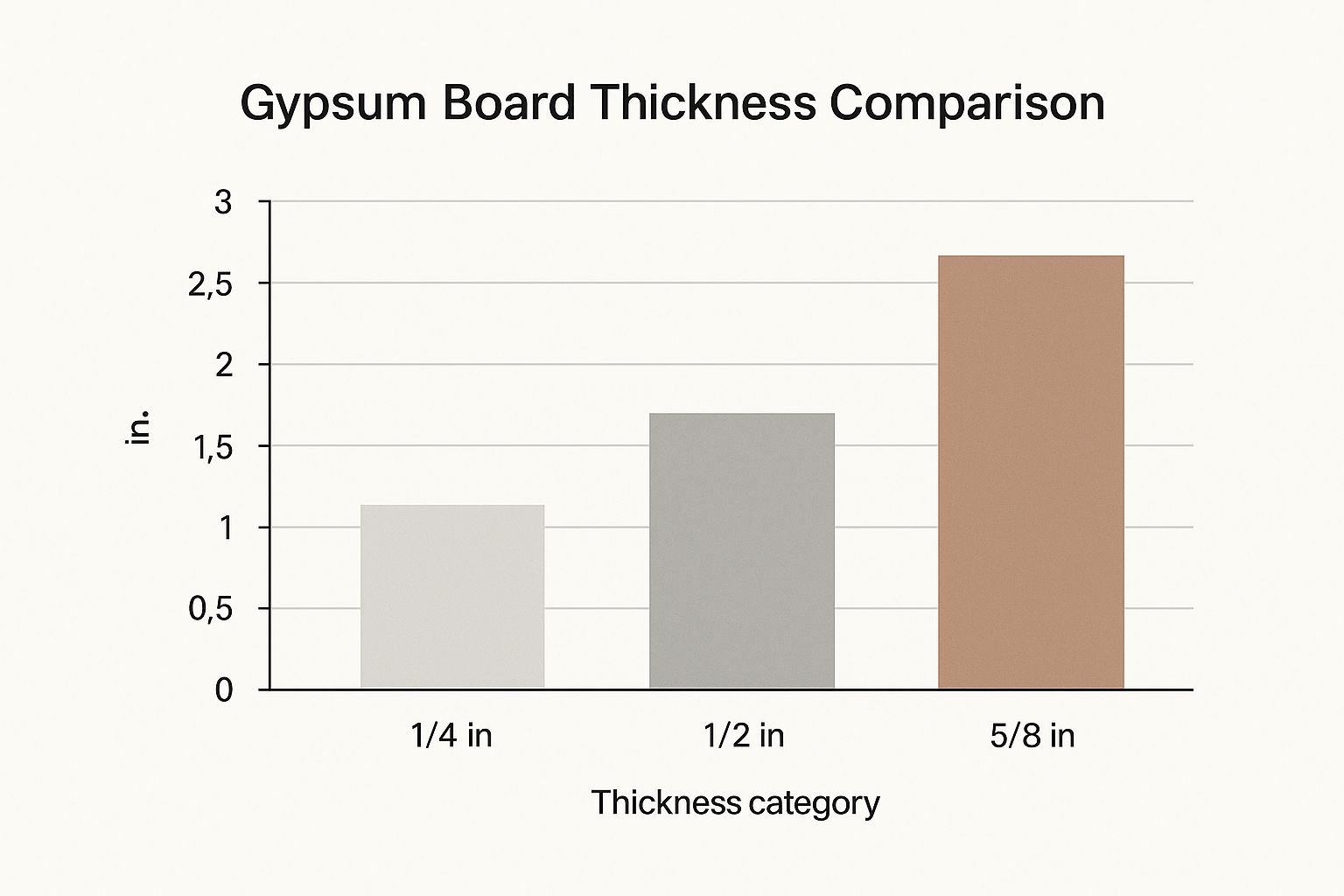
As you can see from this breakdown, there's a big difference in thickness between the options. The 1/4-inch board is quite flexible, but the 1/2-inch and 5/8-inch boards are the real workhorses. Their added thickness and rigidity make them the right choice for standard walls and, especially in the case of 5/8-inch, for fire-rated assemblies where safety is paramount.
Choosing the Right Gypsum Board Thickness
Picking the right gypsum board thickness is one of those decisions that can make or break a project. It’s not just about covering studs; the thickness you choose directly impacts a wall's strength, how well it blocks sound, and its fire resistance. You’ve got a few options, and the right one really depends on where it’s going—whether it's a standard wall in a villa or a high-traffic hallway in a commercial building.
Getting this right from the start means your project will not only perform as expected but will also sail through UAE building code inspections. The most common thicknesses you'll see on-site are 9.5 mm and 12.5 mm for walls, with ceilings sometimes using slightly different specs. In fact, somewhere between 60-70% of construction jobs in the UAE stick to these standard sizes, a testament to their reliability and availability from local and global suppliers.
Common Thicknesses and Their Ideal Applications
Matching the board to the job is where the real expertise comes in. Here’s a quick rundown of the most common thicknesses and where they shine:
- 6mm Boards for Curved Surfaces When you need to create a curved wall, an archway, or any kind of flowing architectural detail, the 6mm board is your best friend. It’s thin, flexible, and light enough to bend and shape on the job site without much fuss.
- 9.5mm and 12.5mm Boards for General Use These two are the true workhorses of the drywall world. Both the 9.5mm (3/8") and 12.5mm (1/2") boards hit that sweet spot of strength and workability, making them perfect for most interior walls and ceilings in homes and offices. If you need a bit more sound dampening or impact resistance, the 12.5mm is the go-to choice.
For the majority of projects, you really can't go wrong with the 12.5mm board. It offers a noticeable step up in acoustic performance and structural feel over thinner boards, all without getting into the specialized (and more expensive) fire-rated panels. It’s the best all-around value.
Specialised Thickness for Enhanced Performance
Sometimes, standard just won't cut it. For areas that need an extra layer of protection, you have to go thicker.
A 15mm (5/8") or even thicker fire-rated gypsum board, often called Type X, is required for areas where fire safety is paramount. Think commercial corridors, stairwells, and the walls separating apartments. These boards have glass fibers and other additives baked into their core, which helps them hold up longer against fire and slow its spread—a non-negotiable safety feature. Thinking about material properties is crucial, much like you would when looking over our guide on https://yasutrading.com/blog/plywood-board-sizes/. This ensures you’re choosing the best material for both the structure and its safety requirements.
Comparing Gypsum Board Widths and Lengths
While a board’s thickness is all about performance, its width and length are where you can get smart about installation efficiency and a clean finish. The standard width for gypsum board is almost always 1220mm (4ft). This isn't a random number—it’s designed to perfectly match standard wall stud spacing, which dramatically cuts down on cutting and waste on the job site.
This consistent width makes planning straightforward, but it's the board's length that offers a real strategic advantage. Choosing the right length for your room's dimensions can save a surprising amount of time and labor, directly impacting the project's final cost and appearance.
Understanding Panel Lengths
The length of your gypsum board dictates the number of seams you'll have to tape and finish. It’s simple, really: fewer joints mean a smoother wall and less work for your crew.
- 2440mm (8ft) Boards: This is your everyday workhorse, the most common length you'll find. It’s perfect for standard residential rooms with ceilings around 2.4 meters, allowing one board to span from floor to ceiling when installed vertically.
- 3000mm (10ft) and 3660mm (12ft) Boards: For modern commercial spaces or homes with higher ceilings, these longer boards are the professional's choice. By running a single board vertically, you can completely eliminate those tricky horizontal joints that are notoriously hard to conceal.
Pro Tip: When you're dealing with walls longer than 12 feet, think about hanging the boards horizontally. We call this "railroading," and it can slash the total linear footage of joints you need to finish by as much as 25%. That's a huge time-saver when it comes to taping and mudding.
Opting for a longer board in a high-ceiling room is always a smart play. Not only does it speed up the installation, but it also delivers a superior, monolithic look that's expected in high-end projects. This approach minimizes the chance of imperfections and gives you that truly professional finish.
How Board Type Influences Size and Selection
Thinking beyond just length and width is where the real expertise comes in. The specific type of gypsum board you choose is absolutely critical, as each one is engineered for a completely different job. This function has a direct impact on which gypsum board sizes and thicknesses make sense for your project.
While you'll find most specialized boards come in standard dimensions like 1220mm x 2440mm, it’s what’s inside—the core composition—that dictates performance. Standard wallboard is your everyday workhorse for most dry interior walls, but it just won't cut it in high-humidity areas. For places like bathrooms, kitchens, and especially laundry rooms in the UAE's humid coastal climate, you need something tougher.
Specialised Boards for Specific Needs
To build something that lasts and meets safety standards, you have to match the board to the environment. It’s that simple. Here’s a quick rundown of how different boards solve specific problems:
- Moisture-Resistant Boards: You’ll often hear these called "green board." They are built with a water-resistant core and a special facing paper designed to stop moisture in its tracks. Using them is non-negotiable for preventing mold and material breakdown in damp spots.
- Fire-Resistant (Type X) Boards: These are the heavy-hitters. Type X boards have a much denser core reinforced with glass fibers, specifically designed to slow down the spread of flames. They are a mandatory requirement in safety-critical zones like commercial hallways, elevator shafts, and the walls separating apartments.
- Acoustic Boards: Built with a high-density core, these panels are all about dampening sound. If you’re trying to keep noise from traveling between rooms, these are your best bet. Think offices, home theaters, or any multi-family building where peace and quiet are a priority.
Getting this choice right from the start ensures your installation not only passes inspection but also performs correctly for years to come. This isn't just about the physical build, either. Accurate specs are just as important in the design phase, particularly for professionals building Revit family libraries for their architectural models.
For a more focused look at ceilings, our gypsum board ceiling guide dives even deeper. At the end of the day, selecting the right board is the first real step toward a successful project.
Matching Board Sizes to Your Project Needs
Picking the right gypsum board isn't as simple as grabbing a standard sheet off the rack. It’s a decision that hinges on performance, how efficiently you can install it, and the unique demands of your project. This guide pulls together everything you need—types, thicknesses, and dimensions—so you can specify your materials with confidence, no matter the job.
The key is to think about the environment where the board will live. A basic residential project has completely different needs than a steamy bathroom or a commercial hallway that requires a specific fire rating. When you really understand the end-use, you can zero in on the perfect combination of gypsum board sizes and types.
Project-Specific Recommendations
Let's walk through a few real-world scenarios to see how this plays out. Each example tackles a common challenge and points to a clear material solution.
- Residential Renovation (Living Room): For a typical living room with 2.4-metre ceilings, you can't go wrong with 12.5mm thick, 1220mm x 2440mm boards. This thickness gives you good sound dampening and a solid feel, and the standard size is easy for installers to handle while keeping waste to a minimum.
- Moisture-Prone Bathroom: In any space with high humidity, like a bathroom or kitchen, moisture is your number one enemy. You absolutely need a 12.5mm moisture-resistant ("green") board. While the standard 1220mm x 2440mm size works just fine, that specialized core is critical for stopping mould and long-term water damage in its tracks.
- Sound-Sensitive Media Room: If you're building a home cinema or recording space, soundproofing becomes the priority. Your best bet is a specialized acoustic gypsum board, usually 12.5mm or 15mm thick. Sticking with standard sizes like 1220mm x 2440mm helps manage the budget, but you can’t compromise on the high-density core needed to block out unwanted noise.
Balancing Cost and Performance
At the end of the day, your choice has to fit your budget and meet local building codes. While high-performance boards offer incredible benefits, they do come with a higher price tag. It's smart to get a clear picture of the overall gypsum board price to understand how your choices affect the bottom line.
A successful project is about the big picture. That means choosing the right interior wall materials from top to bottom, not just the drywall, to create a durable, high-quality space. By carefully matching board specs to project needs, you'll get a result that’s built to last, fully compliant, and cost-effective.
Your Gypsum Board Questions Answered
When you're deep in project planning, a few practical questions about gypsum board sizes always seem to pop up. This is especially true here in the UAE, where getting the small details right from the start can make all the difference.
Let's clear up some of the most common queries so you can move forward with your project confidently.
What Is the Most Popular Size for Homes?
Without a doubt, the 1220mm x 2440mm (4ft x 8ft) board is the go-to standard for residential work. Its popularity comes down to pure practicality. It’s versatile enough for almost any room, and its length is a perfect match for the typical 2.4-meter ceiling heights you see in villas and apartments across the region.
Plus, it's a manageable size for a two-person crew, which keeps installation moving efficiently on both walls and ceilings.
Can I Use a Ceiling Board on a Wall?
Technically, you could, but it's really not a good idea. Ceiling boards are often engineered to be lighter and thinner (sometimes 9.5mm) to minimize the dead load on the ceiling joists.
Wallboards, on the other hand, are usually a sturdier 12.5mm thick for a reason. They offer much better impact resistance, durability, and sound insulation—all critical for surfaces that have to stand up to daily life.
For the best, longest-lasting results, stick to the rule: use the right board for the right job. A proper wallboard is built to handle the wear and tear of high-traffic areas.
How Do I Calculate How Many Boards I Need?
Figuring out how many boards you'll need isn't as complicated as it sounds. It just takes a little bit of simple math.
Start by measuring the total length of the walls you plan to cover, then multiply that by the room's height. This gives you the total area in square meters.
From there, it's just three quick steps:
- Find the area of one board. A standard 1220mm x 2440mm board covers about 2.98 square meters.
- Divide your total wall area by the single board's area. This tells you the base number of boards required.
- Factor in a waste buffer. This is the most important step. Always add 10-15% to your total count. This extra bit covers all the inevitable cuts, odd angles, and potential mistakes, ensuring you don't have to make a last-minute run for more material.
For all your construction material needs, from gypsum boards to specialized hardware, Yasu Trading Co. LLC provides top-quality products to keep your project on schedule. Explore our extensive catalogue or request a quote today at https://yasutrading.com.