How to Choose an Air Purifier: A Guide for a Healthier Home
Choosing the right air purifier is more than just picking a box off a shelf. It's about creating a healthier home by matching the machine's power to your room's size, selecting the right filter for specific troublemakers like dust or allergens, and making sure the performance justifies the long-term cost. It really comes down to understanding the key specs—like CADR ratings, filter types, and noise levels—to make sure you’re investing in something that actually improves the air you breathe every day.
Why Your Indoor Air Quality Really Matters
It’s easy to think of our homes as safe havens from outside pollution, but that's rarely the case. In reality, our indoor spaces can trap an astonishing mix of airborne particles that affect our health day in and day out.
These invisible intruders range from the usual suspects like dust mites and pet dander to volatile organic compounds (VOCs) off-gassing from furniture, cleaning supplies, and even last night's dinner. Then, every time you open a window, you're inviting in outdoor pollutants like pollen and traffic fumes, creating a complex cocktail of contaminants that just circulates around you.
The Unique Challenges in the UAE
Living in the UAE adds another layer to this problem. Frequent dust storms and significant urban pollution are just part of life here, and they take a real toll on indoor air quality. It's become such a pressing issue that studies have shown households exposed to these conditions see up to a 15% higher prevalence of respiratory problems like asthma and chronic bronchitis.
This makes an effective air purifier less of a luxury and more of a necessity for a healthy home. The link between clean air and good respiratory health is just too strong to ignore.
Think of an air purifier as your home’s first line of defense. It works tirelessly to filter out the very particles that trigger allergies, mess with your sleep, and impact your family's overall health. It’s a proactive step toward creating a true sanctuary where you can breathe easier.
What This Guide Will Cover
To make a smart choice, you need to know how these machines actually work and which features will make a real difference for you. This guide is designed to walk you through everything you need to know, without the confusing jargon.
Here's what we'll break down:
- Sizing and Power: How to match a purifier's Clean Air Delivery Rate (CADR) to your room size.
- Filter Technologies: We'll demystify the differences between HEPA, Activated Carbon, and other common filter types.
- Practical Considerations: We'll get real about noise levels, ongoing maintenance, and long-term costs.
- Smart Features: Sorting out the genuinely useful tech from the marketing gimmicks.
Of course, an air purifier is just one piece of the puzzle. For a truly healthy home, it’s worth looking into broader strategies for reducing common household allergens. While a purifier handles airborne threats, managing the sources of pollutants is just as important. In the same vein, don't forget your home's overall ventilation. Following a good HVAC maintenance checklist ensures your entire system is working to keep your air clean.
Key Factors for Choosing Your Air Purifier
This quick summary highlights the most critical features to consider, helping you prioritize what's truly important for your home's air quality.
| Feature | What to Look For | Why It Matters |
|---|---|---|
| Room Size & CADR | Match the CADR to your room's square footage. | Ensures the purifier can clean the entire room's air volume effectively and often. |
| Filter Type | True HEPA for allergens; Activated Carbon for odors/VOCs. | Targets the specific pollutants you want to remove for better, more tailored results. |
| Noise Level (dB) | Look for units under 50 dB on their highest setting. | A loud purifier is one you won't want to run, defeating its purpose entirely. |
| Maintenance & Costs | Check filter replacement costs and frequency. | This is the long-term cost of ownership and a major factor in your overall budget. |
Thinking through these four areas before you buy will put you on the right track to finding a machine that makes a noticeable difference in your home.
Finding the Right Purifier for Your Room Size
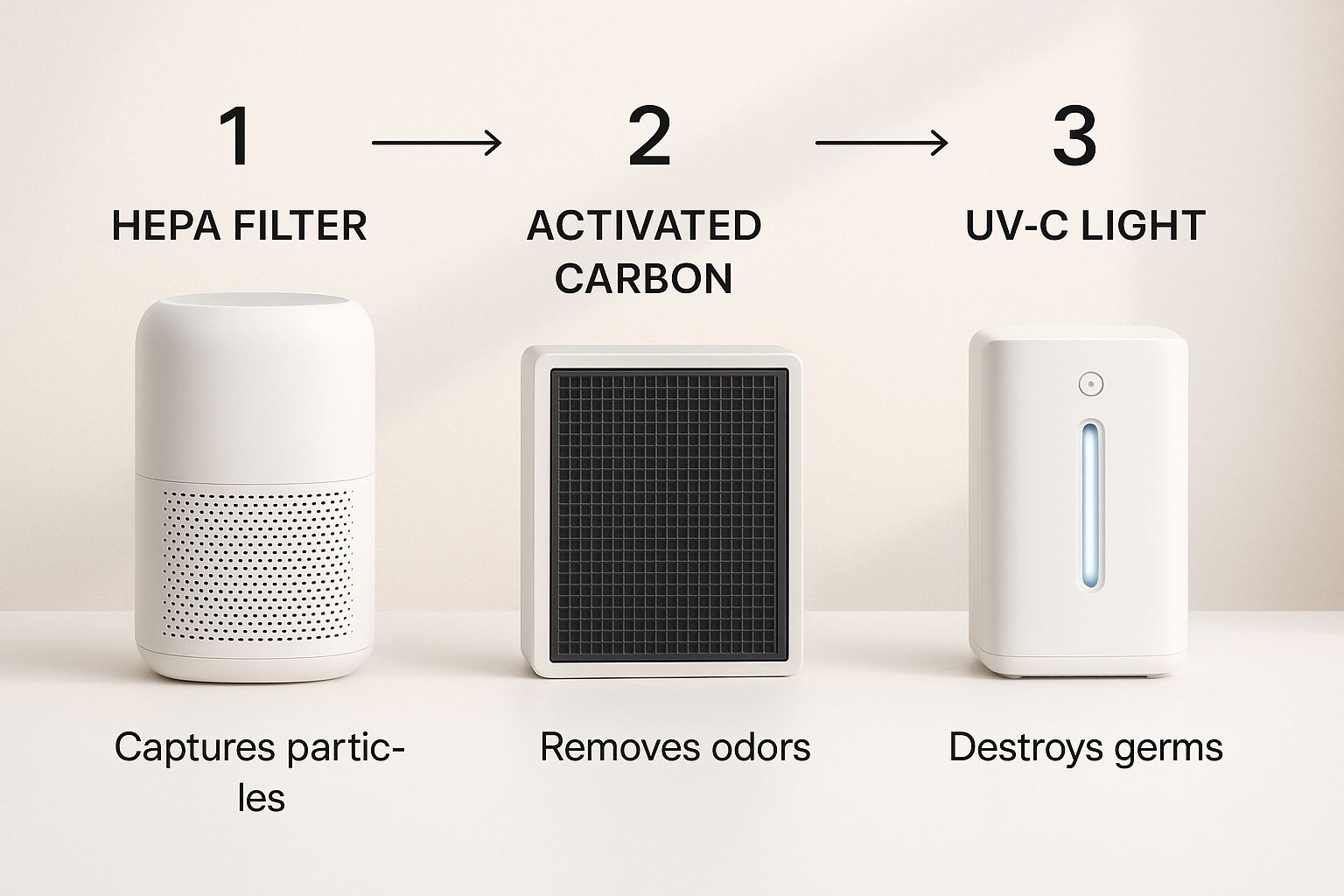
This image hits on the core technologies you'll encounter—HEPA, activated carbon, and UV filters. The real takeaway here is that different tools are needed for different jobs. Each filter type targets specific pollutants, so understanding what you’re trying to remove from your air is the first step toward choosing the right one.
Now, let's talk about the single biggest mistake I see people make: buying an air purifier that’s way too small for their room. It's an easy trap to fall into. You spot a sleek, compact unit and think, "Perfect!" But an undersized purifier is a lot like trying to cool an entire villa with a tiny window AC unit. It just can’t keep up. It will run on high constantly, make a racket, and never actually get the air clean.
To sidestep this common pitfall, you have to look beyond the slick marketing and zero in on one critical number: the Clean Air Delivery Rate (CADR). This isn't just industry jargon; it's a standardized rating that tells you exactly how much clean air the machine can produce and how well it tackles specific pollutants in a given space.
Decoding the CADR Rating
Developed by the Association of Home Appliance Manufacturers (AHAM), the CADR rating measures a purifier's muscle against three of the most common indoor troublemakers: smoke, dust, and pollen. The number itself represents the volume of filtered air delivered in cubic feet per minute (CFM). Simply put, a higher CADR means a faster, more powerful cleaning performance.
You'll almost always see three distinct CADR numbers on the box, something like this:
- Smoke: 200
- Dust: 210
- Pollen: 220
These numbers show how effective the unit is against particles of different sizes. Smoke particles are incredibly small and the toughest to snatch from the air, while larger pollen particles are much easier for a filter to grab. That’s why the pollen number is nearly always the highest of the three.
Pro Tip: When you're comparing models, always lean on the smoke CADR as your benchmark. It’s the ultimate test of a purifier's fine-particle filtration power and gives you the most honest baseline for its overall capability.
Calculate Your Ideal CADR
There’s a straightforward rule of thumb in the industry to make sure your purifier is up to the task, called the "Two-Thirds Rule." It’s a simple formula that helps you match a unit's CADR to your room's square footage, ensuring it can actually do its job effectively.
Here’s how you figure it out:
- Measure Your Room: First, get the square footage. For a basic rectangular room, just multiply its length by its width. A living room that's 15 feet by 20 feet, for instance, is 300 square feet.
- Apply the Rule: Now, take that square footage and multiply it by 2/3 (or 0.67 if that’s easier).
- Find Your Target CADR: The number you get is the minimum smoke CADR you should be looking for.
For that 300-square-foot living room, the math looks like this:300 sq. ft. x (2/3) = 200
So, for that space, you need an air purifier with a smoke CADR of at least 200. This ensures the unit has enough power to cycle and clean all the air in that room about five times an hour—the sweet spot for maintaining genuinely fresh, healthy air.
Handling Real-World Challenges
Of course, these standard calculations are perfect for a typical room with an 8-foot ceiling. But what about trickier spaces? Many modern homes, especially in the UAE, feature layouts that demand a bit more thought.
High Ceilings and Open-Plan Spaces
If your room has vaulted ceilings or flows into an open-plan kitchen and dining area, the basic square footage calculation just won't cut it. The purifier has to clean a much larger volume of air.
- Actionable Tip: As a rule of thumb, for every foot of ceiling height above 8 feet, you should tack on an extra 10-15% to your required CADR. So, for a room with 12-foot ceilings, you’d want a purifier that’s roughly 40% more powerful than what the standard formula suggests.
Unusual Room Layouts
L-shaped rooms or areas with alcoves can create "dead zones" where airflow is poor and pollutants get trapped. A single, large purifier might struggle to reach these corners effectively.
In these cases, you're often better off with two smaller purifiers placed strategically instead of one beast of a machine. Putting one in each section of the "L" will create better overall circulation and ensure no pocket of air gets left behind. After all, proper airflow is everything—much like how a successful AC installation in Dubai hinges on ensuring cool air reaches every corner of the home.
Taking a few extra minutes to properly size your purifier using its CADR rating is the difference between buying a machine that just makes noise and one that truly improves your home’s air and your family's well-being.
Getting to Know Your Air Purifier’s Filter Technology
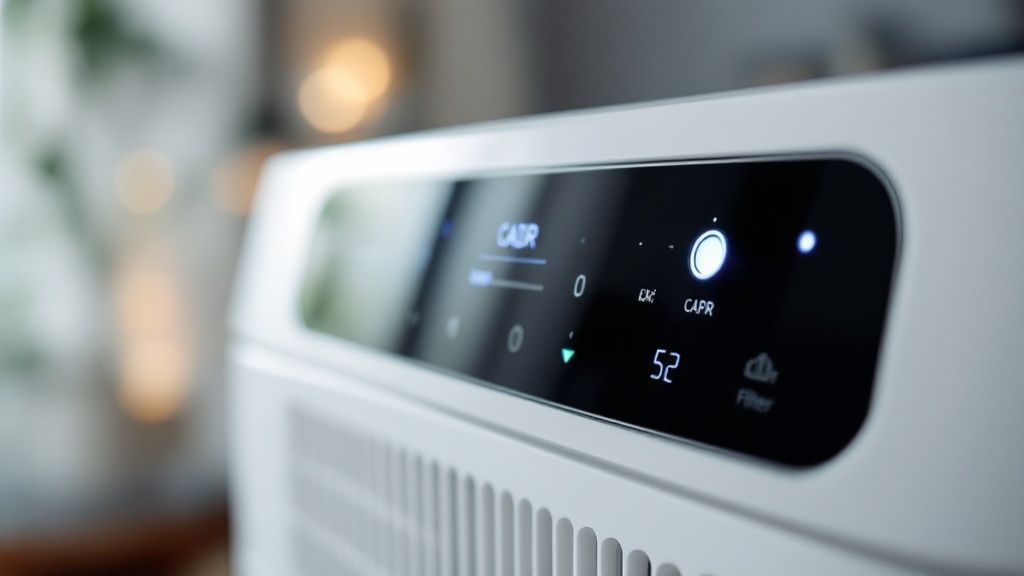
The real magic of an air purifier happens inside, with its filter system. You'll see a lot of technical jargon thrown around, but the core technologies are actually quite easy to grasp. And you need to grasp them, because the filter is what does all the work. Picking the right one is the single most important decision you'll make.
At the heart of any truly effective air purifier is the True HEPA filter. This isn’t just marketing fluff; it's a regulated performance standard that separates the serious contenders from the toys.
A True HEPA filter is engineered to trap an incredible 99.97% of airborne particles as small as 0.3 microns. For a little perspective, a single human hair is about 50-70 microns thick. This is why HEPA is the undisputed champion for grabbing the microscopic triggers of allergies and asthma—things like dust mites, pet dander, pollen, and mold spores. It’s essentially a super-fine net that catches what you can’t see.
The Gold Standard: HEPA Filters
There’s a reason High-Efficiency Particulate Air (HEPA) filters dominate the market; they are simply the best at what they do. Research shows they make up the largest segment of the market, which tells you that consumers, especially in regions like the UAE and the broader Middle East, prioritize their effectiveness. You can dig deeper into these trends by reviewing the research on air purification markets.
One word of caution: watch out for vague terms like "HEPA-type" or "HEPA-like." These sound impressive but don't meet the strict government standards. If you're serious about tackling allergens, insist on a True HEPA filter. No substitutes.
Handling Odors and Gases with Activated Carbon
While HEPA filters are masters of capturing particles, they can't do a thing about gases, chemicals, or smells. For that, you need a completely different tool: the Activated Carbon filter.
Think of activated carbon as a highly porous sponge designed specifically for airborne chemicals and odors. The carbon is treated to create millions of microscopic pores, giving it a massive surface area to absorb and neutralize unwanted smells. It’s your best defense against cooking fumes, pet odors, smoke, and those pesky volatile organic compounds (VOCs) that off-gas from new furniture, paint, and cleaning products.
If funky smells or chemical sensitivities are your main complaints, a purifier with a hefty activated carbon filter is an absolute must-have.
Most top-tier air purifiers use a multi-stage system for a reason. They'll typically combine a pre-filter for large debris like hair, a True HEPA filter for the tiny particles, and an Activated Carbon filter for odors and VOCs. This tag-team approach gives you the most comprehensive protection.
What About Other Technologies like UV-C and Ionizers?
You’ll also see other features, like UV-C lights and ionizers, and it's important to have realistic expectations about what they can and can’t do.
UV-C Light is meant to zap airborne germs like bacteria and viruses by scrambling their DNA. It sounds great on paper, but its real-world effectiveness in a purifier is a point of debate. For the UV light to work, germs need enough direct exposure time—something they may not get as air is quickly pulled through the unit.
Ionizers work by releasing negatively charged ions that latch onto airborne particles. This makes the particles heavier, causing them to drop out of the air and stick to surfaces like your floors and walls. While this gets them out of the air you’re breathing, it doesn’t actually remove them from the room. You'll have to be extra diligent with dusting and vacuuming.
The biggest red flag with some ionizers is their potential to create ozone as a byproduct. Ozone is a known lung irritant that can be especially dangerous for anyone with asthma or respiratory issues. If you do opt for a model with an ionizer, make sure it’s certified as low-ozone or ozone-free by a trusted organization like the California Air Resources Board (CARB).
Choosing the Right Filter for Your Home
The best filter technology for you comes down to what you're trying to fix. Are you battling seasonal pollen, a lingering pet smell, or both? This table shows how the different filter types stack up against common household pollutants.
Filter Performance Against Common Pollutants
See how different filter types stack up against various indoor pollutants, helping you choose the most effective technology for your home.
| Pollutant Type | HEPA Filter | Activated Carbon Filter | UV-C Light |
|---|---|---|---|
| Dust Mites & Pollen | Excellent | Ineffective | Ineffective |
| Pet Dander & Mold | Excellent | Ineffective | Ineffective |
| Cooking & Pet Odors | Ineffective | Excellent | Ineffective |
| Smoke & VOCs | Ineffective | Excellent | Ineffective |
| Bacteria & Viruses | Good | Ineffective | Good (with limits) |
By first identifying your main air quality challenges, you can zero in on the purifier with the right filter technology to solve your specific problem. This targeted approach is the smartest way to invest in a healthier home.
Living With Your Air Purifier: Noise, Maintenance, and Long-Term Costs
A spec sheet gives you the hard numbers, but it can't tell you what it’s actually like to live with an air purifier day in and day out. The practical side of things—how loud it is, what it costs to keep running, and how much upkeep it needs—is just as important as its CADR rating.
Let's be real. If an air purifier sounds like a jet engine, you're just going to turn it off. And if the replacement filters cost a fortune, you'll probably put off buying them, which completely defeats the purpose of owning one in the first place.
The Reality of Noise Levels
Every air purifier lists its noise output in decibels (dB), but those numbers can feel a bit abstract. It’s much easier to understand what you’re signing up for when you compare those decibels to everyday sounds.
- 20-30 dB: Think rustling leaves or a soft whisper. This is exactly what you want for a bedroom—so quiet it just fades into the background without disrupting your sleep.
- 40-50 dB: This is on par with a quiet library or the low hum of a refrigerator. It's a comfortable noise level for a living room or office space during the day.
- 60+ dB: Now we’re getting into the range of a normal conversation or a window AC unit. A purifier running this loud, especially for long periods, can be pretty distracting.
A "sleep mode" is a game-changer. I always recommend looking for models with this feature. It drops the fan to its quietest setting and often dims or shuts off the bright indicator lights, so your bedroom stays dark and peaceful.
Breaking Down Maintenance and Ongoing Costs
The price tag on the box is just the beginning. The true cost of an air purifier shows up over time, mainly in replacement filters and electricity use. A cheap unit with expensive, hard-to-find filters is no bargain.
Before you even think about buying, you need to do a little detective work on the filters. Here’s what I tell people to ask:
- How often do I need to replace them? HEPA filters typically last 6 to 12 months. The activated carbon filters, which tackle odors and VOCs, usually need to be swapped out every 3 to 6 months.
- How much do they cost? This is a big one. Replacement filters can run anywhere from AED 100 to over AED 500. Do the quick math: a AED 200 filter you replace twice a year adds AED 400 to your annual running costs.
- Can I even find them? Stick to well-known brands. Their filters are easy to find online or in stores. Trying to track down a proprietary filter from some obscure brand a year from now can be a real headache.
One of the best money-saving features is a washable pre-filter. This outer screen traps the big stuff like pet hair and dust. Just rinse it out once a month, and you'll dramatically extend the life of the more expensive HEPA and carbon filters inside. A little bit of regular upkeep goes a long way, a topic we explore more in our guide on the importance of preventive maintenance for all your home appliances.
Don't Forget About Energy Consumption
For an air purifier to do its job, it needs to run pretty much 24/7. That means its energy use can add up on your electricity bill.
An Energy Star certification is your best friend here. These models are independently certified to be about 40% more energy-efficient than their non-certified counterparts. They use better motors and fan designs to clean the air effectively without guzzling power.
Another feature to look out for is an "auto mode." This is incredibly useful. The purifier uses built-in sensors to monitor your air quality in real-time. If it detects a jump in dust or fumes, it ramps up the fan speed. Once the air is clean again, it automatically powers down to a low, energy-saving setting. It’s a set-it-and-forget-it approach that keeps the air clean and your energy bills in check.
Smart Features That Actually Make a Difference
Let's be honest, the term "smart" gets thrown around a lot these days. When it comes to air purifiers, it's easy to get lost in a sea of features that sound impressive but don't add much real-world value. The trick is to cut through the marketing noise and focus on the functions that genuinely make your life easier and the air in your home cleaner.
The absolute must-have, in my experience, is Auto Mode. Think of it as a cruise control for your air quality. Purifiers with this feature have built-in sensors that are constantly sniffing the air for things like dust, pollen, or VOCs from cooking fumes.
When it detects a sudden spike—maybe you just opened a window on a high-pollen day or your dog just ran through the room—it automatically ramps up the fan speed to tackle the problem head-on. Once the air is clean again, it dials itself back down to a quiet, energy-sipping hum. This hands-off approach means the unit is only working hard when it absolutely needs to, which is brilliant for both your peace of mind and your electricity bill.
Connectivity and Control from Anywhere
Next up is app connectivity. Hooking your purifier up to your home's Wi-Fi isn't just a novelty; it offers some seriously practical advantages. Being able to control the unit from your smartphone means you can manage your home's air quality from anywhere.
- Remote Operation: Stuck in traffic? You can fire up the purifier before you get home, ensuring you walk into a breath of fresh air.
- Scheduling: Set it and forget it. You can program the purifier to run automatically during peak allergy season or just for an hour before bedtime to clear the air in your bedroom.
- Air Quality Monitoring: The best apps give you a detailed look at your indoor air quality, showing you real-time data and historical trends. This is fascinating stuff—you start to see patterns and understand what's really impacting your air.
Integrating your purifier into a wider setup with the best smart home gadgets can create a truly automated, healthy living environment.
Real-World Scenario: Picture this: You're heading home from work and see a dust storm warning on your weather app. Instead of dreading the gritty air waiting for you, you just open the app, crank your air purifier to its highest setting, and walk through the door to a clean, comfortable home. That's a game-changer.
This kind of advanced control is especially sought after in places like the UAE, where urban living and environmental factors have driven a huge demand for effective air purification. People want technology that can keep up with the unique challenges of the local air quality.
Other Valuable Add-Ons to Consider
While Auto Mode and app control are the big two, there are a couple of other smaller features that I always look for. They might seem minor, but they can make a big difference in your day-to-day experience.
A real-time air quality indicator is fantastic. It's usually a simple color-changing LED light or a digital display right on the unit. A quick glance can tell you if the air is clean (blue or green) or if pollution levels are high (yellow or red). It’s incredibly reassuring to see the light change back to blue after you've finished cooking, confirming the purifier is doing its job.
And if you have kids, a child lock is non-negotiable. It's a simple function that disables the control panel so curious little fingers can't mess with the settings or accidentally turn the machine off. It's a small detail, but one that provides huge peace of mind for parents.
Answering Your Final Air Purifier Questions
Making the final call on an air purifier can bring up a few last-minute questions. It’s completely normal. To help you feel confident in your choice, I’ve put together answers to the most common queries I hear, based on years of experience.
How Often Should I Run My Air Purifier?
Honestly, for the best results, you should leave it running all the time. Think about it: dust from outside, cooking fumes, and pet dander don’t just appear once a day. They're constantly being introduced into your home, so 24/7 operation is really the only way to keep the air consistently clean.
Don't worry too much about your electricity bill. Most modern purifiers are built to be incredibly energy-efficient. But if running it nonstop isn't feasible, at least have it on when you're in the room—especially in your bedroom overnight. That's a solid eight hours where your body is recovering, and clean air makes a huge difference.
Can an Air Purifier Really Help with Allergies?
Absolutely. A good air purifier with a True HEPA filter isn't just a gadget; it can be a lifesaver for allergy and asthma sufferers. These filters are the real deal, designed to capture 99.97% of those microscopic triggers like pollen, dust mites, pet dander, and mold spores that make you miserable.
By physically yanking these irritants out of the air, the purifier directly reduces your symptoms. People often tell me they sleep better and just feel more comfortable in their own homes. If you're also sensitive to smells or chemicals, look for a model that pairs the HEPA filter with an Activated Carbon filter. It’s the ultimate one-two punch.
My Two Cents: HEPA filtration is a proven, mechanical process. It’s not magic—it's science. It physically traps the tiny particles causing your irritation, which is why it makes such a noticeable difference in your day-to-day life.
Where’s the Best Place to Put My Air Purifier?
This is a great question, because where you place your unit really does matter. The golden rule is simple: put it where you spend the most time. For most of us, that's the bedroom or the living room.
To get the most out of it, just follow a few common-sense tips:
- Let It Breathe: Make sure there's at least 15-20 centimeters of open space around the entire unit. Shoving it against a wall or behind a sofa will just choke the airflow and make it less effective.
- Go to the Source: If you can, place it near the origin of pollutants. This could be near your dog's favorite napping spot or close to a busy doorway where pollen and dust get tracked in. You'll catch contaminants before they even have a chance to spread.
- Avoid Corners: It's tempting to tuck it neatly into a corner, but that creates "dead zones" where air just stagnates. A more central location is always going to give you better circulation and cleaner air overall.
Are Air Purifiers That Create Ozone Dangerous?
Yes, they are, and you should steer clear of them. Ozone is a lung irritant, plain and simple. It can make asthma worse and cause other respiratory problems. Some older models, especially certain ionizers, produce ozone as a byproduct of how they work.
When you're choosing an air purifier, safety has to be number one. Stick with devices that use physical filtration methods like HEPA and activated carbon filters. To be absolutely sure, look for a CARB (California Air Resources Board) compliance certification. This is your guarantee that the unit meets incredibly strict low-ozone standards, ensuring the air it puts out is not only clean but truly safe to breathe.
At Yasu Trading Co. LLC, we provide the essential components that build healthier, more efficient living and working spaces. Explore our range of premium HVAC components and building materials designed for the demands of the modern UAE environment.
Learn More and Request a Quotation at Yasu Trading Co. LLC