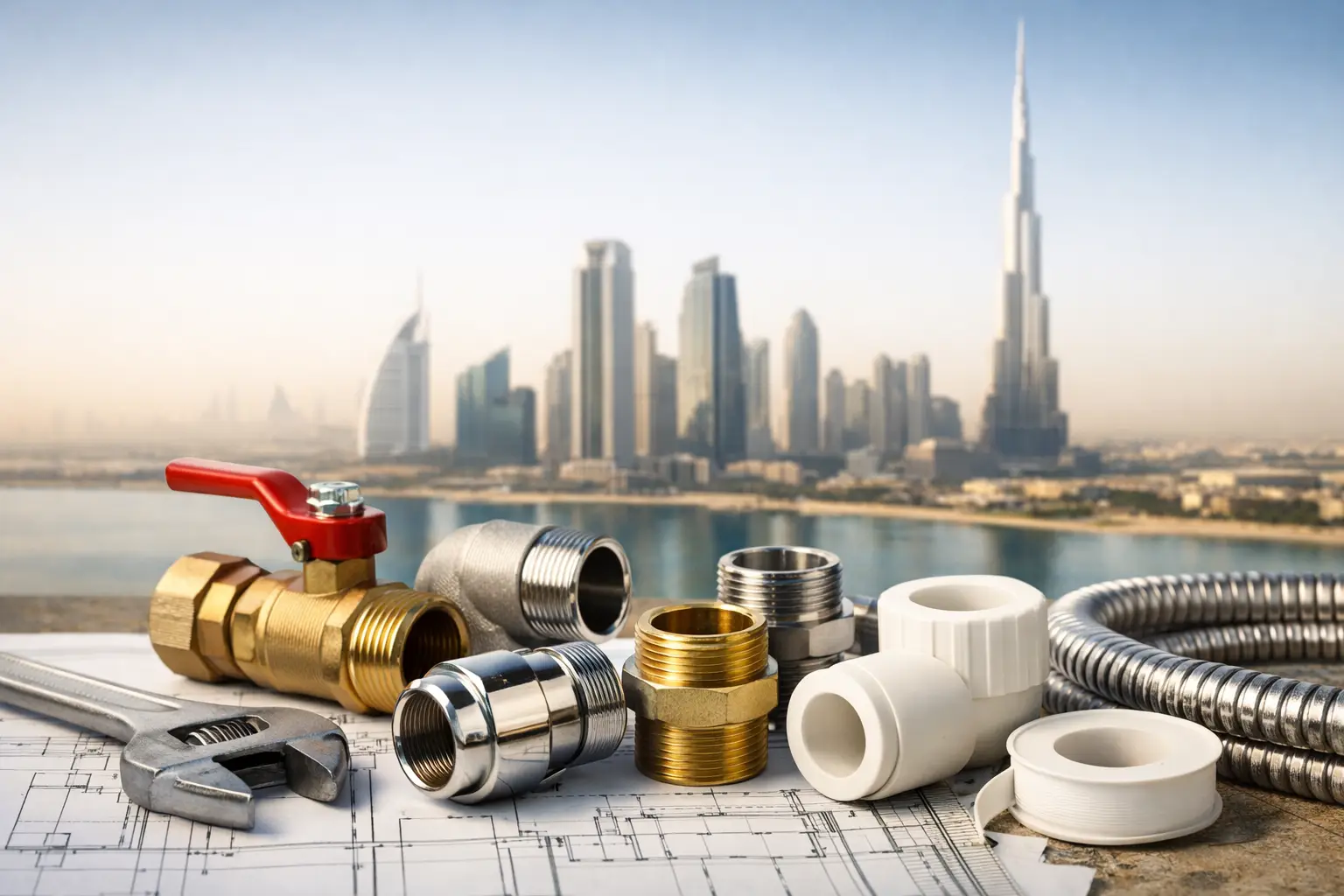
How to Choose Plumbing Fittings for UAE Projects
A fitting that costs a few dirhams can create a major handover issue when it is installed in the wrong material, pressure class, or connection type. For contractors and MEP teams, knowing how to choose plumbing fittings is not simply a purchasing task. It is a specification, compliance, and schedule-control decision.
The correct fitting must match the pipe, the conveyed medium, the operating temperature and pressure, and the project approval requirements. It also needs to be available in the required quantity when the site is ready. A technically suitable item that cannot be delivered on time can still delay pressure testing, ceiling closure, tiling, or final commissioning.
Start With the Pipe System, Not the Fitting
The first rule is straightforward: select fittings as part of a complete piping system. Do not choose a tee, elbow, reducer, or valve based only on size and appearance. Pipe material, jointing method, pressure rating, and approved manufacturer system all matter.
For example, PPR fittings are designed for heat fusion with PPR pipes. They are commonly used for domestic hot and cold water systems because the fused joint becomes part of the pipe system. PVC and uPVC fittings are generally solvent-welded and are suitable for many drainage, waste, vent, and cold-water applications, depending on the specified pipe class. CPVC fittings are intended for higher-temperature water service, while HDPE fittings are often selected for underground water networks, irrigation, and applications requiring flexible, welded connections.
Metal systems require the same discipline. Galvanized iron fittings, brass fittings, and stainless steel fittings have different corrosion behavior, thread forms, and service limits. A threaded brass adapter may be appropriate at a valve or sanitary fixture connection, but it should not be used as a casual substitute for a specified transition fitting in a concealed riser.
Before placing an order, confirm the pipe material, nominal size, standard or schedule, jointing method, and approved system manufacturer. This prevents a common site problem: fittings that physically look compatible but cannot produce a reliable, warrantable joint.
How to Choose Plumbing Fittings by Application
A plumbing network is rarely one uniform system. Potable water, chilled water, drainage, soil and waste, irrigation, and fire protection each place different demands on fittings. The fitting selection should follow the service duty, not just the pipe route.
Domestic hot and cold water
For pressurized domestic water, focus on pressure rating, temperature tolerance, hygiene, and joint reliability. PPR, CPVC, multilayer, copper, and certain approved HDPE systems may be used depending on the design specification. Hot-water lines require fittings that retain their rated performance at operating temperature, not just at ambient conditions.
Check whether the system includes recirculation. Continuous hot-water circulation can increase temperature exposure and place greater stress on joints. This is where using a lower-grade fitting to reduce purchase cost often creates long-term maintenance risk.
Drainage, soil, waste, and vent lines
Drainage fittings are selected around flow direction, gradient, access for cleaning, and resistance to chemical or wastewater exposure. uPVC pipes and fittings are common for these systems, but the correct pattern matters. A long-sweep bend can support smoother flow in a horizontal drain line, while a sharp elbow may be unsuitable where solids could accumulate.
Coordinate reducers, cleanouts, floor drain connections, traps, and vent fittings with the approved shop drawings. The right fitting arrangement helps prevent blockages and keeps rodding access available after finishes are complete.
Underground and external networks
Buried water and irrigation lines need fittings that can handle soil movement, external loading, and the installation method. HDPE electrofusion or butt-fusion fittings are frequently chosen where leak resistance and long service life are priorities. Mechanical compression fittings can be useful for repairs or smaller-diameter connections, but their application must match the project specification and installation conditions.
For underground systems, also verify burial depth, thrust restraint requirements, transition points, and access to isolation valves. The fitting choice is only reliable when the complete connection detail is considered.
Check Pressure Rating, Temperature, and System Compatibility
Never assume that a fitting with the correct diameter has the correct duty rating. Pressure performance is affected by material type, wall thickness, temperature, connection method, and the manufacturer’s published limits.
A fitting rated for cold water at a certain pressure may have a significantly lower allowable pressure at elevated temperature. This is especially relevant for hot-water PPR and CPVC lines. Ask for the applicable pressure-temperature rating rather than relying on a general product description.
Compatibility also extends to the joining materials. Solvent cement must suit the pipe and fitting material. Fusion tools and welding parameters must suit the PPR or HDPE system. Thread sealant, PTFE tape, gaskets, and flange bolts must be compatible with the medium and connection type. A good fitting installed with the wrong consumables can fail just as quickly as a poor-quality fitting.
Where a system transitions between materials, use purpose-made adapters. A brass threaded insert, flange adapter, union, or mechanical coupling may be needed to connect plastic pipework to valves, pumps, water heaters, or sanitary ware. Avoid field-made combinations that create stress points or make future maintenance difficult.
Confirm Standards and Project Approvals Early
Municipality-compliant materials are essential on commercial, residential, and infrastructure projects. The exact approval path depends on the project location, consultant requirements, authority requirements, and the system being installed. Procurement teams should not wait until inspection to verify whether a fitting is accepted.
Request documentation that supports the specified system, including manufacturer data sheets, test certificates where applicable, country of origin details, and warranty information. For approved projects, match the item against the material submittal, consultant-approved brand list, and bill of quantities.
Brand consistency matters as well. Mixing pipe and fittings from unrelated manufacturers can complicate warranty claims and technical responsibility. It may be accepted in limited cases if the consultant approves the combination, but it should never be assumed. Keeping a single approved system through a riser or zone makes installation control, testing, and defect resolution much easier.
Choose the Right Connection and Fitting Geometry
Fittings are not interchangeable just because they connect two pipes. Their geometry affects flow, installation space, pressure loss, and future access.
Elbows should be selected by angle and radius. Long-radius bends are often preferred where smoother flow is required, while compact elbows may be necessary in congested service shafts. Tees need the correct branch size and direction. Reducers may be concentric or eccentric, and the right choice depends on whether the line is horizontal, vertical, pumped, or gravity-fed.
Unions and flanges deserve particular attention around pumps, water heaters, strainers, control valves, and equipment connections. They allow components to be removed without cutting pipework. Omitting them may save a small amount during installation but can turn a simple valve replacement into a disruptive maintenance job.
For threaded fittings, confirm the thread standard and gender. For flanged connections, verify flange rating, drilling pattern, gasket type, and bolt set requirements. These details are easy to miss during bulk ordering and expensive to correct after materials reach the site.
Balance Purchase Price Against Installation and Failure Cost
The lowest unit price is not always the lowest installed cost. Fittings account for a small portion of a plumbing package, but failed joints can trigger water damage, ceiling removal, re-testing, labor overtime, and schedule disruption.
That does not mean every project needs the most expensive option. It means the fitting should be appropriate for the system duty and project risk. For exposed maintenance areas, easy-to-service mechanical connections may offer value. For concealed hot-water lines, a proven fusion system with approved fittings can reduce long-term risk.
Consider the total procurement picture: product quality, documentation, quantity accuracy, batch consistency, availability of matching pipes and valves, and delivery timing. Consolidating plumbing pipes and fittings, valves, sanitary ware connections, sealants, hand tools, and testing accessories through one supplier can reduce coordination gaps and avoid partial deliveries that stall installation crews.
Plan Quantities Around the Installation Sequence
Fitting shortages are common because takeoffs focus on pipe lengths and overlook branches, offsets, transitions, and equipment connections. Review the shop drawings by zone and include allowances for changes at risers, meter rooms, pump rooms, toilets, kitchens, and external tie-ins.
Order standard fittings in bulk where the design repeats, but separate critical nonstandard items for early verification. These may include large-diameter reducers, specialized transition couplings, flanged adapters, valve connectors, and fittings required for testing connections. Mark them against the installation schedule so they arrive before the relevant workfront opens.
For active projects in Dubai, Sharjah, Abu Dhabi, and across the UAE, rapid dispatch is valuable when a site condition changes. However, urgent delivery should support sound planning, not replace it. A controlled material schedule remains the best protection against downtime.
Use Technical Review Before Finalizing the Purchase Order
A short technical review can prevent most fitting-related errors. Compare the requested item description against the pipe schedule, approved submittal, and installation drawings. Confirm sizes in the same unit system, verify pressure classes, and check whether the quantity includes required accessories such as clamps, gaskets, solvent cement, fusion sockets, or thread sealants.
When project requirements are unclear, seek product guidance before materials are released. Yasu Trading Co. LLC supports contractors with jobsite-ready plumbing pipes and fittings, specification alignment, wholesale project quotes, and site-direct delivery. The practical goal is simple: receive the correct, approved materials in time for installation and testing.
Choose fittings with the same care used for the pipe itself. A properly matched, approved connection protects the system behind the wall and the project schedule in front of it.