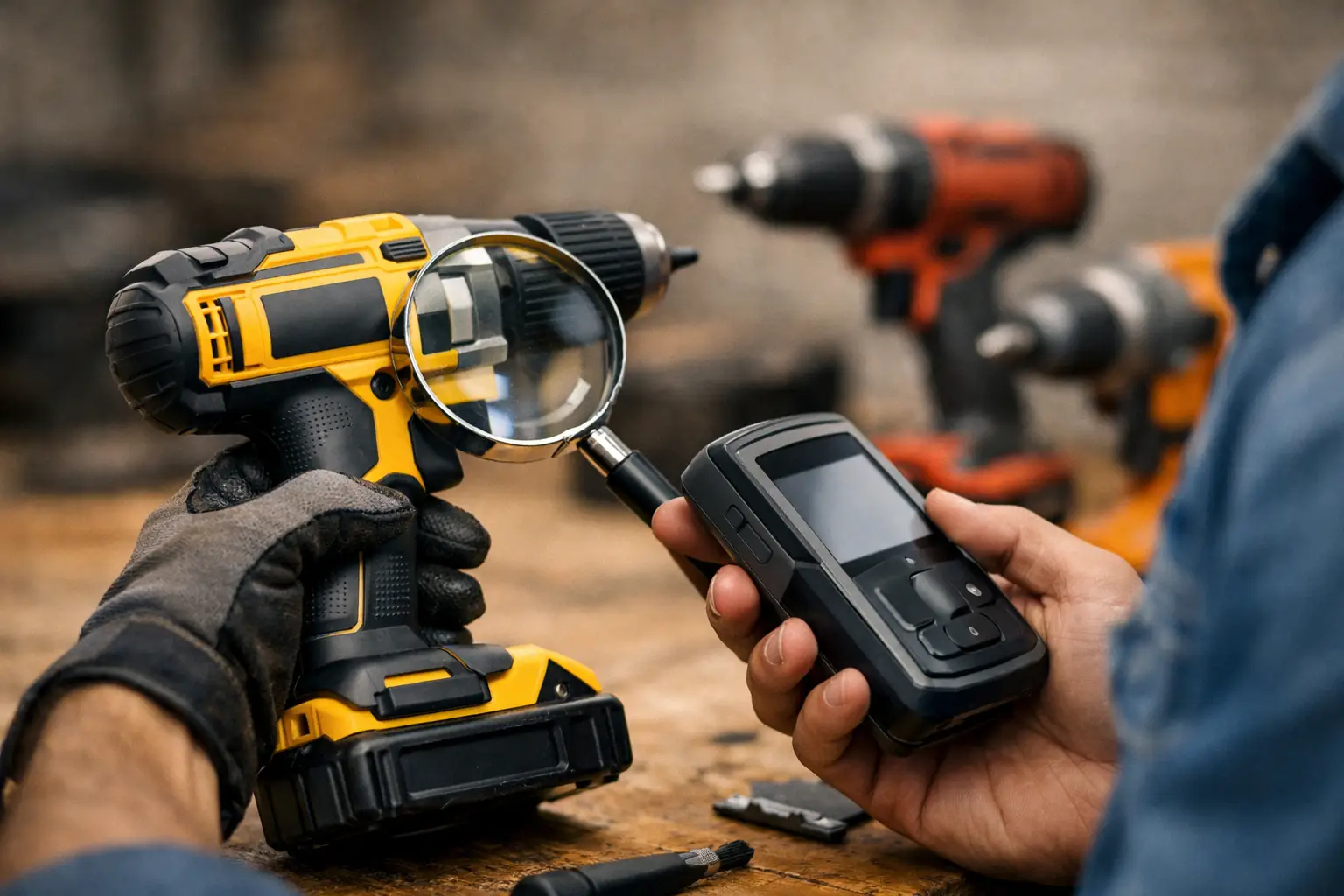
How to Verify Power Tool Authenticity
A counterfeit drill usually does not fail on the shelf. It fails when a crew is waiting, a fixing must go in today, and the tool that looked like a bargain starts overheating, losing torque, or refusing to charge. That is why knowing how to verify power tool authenticity matters for contractors, MEP teams, and procurement managers. This is not just about brand preference. It is about uptime, warranty protection, operator safety, and avoiding avoidable delays on active sites.
For professional buyers, fake tools create a chain reaction. A low-quality battery pack can stall installation work. An unapproved grinder can introduce safety risk. A missing manufacturer warranty can turn a routine replacement into an unplanned purchase. When you are sourcing across power tools, hand tools, fasteners, adhesives and sealants, and electrical components, one weak point in the supply chain can affect an entire workfront.
How to verify power tool authenticity before you buy
The first check is the supplier itself. Authentic tools usually come through authorized distribution channels with clear brand support, invoice traceability, and warranty handling. If a seller cannot confirm where the stock came from, offers no manufacturer-backed warranty path, or avoids documentation, that is a commercial risk before it is a product risk.
Price is another early signal, but not always in the way buyers assume. A wholesale price can be aggressive and still be legitimate, especially in project quantities. What deserves scrutiny is pricing that sits far below market without a clear reason. If a premium rotary hammer, impact driver, or angle grinder is available at a discount that no normal channel can support, there is usually a reason. It may be counterfeit, gray market, refurbished and resold as new, or missing regional warranty coverage.
Packaging also tells a story. Genuine brands are usually consistent with print quality, labeling, product codes, barcodes, and safety markings. Counterfeits often get close on the logo but miss the details. You may see slightly off brand colors, uneven printing, low-quality inserts, grammar mistakes, or packaging that does not match the brand's current regional format. On a busy buying desk, these details are easy to overlook. On a live project, they become expensive.
Check the serial number, model code, and label quality
If you need a practical answer to how to verify power tool authenticity, start with the product label. On genuine tools, the serial number plate or laser marking is usually clean, readable, and aligned with the brand's standard format. The model code on the tool should match the box, the warranty card, and the invoice description.
Mismatched numbers are one of the most common warning signs. If the box says one model and the casing label shows another, stop there. The same applies if the serial number looks like a sticker added after the fact, or if it can be scratched off too easily. Reputable manufacturers invest in durable identification because warranty, recall control, and traceability depend on it.
You should also examine regulatory markings and technical data. Input voltage, wattage, RPM ranges, battery chemistry, charger specifications, and safety icons should be clearly printed and technically plausible. Counterfeit products often copy surface branding but get the technical section wrong. A charger rated incorrectly for the market, or a battery label with inconsistent capacity information, is not a minor issue. It can point to unsafe internals and no valid manufacturer support.
Look beyond the tool body
Professional buyers sometimes focus only on the main unit and ignore the accessories. That is where counterfeit kits often give themselves away. Check the charger, battery pack, plug type, molded cable quality, carry case, instruction manual, and included consumables. If a brand is known for a certain case style, insert tray, or charger label layout, inconsistencies matter.
Battery tools deserve extra attention because that is where performance and safety issues show up fastest. A fake battery may fit, but deliver poor runtime, inconsistent power, or charging faults. On-site, that means interrupted work and more battery swapping. In the worst case, it becomes a heat and fire risk. For teams buying cordless drills, impact drivers, grinders, or combo kits in quantity, verifying battery authenticity is just as important as checking the tool itself.
Fit and finish are useful indicators too. Authentic tools usually have consistent molding, tight assembly, smooth trigger action, and balanced weight. Counterfeits can feel slightly off even when they look convincing in photos. There may be rattling parts, rough seams, loose rubber overmold, or a chuck and spindle that do not run true. These are not cosmetic issues. They often reflect poor manufacturing tolerance and shorter service life.
Documentation and warranty are part of authenticity
A real tool is not just a physical product. It comes with a support structure. That includes invoice traceability, warranty terms, and a clear route for service or replacement. If a seller offers only verbal assurances, that is not enough for a contractor managing project risk.
Ask direct questions. Is the warranty manufacturer-backed or seller-backed? Where is service handled? What documents are required for a claim? Can the supplier confirm the source of the stock? Reliable answers to these questions are often a better test than a sales pitch. A professional distributor should be able to explain the process clearly.
This matters even more when procurement is consolidated. If your business is sourcing power tools alongside plumbing pipes and fittings, electrical components, sanitary ware, and fire and safety equipment, it makes sense to expect the same traceability standard across categories. Authenticity is not a one-off check. It is a purchasing discipline.
Red flags that should stop a purchase
Some warning signs justify immediate escalation. One is a seller who refuses to issue a proper tax invoice with exact model details. Another is bulk stock with damaged or mixed packaging, especially when the units are presented as brand new. A third is inconsistent country-of-origin information between the carton, label, and manual.
Be cautious with marketplace-style sourcing where the storefront name changes frequently or where product photos are generic rather than specific to the actual stock. This does not automatically mean the tool is fake, but it raises the burden of verification. For project procurement, uncertainty itself is a cost.
There is also a gray area between counterfeit and unauthorized parallel import. The tool may be genuine, but not intended for your region, not covered by local warranty, or supplied with incompatible accessories. That may still be acceptable in some low-risk situations, but it is rarely ideal for fleet purchases, service contracts, or jobs where uptime matters more than a small initial saving. It depends on the application, the brand, and the support available after delivery.
A procurement process that reduces risk
The most reliable way to prevent counterfeit tool purchases is to standardize your buying process. Define approved brands and approved supply channels. Require model-specific quotations and itemized invoices. Train receiving teams to check serial numbers, packaging condition, and included accessories before stock is signed in or dispatched to site.
For larger orders, sample one or two units before releasing the full quantity to operations. Run basic checks on charging, no-load operation, trigger response, and label consistency. If the tools are for critical installation work, involve the site supervisor or storekeeper in the inspection. A ten-minute check at goods receipt is much cheaper than replacing failed tools during peak activity.
It also helps to buy from suppliers that can support the full picture, not just the carton on the counter. A dependable B2B partner should be able to align tool selection with application, maintain inventory readiness, and handle warranty issues without making your team chase multiple parties. That becomes especially valuable when jobs are moving across Dubai, Sharjah, Abu Dhabi, or other UAE project locations and site delivery timing matters just as much as price.
How to verify power tool authenticity after delivery
If the tools have already arrived, do not send them straight to the crew. Quarantine first, verify second. Match the delivered quantity and model numbers to the purchase order and invoice. Inspect outer cartons for resealing, then check each unit label, battery, charger, and manual set.
Where the manufacturer provides serial verification or registration, complete it immediately. If anything does not line up, raise it before the tool enters service. Once a unit has been used on site, return disputes get harder and accountability gets weaker.
Good procurement protects schedule, compliance, and cost control at the same time. Authentic tools support safer work, valid warranty claims, and predictable performance. When buyers treat authenticity as part of operational planning rather than a last-minute check, they reduce the chance of tool failure becoming a project problem. If there is any doubt, pause the purchase and verify the channel first. That one decision can save a crew, and a schedule, from unnecessary disruption.