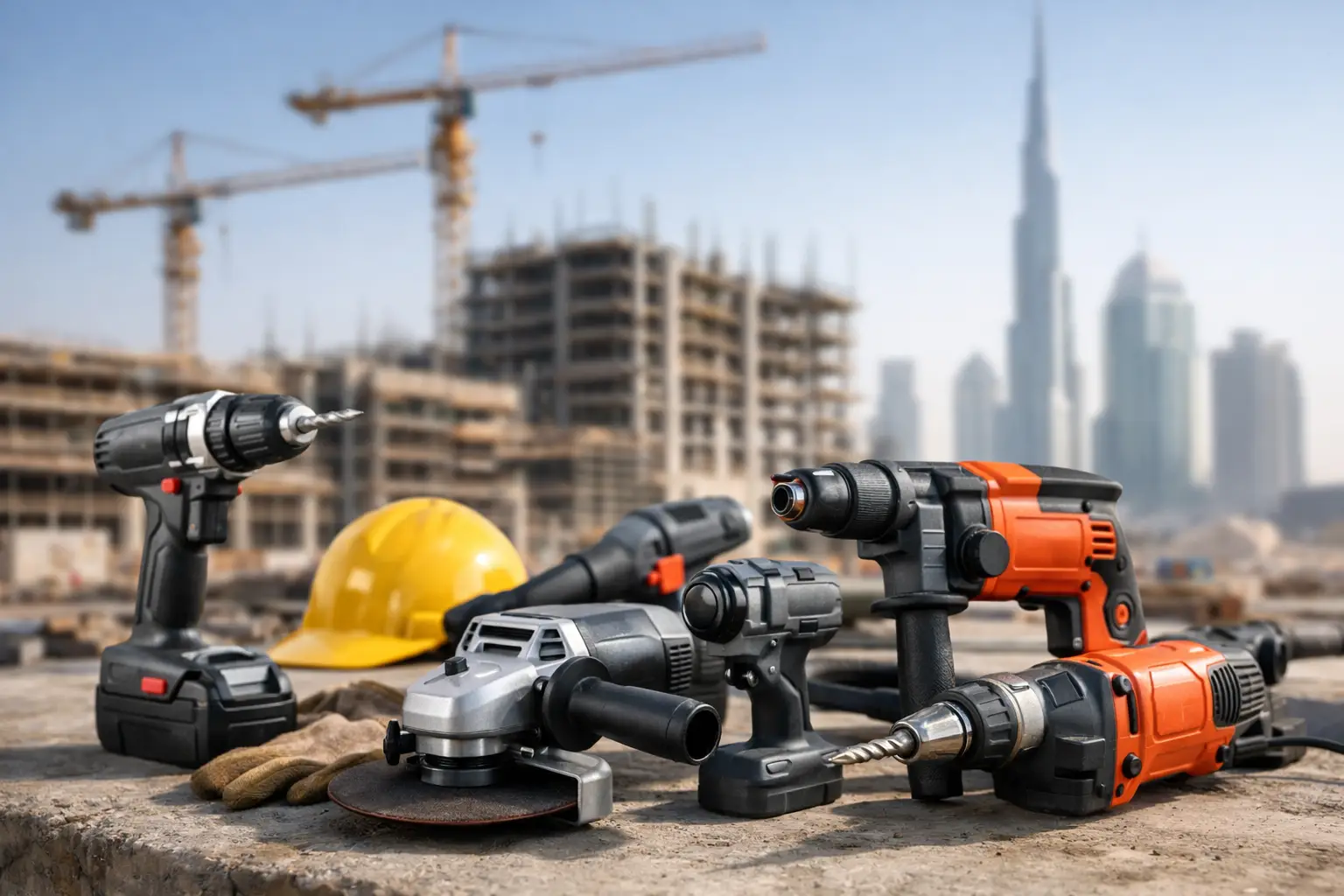
Industrial Power Tool Brands for UAE Projects
A failed grinder, a depleted battery fleet, or an unavailable replacement drill can stop a workfront far beyond the value of the tool itself. For contractors managing concrete, steel, MEP installation, or fit-out work, choosing between industrial power tool brands is a procurement decision that affects labor output, safety controls, warranty exposure, and the ability to maintain the project schedule.
The best brand is not automatically the one with the highest catalog price or the largest marketing presence. It is the brand and tool platform that match the application, crew size, duty cycle, site conditions, and service support required for the work. A procurement team should evaluate the total operating picture before standardizing a tool range.
What Separates Industrial Power Tool Brands
Consumer-grade tools are built for intermittent household use. Industrial tools are expected to operate under sustained load, dust, heat, vibration, and frequent transport between work areas. The difference shows up in motor design, gearbox construction, overload protection, battery management, spare-parts availability, and the warranty process.
For a UAE jobsite, electrical suitability also matters. Confirm that corded tools are supplied in the correct voltage configuration and plug format for the site. Temporary power arrangements, extension leads, residual-current protection, and equipment inspection procedures must align with the project safety plan. A capable tool still creates risk if its electrical setup is unsuitable for site conditions.
Tool selection should also reflect the consequence of downtime. A single drill for a maintenance technician has a different requirement from a crew of installers relying on multiple rotary hammers throughout a concrete drilling program. For high-use applications, proven availability of replacement units, batteries, chargers, consumables, and warranty support can be more valuable than a small saving on the initial purchase price.
Major Industrial Power Tool Brands and Their Fit
Established professional brands each have strengths, but no one range is the right answer for every trade. The practical approach is to choose a core platform where common batteries and chargers reduce site complexity, then specify specialist equipment where the application demands it.
Bosch Professional
Bosch Professional is commonly specified across general construction, MEP installation, maintenance, and fit-out work. Its range covers drills, impact drivers, rotary hammers, grinders, saws, measuring equipment, and dust-control accessories. This breadth makes it useful for contractors seeking a familiar platform across several departments.
It is a strong consideration where a project needs broad everyday coverage rather than a narrow specialist fleet. Procurement teams should still separate light fastening tasks from continuous concrete drilling or heavy grinding. Select the individual tool by output, impact energy, disc size, and expected daily use instead of relying on brand name alone.
Makita
Makita is widely used by carpentry, joinery, interior fit-out, MEP, and general construction teams because of its extensive cordless ecosystem and broad tool selection. A common battery platform can simplify charging stations, reduce charger duplication, and make battery rotation easier for supervisors.
That advantage depends on control. If several subcontractors bring incompatible platforms to one site, battery stock becomes fragmented and chargers occupy valuable storage and power points. Standardizing a defined platform for direct labor teams can reduce that friction, provided the selected range covers the actual tools required.
DeWalt
DeWalt is often considered for demanding construction applications, including drilling, fastening, cutting, grinding, and jobsite equipment. It suits contractors that need a familiar professional-grade range for structural, civil, and interior works, with cordless options that support mobile crews.
For comparison purposes, focus on the tool class rather than headline voltage alone. A compact drill-driver may be productive for metal framing and electrical containment, while large anchors, core drilling, and repeated concrete penetration require a purpose-rated rotary hammer or dedicated drilling solution. Using an undersized tool can cause premature failure, slow output, and inconsistent hole quality.
Milwaukee
Milwaukee has a substantial professional cordless offering, particularly relevant to MEP, maintenance, steelwork, fastening, and trade-specific applications. Its appeal for many contractors is the depth of cordless options beyond standard drills and grinders, which can help reduce reliance on leads in congested work areas.
Cordless productivity has limits. High-load grinding, cutting, and drilling consume batteries quickly, especially in hot or dusty conditions. A site rollout should include enough batteries, approved chargers, charging locations, and an accountable issue-and-return process. A cordless fleet without battery planning simply transfers downtime from the cable to the charging station.
Hilti and Specialist Concrete Tools
For anchor installation, overhead drilling, concrete breaking, diamond drilling, and other high-consequence applications, specialist concrete tool systems deserve separate evaluation. Hilti is frequently associated with these tasks because the decision often extends beyond the tool to include anchors, dust management, consumables, technical data, and service arrangements.
This is especially relevant where drilled holes support fire-rated systems, cable containment, pipe supports, or structural fixings. The drill, bit, anchor, embedment depth, substrate condition, and installation procedure must work together. A cheaper tool choice cannot compensate for an incorrect fixing specification. For safety-critical work, require approved submittals and maintain installation records as required by the project.
HiKOKI, Metabo, and Other Professional Options
HiKOKI, Metabo, and other established professional manufacturers can be appropriate choices when their performance, availability, and platform fit the application. They may offer strong value in specific categories such as grinders, metalworking tools, drilling equipment, or cordless trade tools.
The key is not to create unnecessary variation. Adding another brand can be justified when it solves a clear technical need, improves availability, or delivers a better lifecycle outcome. Adding it only because it is discounted can increase the number of batteries, chargers, repair channels, and spare consumables that procurement must manage.
Build the Tool Schedule Around the Workfront
A useful procurement schedule groups tools by the tasks crews will perform. For concrete and masonry, identify rotary hammers, demolition hammers, diamond drilling equipment, vacuum extraction, drill bits, and anchor installation accessories. For metalwork, consider grinders, cut-off tools, magnetic drills where needed, welding accessories, and the correct abrasive discs.
For MEP work, the schedule may include drill-drivers, impact drivers, rotary hammers, cable-pulling equipment, pipe threading or pressing tools, test instruments, and appropriate hand tools. Fit-out packages often require saws, sanders, laser levels, fastening tools, and dust extraction. This task-based method prevents a common buying error: ordering the main tool while overlooking the accessories that make it productive.
Consumables deserve equal attention. Grinding discs, drill bits, saw blades, cutting wheels, batteries, chargers, and extraction bags are not minor additions. If they are unavailable on the day of installation, the crew cannot complete the work. Keep fast-moving consumables aligned with the number of active crews and the material being worked.
Evaluate Total Cost, Not Purchase Price
The lowest unit price can be costly when tools fail early, batteries are incompatible, repair turnaround is unclear, or a replacement cannot reach the site when needed. Compare quotes on a like-for-like basis: tool model, included batteries, charger type, case, accessories, warranty terms, and expected delivery date.
For project purchases, ask suppliers direct questions. Is the product authentic and covered by the manufacturer warranty? Can matching consumables be supplied with the tools? Is there stock for phased releases? What happens if a tool needs service during a critical work package? Can delivery be made directly to the site with a clear itemized delivery note?
These questions matter when procurement is supporting multiple sites or short-duration work packages. A consolidated supplier can reduce purchase orders, delivery coordination, and invoice matching across power tools, hand tools, fasteners, safety equipment, electrical components, and plumbing materials. The benefit is operational control, not merely convenience.
Compliance and Site Safety Must Shape the Order
Power tools should enter site through the same control process applied to other construction equipment. Verify electrical condition, guards, switches, cables, plugs, battery condition, and required safety features before issue. Grinders require particular discipline: use the correct guard, handle, disc rating, and personal protective equipment, and never fit damaged or unsuitable discs.
Dust control is also a productivity and compliance issue. Concrete drilling and cutting can create hazardous dust, restrict nearby trades, and trigger housekeeping problems. Specify compatible extraction where the task and project rules require it. For indoor fit-out and occupied-building work, lower-dust methods can prevent avoidable disruption.
Toolbox talks should cover the specific tool and application, not a generic reminder to work safely. Operators need to understand kickback risk, correct bit or disc selection, battery handling, inspection routines, and when a damaged tool must be removed from service. Better use extends tool life and protects the crew.
Keep Tool Supply Ready for the Next Shift
A well-run tool program needs a simple replenishment rhythm. Supervisors should report critical shortages before the shift ends, not when the crew is already waiting. Maintain a site register for high-value tools, track battery quantities, and assign responsibility for charging, storage, and inspection.
For contractors in Dubai and across the UAE, Yasu Trading can support project-based procurement with jobsite-ready power tools, hand tools, fasteners, safety products, and related construction materials from one wholesale supply channel. The right order combines suitable professional brands with the consumables and delivery planning needed to keep work moving.
Before releasing the next tool order, match every item to the workfront, confirm its electrical and safety requirements, and secure the replacement path. That preparation gives the site team something more useful than a popular brand name: tools ready to perform when the shift starts.