
Your Essential Kitchen Exhaust Hood Guide
Picture this: you're searing a beautiful steak, getting that perfect crust, but there's no frantic waving of a dish towel at a shrieking smoke alarm. Or maybe you're simmering a fragrant curry, and the delicious aroma doesn't become a permanent resident in your living room curtains. This is the magic of a good kitchen exhaust hood—an appliance that’s so much more than just a metal box over your stove. It’s the single most important guardian of your home's air and cleanliness.
Why a Kitchen Hood Is Your Most Important Appliance
In the glitz and glamour of a kitchen remodel, the exhaust hood often gets pushed down the list, overshadowed by show-stopping ovens and refrigerators. But here's the thing: your hood is the unsung hero, the quiet workhorse that makes your kitchen truly functional. Think of it as your kitchen’s own set of lungs, tirelessly breathing out the bad stuff so you can breathe in the good.
Every time you cook, you're not just creating delicious food; you're also creating a cocktail of airborne particles. Smoke, grease, steam, and powerful odors all get released into the air. Without a proper ventilation system, these particles don't just vanish. They float around before settling on your cabinets, walls, and ceilings, leaving behind a sticky, greasy film that’s a nightmare to clean and can ruin finishes over time.
More Than Just Clearing Smells
While nobody wants last night's fish tacos announcing themselves for days, a quality hood does far more than just control odor. It's a critical component for your family's health. Those fumes, especially from gas cooktops, can carry pollutants you really don't want in your home, like carbon monoxide and nitrogen dioxide. A powerful fan actively sucks these contaminants out of your breathing zone before they have a chance to circulate.
To give you a clearer picture, here’s a quick breakdown of what a hood really does for you.
Kitchen Exhaust Hood at a Glance
| Core Function | Key Benefit |
|---|---|
| Air Filtration | Removes smoke, grease, and cooking odors from the air. |
| Pollutant Removal | Vents harmful gases like carbon monoxide away from your living space. |
| Grease Trapping | Captures airborne grease particles before they coat your kitchen surfaces. |
| Heat & Steam Reduction | Pulls excess heat and moisture out, making the kitchen more comfortable. |
This isn't just a concern for home kitchens. The intense cooking environment of a commercial space, for example, demands top-tier ventilation, making it a key consideration when selecting essential food truck kitchen equipment. The principles of clean, safe air apply everywhere.
A great kitchen exhaust hood does more than just clear the air; it removes excess heat and moisture. This helps maintain a more comfortable cooking environment and prevents the growth of mold and mildew, which thrive in damp conditions.
At the end of the day, the right kitchen hood completely changes how you cook. It gives you the freedom to experiment—to crank up the heat for a perfect sear or try out that new stir-fry recipe—without worrying about lingering smells, a greasy mess, or setting off the smoke alarm. It simply makes your kitchen a cleaner, safer, and all-around more enjoyable place to be.
How Kitchen Exhaust Hoods Actually Work
Ever glanced at that metal canopy over your stove and wondered what’s really going on inside? It's much more than just a kitchen accessory. Think of your kitchen exhaust hood as your home's dedicated respiratory system. Its one job is crucial: to suck up all the gunk in the air and either boot it outside or scrub it clean before sending it back.
At its heart, the magic comes from a powerful fan, often called a blower. The moment you flip that switch, the blower roars to life, creating a pocket of low pressure right above your cooktop. This creates a surprisingly strong suction that grabs smoke, steam, tiny grease particles, and cooking smells before they have a chance to wander off and linger in your living room.
This whole process is fundamental to keeping your home’s air clean and healthy. In recent years, especially with the increased focus on wellness at home, good ventilation has become non-negotiable. The COVID-19 pandemic, for example, drove home the importance of high-quality indoor air in the UAE and beyond, turning appliances like exhaust hoods from a "nice-to-have" into a "must-have" for home health. As a result, installations shot up as people got serious about clearing the air.
The Two Paths of Air Purification
So, once the hood captures all that contaminated air, where does it go? It follows one of two paths, and this decision is what separates different types of hoods, impacting both performance and how they're installed. Getting this distinction is key before you even think about buying one.
The two main types are:
- Ducted (Vented) Systems: These are the heavy hitters. They pull the air through filters and then whisk it straight out of your house through a series of pipes, or ducts. Problem solved.
- Ductless (Recirculating) Systems: These are the go-to solution when you can't install ductwork to the outside. They suck air through grease and odor filters, then release the "cleaned" air right back into your kitchen.
A ducted kitchen exhaust hood is like opening a window to let smoke out—it removes the problem entirely. A ductless hood is more like an air purifier, capturing contaminants but keeping the air within the same space.
Key Components Doing the Heavy Lifting
To make any of this happen, every exhaust hood depends on a few core parts working together perfectly. Think of them as the vital organs of this breathing system, each with a specific job to do to keep your air fresh.
Here are the main players:
- The Fan (Blower): This is the engine. A powerful motor-driven fan creates the suction that pulls air up and into the unit. The stronger the blower, the more air it can clear.
- The Filters: These are your front-line soldiers against grime. Ducted hoods typically use metal baffle or mesh filters to trap grease. Ductless models add charcoal filters to the mix, which are fantastic at absorbing smells and smoke before the air is recirculated.
- The Ductwork (for Ducted Systems): This is simply the network of pipes that creates a clear escape route for the dirty air, guiding it from your kitchen to the outside world.
Understanding how these parts cooperate is the first real step in appreciating what goes into a complete kitchen exhaust system. With this knowledge, you can pick a hood that doesn't just match your decor but actually does the hard work you need it to do.
Choosing Between Ducted and Ductless Hoods
When it comes to picking a kitchen exhaust hood, your first big decision is a fork in the road: ducted or ductless? This isn't really about which one is "better" overall, but which one makes sense for your home's layout and the way you cook. Think of it this way: are you building a dedicated exit for kitchen fumes, or setting up a high-tech air purification station right above your stove?
The Power of Ducted Hoods
For pure, uncompromising performance, the ducted exhaust hood is the undisputed king. It’s like a super-powered vacuum for your kitchen, physically capturing smoke, steam, grease, and those powerful cooking smells and venting them completely outside your home through ductwork.
If you’re a serious home cook who loves searing steaks, frying, or whipping up aromatic curries, a ducted system is the gold standard. It's the most effective way to keep your indoor air fresh and clean. The catch? Installation can be a project. It requires a clear path—the ducting—from your cooktop to an exterior wall or the roof, which might mean cutting into drywall or ceilings. It's a perfect match for new builds, major remodels, or homes that already have ducting in place.
The Flexible Alternative: Ductless Hoods
But what if tearing into your walls just isn't in the cards? That’s where the ductless (or recirculating) kitchen exhaust hood comes in. These are a lifesaver for apartments, condos, or any kitchen where venting to the outside is a no-go.
Instead of sending air out, a ductless hood cleans it in a two-step process. First, a mesh or baffle filter grabs airborne grease. Then, the air is pushed through a charcoal filter that traps smoke and odors. Finally, this "scrubbed" air is released back into your kitchen. This all-in-one design makes installation a breeze—you basically just mount it and plug it in. For a deeper dive, this comprehensive rangehood buying guide is a fantastic resource.
This image breaks down the decision, connecting your cooking style to the right type of hood.
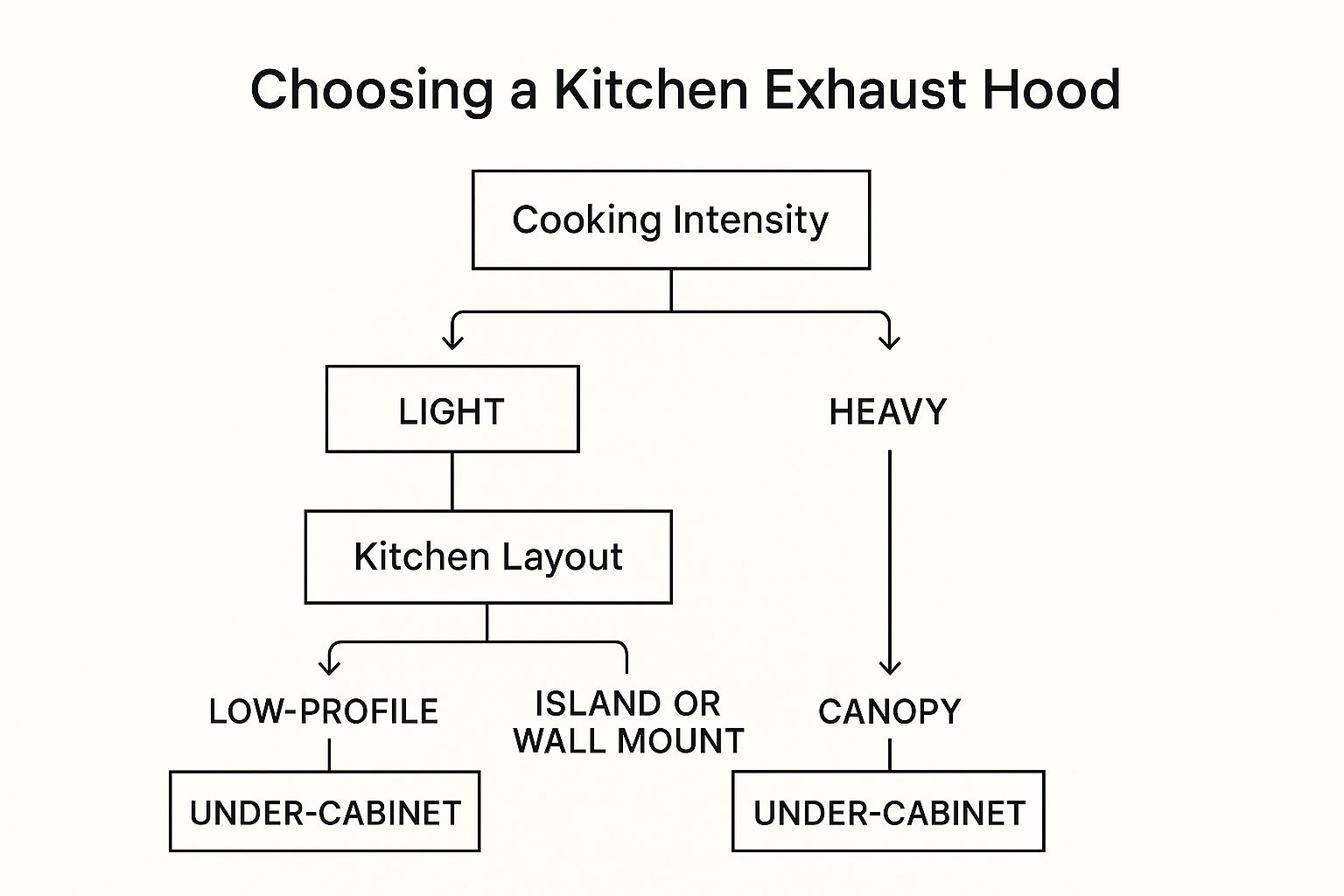
As you can see, the more intense and frequent your cooking, the stronger the case for a ducted system to handle the job effectively.
Performance and Maintenance: What to Expect
While ductless hoods are incredibly convenient, it's important to know their limits. They don’t remove heat or humidity, and their performance is only as good as their filters. The charcoal filters, in particular, need to be replaced every 3-6 months to keep the unit working properly—they can’t just be washed and reused.
To put it simply, ducted hoods remove pollutants from your home, while ductless hoods manage them. Your choice really boils down to which approach is more practical for your living situation.
Let's break it down with a side-by-side comparison.
Ducted vs. Ductless: A Head-to-Head Comparison
This table cuts through the noise and lays out the core differences to help you see which option aligns better with your needs.
| Feature | Ducted Exhaust Hood | Ductless Exhaust Hood |
|---|---|---|
| Air Management | Physically removes all airborne contaminants from the home. | Filters and recirculates air back into the kitchen. |
| Performance | Excellent for removing heat, steam, grease, and all odors. | Good at removing grease and odors; does not remove heat or humidity. |
| Installation | More complex and potentially costly; requires ductwork outside. | Simple and usually less expensive; no ductwork needed. |
| Maintenance | Metal filters need periodic cleaning. | Metal filters need cleaning, and charcoal filters need regular replacement. |
| Best Fit | Serious home cooks, gas stovetops, new builds, and renovations. | Apartments, condos, rentals, and kitchens where ducting isn't an option. |
Ultimately, there's a perfect kitchen exhaust hood for you. If you have the option to install ductwork, a ducted model will always give you the best ventilation. But if not, a good ductless model is a fantastic and effective alternative that will make a huge difference in your cooking space.
Matching Your Hood to Your Kitchen Style
Don't think of your kitchen exhaust hood as just another appliance. It’s a major design element that can make or break the entire look and feel of your kitchen. Function and form have to work together here. The right hood can be a stunning centerpiece, but the wrong one can feel clunky and out of place, completely disrupting the room’s flow.
Once you’ve wrestled with the big ducted vs. ductless decision, your next challenge is picking a style that fits your space. Are you going for something subtle and integrated, or do you want a bold, architectural statement? Let’s walk through the most common designs to see how they fit into different kitchens.

Under-Cabinet Hoods for Integrated Design
The under-cabinet hood is probably the one you’re most familiar with. It’s a classic for a reason. True to its name, it tucks neatly away under your upper cabinets, right above the cooktop. This creates a clean, uninterrupted line that’s perfect for smaller kitchens or for anyone who prefers a more subtle, built-in look.
These hoods are a fantastic choice for:
- Traditional Kitchens: They fit right into a classic layout without demanding attention.
- Space-Conscious Designs: You get the ventilation you need without sacrificing precious cabinet space above.
- Budget-Friendly Remodels: Generally, they are one of the more affordable and straightforward types to install.
Wall-Mount Hoods: The Bold Statement Piece
What if your cooktop is on a wall with no cabinets overhead? That’s where the wall-mount hood shines. Often called "chimney" hoods, these feature a visible flue that runs up the wall to the ceiling, instantly becoming an architectural focal point. They come in a huge range of materials, from sleek stainless steel and hammered copper to custom-finished wood.
A wall-mount hood is your go-to for creating drama. It works just as well in an industrial loft as it does in a rustic farmhouse. A slick, angular steel model reinforces a modern vibe, while a handcrafted plaster or wood-trimmed hood can give the room a warm, European feel.
The right wall-mount hood doesn’t just vent your kitchen; it anchors the entire design. By drawing the eye upward, it can make your ceilings feel taller and the room more spacious and grand.
Island Hoods for Open-Concept Living
In today's open-plan homes, the kitchen island is the command center—it’s where you cook, chat, and entertain. An island hood is designed specifically for this setup, mounting directly to the ceiling above your island cooktop. Since it’s on full display from every angle, its look is absolutely critical.
You’ll often see these in stunning, sculptural forms made of glass, stainless steel, and other high-end materials. They deliver powerful ventilation without needing a wall for support, preserving that open, airy atmosphere everyone loves.
Downdraft Systems: The Minimalist Choice
For the true minimalist, a downdraft system is ventilation that disappears. Instead of hanging overhead, these vents are built right into the countertop, either behind or next to the cooktop. With the push of a button, the vent pops up to pull smoke and steam down and away.
Downdraft systems are a brilliant solution for kitchen islands where you don’t want a big hood blocking sightlines, or in any kitchen where the goal is a perfectly flat, unbroken countertop. While they look incredibly sleek, it's worth noting they have to work against the natural tendency of heat and steam to rise. This can make them a bit less effective for tall stockpots or really high-heat cooking compared to their overhead counterparts.
Decoding Performance Power and Noise Level

Let's be honest, staring at technical specs can make anyone's eyes glaze over. But when you’re looking at a kitchen exhaust hood, those numbers are telling a crucial story: how well it will clear the air and how loud it will be while doing it. Getting a handle on these metrics is the key to finding a hood that actually works for your cooking style—without being underpowered or deafening.
Think of it like choosing an engine for your kitchen. If you only do light-duty cooking, a small, quiet engine works just fine. But if you’re constantly searing steaks, frying up a storm, or cooking with pungent spices, you’re going to need more muscle to keep your home smelling fresh.
Let’s break down the two most important specs you’ll see: CFM and Sones.
Understanding Airflow with CFM
The single most important number you’ll come across is CFM, which stands for Cubic Feet per Minute. This isn't just jargon; it’s a direct measure of the hood's suction power. It tells you exactly how much air the fan can move in one minute. A higher CFM rating means a more powerful fan that clears smoke, steam, and odors much faster.
So, how much CFM do you actually need?
- For Electric Cooktops: A good rule of thumb is 100 CFM for every 25 cm of cooktop width. A standard 76 cm electric range, for example, pairs well with a hood rated for at least 300 CFM.
- For Gas Cooktops: Gas burns hotter and produces more exhaust, so it needs more ventilation power. Here, the guideline is to have 1 CFM for every 100 BTUs of your cooktop’s total output.
Choosing the right CFM is a balancing act. Too little, and you’ll find that cooking smells linger for hours. Too much, and you’re just paying for power you’ll never use. Getting this right ensures your kitchen exhaust hood is a perfect match for the way you cook.
Noise Levels and Sones Explained
All the power in the world doesn’t matter if your exhaust hood sounds like a jet taking off in your kitchen. This is where Sones come into play. A Sone is a unit of loudness designed to reflect how our ears actually perceive sound. It’s simple: a lower Sone rating means a quieter hood.
To put it in perspective:
- 1 Sone: This is about as quiet as a modern refrigerator's hum. You’ll barely notice it.
- 4 Sones: This is comparable to the sound of a normal conversation.
- 8 Sones: Now we’re getting loud—think of a busy, bustling restaurant.
Keep in mind that a hood's Sone rating is usually measured at its lowest fan speed. When you crank up the power for a higher CFM, the noise level will naturally go up too. A high-quality hood strikes a great balance, offering powerful ventilation without being overwhelmingly loud at its most-used settings.
This balance between performance and comfort is a huge driver for consumers. In the United Arab Emirates, for instance, the market for residential kitchen exhaust hoods is booming, largely because modern lifestyles demand kitchens that are both hygienic and pleasant to be in. In fact, industry analysis suggests this demand will help the regional market grow at a CAGR of about 3.5% by 2028. You can dive deeper into these trends on the Middle East and Africa residential cooker hoods market report on databridgemarketresearch.com.
The Role of Filters in Performance
Finally, don't overlook the filters. The type of filter inside your hood directly affects both its performance and how often you have to clean it. Most hoods use either baffle or mesh filters to trap grease before it enters the ductwork.
Baffle Filters: Built from interlocking metal channels, these filters force greasy air to change direction abruptly. This action separates the grease from the air, causing it to drip down and collect in the baffles. They are incredibly efficient, durable, and the standard for professional-style hoods.
Mesh Filters: These are made of several layers of aluminum mesh that trap grease particles as air passes through. While effective, they can sometimes restrict airflow more than baffle filters, especially if they aren't cleaned regularly.
For ducted systems, the ducting itself is just as important. Smooth, properly sealed ducts are vital for efficient airflow. To learn more about robust materials, you can check out our resources on stainless steel pipe and fittings. But remember, no matter which filter you have, regular cleaning is the one thing you can’t skip if you want to maintain peak performance.
Installation and Maintenance Made Simple
Choosing the right kitchen exhaust hood is only half the battle. To really get the performance you paid for, proper installation and regular upkeep are absolutely critical. A well-installed hood runs quietly and effectively, but a little routine care is what protects your investment and keeps it clearing the air for years to come.
You simply can’t compromise on installation. Even the best hood on the market won't do its job if it's set up incorrectly. It's more than just screwing a unit to the wall; it’s a job that requires careful planning and often a professional touch. For anyone looking at a bigger kitchen overhaul, learning about HVAC unit installation can offer some great perspective on why getting the setup right from the start is so important.
Key Installation Rules
To get your hood working as it should, there are a few non-negotiable rules. Sticking to these guidelines is the difference between an efficient appliance and a loud, clunky ornament hanging over your stove.
Optimal Mounting Height: Where you position the hood is crucial. For electric cooktops, the sweet spot is typically between 66 to 76 centimetres (26 to 30 inches) above the cooking surface. For powerful gas ranges, you’ll want to go a bit higher, around 76 to 91 centimetres (30 to 36 inches). Go too high, and it won't catch the fumes. Too low, and it’s a fire risk that gets in your way.
Smooth, Straight Ducting: If you have a ducted model, the pathway for the air is everything. The ductwork needs to be as short and straight as you can possibly make it. Every single bend or elbow adds resistance, which kills airflow and ramps up the noise. Always opt for smooth, rigid ducting over the flimsy, flexible kind.
A correctly installed kitchen exhaust hood not only enhances kitchen air quality but also adds significant value and functionality. The goal is to create a seamless path for air to travel, maximising suction power while minimising operational noise.
A Simple Maintenance Schedule
Once your hood is up and running, a simple cleaning routine is all it takes to keep it in peak condition. Forgetting about maintenance is the quickest way to kill its performance and create a serious fire hazard from all the grease buildup.
Just follow this easy schedule:
Grease Filters (Monthly): Think of these metal or baffle filters as the first line of defense against grease. They need a good cleaning at least once a month—more if you do a lot of frying. Most are dishwasher-safe, which makes it a breeze. A clean filter means clear airflow.
Charcoal Filters (Every 3-6 Months): For ductless hoods, these are the secret to neutralizing odors. You can't clean these; they have to be replaced. Check what your manufacturer suggests, but swapping them out every 3 to 6 months is a good rule of thumb.
Exterior Surfaces (Weekly): Give the outside of the hood a quick wipe-down with a soft cloth and a gentle cleaner. This keeps grease from getting baked on and ensures your kitchen's focal point stays looking sharp.
Your Top Kitchen Exhaust Hood Questions, Answered
Alright, even after you’ve done your homework, some nagging questions always seem to pop up right when you’re about to make a final decision. That’s completely normal. Getting clear, straightforward answers can make all the difference, giving you the confidence that you're choosing an appliance you'll be happy with for years.
Most people get a little tripped up by the technical specs or the thought of installation. And they should—making the wrong call here can mean ending up with a kitchen that’s still smoky or an exhaust fan that sounds like a jet engine taking off.
So, let's tackle the most common questions we hear from homeowners every day.
How Do I Know What CFM I Need?
Figuring out the right airflow, measured in CFM (Cubic Feet per Minute), is probably the most critical part of this whole process. It's the engine of your ventilation system. There’s a pretty simple rule of thumb to get you started:
- For Gas Cooktops: You'll want at least 1 CFM for every 100 BTUs your cooktop puts out. Just add up the BTUs for all your burners.
- For Electric Cooktops: A solid baseline is 100 CFM for every 10 inches of cooktop width.
Now, a word of advice from experience: if you’re someone who loves to sear steaks, fry bacon, or cook with aromatic spices, don't just meet the minimum. Go for a hood with a bit more CFM power. You’ll be thankful you have that extra boost when you really need it.
Can I Install a Ducted Hood Myself?
Look, if you're a seasoned DIY pro and you're just swapping out an old under-cabinet hood for a similar new one, you might be able to handle it. But installing a brand-new ducted system from scratch? That's a different beast entirely. It can involve cutting into drywall or even exterior walls, running and sealing ductwork perfectly, and making sure the outdoor vent cap is installed correctly.
We almost always recommend hiring a qualified professional for any new ducted hood installation. It’s the only way to be certain the system is safe, works as it should, and meets local building codes. It's just not worth the risk.
How Often Should I Clean My Filters?
This is non-negotiable. Clean filters are the key to a long-lasting, effective hood. It's the single most important maintenance task you can do.
- Metal Grease Filters (Mesh or Baffle): Give these a good cleaning at least once a month. The best part? Most are dishwasher-safe, so it’s an easy chore.
- Charcoal Filters (Ductless Hoods): These can't be washed; they have to be replaced. Depending on how much you cook, you’ll need to swap them out every 3 to 6 months. This is crucial for keeping kitchen odors under control.
At Yasu Trading Co. LLC, we supply the high-quality components and materials needed to ensure your kitchen ventilation system is installed for maximum performance and longevity. Explore our extensive range of building and HVAC supplies for your next project at https://yasutrading.com.