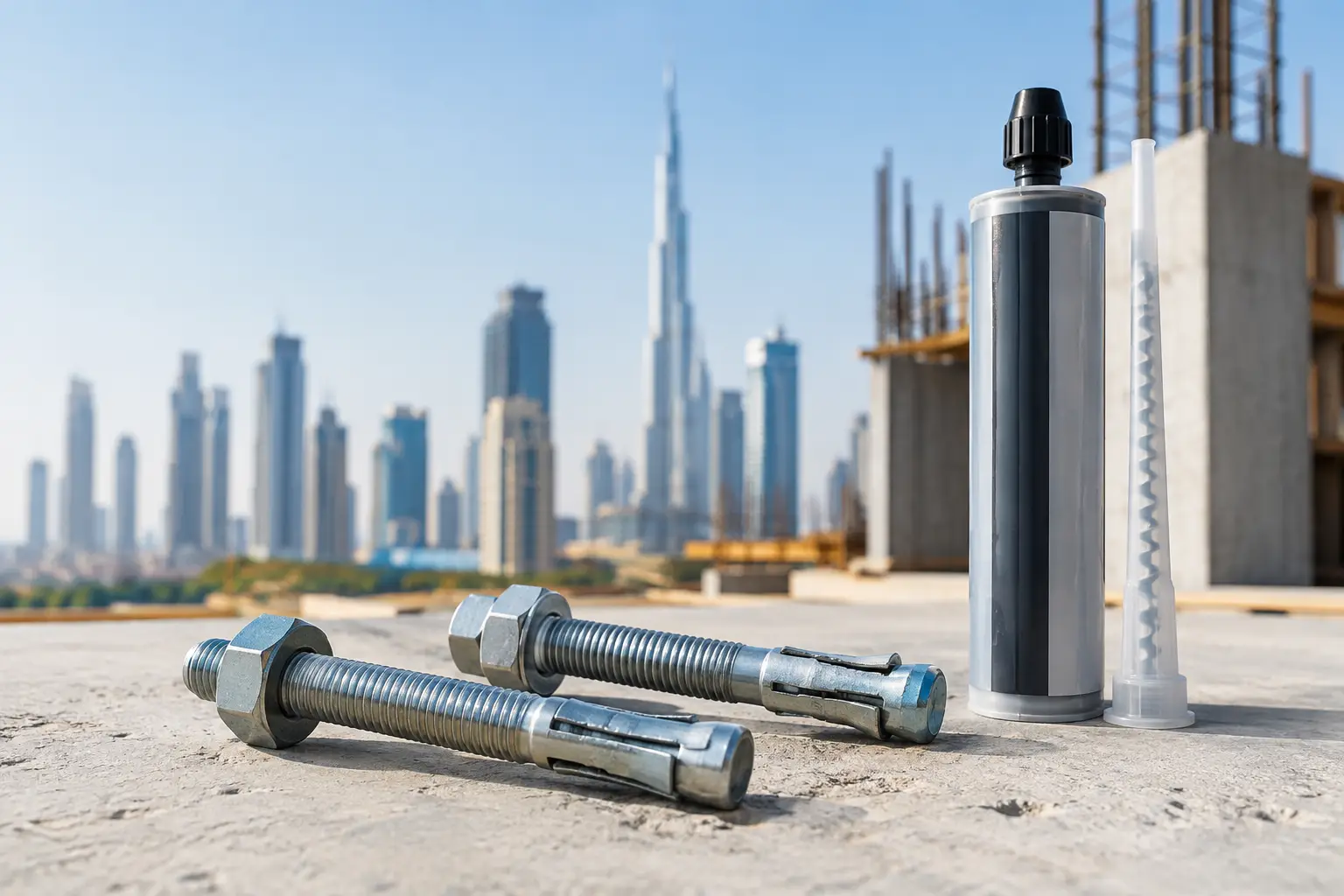
Mechanical Chemical Anchors for UAE Projects
A failed anchor rarely starts with the anchor itself. It usually starts with an incomplete specification, an unknown base material, or installation carried out under site pressure. For contractors buying mechanical chemical anchors, the priority is not simply finding a fastener that fits the hole. It is selecting an approved anchoring system that transfers the required load safely, meets the project specification, and can be installed consistently by the site team.
On MEP, fit-out, façade support, and maintenance work, anchor decisions affect inspection approvals, rework exposure, and handover dates. The right choice depends on the load, edge distance, concrete condition, environmental exposure, and the manufacturer’s approved installation data.
Mechanical chemical anchors: start with the load path
The term mechanical chemical anchors is often used in procurement requests, but mechanical anchors and chemical anchors work differently. They should not be treated as interchangeable products.
Mechanical anchors achieve holding power through expansion, undercutting, or screw-thread engagement with the base material. Common options include wedge anchors, sleeve anchors, drop-in anchors, concrete screws, and heavy-duty through bolts. When tightened or set, these anchors develop a mechanical connection with concrete or masonry.
Chemical anchors, also called adhesive anchors, use an injected resin to bond a threaded rod, rebar, or internal threaded sleeve into a drilled hole. The resin fills the annular space around the fixing and, once cured, transfers load into the substrate. Polyester, vinylester, epoxy, and hybrid resin systems have different strengths, cure times, temperature limits, and approved applications.
The practical question for a buyer is not which category is better. It is which system has the required approved performance in the actual substrate and site condition. A light cable tray installation in sound concrete may suit a mechanical anchor. A high-load support close to a concrete edge, or a post-installed rebar connection, may require a chemical anchor system designed and approved for that application.
Select the anchor before ordering the fixing
Anchor selection should start with the engineering requirement, then move to the product. Ordering by diameter alone creates risk because two anchors with the same nominal size can have very different load ratings, embedment depths, and approvals.
Confirm the base material
Concrete is not one condition. The slab or wall may be cracked or uncracked, hollow block, solid block, lightweight concrete, or aged concrete with unknown strength. An anchor approved for solid concrete may not be suitable for hollow masonry, where a perforated sleeve or a specialist fixing may be required.
For existing buildings, the base material should be verified before a large installation begins. Concrete scanning is often necessary to identify reinforcement, post-tension cables, embedded conduits, and other hidden services. This is especially relevant on retrofit MEP and facilities-maintenance work, where a misplaced hole can create a far larger delay than the anchor installation itself.
Check load type, direction, and safety factor
The anchor must be evaluated for tension, shear, or combined loading. Tension pulls the anchor out of the substrate. Shear loads act across the fixing. Brackets, suspended services, handrails, equipment bases, and pipe supports often introduce both.
Static loading is only one part of the picture. Vibration from equipment, repeated opening cycles, seismic design requirements, wind action, fire exposure, and overhead installation can change the correct product choice. Safety-critical supports should never be specified from a generic catalog load figure without considering the full fixing design.
The anchor layout matters as much as the individual anchor. Spacing between anchors, distance to edges, embedment depth, fixture thickness, and concrete strength can reduce the allowable load. The design professional or responsible engineer should confirm the final fixing arrangement where the application is structural, life-safety related, or governed by project approvals.
Match the product to the installation condition
Mechanical anchors offer speed. With the correct drilled hole and torque-controlled setting, a qualified installer can load many mechanical anchors immediately. That makes them efficient for repetitive supports in suitable concrete, particularly when rapid progress is required.
Chemical anchors offer flexibility in embedment and can be effective close to edges or for heavier-duty applications, subject to their approval data. However, they require more installation control. Hole cleaning, resin mixing, correct injection technique, rod insertion, and cure time are all essential. A chemical anchor is not ready for loading until the stated curing period has passed for the actual base-material temperature.
Temperature matters in the UAE. High ambient temperatures can affect resin workability and curing behavior, while stored cartridges left in direct sun may not perform as intended. The team should follow the manufacturer’s storage and installation temperature limits rather than assuming all resins behave the same way.
Installation quality determines anchor performance
A tested and approved anchor can still fail if installed incorrectly. Site supervisors should treat anchor installation as a controlled activity, not a minor finishing task delegated without guidance.
For mechanical anchors, drill the specified hole diameter and depth, remove drilling dust, place the anchor to the required setting depth, and tighten it to the manufacturer’s stated torque. Under-torque can leave the anchor inadequately set. Over-torque can damage the anchor, strip threads, or crack weak substrate material.
Chemical anchors require even greater discipline. The drill hole must be cleaned using the stated blow-brush-blow sequence or the applicable cleaning method for the substrate. Dust left inside the hole can prevent the resin from bonding properly. The initial resin discharged from a new cartridge should be discarded until a uniform mix is achieved, then resin should be injected from the back of the hole to avoid air pockets.
Insert the threaded rod or rebar with a rotating motion to the required embedment mark. Do not disturb the rod during the full curing period. If a fixture is installed or loaded too early, the bond can be compromised even though the resin appears hard at the surface.
For critical installations, keep a simple installation record that identifies the anchor type, size, batch information, location, installer, installation date, and cure time. Pull-out testing may also be specified for selected anchors, especially where existing concrete strength is uncertain or where the project consultant requires verification.
Procurement controls that prevent site delays
Anchor procurement often becomes urgent because supports, brackets, and equipment arrive before the required fixing schedule is finalized. The fastest way to avoid substitutions and repeat deliveries is to issue a complete request from the start.
A useful anchor request should include the required anchor type, diameter, embedment, base material, load requirement, fixture thickness, environmental condition, quantity, and any required approval or test documentation. For chemical systems, specify the resin type, rod grade and finish, and whether accessories such as nozzles, brushes, blow pumps, sleeves, or setting tools are required.
Do not separate the anchor from its accessories during purchasing. A chemical anchor cartridge without the correct mixing nozzle, cleaning brushes, or compatible threaded rod can stop installation. Likewise, a mechanical anchor order may need washers, nuts, setting tools, drill bits, and torque-control equipment to complete the work correctly.
For contractors managing multiple work fronts, consolidated supply reduces coordination pressure. Yasu Trading Co. LLC can support project-based requirements across anchors, fasteners, power-tool accessories, sealants, MEP supports, and related installation materials, helping site teams avoid waiting on several suppliers for one completed fixing package.
Choose compliance over a convenient substitute
Low-cost substitutions are tempting when stock is tight, but anchors are not a category where visual similarity proves technical equivalence. A different resin chemistry, steel grade, coating, or approval classification can change whether the fixing is suitable for the intended environment and load case.
For exterior, humid, or corrosive locations, verify the anchor material and corrosion resistance. Zinc-plated steel may be appropriate for dry internal conditions but not for exposed or aggressive environments. Stainless steel grades, hot-dip galvanized options, and specialist coatings should be selected according to the project specification and exposure classification.
Municipality-compliant materials, manufacturer documentation, and traceable products protect more than an inspection result. They protect the contractor from removing and reinstalling supports after ceilings are closed, finishes are completed, or equipment is commissioned.
A well-specified anchor is a small line item with a large effect on project certainty. Confirm the substrate, loading, approval requirement, and installation method before release, then procure the complete system with the accessories needed on site. That approach keeps the fixing work moving when the schedule has no room for a second attempt.