Essential Pipeline Accessories Dubai Projects Rely On
Sourcing the right pipeline accessories in Dubai isn't just a box-ticking exercise; it's fundamental to the safety and success of any major project in the industrial, construction, or utility sectors. These parts, from the smallest gasket to the largest valve, are the critical connections that keep complex systems running, prevent catastrophic failures, and ensure operational integrity across the region.
Why Pipeline Accessories Are a Big Deal in Dubai
Picture Dubai's sprawling industrial landscape—a massive network of oil and gas facilities, desalination plants, and iconic construction sites. Think of this network as the city's circulatory system. The pipelines are the major arteries, but they'd be nothing without the smaller, specialised components that connect, direct, and control the flow.
That's precisely where pipeline accessories come into play. They are the unsung heroes of this entire system, each performing a vital job to keep things moving smoothly, safely, and efficiently.
The Essential Cogs in the Machine
It's helpful to think of pipeline accessories as the essential support crew for the main network. Without them, the entire system would grind to a halt. Each piece has a very specific and non-negotiable role to play.
- Flanges and Fittings: These are the strong connectors, joining pipes securely while also allowing for easier maintenance and disassembly down the line.
- Valves: They act like traffic police for the pipeline, giving you precise control over the flow, pressure, and direction of whatever is moving inside.
- Supports and Hangers: This is the structural backbone. They bear the pipeline's weight and prevent the kind of stress that can lead to disastrous failures.
- Gaskets: A simple but crucial component, gaskets create tight seals to stop dangerous leaks that could put people, the environment, and your budget at risk.
Without these carefully engineered parts, a pipeline is just an empty tube. Choosing the correct pipeline accessories in Dubai is what turns that tube into a reliable, functional, and safe asset.
Picking the right accessories is far more than a simple procurement task. It’s a strategic decision that directly affects a project's long-term success, safety record, and operational uptime.
The financial impact of these components is huge. The Middle East's pipeline maintenance market, which is completely dependent on a steady supply of high-quality accessories, is valued at roughly $419 million and is expected to keep growing. This number alone shows the massive, ongoing investment in keeping the region's critical infrastructure in top shape. You can dive into the specifics by checking out the Middle East pipeline maintenance market report at Mordor Intelligence.
This guide is designed to walk you through everything you need to know, explaining why these parts are so foundational to any successful project in Dubai's demanding industrial environment.
Understanding the Core Types of Pipeline Accessories
Walking into the world of pipeline accessories can feel overwhelming. It’s a bit like looking at an engine for the first time—a maze of parts and pieces. But it's simpler than it looks if you group everything by its job. Every single component has a specific role, all working together to keep the pipeline running safely and efficiently.
Instead of getting lost in a long list of technical names, let's break these crucial items down by what they actually do. Think of a pipeline system as a highly skilled team. You have players who connect, players who control the flow, and others who protect the entire structure. Grasping these roles is the first real step to choosing the right pipeline accessories in Dubai for your project.
The Connectors and Directors
At its heart, a pipeline is just a series of tubes that need to be joined, change direction, or manage what’s moving through them. This is where the first two big families of accessories come in.
- Connecting Components (Fittings and Flanges): These are the nuts and bolts—literally the skeleton of the pipeline. Fittings like elbows and tees are what let a pipe turn a corner or split into two paths. Flanges, on the other hand, are all about creating solid, sealed connection points that make assembly and future maintenance possible. For a deeper dive, check out our guide on the different types of pipe connectors used in Dubai.
- Flow Control Components (Valves): Think of valves as the traffic cops of a pipeline. They have one job: to start, stop, or regulate the flow of whatever is inside, whether it's liquid or gas. Without good valves, a system would be chaotic and downright dangerous.
This infographic gives you a great visual of how these fundamental pieces come together.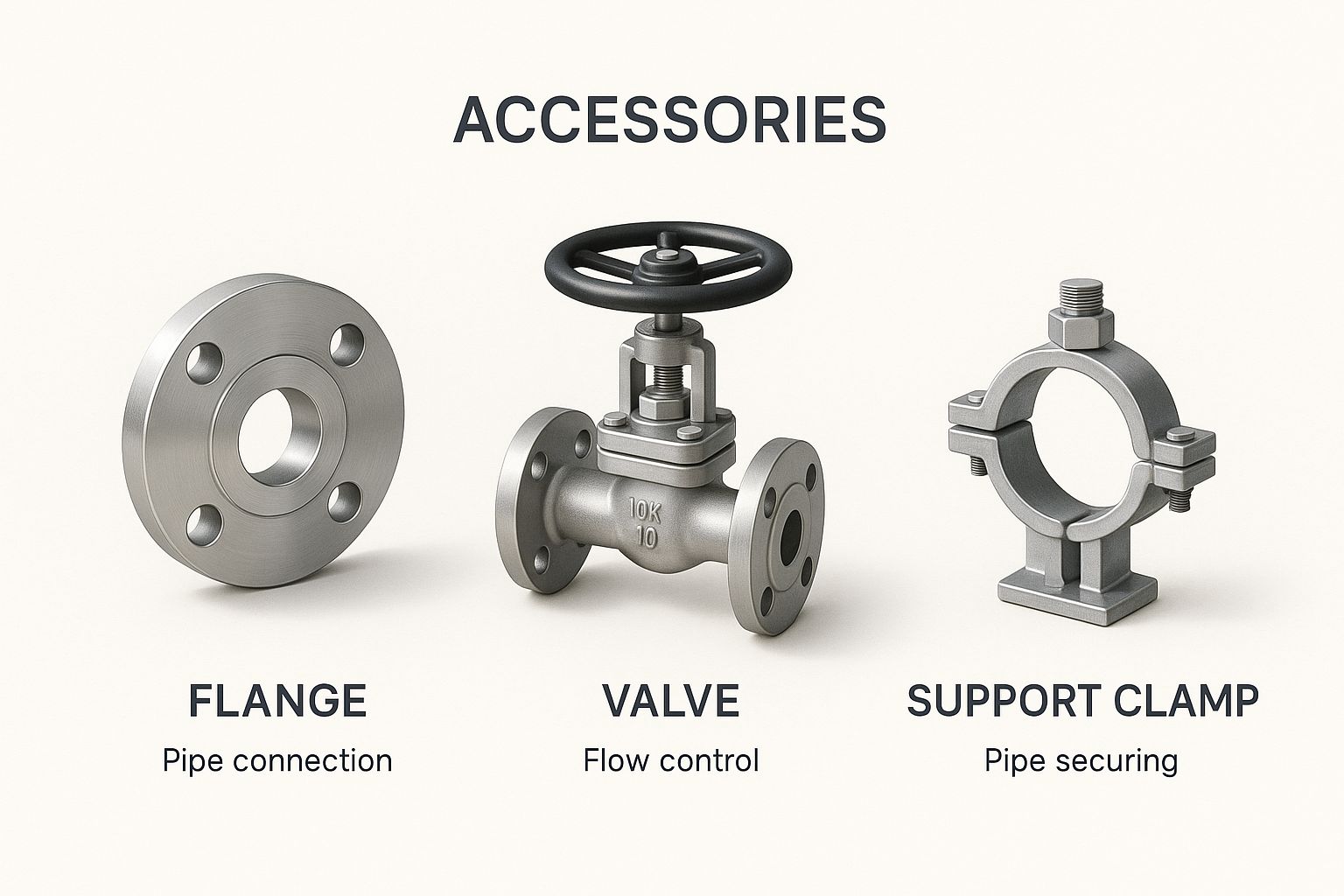
As you can see, it takes a combination of distinct parts—flanges for connection, valves for control, and supports for stability—to build a truly functional network.
The Protectors and Stabilisers
Moving materials from A to B is just one part of the equation. A pipeline also has to be perfectly sealed, stable, and clean. This is where a whole different set of accessories comes into play, all focused on integrity and support. Their job is often preventative, stopping small issues from becoming catastrophic failures.
Every joint is a potential point of failure. Accessories like gaskets and clamps are not just additions; they are essential safeguards that maintain the system's integrity against immense pressure and harsh environmental conditions.
The final two functional groups are dedicated to this critical protective role.
- Stability Components (Supports and Clamps): Pipelines are incredibly heavy and have to deal with constant vibration and temperature changes that cause expansion and contraction. Supports and clamps act as the structural backbone, holding the weight and securing the pipeline to prevent stress, cracks, and collapse.
- Integrity Components (Gaskets and Strainers): Gaskets are the unsung heroes here. They create the perfect, leak-proof seal between two flanges. Strainers, meanwhile, are the gatekeepers. They act like a sieve, catching debris and gunk before it can damage expensive downstream equipment like pumps and meters.
To get a better sense of how to keep your system clean, exploring the range of available filter accessories is a must for any project manager.
Here’s a quick summary of how these components are categorised by their function, which is the most logical way to approach selection and ensure all your bases are covered.
Functional Categories of Essential Pipeline Accessories
| Accessory Category | Primary Function | Common Examples |
|---|---|---|
| Connecting Components | Join pipe sections, change direction, or create branches. | Flanges, Elbows, Tees, Reducers |
| Flow Control Components | Start, stop, or regulate the flow of fluid or gas. | Gate Valves, Ball Valves, Globe Valves, Check Valves |
| Stability Components | Secure the pipeline, manage weight, and absorb vibration. | Pipe Supports, Hangers, Clamps, Saddles |
| Integrity Components | Ensure a leak-proof seal and protect equipment from debris. | Gaskets, Strainers, Filters, Expansion Joints |
By thinking in terms of function—connecting, controlling, stabilising, and protecting—you can systematically build a robust and reliable pipeline, no matter the scale of the project.
Selecting Materials Built for Dubai's Climate
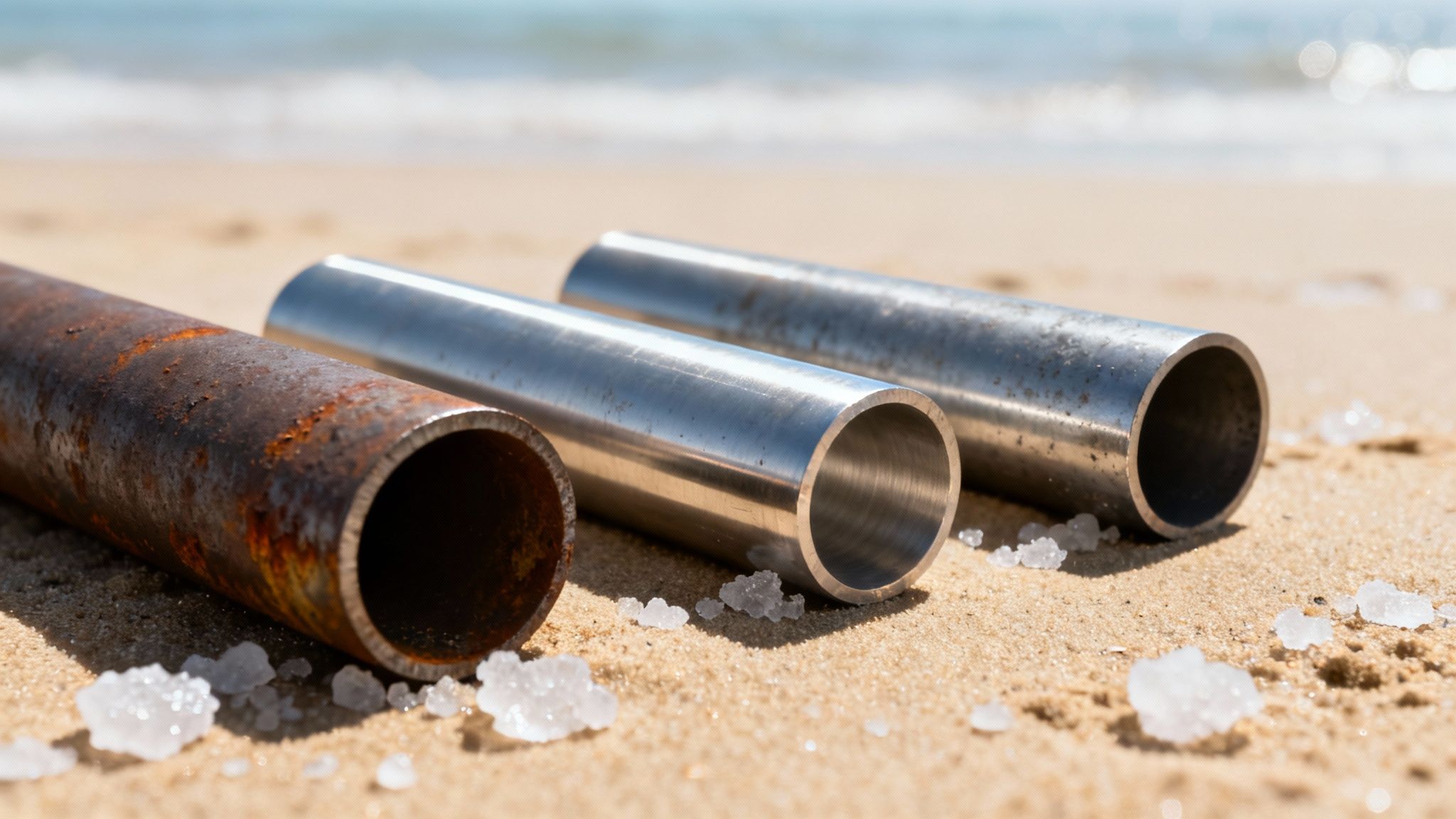
Dubai's environment is relentless. The mix of blistering heat, high humidity, and salty coastal air is a perfect recipe for corrosion, and it can chew through standard materials faster than you'd believe. That’s why choosing the right material for pipeline accessories in Dubai isn't just a small technical detail. It’s the single most important decision you'll make for the long-term safety and integrity of your entire system.
Think of it like picking the right tyres. You wouldn't use summer slicks for an arctic expedition, would you? The same logic applies here. In Dubai, your pipeline's material is its primary shield against a constant environmental assault.
A simple carbon steel fitting might hold up just fine in a temperate, dry climate. But install that same fitting in a coastal desalination plant near Jebel Ali, and you'll see rust and degradation in a matter of months. This creates a weak link that puts the whole operation at risk. This isn't just a theory; it's a costly reality for projects that misjudge the local conditions.
The Trade-Off Between Cost and Corrosion Resistance
When it comes to materials, project managers are always walking a tightrope between upfront cost and long-term performance. It’s tempting to pick a cheaper option to stay on budget, but this is almost always a false economy. The money you save today will be spent many times over on maintenance, downtime, and eventual replacement.
Here’s a rundown of the most common materials and where they fit in:
- Carbon Steel: This is the go-to for many industries because it’s strong and affordable. In Dubai's corrosive air, however, it absolutely needs protective coatings or linings. This adds another step and, more importantly, another potential point of failure if that coating gets damaged.
- Stainless Steel: With far better corrosion resistance, grades like 304 and 316L are very popular. They hit a sweet spot for many projects. For a much closer look at where they shine, our article on stainless steel pipe fittings gets into the specifics.
- Specialised Alloys: For the truly harsh jobs—think pipelines moving brine or getting hit with direct seawater spray—you need the heavy hitters. Materials like Duplex and Super Duplex stainless steel are non-negotiable. Their superior resistance to chloride-induced cracking is worth every penny in these critical applications.
The initial investment in a corrosion-resistant alloy is not an expense; it is insurance against catastrophic failure, operational disruption, and environmental damage down the line.
This demand for tough components is felt across related sectors. For example, the UAE's aluminium profiles and accessories market has hit an estimated $289.6 million. The accessories segment is growing the fastest, driven by this exact need for specialised, durable pipeline parts.
Ultimately, choosing the right material is a matching game. You have to match the accessory's composition to the specific fight it will face every day, ensuring it’s built to last for decades, not just a few years.
Meeting Key Standards and Compliance in the UAE
In Dubai's high-stakes industrial world, compliance isn't just the last box you tick. It’s the concrete foundation for a project's safety, legality, and ultimate success. Sourcing pipeline accessories in Dubai without a solid grasp of the required standards is a recipe for disaster.
Think of these standards as a universal language for engineers and suppliers. They guarantee that a valve from one certified maker will perform exactly as designed when bolted to a flange from another. This system is crucial for preventing dangerous mismatches in pressure ratings, material strength, and even simple dimensions—protecting both expensive assets and, more importantly, people.
Navigating the Alphabet Soup of Standards
For anyone new to the industry, the swarm of acronyms can feel overwhelming. But in reality, just a few key organisations set the rules for most projects in the region. Getting to know them is the first step in making sure every part you buy is right for the job.
- API (American Petroleum Institute): In the oil and gas sector, API is king. If you’re working with hydrocarbons, their certification isn't just a good idea; it's mandatory.
- ASME (American Society of Mechanical Engineers): ASME's codes cover a huge territory, from boilers to pressure vessels. Their standards for flanges (B16.5) and fittings (B16.9) are quoted in project specs all the time.
- ISO (International Organisation for Standardisation): ISO focuses on quality management. An ISO 9001 certification, for example, tells you a supplier has reliable processes for delivering consistent, high-quality products.
Cutting corners on these certifications can stop a project in its tracks. Picture this: hundreds of fittings have been installed, but a site inspector discovers they don't have the proper Mill Test Certificates (MTCs). That one oversight can lead to a stop-work order, forcing you to rip everything out and start over, blowing your budget and schedule by weeks or even months.
Local Requirements Are Paramount
On top of the international codes, suppliers have to meet the strict demands of local authorities and major project owners. Getting the green light often means getting approval from multiple gatekeepers, each with their own approved vendor lists and compliance rules.
In Dubai, a product is only as good as its documentation. Without the correct certifications from bodies like Dubai Municipality or approvals from giants like ADNOC and DEWA, even the highest-quality accessory is effectively useless for a major project.
That's why checking a supplier's credentials is so critical. Always ask for—and carefully review—their documentation. Make sure every single batch of pipeline accessories in Dubai you buy is fully traceable and certified to meet both the global standards and the specific local requirements.
How to Choose the Right Supplier in Dubai
Picking a supplier for pipeline accessories in Dubai isn't just about ticking an item off a procurement list. Think of it as bringing a long-term partner onto your project—one whose reliability can make or break your success. In a market this crowded, falling for the lowest price tag is a classic mistake, often leading to project delays, component failures, and costs that snowball down the line. A real partner delivers more than just parts; they bring expertise, dependability, and solid logistical support to the table.
The best suppliers become an extension of your own team. They get what you’re trying to build and understand the unique challenges of our local climate. Their role is absolutely critical. Just look at the Middle East's gas pipeline network, where the compressor stations—packed with a huge array of valves, fittings, and monitoring gear—are responsible for nearly 60% of the regional gas pipeline revenue. That single statistic from Grand View Research shows you just how much is riding on the performance of every single component. Sourcing from a supplier who guarantees that performance isn’t just good practice; it's a strategic necessity.
Evaluating Technical Expertise and Local Knowledge
A massive catalogue is useless if the team behind it doesn't have the know-how to match. You need a supplier who can do more than just process an order. Can they sit down with you and talk through your technical specs? Can they confidently recommend the right materials to fight corrosion in a high-salinity environment? Do they know the difference between ASME standards and specific Dubai Municipality regulations?
That local knowledge is the real game-changer. A supplier who knows the lay of the land in Dubai understands the common project hurdles, from tricky logistics to navigating approvals. They've built the relationships that can smooth out the delivery process. This is the kind of practical advice an overseas vendor simply can't provide, ensuring every valve, flange, and fitting is genuinely fit for purpose.
Stock Availability and Quality Control
Project timelines here are legendarily tight. You can't afford to put everything on hold for weeks waiting for a critical part to arrive from overseas. This is where a top-tier local supplier truly shines: their on-the-ground stock availability.
A reliable local supplier with a well-managed inventory is your best insurance against project delays. Their ability to deliver certified, high-quality components on short notice can be the difference between meeting a deadline and facing costly penalties.
Before you sign any contracts, you need to dig into their quality control. Get straight answers to these questions:
- Material Origin: Can they give you full traceability on their products, complete with Mill Test Certificates (MTCs)? No excuses.
- Certification: How do they verify that every item meets the required API, ASME, or ISO standards? What's their process?
- Inspection: What happens when goods arrive at their warehouse? Do they have a rigorous inspection process to catch defects or counterfeit parts before they ever get near your site?
To make this process easier, we've put together a checklist you can use when vetting potential suppliers.
Supplier Evaluation Checklist for Pipeline Accessories
This checklist provides a structured way to compare suppliers and ensure you're choosing a partner that aligns with your project's quality, timeline, and budget requirements.
| Evaluation Criterion | Why It Matters | Questions to Ask |
|---|---|---|
| Local Stock Levels | Immediate availability prevents costly project delays. | "What's your typical stock level for the items I need most? What's your lead time for out-of-stock items?" |
| Technical Expertise | Ensures you get the right product for your specific application and environment. | "Can your team advise on material selection for high-corrosion environments? Are you familiar with local regulations?" |
| Quality Control & Certification | Guarantees product integrity and compliance, protecting your project from failure. | "Can you provide a Mill Test Certificate (MTC) for every item? How do you verify product authenticity?" |
| Logistics & Delivery | A streamlined supply chain is crucial for meeting tight construction schedules. | "What are your standard delivery times within Dubai? Do you have your own delivery fleet?" |
| After-Sales Support | A true partner provides support beyond the initial sale. | "What's your process for handling returns or warranty claims? Who is my dedicated point of contact?" |
Ultimately, choosing the right supplier is about safeguarding your project's integrity, budget, and reputation. It's a decision that requires a thorough look at their entire operation, not just their price list.
For a deeper dive into sourcing materials in the region, our guide on finding the best plumbing materials suppliers in Dubai offers more practical tips. A supplier who ticks all these boxes is one you can count on for the long haul.
Frequently Asked Questions
When it comes to sourcing and installing pipeline accessories in Dubai, a few key questions always come up. Here are some straightforward answers based on years of experience in the field, aimed at helping project managers and procurement teams navigate the local market.
What Are the Biggest Challenges When Sourcing Pipeline Accessories in Dubai?
The toughest parts of the job usually come down to two things: verification and logistics. One of the biggest headaches is sifting through the market to find genuine products. You have to be incredibly careful to avoid counterfeits, because a fake valve or fitting doesn't just fail—it can put your entire system at risk. We're constantly working to ensure every component we source is truly rated for the region's intense heat and corrosive environments.
Another hurdle is making sure your supplier's paperwork is in order. You need to see current, valid certifications that meet the strict standards set by local authorities and major players like ADNOC or DEWA. And of course, there's the ever-present challenge of logistics. Getting the right parts to the right place at the right time is crucial, and any delay can throw a project schedule completely off track.
"In a market flooded with options, the real risk isn't paying too much—it's getting a fake. A counterfeit flange or a valve with bogus certification creates a domino effect of safety hazards and financial black holes. For a project, that's nothing short of catastrophic."
This is why digging deep into a supplier's quality control and documentation isn't just a good idea; it's a fundamental part of managing your project's risk.
Which Material Is Best for Seawater Pipelines in the UAE?
If your pipeline is going to be in contact with seawater, especially in the UAE's highly corrosive coastal areas, there's really only one answer: Duplex and Super Duplex Stainless Steel. These materials are specifically engineered to fight off the kind of damage we see here all the time, like chloride stress corrosion cracking and pitting.
You might be tempted to use standard stainless steel grades to save a bit upfront, but they just don't hold up over the long haul in this environment. Yes, Duplex materials cost more initially, but they last so much longer and require far less maintenance that they end up being the smarter financial choice. For any critical coastal or offshore project, their long-term reliability makes them the only sensible option.
How Can I Verify a Supplier's Products Meet ASME Standards?
This is a step you can't afford to skip, and it involves a few checks. First, always insist on a Mill Test Certificate (MTC) or a Certificate of Conformance (CoC) for every single item. Any credible supplier of pipeline accessories in Dubai will have this ready for you, no questions asked.
Once you have the certificate, it's time to play detective. Match the details on the paperwork—like the heat number and material grade—to the markings stamped directly onto the accessory. They have to be an exact match.
For high-stakes projects where failure is simply not an option, bring in a third-party inspector. It's a smart investment. They can independently confirm that everything is up to standard before it even gets to your site, giving you a crucial layer of confidence.
When your project demands certified quality and delivery you can count on, you need a partner who knows the local terrain. Yasu Trading Co. LLC offers a complete range of fully certified pipeline accessories designed for Dubai's most demanding conditions. Take a look at our catalogue and let's secure your project's success at https://yasutrading.com.