
Procurement Managers Dubai: Expert Guide to Success
In a city that moves as fast as Dubai, a procurement manager is so much more than just a buyer. They are the strategic core of their company, the ones responsible for keeping the engine of growth and stability running smoothly. Think of them as the navigators of complex supply chains, the guardians of the budget, and the ultimate reason projects get delivered on time. In a very real way, their work is critical to the city's economic heartbeat.
The Strategic Role of Procurement in Dubai's Economy
Forget the old image of a procurement manager simply processing purchase orders. In a market defined by record-breaking construction projects and a booming retail landscape, they are the strategic navigators for a company’s most vital resources. Their decisions ripple through the entire organisation, affecting everything from project schedules to the bottom line. They’re the ones charting a course through the often-choppy waters of global supply chains and local market volatility.
Every single choice, whether it's selecting a steel supplier for a new skyscraper or negotiating contracts for hotel fit-outs, has a direct impact. A smart, well-executed procurement plan can be the one thing that separates a successful project from a costly, delayed failure.
Driving Growth Beyond the Purchase Order
The role has changed. It's no longer a back-office function obsessed only with cutting costs. Today, procurement managers in Dubai are on the front lines, creating value and building a more resilient business. They are deeply involved in:
- Risk Mitigation: Spotting potential weak links in the supply chain long before they break and having contingency plans ready to go.
- Supplier Relationship Management: Moving beyond transactional relationships to build strong, collaborative partnerships that spark innovation and guarantee reliability.
- Strategic Sourcing: Looking past the price tag to understand the total cost of ownership, which includes everything from quality and logistics to long-term supplier performance.
This strategic mindset is absolutely essential in Dubai’s non-oil private sector, a major engine for the UAE's economic growth. The S&P Global UAE Purchasing Managers' Index (PMI) recently showed a significant expansion in this area, with the index hitting a nine-month high of 55.4. This signals a huge influx of new business.
But for procurement professionals, this boom is a double-edged sword. They have to scramble to meet the soaring demand while dealing with squeezed supply chains and intense pressure on their margins. Interestingly, the same report noted that while new orders were up, purchasing growth actually slowed and inventory levels dropped. This tells us that procurement managers in Dubai are getting smarter, actively optimising their stock to navigate these pressures. You can dig into the numbers yourself by exploring the full PMI report on economic trends in the UAE private sector.
In essence, a procurement manager’s success isn't just measured by the money they save. It’s measured by the competitive advantage they build for their company. They are the architects of a tough, efficient supply chain.
By mastering these strategic skills, these professionals do far more than just manage spending. They become absolutely central to their company's ability to win in one of the most competitive markets on the planet.
Getting to Grips with Dubai's Procurement Rules
For any procurement manager in Dubai, getting your head around the local legal landscape isn't just a box-ticking exercise. It’s the absolute foundation of your job. Think of it as learning the unique traffic laws of the emirate—without knowing them, you're bound to run into trouble, whether it's costly fines, frustrating project delays, or major compliance headaches. These rules aren't there to trip you up; they're designed to keep things fair, transparent, and high-quality across the board.
A big part of succeeding here is understanding the crucial differences between sourcing on the mainland versus within one of Dubai's powerhouse free zones, like Jebel Ali Free Zone (JAFZA) or the Dubai Multi Commodities Centre (DMCC). Each has its own playbook for contracts, customs, and getting suppliers on board. It creates a complex environment, but for a sharp procurement professional, it's entirely manageable.
Mainland vs. Free Zone Procurement
On the mainland, your procurement activities are largely guided by UAE Federal Law and specific Dubai government regulations. For government projects, this means following strict public tendering laws that demand transparency and open, competitive bidding. It’s all about creating a level playing field.
Free zones, on the other hand, march to the beat of their own drum. They operate with independent regulatory authorities. This can give companies some great perks, like 100% foreign ownership and different customs rules, but it also means you have to master a whole separate set of compliance standards. A contract that’s perfectly fine in JAFZA might not pass muster for a mainland project.
For a procurement manager, the real trick isn't just knowing what the rules are, but understanding why they're there. They exist to build a competitive, high-quality market. Once you master them, you’ve got a serious strategic advantage.
This is a good visual breakdown of how a procurement manager has to balance their core duties within this specific regulatory environment.
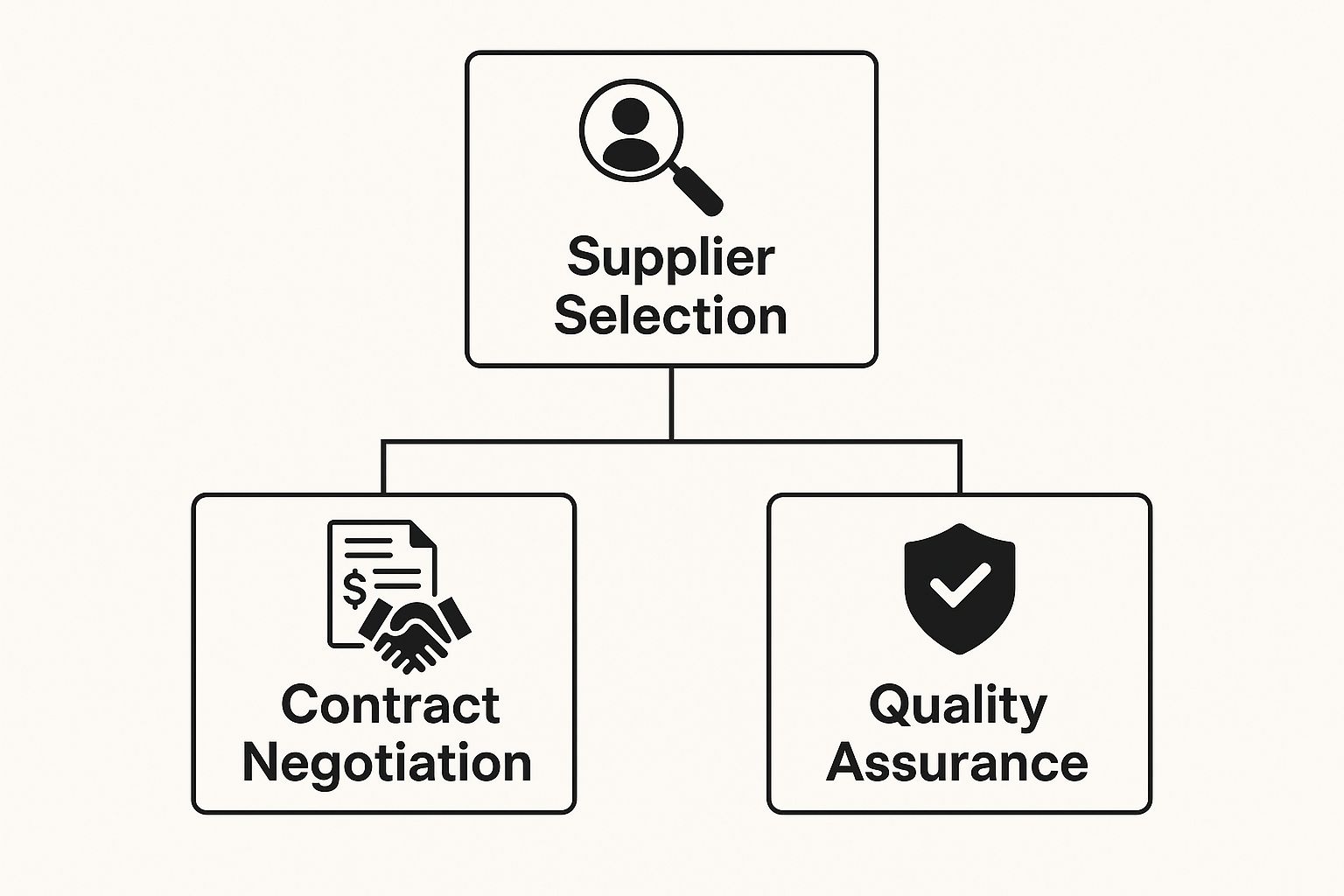
As you can see, the classic duties—supplier selection, negotiation, quality control—are all there. But in Dubai, how you actually do them is shaped heavily by the local regulations.
To help clarify which authorities you'll be dealing with, we've put together a quick summary of the key players and their roles.
Key Regulatory Bodies and Their Procurement Focus in Dubai
This table highlights the main government and free zone bodies that procurement managers in Dubai need to know, along with their specific areas of oversight.
| Regulatory Authority | Primary Procurement Focus | Example Requirement |
|---|---|---|
| Dubai Municipality (DM) | Construction materials, public health, safety standards | All building materials must have a DM certification to be used in projects. |
| Roads and Transport Authority (RTA) | Infrastructure projects, transport-related goods and services | Strict pre-qualification process for contractors and suppliers on public tenders. |
| Dubai Customs | Import/export duties, clearance of goods | Correct HS code classification and duty payments for all imported materials. |
| Jebel Ali Free Zone (JAFZA) | Zone-specific trade, licensing, and customs rules | Companies must use the Dubai Trade portal for all customs declarations. |
| Ministry of Economy (MoE) | Commercial law, consumer protection, ICV Program oversight | Adherence to the In-Country Value (ICV) program for specific contracts. |
Understanding these different authorities and their mandates is the first step towards building a compliant and efficient procurement strategy in the emirate.
Essential Compliance Programmes to Know
Beyond the basic laws, procurement managers in Dubai have to get on board with specific strategic programmes that are all about boosting the local economy and maintaining top-tier standards. These aren't just nice-to-haves; they are woven into the fabric of successful procurement here.
Two of the most critical programmes are:
- The In-Country Value (ICV) Programme: This is a mandatory initiative aimed squarely at localising supply chains and driving the UAE's economic growth. As a procurement pro, you have to factor a supplier's ICV score into your decisions, giving an edge to partners who invest in local manufacturing, hire Emiratis, and source local goods.
- Dubai Municipality Standards: For any construction project, all your materials have to meet the tough quality and safety standards set by the Dubai Municipality. This means chasing down proper certifications from suppliers and making sure everything passes strict inspections when it lands.
If you don't stick to these standards, you could see your materials rejected at the site, which means more project delays and a hit to your budget. To get a much deeper understanding of these specific rules, you can learn more about UAE construction supply regulations in our dedicated guide. Getting these frameworks right is non-negotiable for any team that wants to be efficient, compliant, and successful in Dubai for the long haul.
Building a Winning Supplier Network in the UAE

Any seasoned procurement professional knows the truth: outstanding projects are built on the back of outstanding suppliers. For procurement managers in Dubai, curating a supplier network is less like shopping and more like being the general manager of a championship sports team. You don't just pick players off a list; you scout for raw talent, nurture their strengths, and forge a cohesive unit that performs under intense pressure.
Think of your supplier base as a core strategic asset, not just a list of vendors. Every partner is a key player, and their performance directly impacts your project’s success, budget, and your company's hard-earned reputation. One weak link can throw the entire project off track.
Scouting for the Right Partners
The first order of business is identifying potential suppliers who truly align with your project’s specific needs and unwavering quality standards. This isn't about a quick Google search. It’s a proactive hunt for partners who are not just capable, but genuinely reliable.
Effective scouting methods look a little something like this:
- Industry Exhibitions: Events like The Big 5 are goldmines. You get to meet suppliers face-to-face, handle their products, and get a real feel for their operation.
- Trade Publications: Keep an eye on local and regional construction magazines. They often feature reputable suppliers and showcase their recent work on major projects.
- Professional Networks: Your connections are invaluable. Tap into your network on LinkedIn and through industry associations to get recommendations from people you trust.
This initial search gives you a longlist. The real work begins now, as you meticulously vet these potentials to create a shortlist of genuine contenders.
Conducting Rigorous Due Diligence
With a shortlist in hand, it’s time to dig deep. This is the pre-season physical for your potential team members. You need to verify their financial health, technical know-how, and most importantly, their track record.
A supplier's promises are only as good as their proven performance. Thorough due diligence is your primary defence against project delays, cost overruns, and quality failures. It separates the reliable partners from the risky ones.
Here are the key areas to investigate during your due diligence phase:
- Financial Stability: Don't be shy. Request financial statements to ensure they have the cash flow to handle your orders without creating a bottleneck.
- Certifications and Compliance: Check that they hold all the necessary certifications from bodies like Dubai Municipality and are fully compliant with UAE labour laws.
- Past Performance: Ask for references and actually call them. If possible, visit sites where their materials were used to see the quality for yourself.
- Production Capacity: You need to be certain their facilities and team can handle your project timelines without cutting corners on quality.
This vetting process is absolutely non-negotiable. For a more detailed breakdown, our comprehensive guide for comparing building material suppliers in Dubai offers specific criteria to help you evaluate material quality and availability effectively.
Fostering Strong and Resilient Relationships
Getting a great supplier on board is just the start. The real goal for any sharp procurement manager in Dubai is to cultivate long-term, collaborative partnerships. In the UAE's business culture, relationships built on trust and mutual respect are everything. A purely transactional, cost-driven arrangement is fragile and will break under pressure; a true partnership is resilient.
Here’s how you build those strong bonds:
- Establish Clear Communication: Set up regular check-ins and establish clear, direct channels for updates and resolving issues before they escalate.
- Use Performance Scorecards: Track key metrics that matter—on-time delivery, quality acceptance rates, responsiveness. Share this feedback with your suppliers to encourage continuous improvement.
- Negotiate Fair Contracts: Draft agreements that are balanced. Clearly define responsibilities, payment schedules, and quality expectations so there's no ambiguity.
When you invest in these relationships, you create something far more valuable than a simple supply chain—you build a competitive advantage. These are the partners who will work with you through market volatility, bring innovative solutions to the table, and go that extra mile to see your projects succeed.
Using Technology for Smarter Procurement Decisions
Trying to manage procurement in today's market with spreadsheets and manual follow-ups is like trying to navigate Sheikh Zayed Road during rush hour using a crumpled paper map. You might get there eventually, but it’s going to be slow, stressful, and you’ll probably miss a few crucial exits. Technology changes the game entirely, shifting procurement from a reactive, paper-pushing job to a strategic, data-backed function.
For any procurement manager in Dubai, getting the right tech in place isn’t just a nice-to-have anymore; it's a matter of survival. E-procurement platforms and specialised software give you a central control tower, a clear, real-time view over your entire operation. This kind of visibility is priceless. It lets you spot potential savings and stamp out supply chain risks before they blow up into full-fledged emergencies.
Automating for Strategic Advantage
One of the first and most powerful wins from adopting technology is automation. All those repetitive, time-sucking tasks—creating purchase orders, chasing approvals, processing invoices—can be put on autopilot. This instantly frees up your team from the daily grind.
Just think about what you could accomplish if you weren't drowning in administrative work. That reclaimed time is pure gold. It can be poured back into high-value activities that actually strengthen the business, like:
- Strategic Negotiations: Having the headspace to build data-driven arguments and negotiate smarter deals with your key suppliers.
- Supplier Development: Working alongside your partners to innovate, improve quality, and build relationships that can weather any storm.
- Risk Analysis: Getting ahead of potential disruptions by identifying them early and building solid contingency plans.
When you automate the mundane, you’re not just saving time. You’re elevating your role from a transaction processor to a strategic decision-maker who gives your company a real competitive advantage.
Technology empowers you to work on the business, not just in it. It gives you the space to think strategically, innovate, and drive long-term value instead of getting bogged down in daily administrative tasks.
This shift isn't just helpful; it's critical if you want to stay ahead in Dubai’s incredibly demanding construction and commercial sectors.
Harnessing the Power of Procurement Analytics
This is where things get really interesting. If automation is about efficiency, then data analytics is about intelligence. Think of it as developing a sixth sense for your supply chain. Analytics tools pull together data from all over—purchase orders, supplier scorecards, market reports—and transform that raw information into insights you can actually use.
This is especially true here in the UAE, where the push for data-driven decisions is gaining serious momentum. The global procurement analytics market, with Dubai as a major hub, is set to jump from $5.36 billion to $6.29 billion in a single year. That’s a compound annual growth rate (CAGR) of 17.4%. The reason for this explosion is simple: everyone is scrambling for cost reduction, better supplier oversight, and clearer spend visibility—all top priorities for procurement managers in Dubai. You can get a deeper look into this trend by reading more about the growth of the procurement analytics market.
What does this mean for you on the ground? It means using technology to:
- Automate Spend Analysis: Get an instant, honest look at where every dirham is going, flagging rogue spending and finding clear opportunities to consolidate.
- Optimise Sourcing: Move beyond just the lowest price. Analyse bids against historical performance data to choose suppliers based on true, long-term value.
- Monitor Performance: Use live dashboards to keep a close eye on supplier delivery times, quality metrics, and compliance, allowing you to manage them proactively, not reactively.
By embracing these tools, you turn a flood of data into your most powerful strategic asset. It allows you to make smarter, faster, and more profitable decisions, cementing your role as a key driver of business success in Dubai’s dynamic market.
Strategies for Managing Risk and Cost
In Dubai's high-stakes construction market, managing risk and cost isn't just about playing defense—it's your sharpest competitive edge. Think of a well-built procurement system like the suspension on a luxury car; it’s designed to absorb the bumps and shocks of the market, ensuring your project journey remains smooth and on track. This means getting far beyond simple price negotiations and building a resilient framework that actively protects your bottom line.
For any procurement manager in Dubai, this is about becoming a bit of a fortune teller. You have to actively hunt for potential financial, logistical, and even geopolitical risks before they ever show up on your project site. Having solid contingency plans in place for things like sudden material shortages or unexpected shipping delays is what keeps the work moving. It's this foresight that separates the good managers from the truly great ones.
Beyond the Price Tag: True Cost Management
Real cost management is about seeing the whole picture, not just grabbing the lowest price tag. The cheapest option today can often become the most expensive headache tomorrow. This is where more sophisticated methods come into play, giving you a much clearer view of long-term value.
Two techniques are absolutely essential in your toolkit:
- Total Cost of Ownership (TCO) Analysis: This forces you to look beyond the initial invoice. TCO makes you calculate all the costs tied to a material or piece of equipment over its entire life—from installation and maintenance to energy use and eventual disposal.
- Value Engineering: This is a more creative, systematic process. It’s all about collaborating with suppliers and your own team to ask, "Is there a smarter, more cost-effective way to get this done without compromising on quality or performance?"
When you start using these approaches, the conversation shifts from "how much?" to "what's the real value?" That mindset is fundamental to delivering projects that aren't just on budget, but are built to stand the test of time. For a much deeper dive, our guide on comprehensive construction risk management offers practical frameworks you can start using right away.
Aligning Your Strategy with Economic Reality
Your procurement strategy can't operate in a bubble. It has to be flexible and responsive to what's happening in the wider economy. This is where staying on top of economic data becomes one of your most powerful risk management tools.
A procurement manager who ignores economic data is like a ship's captain ignoring the weather forecast. You might be fine for a while, but eventually, you'll sail directly into a storm you could have avoided.
The trends in Dubai's procurement world are directly linked to the health of the UAE's manufacturing and service sectors. The S&P Global UAE PMI data shows this perfectly. In one recent period, a sharp rise in new orders pushed the PMI to a strong 54.0, showing healthy expansion. But a later dip to 53.5 was a clear signal of softer growth.
As a procurement manager in Dubai, you have to react to these subtle shifts. A dip might mean adjusting your purchasing timelines or inventory levels to stay efficient, especially when even small rises in input costs start squeezing your budget. You can explore the data yourself to see how these economic fluctuations impact Dubai's non-oil sector. This kind of data-driven thinking is what builds a procurement operation that's not just cost-effective, but truly resilient.
The Future of Procurement in Dubai

The role of a procurement manager is never static; it's always evolving, shaped by global trends and Dubai's own incredible ambitions. For procurement managers in Dubai, looking to the horizon isn't just a mental exercise—it’s a fundamental part of the job. We're standing at a crossroads where two powerful forces are set to completely redefine our profession: sustainability and artificial intelligence.
These aren't some far-off ideas. They are immediate priorities. The choices we make today will dictate which professionals and companies lead the charge tomorrow. Staying ahead of these shifts is the only way to build a lasting career in this dynamic field.
The Rise of Sustainable and Ethical Sourcing
Sustainability has gone from a corporate buzzword to a core business requirement, and it’s happened fast. Driven by global pressure and local commitments like the UAE's Net Zero 2050 strategy, the demand for green and ethically sourced materials is exploding. This means our procurement decisions are no longer judged on just price and quality; they're now under a microscope for their environmental and social impact.
This is a whole new way of thinking. A top-tier procurement manager in Dubai now needs to be an expert in Environmental, Social, and Governance (ESG) criteria. It’s no longer optional.
This means you’ll be:
- Vetting Suppliers for ESG Compliance: You're not just checking quality anymore. You're digging into a partner’s carbon footprint, their labour practices, and whether their materials are sourced ethically.
- Prioritising Circular Economy Principles: This means actively seeking out suppliers who use recycled materials or design their products to be taken apart and reused, cutting down on project waste.
- Transparent Reporting: You'll need to track and report on your supply chain's sustainability metrics. Stakeholders and regulators are demanding it.
The modern procurement professional is becoming a steward of their company's reputation. Their choices directly reflect the organisation's commitment to building a sustainable future, a responsibility that carries significant weight in today's market.
AI as a Strategic Partner
The second huge force is Artificial Intelligence (AI). Forget the sci-fi stuff; AI is becoming a practical, strategic partner. It’s here to handle the heavy lifting of complex analysis and automate routine tasks, freeing you up to focus on high-level strategy. Think of it as an AI co-pilot that can process mountains of data in seconds, giving you insights that would take a human team weeks to find.
You'll see this technology showing up in a few key ways:
- Predictive Analytics: AI will forecast material price swings and potential supply chain disruptions with astonishing accuracy. This lets you buy at the perfect moment and prepare for problems before they even happen.
- Automated Negotiations: For your standard, low-risk buys, AI-powered bots can handle the back-and-forth, securing great terms based on market data and your own preset rules.
- Advanced Risk Modelling: By analysing countless variables—from geopolitical tensions to weather patterns—AI can build sophisticated risk models, giving you a much clearer picture of potential threats to your project.
Ultimately, the future procurement leader in Dubai will need to be a jack of all trades and a master of several. You’ll need the classic skills of a shrewd negotiator, the sharp mind of a data scientist, and the forward-thinking vision of a strategist. Embracing these new demands is how you'll not just survive, but truly thrive in the exciting next chapter of procurement.
Answering Your Top Questions
Even the most detailed guide can leave you with a few lingering questions. It’s only natural when you’re navigating a market as dynamic as Dubai’s. Here are some straightforward answers to the questions we hear most often from procurement professionals on the ground.
What’s a Typical Salary for a Procurement Manager in Dubai?
This is a tough one to pin down because salaries really swing based on your years in the game, the scale of the company you work for, and your specific sector—construction is a different beast from hospitality or retail, for example. That said, an experienced procurement manager can command a very competitive package. It's not uncommon for it to include housing allowances and other perks, which reflects just how critical the role is to the region's economy.
Are Professional Certifications Really That Important?
In a word, yes. While nothing beats hands-on experience, professional certifications can give you a serious leg up. Think of credentials like the Certified Professional in Supply Management (CPSM) or qualifications from the Chartered Institute of Procurement & Supply (CIPS). They’re recognised all over the world and show employers you’re truly committed to your craft. More often than not, they open doors to better jobs and bigger paycheques.
For a procurement manager in Dubai, a certification isn’t just another line on your CV. It’s a stamp of approval, telling employers you have a high-level, standardised grasp of strategic sourcing, negotiation, and supply chain management.
Can I Actually Manage Procurement Remotely?
Absolutely, and it’s becoming more common every day. Modern mobile e-procurement software means you’re no longer chained to your desk. You can handle a surprising number of critical tasks from anywhere.
- Approve purchase orders: Keep the project flowing, even when you're not in the office.
- Track budgets: Get a real-time pulse on project spending and costs.
- Manage supplier chats: Keep the lines of communication with partners open, wherever you are.
This kind of flexibility is a lifesaver in Dubai's fast-paced environment. It means you can handle urgent orders and sign-offs whether you’re on-site, at home, or even travelling.
What's a Common Mistake I Should Avoid?
One of the easiest traps to fall into is getting fixated on the initial sticker price and ignoring the Total Cost of Ownership (TCO). That seemingly cheaper material might end up costing you a fortune in higher maintenance, tricky installation, or early replacement costs. The best procurement managers in Dubai have learned to look at the bigger picture and analyse long-term value. It’s how they protect their project’s budget and reputation for quality.
For all your construction and building material needs, trust the experts at Yasu Trading Co. LLC. We provide premium-quality hardware, safety equipment, and tools with reliable, on-time delivery across the UAE. Request a quote today and let us help you build with confidence.