PVC Conduit Versus Trunking for UAE Projects
An electrical containment decision can affect more than material cost. It can determine how quickly a crew installs cable, how easily maintenance teams trace faults, and whether a finished area stays presentable after handover. When comparing PVC conduit versus trunking, contractors should start with the installation environment, cable type, access requirements, and authority-approved project specifications - not simply the lowest unit rate.
For UAE projects, both systems have a clear place in commercial fit-outs, residential buildings, retail spaces, warehouses, and maintenance work. The right choice is the one that protects cables, supports inspection and future work, and keeps the program moving without creating rework.
PVC conduit versus trunking: the practical difference
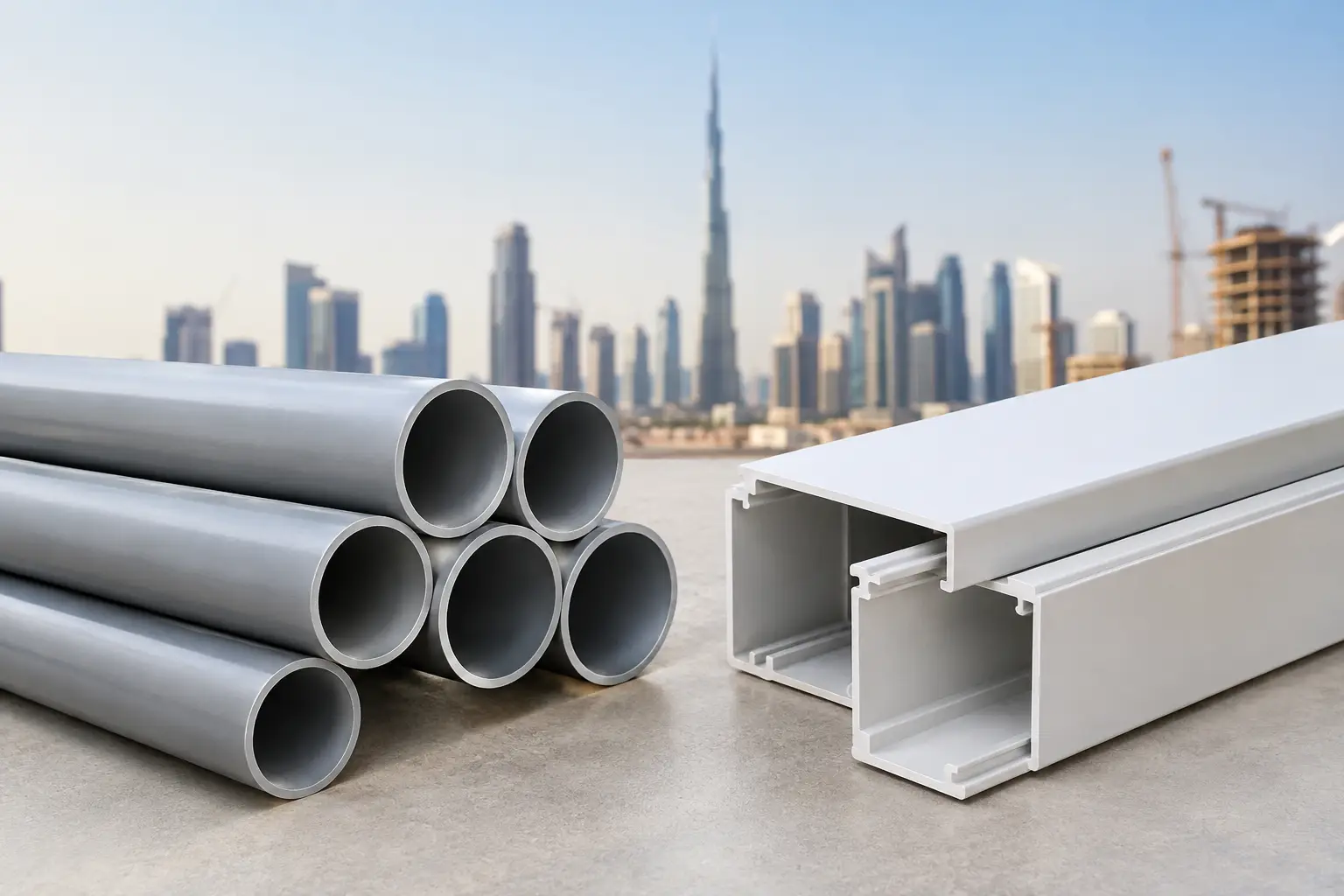
PVC conduit is a closed, round raceway that carries individual conductors or cables between boxes, panels, equipment, and outlets. It is commonly installed concealed within walls, slabs, ceilings, or partitions, although it can also be surface-mounted where appropriate. Fittings such as bends, couplers, adaptable boxes, saddles, and junction boxes create a continuous protected route.
PVC trunking is a rectangular containment system with a removable cover. It is generally used for surface cable routing where access, modification, and cable segregation matter. Straight lengths, couplers, internal and external angles, tees, end caps, and divider systems allow installers to build organized runs along walls, above ceilings, inside service rooms, or around workstations.
The distinction is straightforward: conduit prioritizes enclosed protection and concealed routing, while trunking prioritizes accessible, orderly distribution. Neither is automatically better. A project may require both, often within the same floor or even the same circuit route.
Choose based on the installation condition
The most reliable selection process begins at the route itself. Ask where the containment will sit, what it needs to carry, and who must access it after completion.
Concealed walls, slabs, and embedded routes
PVC conduit is usually the practical choice for routes embedded in concrete, masonry, or drywall partitions. Its round profile suits chased walls and concealed installations, while its continuous enclosure protects conductors from incidental impact during construction. It also gives a clean finished appearance because the containment is not visible once finishes are complete.
That said, installation quality is critical. Poorly planned bends, undersized conduit, excessive run lengths between draw points, or inadequate fixing can make cable pulling difficult and create delays during testing. Contractors should coordinate routes before civil works close up and provide accessible pull boxes where the design requires them.
For slab work, verify the approved conduit type, diameter, wall thickness, and installation method against the project specification. The wrong product selection can lead to rejection during inspection, especially where fire ratings, concrete cover, mechanical protection, or low-smoke requirements apply.
Surface-mounted office, retail, and fit-out work
PVC trunking often provides a faster, cleaner answer for surface installations. In offices, schools, shops, temporary spaces, and refurbishment projects, a trunking run can carry power, data, communication, and control cables while keeping them accessible. A removable lid allows teams to add, replace, or inspect cables without opening finished walls.
This is particularly useful when late-stage changes are likely. A tenant may request additional outlets, a facilities team may need another data point, or a fit-out contractor may need to reroute low-current cabling after furniture plans change. With correctly sized trunking and planned spare capacity, these changes are manageable rather than disruptive.
However, trunking is not a shortcut for poor coordination. Visible routes must be straight, level, securely fixed, and finished with compatible accessories. Misaligned joints, loose covers, and improvised corners are immediately noticeable in client-facing areas.
Exposed industrial and service areas
For service corridors, plant rooms, workshops, and back-of-house spaces, the decision depends on mechanical exposure and maintenance needs. Conduit can be preferable for branch circuits needing stronger enclosure and a compact profile. Trunking can be more efficient for multiple parallel cables that require regular additions, identification, or segregation.
Where impact, heat, UV exposure, chemicals, or outdoor conditions are present, standard PVC may not be suitable. Confirm the environmental rating and approved material before ordering. In some locations, galvanized steel conduit, cable tray, ladder systems, or specialized heavy-duty containment may be required instead.
Protection, access, and cable capacity
A useful way to compare the two systems is to consider what the cable route must do after installation.
Conduit provides a more enclosed path. This can offer good protection from dust, contact, and localized damage, especially when properly installed with compatible boxes and fittings. It is well suited to individual circuit runs and concealed branch wiring. The trade-off is access: altering or adding conductors later may require pulling through existing routes, opening draw boxes, or replacing sections if capacity is already used.
Trunking provides easier access and a broader internal space for grouped cables. It is useful where several circuits share a route and future expansion is expected. Dividers can separate power and data services where the design calls for segregation. The trade-off is that trunking needs more visible space and disciplined cable management. Overfilled trunking can trap heat, damage cable insulation, complicate cover closure, and make future maintenance slower rather than easier.
Cable fill must be calculated, not guessed. Allow sufficient space for pulling, bending, heat dissipation, identification, and future capacity. The correct trunking width or conduit diameter depends on conductor size, quantity, insulation type, route length, bends, and applicable electrical requirements.
Compliance is a specification issue, not a product label
Professional buyers should avoid treating any PVC containment as automatically compliant because it is commonly used on local sites. Compliance depends on the approved project submittal, the consultant's requirements, applicable authority regulations, installation location, and the complete system being installed.
Check product documentation, brand approval status where required, dimensional consistency, and compatibility across fittings and accessories. A low-cost trunking length is not a saving if its cover does not lock securely, its accessories do not align, or its material performance is inconsistent across a large installation. The same applies to conduit: inconsistent diameter or poor-quality bends can slow installation and compromise cable pulling.
For fire-rated walls and penetrations, containment selection is only one part of the issue. The opening, cable route, sealing system, and firestop method must all follow the approved detail. Do not assume PVC conduit or trunking alone provides the required fire performance.
Cost comparison: look beyond the price per length
PVC conduit can be economical for repetitive concealed runs, especially when installation is coordinated before plastering, ceiling closure, or concrete works. Its material cost is often predictable, but labor can increase when routes contain many bends, difficult pulls, or late design changes.
PVC trunking may carry a higher visible material cost once covers, bends, tees, couplers, and dividers are included. Yet it can reduce labor on surface routes and lower future alteration costs because access is direct. For a phased office fit-out or an actively occupied facility, that access can be worth more than a small difference in initial material price.
Procurement teams should compare complete installed cost: straight lengths, fittings, supports, boxes, cable pulling time, access constraints, wastage, inspection risk, and expected future modifications. Buying containment in incomplete batches can also disrupt site progress. Matching accessories, available stock, and scheduled delivery matter as much as the headline rate.
A procurement checklist for contractors
Before releasing a purchase order, align the containment package with the approved drawings and site sequence. Confirm the conduit diameter or trunking dimensions, required accessories, quantities by route, color or finish requirements, and the approved brand or equivalent process. Ensure the order includes practical installation items such as saddles, inspection boxes, couplers, bends, covers, and dividers where needed.
For larger projects, phase delivery by work area while protecting critical-path quantities. Electrical containment is often installed early, so a missing fitting can hold up cable pulling, ceiling closure, testing, or finishing trades. Consolidating conduit, trunking, electrical boxes, accessories, fasteners, and related site materials through one dependable B2B supplier reduces purchase-order fragmentation and keeps accountability clear.
Yasu Trading supports contractors with jobsite-ready electrical materials, specification guidance, wholesale project quoting, and site-direct dispatch across key UAE project locations. The goal is not simply to supply a length of conduit or trunking, but to help crews receive the correct compatible system when the workfront is ready.
Make the route easy to install and easier to maintain
Use PVC conduit when the route is concealed, compact, and intended for protected branch wiring. Use PVC trunking when surface access, organized multi-cable routing, and future changes carry greater value. Where a project has both conditions, combining the two systems is often the most efficient approach.
The strongest containment choice is made before installation starts: specify the full system, verify compliance, allow for cable capacity, and secure all fittings with the initial order. That preparation protects inspection outcomes, keeps electricians productive, and prevents a small material gap from becoming a schedule problem.