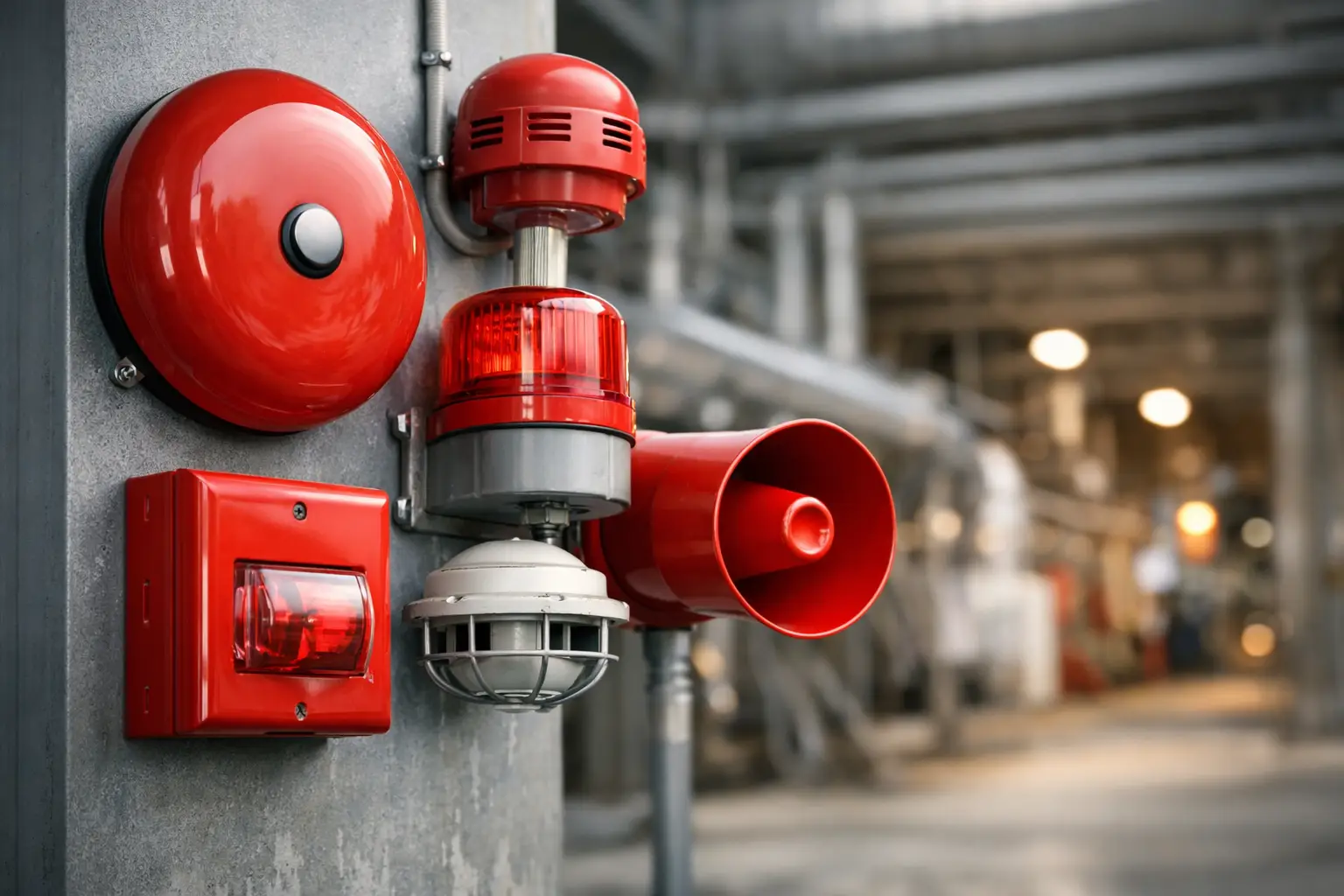
Review Industrial Fire Alarm Devices for Sites
A fire alarm device that looks correct on a submittal can still create a failed test, nuisance alarms, or a delayed handover when it is mismatched to the environment or control system. To review industrial fire alarm devices properly, contractors need to look beyond unit price and confirm approval status, operating conditions, panel compatibility, installation requirements, and replacement availability before material reaches the site.
For industrial facilities, warehouses, plant rooms, workshops, high-rise service areas, and large commercial projects, fire alarm selection is a coordination decision. Detection, notification, control, and monitoring devices must work as one system. A low-cost device that cannot be addressed correctly, does not suit the ambient temperature, or arrives without the required documentation can cost far more than its purchase price once labor, rework, and inspection time are added.
What a practical device review should establish
The first question is not which detector is most popular. It is whether the proposed device is suitable for the approved fire strategy and the authority having jurisdiction. Requirements can vary by building use, risk classification, room condition, and project-specific Civil Defense documentation. Procurement teams should obtain the approved specification, coordinated drawings, and bill of quantities before releasing a purchase order.
A useful review checks five connected points: code and authority approval, environmental suitability, system compatibility, installation practicality, and lifecycle support. Missing one of these points can affect commissioning even when every box delivered is genuine and undamaged.
Approval should be treated as a project requirement, not a marketing claim. Confirm the brand, model number, certification basis, and supporting documents requested by the consultant or approving authority. If an item is presented as an equivalent, the technical team should verify it against the exact specification rather than relying on a general product category match.
Environmental suitability is equally important. Dust, humidity, fumes, vibration, direct sunlight, high ceilings, cold rooms, generator areas, and outdoor exposure can all change which device will perform reliably. Industrial projects rarely have uniform conditions throughout the site, so one detector type should not be assumed suitable for every space.
Review industrial fire alarm devices by system role
A complete review separates devices by what they must do in the system. This prevents a common procurement error: ordering compatible-looking components that cannot deliver the required detection coverage, alarm audibility, or control function.
Detection devices
Smoke detectors are commonly used in clean, conditioned internal areas where early warning is needed. Their performance can be affected by dust, steam, aerosols, and airborne contaminants. In workshops, loading zones, kitchens, generator rooms, or spaces with exhaust fumes, a smoke detector may create repeat nuisance alarms if the detection method is not suited to the actual operating environment.
Heat detectors are often considered where smoke detection is impractical, but they generally respond later than smoke detection. They should be selected according to the expected ambient temperature and the fire risk, not simply because the room is dusty. Fixed-temperature and rate-of-rise characteristics need to match the design intent.
Flame detectors, beam detectors, aspirating systems, and duct detectors serve more specialized applications. A high-ceiling warehouse may require a different approach from a small electrical room. Open-area flame detection can be influenced by line of sight and potential false sources, while duct detectors require proper airflow conditions and access for maintenance. These devices demand early coordination with the fire consultant, MEP contractor, and commissioning team.
Manual alarm and notification devices
Manual call points must be visible, accessible, and suitable for the intended installation location. Review operating method, reset requirements, protective covers where specified, weather resistance for external areas, and whether the addressable protocol matches the fire alarm panel.
Sounders, bells, horns, strobes, and combined notification appliances should be reviewed against required sound levels, visual alarm needs, mounting conditions, and circuit loading. A device may be approved individually but still be poorly suited to a noisy plant room or a large open warehouse. In high-noise zones, audibility calculations and final testing matter more than nominal decibel ratings on a data sheet.
Control, interface, and monitoring devices
Modules are often the small components that decide whether a system functions at handover. Monitor modules, control modules, relay interfaces, isolators, and input-output units connect the fire alarm system to pumps, dampers, smoke control equipment, access control, elevators, and other life-safety functions.
For each module, confirm the required input or output type, voltage, supervision method, load rating, enclosure requirement, and address capacity. Ask a direct question: what equipment is this module controlling or monitoring, and is that interface shown on the approved cause-and-effect matrix? This check reduces late-stage wiring changes and commissioning disputes.
Fire alarm control panels and repeaters require the same discipline. Confirm loop capacity, number of devices, network architecture, battery calculation, event programming needs, future expansion allowance, and integration with other approved systems. Mixing products across brands or generations can create limitations that are not visible until programming and testing begin.
Compatibility is more than a connector fit
Addressable fire alarm systems are manufacturer-specific in many cases. Devices that appear physically similar may use different communication protocols, addressing methods, bases, or software tools. A contractor should never assume that an addressable detector, module, or sounder will work on an existing panel because it has the same voltage rating or terminal layout.
When replacing devices in an occupied facility, confirm the installed panel model, firmware generation where relevant, existing loop device family, and approved replacement procedure. For phased projects, verify whether new devices can coexist with existing equipment during the transition. The right answer may be a direct replacement, a listed compatible device, or a planned panel upgrade. It depends on the system’s approval history and operational condition.
Conventional systems have their own risks. Zone loading, end-of-line device requirements, polarity, detector base compatibility, and alarm circuit current must be checked. A procurement saving disappears quickly if the installer must return to replace bases, add interface relays, or reconfigure circuits after a failed test.
Procurement checks that protect the schedule
Fire and safety equipment should be purchased against a controlled material schedule, not from a generic description such as “smoke detector” or “fire alarm module.” The schedule should identify manufacturer, model, device type, color where applicable, mounting accessories, bases, back boxes, isolators, and any required weatherproof or protective accessories.
Before dispatch, the procurement team should verify quantity by floor or zone, model consistency, packaging condition, date-sensitive product requirements, documentation, and warranty terms. For large projects, staged delivery is often better than sending the full order too early. It limits site storage risk, reduces damage and loss, and keeps the latest approved material available for each installation phase.
Availability matters because fire alarm packages are frequently affected by late drawing revisions. A distributor with inventory depth can help protect the program, but substitutions still require technical review and formal approval where necessary. Fast delivery should support compliance, not bypass it.
For contractors managing multiple work fronts across Dubai, Sharjah, Abu Dhabi, Fujairah, or Ras Al Khaimah, consolidated supply can reduce coordination time. Fire alarm devices, electrical accessories, conduits, cables, fasteners, sealants, and site safety items are often needed together. A single B2B supply partner can simplify purchase orders and delivery planning, provided each safety-critical item remains traceable to its approved specification.
Plan for testing, maintenance, and replacement from day one
A device is not fully selected until the maintenance team can access, test, clean, and replace it. Detectors installed above difficult ceilings, inside dusty service spaces, or behind fixed equipment may meet drawing requirements while creating expensive maintenance work later. Access panels, test points, labeling, spare devices, and as-built records should be planned during installation.
Facility teams should also consider the lead time for replacement heads, bases, modules, and panel components. Choosing a device family with dependable local availability can reduce downtime after accidental damage, contamination, or a fault condition. For critical facilities, keeping approved spares is often more practical than waiting for an urgent import order.
The strongest procurement decision is the one that helps the installer finish cleanly, helps the commissioning team test confidently, and helps the facility team maintain the system after handover. When preparing your next fire alarm material request, send the approved device schedule, panel details, and installation environment with the inquiry. That level of information enables an accurate quote, correct material matching, and delivery that keeps the site moving.