Find Your Trusted Safety Equipment Supplier Near Me Today
Typing "safety equipment supplier near me" into a search bar is about more than just convenience. It's a smart move to build a responsive, reliable safety net for your crew. Having a local partner means you get immediate access to critical gear and hands-on service, which helps you avoid expensive delays and stay compliant. It turns a simple supplier relationship into a real safety asset.
Unlocking the Strategic Advantage of a Local Partner
Going with a local supplier for your safety equipment brings real benefits that a shorter drive time can't capture. You're actually building a partnership that makes your entire operation stronger and keeps your team better protected, minute by minute. This local connection gives you an agility that big national chains just can't offer.
Picture this: a surprise safety inspection flags that your fall protection harnesses are about to expire. You need new ones for a project starting tomorrow. A national distributor might take days to ship them, bringing your work to a screeching halt and costing you a fortune.
A local safety equipment supplier, on the other hand, can often get you what you need the very same day. What could have been a full-blown crisis becomes a minor hiccup. That kind of rapid response is a massive win for your project timelines and your budget.
Personalised Service and Regional Expertise
Another huge plus is the personal touch. A local sales rep gets to know your business, your job sites, and the specific dangers your team deals with every day. They know the ins and outs of regional safety rules and can give you specific advice that someone in a faraway call center just can't.
This relationship is built on trust and reliability. For example, a local pro might give you a heads-up about upcoming changes to safety laws in your area or recommend a better type of respirator because of new materials trending in your industry.
The true value of a local supplier isn't just in the products they sell, but in the problems they help you solve. Their proximity allows for on-site consultations, product demonstrations, and immediate troubleshooting—services that are indispensable for maintaining a robust safety culture.
More Than Just a Vendor
At the end of the day, working with a local supplier makes the relationship less of a transaction and more of a collaboration. They become part of your safety team, genuinely invested in your success. This partnership ensures you have the right gear, expert advice, and quick support right when you need it.
For those in high-risk fields, knowing how to choose from specialized construction safety equipment suppliers takes this a step further. It guarantees you find a provider who truly gets the unique demands of your industry—a level of focused expertise that's non-negotiable when safety is on the line.
Vetting a Supplier for Reliability and Expertise
Alright, you've got a shortlist of local suppliers. Now the real work starts. A slick website or a thick catalog doesn’t tell you the whole story. You need to dig in and see who’s a genuine partner and who’s just a product pusher.
The first thing I always look for is a commitment to quality management. Is the supplier ISO 9001 certified? That’s not just a logo for their letterhead; it means they have internationally recognized systems for everything from how they handle inventory to how they answer a customer call. It’s a huge indicator of professionalism and consistency.
Next, you have to get some real-world feedback. Forget the glowing testimonials on their homepage. Go look for independent reviews on third-party sites. Even better, ask for referrals from other businesses in your line of work. Nothing beats hearing directly from a peer about their actual experience with a supplier.
Assessing Inventory Depth and Specialized Knowledge
A supplier’s real value becomes clear when you need something beyond the standard hard hats and gloves. Can they get you specialized gear when a unique situation arises? This is where a truly great local supplier really shines.
Let's say you're working in a hazardous zone with flammable gases. You need intrinsically safe equipment—gear specifically designed to prevent sparks that could trigger a catastrophe. A top-tier supplier won't just know the term; they'll understand the specific ratings and certifications your environment demands.
This kind of expertise is critical here in the AE region, especially with our massive oil and gas sector. Regulations in places like the UAE and Saudi Arabia are incredibly strict, which drives a huge demand for intrinsically safe gear on rigs and in refineries. A local supplier who gets this is indispensable for staying compliant and keeping your people safe.
Questions That Reveal a True Partner
When you finally get a supplier on the phone, your conversation needs to go way beyond price and delivery schedules. You're trying to gauge their capabilities and their resilience. A few pointed questions can quickly separate the simple vendors from the strategic partners. If you're new to this, learning how to find a professional service provider near you can offer some great foundational insights.
Here are the kinds of questions I ask to get a real feel for who I’m dealing with:
- Supply Chain Resilience: "What happens if your main manufacturer has a production issue? What's your backup plan?"
- Urgent Requests: "Tell me about a time you had to handle an urgent, out-of-the-ordinary request for a client. How did it go?"
- Technical Expertise: "If we encounter a specific chemical hazard, who on your team can advise us on the right PPE?"
- Scalability: "How do you handle inventory for a massive project where our needs might change week to week?"
Their answers—or lack thereof—will tell you everything you need to know about their operational muscle. In fields like construction, having the right gear is non-negotiable. For a deeper dive, check out our guide on crucial safety equipment for construction.
How to Verify Product Quality and Compliance
When it comes to safety equipment, there are no second chances. This gear is the last line of defense for your team, so its integrity is absolutely non-negotiable. Once you’ve found a promising local supplier, the real work begins: rigorously checking that their products are genuinely compliant and built to perform when it counts.
This means looking beyond the price tag and digging into the certifications that prove a product’s worth. For any Personal Protective Equipment (PPE), you need to see specific markings and be able to access the right documentation. These aren't just suggestions—they're proof that the gear has passed strict testing. A trustworthy supplier will have no problem providing a Declaration of Conformity or technical data sheets for their stock.
Think of the essential gear that forms the foundation of workplace safety.
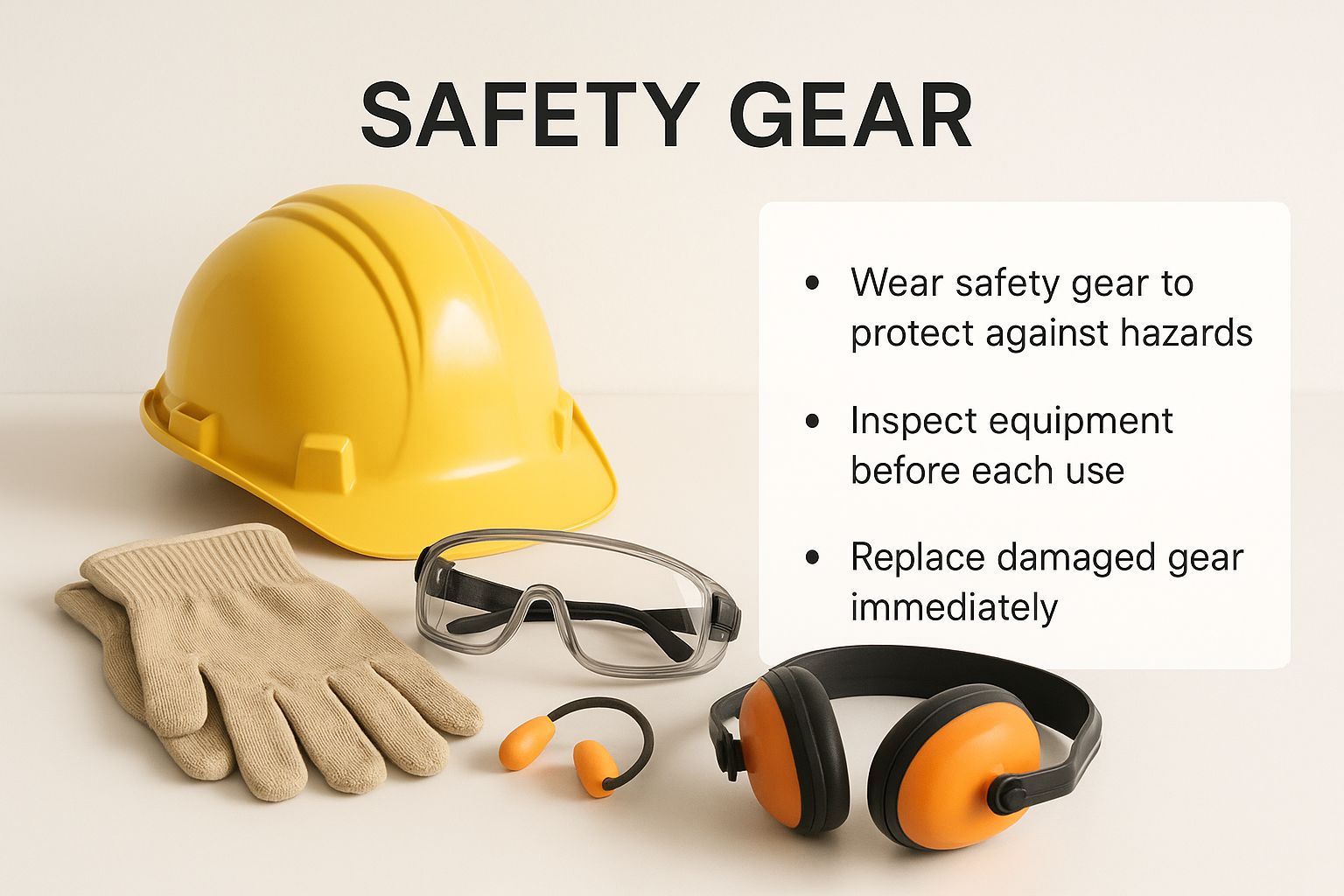
Every single item here, from hard hats to high-vis vests, has its own set of standards it must meet to be considered truly protective.
Demystifying Certifications and Standards
Navigating compliance standards can feel like wading through an alphabet soup of acronyms, but you only need to know a few key ones to start. For example, a safety helmet should be marked with EN 397, the European standard for industrial hard hats. A fall arrest harness needs to meet EN 361, which covers its specific design and testing requirements.
It’s not good enough for a supplier to just say their products are compliant. You have to see the proof for yourself. This level of diligence applies across all areas of safety. For instance, understanding the current smoke alarm legislation in Queensland is a perfect example of how crucial it is to stay on top of regulations. The same principle applies to every piece of PPE you buy.
A quick tip from the field: Check how the certification marks are applied. On genuine gear, they’ll be permanently etched or stamped right onto the product. If it’s just a flimsy sticker, that’s a major red flag for counterfeit equipment.
Spotting Red Flags and Counterfeit Gear
Substandard equipment is more than just a bad investment; it's a massive risk. It exposes your team to danger and your company to serious legal trouble. The scary part is that the differences between legitimate and fake gear can be subtle. A non-compliant safety harness might have weaker stitching that gives way under pressure, or a counterfeit hard hat could be made from brittle plastic that shatters on impact.
To help you tell the good from the bad, I've put together a quick checklist.
Compliant vs Non-Compliant PPE Checklist
This table breaks down what you should look for in high-quality, certified PPE versus the red flags that signal a potentially dangerous product.
| Feature | Compliant PPE (What to Look For) | Non-Compliant PPE (Red Flags) |
|---|---|---|
| Markings | Permanent, clear certification marks (e.g., EN, ANSI) and manufacturer details. | Missing, misspelled, or sticker-based certification marks. Vague manufacturer info. |
| Documentation | Readily available Declaration of Conformity and technical data sheets. | Supplier is hesitant or unable to provide compliance documents. |
| Material Quality | High-quality materials, robust stitching, and a solid, durable feel. | Flimsy materials, uneven stitching, or an unusually light weight. |
| Price | Priced in line with other certified products from reputable brands. | The price seems too good to be true—it usually is. |
Keep this handy when you're evaluating a new supplier. If you ever suspect you're being sold substandard gear, don't hesitate to demand clarification and proper documentation. Your team’s well-being is worth far more than saving a few dollars on equipment that might fail when they need it most.
Look Beyond the Product Catalog: The Real Value is in Support and Training
When you're looking for a safety equipment supplier, it’s easy to get lost comparing product catalogs and price lists. But the real difference between a simple vendor and a genuine safety partner lies in what happens after the sale. The best local suppliers become advocates for your team, offering the kind of support and training that truly builds a stronger safety culture.
Think of it this way: an exceptional supplier acts like an extension of your own safety department. They aren’t just shipping boxes to your door; they’re invested in making sure the equipment is used correctly and effectively from the moment it arrives.
It’s one thing to sell you a case of specialized respirators. It's something else entirely to provide on-site fit-testing to guarantee every single worker gets a perfect seal. That hands-on commitment is the mark of a supplier you can trust.
Do They Have Real-World Technical Know-How?
Expertise isn't just about reciting product specs from a brochure. A top-tier supplier has people on their team who can come to your site for product demos, field tough questions about compliance, and even help you conduct a proper workplace hazard analysis. Their knowledge should be practical, not just theoretical.
I saw this in action at a local manufacturing plant that was dealing with a spike in skin-related injuries. A great supplier didn't just push a different type of glove. Instead, they came in and ran a workshop for the entire team, teaching them how to select the right chemical-resistant gloves for very specific tasks. The result? A dramatic drop in incidents.
That’s the kind of proactive partnership you should be looking for. Don't hesitate to quiz potential suppliers on their team's qualifications or ask for concrete examples of how they've helped other businesses in your industry.
You can tell how committed a supplier is to your safety by how much they invest in you after the purchase. When they offer training on proper use, inspection, and maintenance, it’s a clear sign they care more about preventing incidents than just selling inventory.
This kind of proactive support is becoming more important every day. The demand for personal protective equipment in the Middle East and Africa is projected to climb by roughly 6.6% each year between 2025 and 2033. This growth is being pushed by tougher regulations and a rising awareness of workplace safety.
With protective clothing alone making up over 27% of the market in 2024, you need a supplier who can offer expert guidance on an ever-expanding range of products. You can learn more about the trends in the regional PPE market to see just how fast things are changing.
At the end of the day, you want to find a supplier who is just as invested in your team’s well-being as you are. Their support and training aren't just nice-to-haves—they are the foundation of a robust and successful safety program.
Evaluating Cost vs. Value in a Lasting Partnership
When you start looking for a local safety equipment supplier, it’s all too easy to let the price tag do the talking. A cheap hard hat here, a discounted pair of gloves there—it feels like a win. But I’ve learned from experience that the cheapest option today often becomes the most expensive headache tomorrow.
The real game-changer is shifting your mindset from the initial purchase price to the total cost of ownership. Think bigger. A great supplier isn't just selling you gear; they're becoming a strategic partner who actively contributes to your operational success and, ultimately, your bottom line.
Looking Beyond the Initial Price Tag
Let’s get practical. Imagine you buy a budget safety harness. It’s cheaper upfront, sure. But if it frays, fails inspection, and needs replacing twice as often as a premium model, you've already lost. You’re not just paying for two harnesses; you’re paying for the downtime, the administrative hassle of reordering, and the unacceptable risk of equipment failure.
A supplier who gets this will steer you toward durable equipment that lasts, cutting down your replacement costs over time. They might even offer value-adds like free training on proper gear inspection, which helps your team prevent premature wear and stay compliant. As we’ve covered before, essential construction site safety equipment is an investment, not just an expense.
This focus on long-term value is more important than ever. The public infrastructure safety market in the Middle East and Africa is projected to hit USD 325.31 million in 2025, a surge fueled by massive projects demanding the absolute highest safety standards. This regional boom means you need a supplier who understands the rigorous demands of both public and private sector work. You can get the full picture by reading the report on the MEA public infrastructure safety market.
Negotiating a Mutually Beneficial Agreement
Once you’ve found a supplier who shares your vision for a long-term relationship, you open up new possibilities for smarter purchasing. Don't hesitate to have an open conversation about terms that work for both of you. A supplier who views you as a long-term partner will be much more willing to work with you.
Here are a few things I always suggest bringing to the table:
- Bulk Pricing: Ask about discounts for consolidating your orders. It simplifies things on your end and can unlock some serious savings.
- Long-Term Contracts: Proposing a one or two-year agreement can lock in your pricing. This protects you from unexpected market hikes and shows the supplier you’re committed.
- Priority Service Agreements: This is a big one. Can you negotiate guaranteed stock levels for your critical items? Or get priority service when an emergency hits? That kind of assurance is worth its weight in gold.
A strong partnership isn't just about getting a better price. It's about securing a reliable ally who offers proactive advice on new regulations, priority access to inventory, and an unwavering commitment to your team's safety. This transforms a simple supplier into an indispensable part of your operational success.
Have Questions? We've Got Answers
Picking the right local safety equipment supplier means you have to ask some tough questions. We get it. Project managers and safety officers ask us these all the time, so we’ve put together the answers to help you cut through the noise.
This isn't just about ticking a box for procurement. It’s about finding a partner who takes your team's safety as seriously as you do. Getting straight answers is the first step in building that kind of trust.
How Do I Know a Supplier's Gear Actually Meets Local Safety Standards?
This is the big one, and you can't afford to get it wrong. First thing's first: ask them for the paperwork. A legitimate supplier will have no problem providing a Declaration of Conformity or certificates from recognized testing bodies. They should also be able to hand over technical data sheets that spell out the performance specs.
Then, check the gear itself. Real, certified equipment will have codes like EN (European Norm), ANSI (American National Standards Institute), or ISO stamped or etched right onto it. If you see a flimsy sticker or markings that look blurry or cheap, that's a huge red flag. When in doubt for projects here in the AE, a quick check with local regulators can give you that final peace of mind.
What’s the Real Difference Between a Specialist Supplier and a Big-Box Hardware Store?
Expertise and inventory, plain and simple. When you search for a safety equipment supplier near me, you're looking for someone who lives and breathes this stuff. A specialist brings deep knowledge and a massive range of certified, job-specific equipment. Their team can give you solid advice on compliance for tricky situations, like confined space entry or handling hazmat.
Your local hardware store has the basics—think simple gloves and dust masks. But they just don't have the specialized gear or the technical know-how for serious industrial hazards. For safety that truly protects your people, a specialist is always the smarter, safer bet.
A specialist knows the difference between a glove that resists punctures and one that resists corrosive chemicals. A hardware store clerk probably doesn't. That distinction can be the difference between a safe workday and a serious injury.
Should I Stick with One Main Supplier or Use a Few Different Specialists?
It really comes down to your operation. Partnering with a single supplier can make life a lot easier. It simplifies your purchasing, makes invoicing a breeze, and often gets you better pricing on bulk orders. This approach is perfect if you find a partner with a comprehensive catalog that covers all your bases.
On the other hand, sometimes you have to go niche. If you need highly specific gear—like advanced respiratory systems for a chemical plant or a unique fall arrest system for a complex build—you might need to bring in a specialist for that one item. The best strategy? Consolidate what you can with one trusted primary supplier and only branch out when a specific, high-stakes hazard demands it.
At Yasu Trading Co. LLC, we provide more than just products; we deliver peace of mind with certified equipment and expert guidance. Discover our full range of safety solutions today.