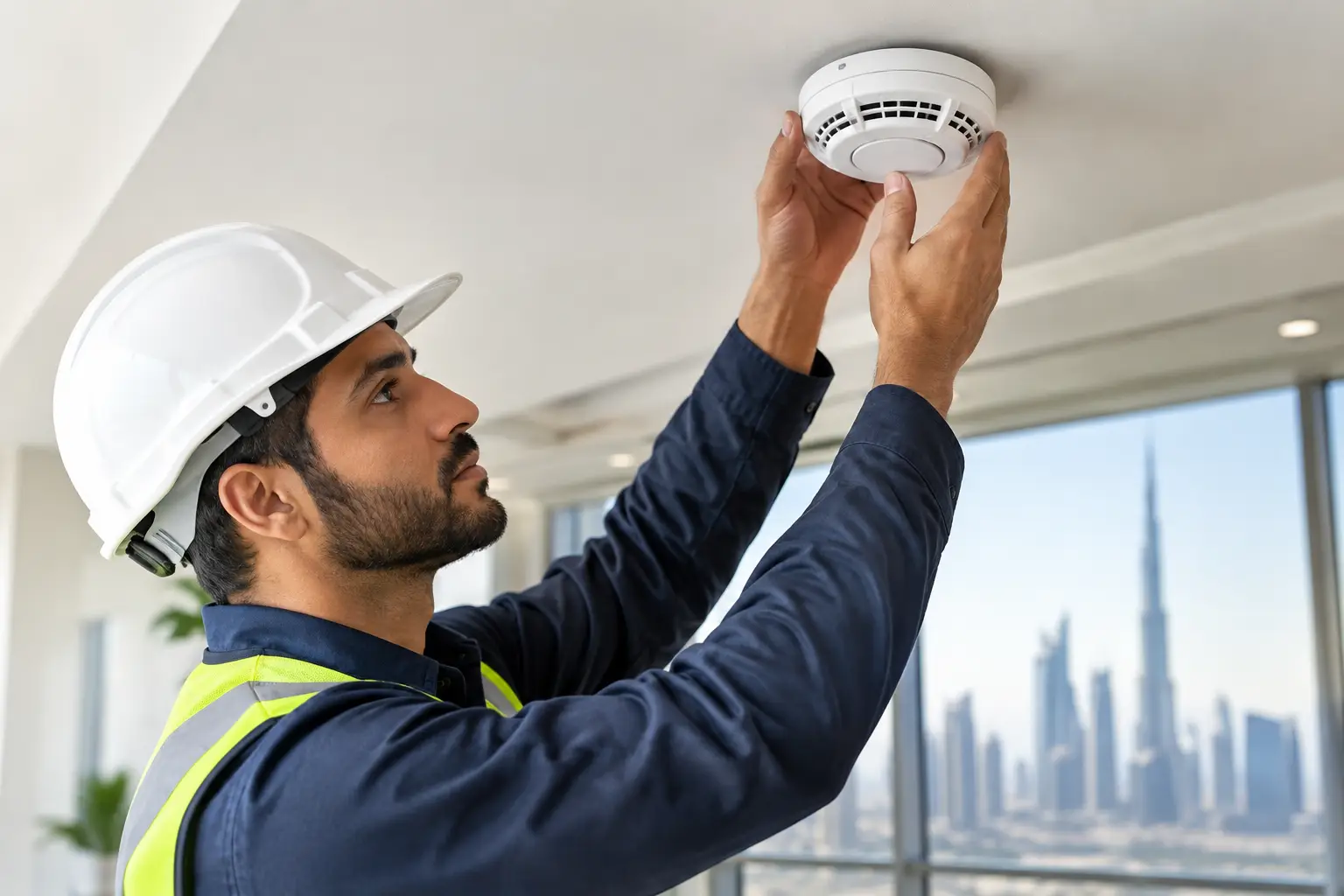
Smoke Detector Requirements for UAE Projects
A fire alarm package can look complete on a purchase order and still fail at handover. Smoke detector requirements are not just about selecting a detector and fixing it to a ceiling. They affect device type, approved system compatibility, zoning, cable routing, power backup, testing records, and the final authority inspection. For contractors and MEP teams, getting these decisions right early protects the construction schedule from costly rework.
On UAE projects, the governing requirement is the approved fire and life-safety design for the specific building, together with the requirements of the relevant Civil Defense authority and local jurisdiction. A residential tower, warehouse, hotel, school, retail fit-out, and industrial facility may need very different detection coverage and alarm interfaces. Treat the approved drawings and project specifications as the procurement baseline, not a generic detector schedule from a previous job.
Smoke Detector Requirements Start With the Approved Design
The most reliable way to manage compliance is to trace every supplied device back to an approved fire alarm drawing, material submittal, and cause-and-effect sequence. This creates a clear chain from design intent to site installation and final testing.
A compliant package normally includes more than smoke detectors. Depending on the project, it may include a fire alarm control panel, loop modules, manual call points, sounders, strobes, heat detectors, beam detectors, aspirating smoke detection, interface modules, fire-rated cables, batteries, and associated containment. Each component must be compatible with the listed fire alarm system and accepted under the project approval process.
Do not substitute a detector because the base shape, voltage, or price appears similar. Addressable devices communicate with a specific panel protocol, while conventional devices must match the zone arrangement and compatible control equipment. An unapproved substitution can create commissioning faults that only become visible when the system is tested under pressure.
Confirm the authority having jurisdiction
Before ordering, confirm which authority has jurisdiction over the site and what has been approved through the consultant and fire authority process. Requirements can vary by emirate, building use, and whether the work is new construction, a tenant fit-out, refurbishment, or maintenance replacement.
The fire consultant, MEP consultant, main contractor, and specialist fire alarm contractor should agree on the approved manufacturer, device schedule, and documentation required for material inspection. Procurement teams should request the relevant certificates, technical data sheets, warranty information, and approved submittal references with the quotation. This reduces the risk of receiving authentic equipment that is still unacceptable for that particular project.
Selecting the Right Type of Detector
Smoke detection is not one-size-fits-all. The environment, expected fire characteristics, ceiling conditions, airflow, and nuisance-alarm risk influence the correct device selection.
Photoelectric smoke detectors are commonly used where smoldering fires are a concern and are widely specified in occupied areas. Ionization technology may be used in certain applications, subject to the approved design and local acceptance. Heat detectors are often selected instead of smoke detectors in kitchens, parking areas, plant rooms, or dusty spaces where steam, fumes, and airborne particles could cause unwanted alarms.
For large open spaces, high ceilings, atriums, and warehouses, point detectors may not provide the required response or coverage on their own. Beam detection or aspirating systems may be specified. These systems require careful positioning, commissioning, and ongoing maintenance access. Selecting a low-cost point detector for a high-bay space can create a false economy if the authority or consultant later requires a different detection method.
Duct smoke detectors are another common source of coordination issues. Where required, they are generally installed to support HVAC shutdown or smoke-control functions, not as a replacement for room detection unless the approved design specifically says so. The interface between the fire alarm system and mechanical controls must be tested as part of the cause-and-effect sequence.
Placement, Coverage, and Site Conditions
Detector placement must follow the approved layout and applicable code criteria. The drawing should show device locations, loop or zone references, ceiling type, device spacing, and interfaces. Field changes should be reviewed before installation, particularly where architectural coordination alters ceilings, bulkheads, partitions, diffusers, or light fittings.
A detector that was correctly placed on an early coordinated drawing can become ineffective after a fit-out changes the air movement or creates an enclosed pocket. Supply air diffusers, return grilles, high airflow, beams, sloped ceilings, open ceilings, and obstructions all affect performance. Detector spacing is therefore not a simple grid exercise.
Avoid placing smoke detectors where cooking vapors, shower steam, dust, paint spraying, or diesel fumes will predictably trigger nuisance alarms. The correct answer may be a different detector type, a revised location, or a design-level solution. Disabling a device after repeated false alarms is not a solution and can create a serious life-safety exposure.
Installation quality matters just as much as device selection. Devices should be securely mounted, clearly identifiable, protected during dusty construction activities, and accessible for testing and replacement. Final detector heads are often installed later in the program to prevent contamination, but the sequence must still allow enough time for loop testing and authority inspection.
Power, Wiring, and System Integration
Smoke detectors form part of a complete supervised fire alarm system. The panel must monitor relevant circuits and report faults, alarms, and tamper conditions as designed. Power supplies and backup batteries must be sized for the system load and required standby operation, based on the approved design.
Use the specified fire-rated cables, containment method, glands, labels, and termination practices. Poor cable segregation, unsupported wiring, undocumented joints, and incorrect screen termination can lead to intermittent faults that delay commissioning. These issues are especially disruptive after ceilings are closed and finishes are complete.
For addressable systems, maintain accurate loop records and device addressing. Every detector should correspond to the panel description, approved drawings, and as-built documentation. A clear description such as a room name, level, or zone reference helps facilities teams respond quickly after handover. Generic labels make fault finding slower when a real alarm occurs.
Integration must also be checked. A smoke alarm may need to trigger sounders and strobes, release magnetic door holders, recall elevators, shut down air handling equipment, activate smoke-control systems, or report to a monitoring arrangement. The exact response depends on the approved cause-and-effect matrix. Supplying devices without confirming these interfaces is a common procurement gap.
Testing and Documentation for Handover
A detector installation is not complete when the heads are mounted. It is complete when the system has been inspected, functionally tested, documented, and accepted through the project process.
Testing should verify that each detector communicates correctly with the panel, displays the right address and location text, activates the required alarm logic, and returns to normal after reset. The specialist contractor should also test fault conditions, battery backup, sounder circuits, interfaces, and any connections to building management or mechanical systems.
For a smooth inspection, maintain an organized handover file. At minimum, project teams commonly need approved material records, product certificates, test reports, commissioning records, battery calculations where applicable, cause-and-effect testing evidence, warranties, operation and maintenance information, training records, and marked-up or final as-built drawings. The precise submission set depends on the project and authority requirements.
Documentation is not paperwork for its own sake. It proves what was installed, supports the inspection process, and gives the facilities team a usable record after occupation. Missing records can hold up completion even where the physical installation is sound.
Procurement Controls That Prevent Delays
Fire and safety equipment should be purchased with the same control applied to other specification-critical MEP materials. Start with the approved brand and model schedule, then verify quantities against drawings, loop architecture, and spare-device requirements. Check lead times for panels, modules, specialty detectors, batteries, and accessories rather than assuming all parts have the same availability.
When the project needs staged delivery, align supply with installation readiness. Delivering detector heads too early can expose them to damage and dust; delivering them too late compresses testing time. A capable B2B supplier can help consolidate the fire alarm package with related electrical components, cables, containment accessories, tools, and safety items while keeping approved materials and documentation traceable.
For replacement work, record the exact existing panel manufacturer, device model, and loop type before ordering. A like-for-like replacement may be straightforward, but older systems can have discontinued components or compatibility limits. In those cases, technical review is faster and safer than an urgent site purchase based on appearance alone.
Yasu Trading supports contractor procurement with jobsite-ready fire and safety equipment, coordinated material supply, and practical guidance for specification-driven orders. For projects in Dubai and across the UAE, the goal is simple: approved materials on site when installation teams need them, without creating a documentation problem at handover.
The best time to resolve smoke detector requirements is before ceilings close, not when an inspector is waiting. Build the approved device schedule, interfaces, documents, and delivery plan into the project program early, and the fire alarm scope becomes a controlled handover activity rather than a late-stage risk.