A Practical Guide to SS Pipe Fittings
SS pipe fittings are the unsung heroes of any robust piping system. They're the components that connect, steer, and manage the flow of liquids and gases, celebrated for their incredible strength, resistance to corrosion, and sheer longevity. Think of them as the vital joints holding together an industrial skeleton, providing both flexibility and unwavering reliability.
Why Modern Industry Can't Function Without SS Pipe Fittings
Picture a massive, complex facility—maybe a coastal desalination plant in the UAE or a sprawling petrochemical complex. The intricate web of pipes is its lifeblood, its circulatory system, moving everything from simple water and steam to aggressive chemicals under extreme pressure. In a high-stakes setting like this, SS pipe fittings aren't just bits of hardware; they are the linchpin components that keep the entire operation running safely and smoothly.
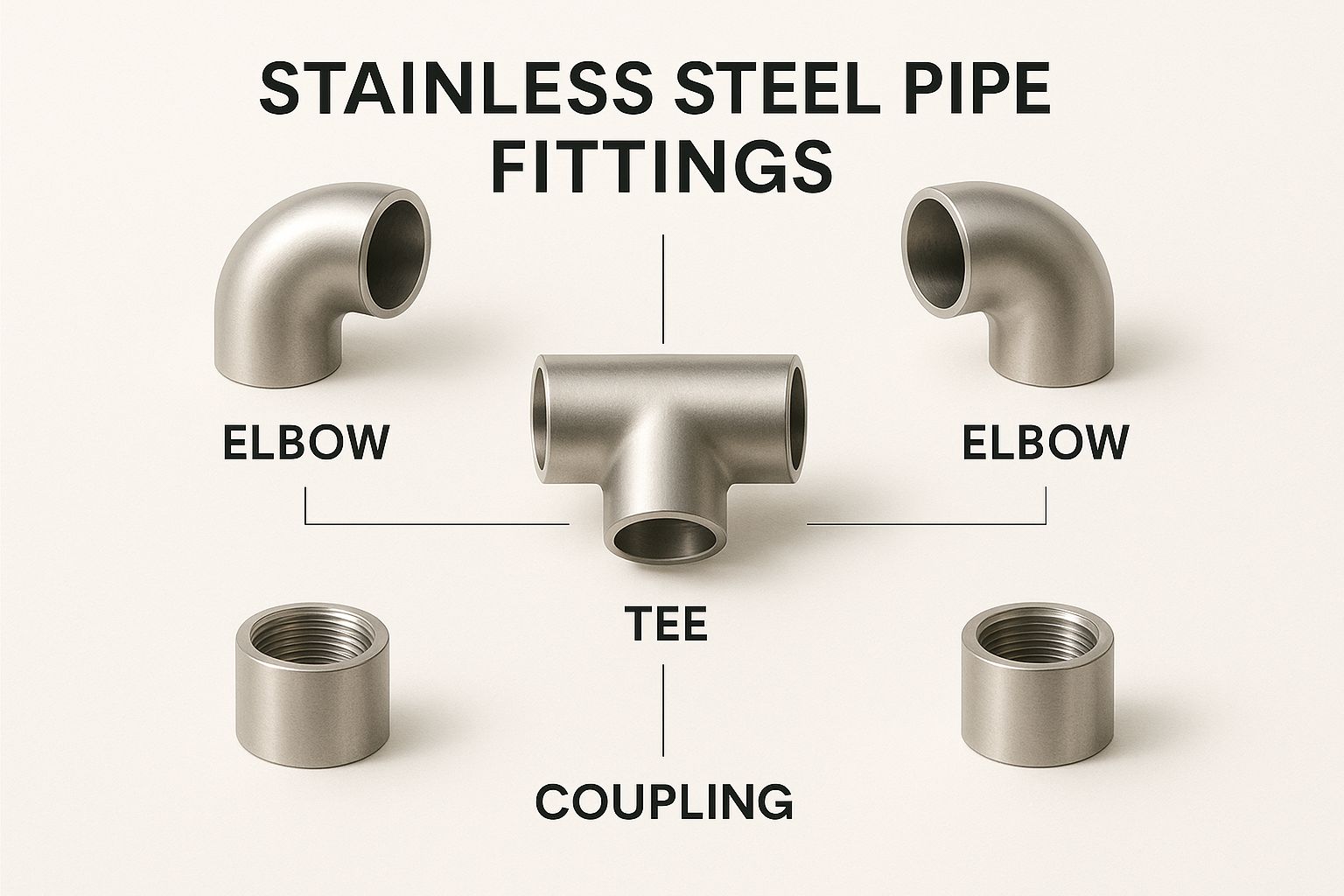
These fittings are the elbows, tees, and couplers that change the direction of a pipeline, create branches for different processes, or connect pipes of varying sizes. Without them, all you'd have is a collection of straight, useless tubes. Their job is to forge a completely sealed, leak-proof, and efficient network that can take a beating from demanding operational conditions.
The Unmatched Advantage of Stainless Steel
So, why stainless steel? The choice is clear: its natural, built-in resistance to both corrosion and heat is second to none. While other metals might quickly rust or break down when faced with salt water, harsh chemicals, or soaring temperatures, stainless steel holds its ground, maintaining its structural integrity. This quality makes it absolutely essential for the key industries driving the UAE and the wider Middle East.
Here's what makes it stand out:
- Corrosion Resistance: A passive, self-healing layer of chromium oxide on the surface acts as a shield against rust and chemical damage.
- High Strength: Stainless steel is tough. It can handle immense internal pressure and external stress without warping or failing.
- Temperature Tolerance: It performs beautifully in a huge temperature spectrum, from cryogenic lows to scorching highs.
- Hygienic Properties: The surface is non-porous and incredibly easy to sanitize, which prevents bacteria from taking hold—a must-have for food, beverage, and pharmaceutical processing.
This incredible resilience pays off in both safety and cost-effectiveness. A system constructed with high-quality SS pipe fittings means less downtime for maintenance, fewer costly surprise shutdowns, and a significantly lower risk of dangerous leaks. This reality is reflected in the market's explosive growth. The Pipes and Fittings Market in the Middle East and Africa, for example, has swelled to a USD 7.98 billion valuation, powered by a boom in industrial and construction endeavors. You can get more details on this trend over at marknteladvisors.com.
Decoding the Different Types of SS Pipe Fittings
Walking into the world of SS pipe fittings can feel a little overwhelming at first, almost like you're trying to learn a new language. But it really just boils down to a handful of key players. Every fitting has a specific job—directing flow, connecting pipes, or stopping a line in its tracks.
Getting to know these fundamental components is your first real step toward building a piping system that’s not just efficient but also durable and completely leak-proof. Think of them as the essential vocabulary for any fluid or gas network.
To make things clearer, this table offers a quick snapshot of the most common fittings and what they do.
A Quick Guide to Common SS Pipe Fitting Functions
| Fitting Type | Primary Function | Common Applications |
|---|---|---|
| Elbow | Changes the direction of flow. | Navigating corners, routing pipes around obstacles or equipment. |
| Tee | Splits or combines flow. | Branching a main line to supply multiple outlets. |
| Reducer | Connects pipes of different sizes. | Managing flow velocity and pressure changes in a system. |
| Coupling | Joins two pipes of the same size. | Creating long, straight pipe runs. |
| Cap/Plug | Seals the end of a pipe or fitting. | Terminating a pipeline or providing access for future connections. |
Each of these pieces plays a vital role in turning a simple collection of pipes into a functional, reliable system. Now, let's take a closer look at how they work.
The Direction Changers and Branch Creators
You'll run into these fittings more than any others. They give you the flexibility to guide pipelines around obstacles and build out more complex networks from a single source.
Elbows: These are probably the fittings you’d recognize instantly. An elbow’s only job is to change the direction of a pipe. The most common are 90-degree elbows for sharp, right-angle turns, and 45-degree elbows for when you need a more gradual shift in direction. They’re absolutely essential for getting around corners and routing pipework neatly around equipment.
Tees: What if you need to split one flow of liquid or gas into two? That’s where a tee comes in. It’s shaped exactly like the letter 'T', with one inlet and two outlets positioned at 90 degrees to the main line. This is how you create a branch line, letting you supply different areas or machines from a single source pipe.
The Connectors and Size Changers
Another crucial family of fittings is responsible for joining pipes or adapting a line to a different diameter. These are the pieces that ensure your system stays connected and performs as designed.
For instance, a reducer is used to connect a larger pipe to a smaller one. You’ll often see this where you need to adjust the flow velocity or pressure. Reducers come in two main flavors: concentric, which taper symmetrically around the center, and eccentric, where the taper is offset. Eccentric reducers are great for preventing air from getting trapped in liquid lines.
A piping system without the right fittings is just a collection of disconnected tubes. It’s the elbows, tees, and reducers that transform them into a functional network, ensuring every drop of fluid reaches its intended destination precisely and safely.
You'll also frequently use couplings to connect two pipes of the same size, creating a longer, straight run. As you dig deeper, you’ll find specialized components, like a 2-inch stainless steel bulkhead tank fitting, which are designed for very specific jobs like creating a secure connection through a tank wall.
The Terminators and Specialized Components
Finally, you have fittings designed to end a line or provide access for maintenance. They might seem simple, but they're critical for the safety and long-term usability of your system.
Caps are a perfect example—their one job is to seal the end of a pipe, stopping the flow cold. This is vital for lines that will be connected later or for pipelines that need to be permanently terminated. Plugs do a similar job but are designed to seal openings within other fittings.
To see how all these parts come together in the bigger picture, take a look at our complete guide to stainless steel pipe and fittings. Understanding what each component does is the key to choosing the perfect part for every challenge your project throws at you.
Choosing the Right Stainless Steel Grade
Picking the right stainless steel grade for your pipe fittings isn't all that different from choosing the right tires for a car. You wouldn't put standard road tires on a vehicle meant for extreme off-roading, would you? The same logic applies here. Not all stainless steel is created equal, and your choice is a critical decision that ensures the safety and longevity of your entire piping system.
This decision is about more than just a part number; it directly affects how well your ss pipe fittings will stand up to corrosion, heat, and pressure. A poor choice can lead to leaks, expensive downtime, and serious safety risks. It all boils down to matching the metal's properties to the real-world environment it's going to live in.
The Workhorse: Grade 304
Think of Grade 304 stainless steel as the trusty, all-around performer in the world of fittings. It's the most common grade you'll find, and for good reason. It offers a fantastic mix of corrosion resistance, durability, and value for money. Made mostly of chromium and nickel, it holds up well against most oxidizing acids.
This makes Grade 304 a solid choice for a huge range of everyday applications:
- Water treatment and plumbing systems
- Food and beverage processing
- Architectural details
- General industrial piping
But it does have a weak spot: chlorides. In salty environments, like coastal regions or systems that handle brine, Grade 304 can suffer from pitting and crevice corrosion. These small points of failure can eventually compromise the entire fitting. For those tougher jobs, you need to step up to a more specialized grade.
The Corrosion Champion: Grade 316
When conditions get a bit more hostile, Grade 316 stainless steel is ready to take the punishment. Its chemical makeup is a lot like 304's, but with one game-changing addition: molybdenum. Just a small amount of this element dramatically boosts its ability to resist corrosion, especially from chlorides and harsh industrial chemicals.
Think of molybdenum as a shield. It gives Grade 316 the edge it needs to be the undisputed champion in harsh environments. It's the grade you choose when failure just isn't an option.
This superior resilience makes it the perfect material for ss pipe fittings in demanding industries. Its knack for handling both saline and high-temperature conditions is a big reason why it’s so popular for major projects across the Middle East. With the construction boom in the region—think luxury hotels, oil refineries, and huge residential complexes—the demand for robust piping that can last for decades is soaring. In fact, a report on stainless steel plumbing fittings highlights this exact growth trend.
You’ll want to specify Grade 316 for applications like:
- Marine and coastal installations
- Chemical and petrochemical processing plants
- Pharmaceutical manufacturing
- Oil and gas pipelines
Yes, Grade 316 costs more than 304. But that extra investment buys you crucial peace of mind and long-term reliability in places where lesser materials would quickly fail.
The High-Performance Option: Duplex Grades
Now, for the most extreme jobs—we’re talking high pressures, high temperatures, and seriously corrosive threats—you need Duplex stainless steel. This isn't your standard steel; Duplex has a mixed microstructure of austenite and ferrite, which means it basically gets the best qualities of both.
This unique structure gives Duplex fittings some major advantages:
- Exceptional Strength: Duplex stainless steel is often twice as strong as standard grades like 304 and 316. This means you can use fittings with thinner walls, which saves on both weight and material costs.
- Outstanding Corrosion Resistance: It’s incredibly resistant to stress corrosion cracking, a type of failure that plagues other steels in hot, chloride-heavy environments.
- Toughness and Durability: It stays tough even under difficult conditions, making it ideal for the most critical applications.
These features make Duplex ss pipe fittings a must-have for specialized fields like offshore oil and gas platforms, desalination plants, and chemical facilities where you need both incredible strength and top-tier corrosion resistance. While it's a premium product with a premium price tag, its performance in these demanding roles is simply unmatched, offering a level of security that other grades just can't provide.
Making Sense of Key Industry Standards
Ever looked at the jumble of letters and numbers stamped on a piece of metal and wondered what it all means? When it comes to ss pipe fittings, those codes aren't just for show. They're your single best guarantee of quality, safety, and—crucially—compatibility.
Think of these standards as a universal language for plumbing and industrial piping. They ensure that a fitting forged in one part of the world will mate perfectly with a pipe made in another. This system eliminates the guesswork, giving you a clear, reliable benchmark for performance. When you see a marking, you know exactly what you're getting.
The heavy lifting of creating these standards is done by globally respected bodies like the American Society for Testing and Materials (ASTM) and the American Society of Mechanical Engineers (ASME). So, when you see 'ASME B16.9' on a butt-weld elbow, it’s not a random product code. It's a promise.
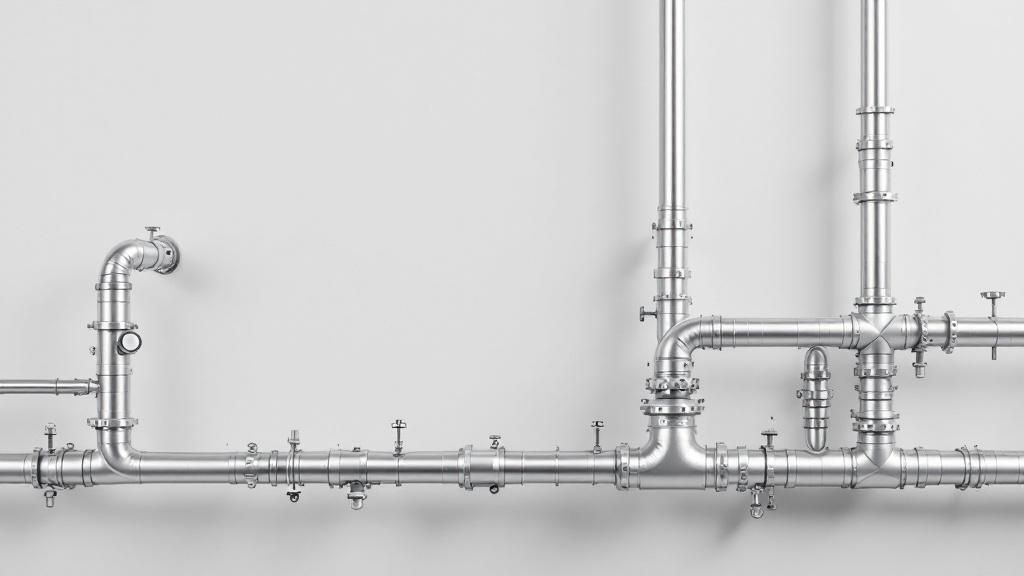
That stamp is a certification. It tells engineers and project managers that the fitting meets strict rules for everything from its dimensions and material makeup to its pressure-temperature ratings. This confidence is what allows for the procurement of components that are not only dependable but also fully interchangeable.
Understanding Core ASTM Standards
Let's start with ASTM. These standards are all about the material itself—the very stuff the fittings are made from. They get into the nitty-gritty of the stainless steel's chemical composition and its mechanical properties.
- ASTM A403: This is the big one for wrought austenitic stainless steel piping fittings. It’s the standard that ensures the material for common parts like elbows and tees can handle the stress of welding and long-term service.
- ASTM A182: This spec is all about toughness under pressure, specifically for forged or rolled steel parts—flanges, fittings, and valves—that will be used in high-temperature environments. If it's going to get hot, you want to see this standard.
By insisting on fittings that meet these ASTM standards, you’re basically ensuring the raw material is up to the job. It’s your first line of defense against problems like corrosion or mechanical failure.
Demystifying Key ASME Standards
If ASTM handles the material, then ASME standards tackle the design. They are the rulebook for the physical dimensions and geometry of ss pipe fittings, making sure everything lines up perfectly on-site.
Think of it this way: ASTM ensures you have the right ingredients (the steel), while ASME provides the recipe (the fitting's exact shape and size). You absolutely need both to get the job done right.
Here are the most common ASME standards you’ll run into:
- ASME B16.9: This standard is for factory-made butt-welding fittings. It defines their dimensions and tolerances with incredible precision. A B16.9 elbow will have a specific radius, guaranteeing predictable pipe runs.
- ASME B16.11: This one covers forged steel fittings, both socket-welding and threaded types. It dictates the exact dimensions for the sockets and threads to create a tight, leak-proof seal.
- ASME B16.5: The go-to standard for pipe flanges and flanged fittings. It specifies everything from bolt hole patterns to the finish of the flange face, ensuring a secure connection to a valve or another pipe.
Following these standards isn't optional, especially on large-scale industrial projects. A mismatch can lead to expensive delays, rework, and even serious safety hazards. In booming regions where construction moves fast, knowing these global codes is non-negotiable. For a deeper dive into how these codes are applied locally, you can learn more about building materials quality standards in the UAE.
Ultimately, these standards build a framework of trust and reliability. When you buy a certified fitting, you're not just buying a piece of metal. You're buying the assurance that it was made and tested to the industry's highest benchmarks, making your entire piping system safer, more predictable, and built to last.
Proper Installation Techniques for Leak-Proof Systems
Even the highest-quality fitting is worthless if it's not installed correctly. Honestly, a poorly installed fitting is a ticking time bomb, just waiting to cause leaks, pressure loss, and expensive shutdowns. Think of it like buying a state-of-the-art security lock but then failing to attach it properly to the door—the entire system is useless.
Let's walk through the essential techniques for installing ss pipe fittings to build tough, leak-proof systems that last. For any technician or engineer serious about building reliable infrastructure, getting these steps right is non-negotiable. The demand for this kind of durability is huge; just look at the Middle East, where production of stainless steel seamless pipes recently shot up to 104,000 tons. That's an 84% jump year-over-year, mostly thanks to the oil and gas industry. You can dig into more of that data over at IndexBox.io.
Pre-Installation Checks: The Foundation of a Good Fit
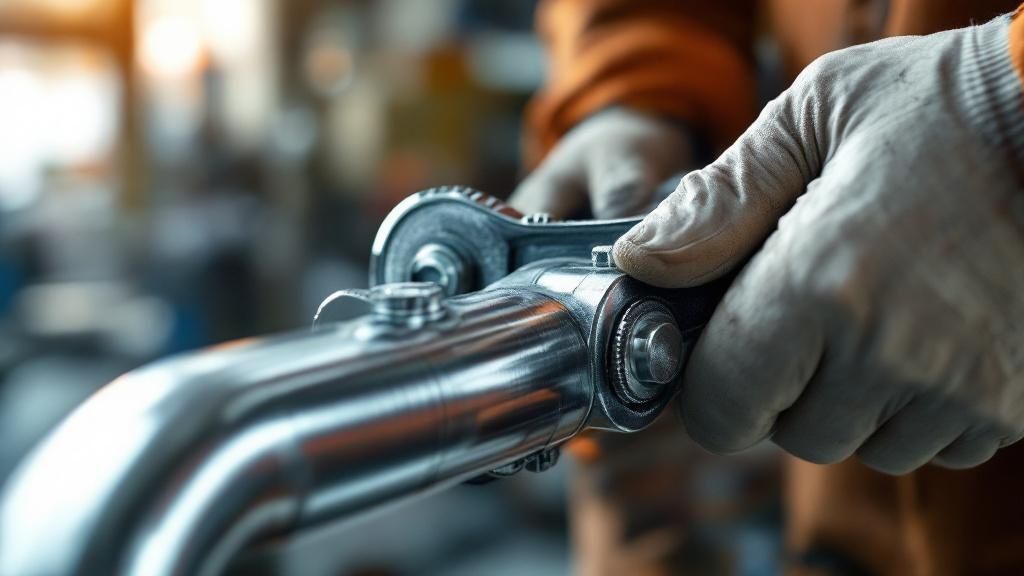
Before you even think about picking up a wrench, you need to run through a few critical checks. Rushing this stage is a rookie mistake that can cost you dearly down the road. Treat it like a pilot’s pre-flight checklist.
First up, material verification. Always, always double-check that the fitting’s grade (like 316 or 304) and its schedule number are a perfect match for the pipe and the project specs. A mismatch can cause everything from galvanic corrosion to creating a dangerous weak point in the line.
Next, give everything a good look-over. Inspect the fitting and the pipe ends for any damage—dents, cracks, scratches, you name it. Make sure every surface is spotless and free of oil, dirt, grease, or rust. Any little bit of contamination can get in the way of a perfect seal.
Mastering Threaded and Welded Connections
The two main ways to join ss pipe fittings are threading and welding. Each one calls for its own specific skill set and a sharp eye for detail to keep things from leaking.
Threaded Connections Best Practices
Threaded fittings are convenient, but they're notorious for leaks when they aren't handled with care. The secret is to get a solid seal without wrecking the threads.
- Seal It Right: Use a high-quality thread sealant tape (PTFE) or a pipe dope specifically made for stainless steel. The key is to apply it in the same direction the threads turn, so it doesn't bunch up or unravel as you tighten.
- Don't Overdo It: This is the single biggest mistake people make. Overtightening can cause the threads to gall (seize up) or even crack the fitting itself. A good rule of thumb is to go hand-tight, then add one to two full turns with a wrench.
A properly tightened threaded fitting should feel snug, not like you're fighting it. You're trying to compress the sealant to create the seal, not force the threads all the way to the bottom. Applying brute force is just asking for a leak later on.
Butt-Welding and Socket-Welding Techniques
For any system dealing with high pressure or high temperatures, welding is the way to go. Tungsten Inert Gas (TIG) welding is usually the best choice for stainless steel because it creates a clean, strong, and corrosion-resistant joint.
- Prep is Everything: The pipe and fitting ends must be perfectly beveled and lined up. A sloppy fit-up will always lead to a weak weld.
- Purge the Weld: While you’re welding, you have to purge the inside of the pipe with an inert gas like argon. This stops oxidation from forming on the inside of the weld, which would ruin its strength and corrosion resistance.
- Keep It Clean: The entire welding area needs to be absolutely pristine. Any contamination can create defects in the weld bead, setting up a future failure point.
Beyond just the fittings, understanding best practices in the broader field of piping and repiping services is vital for the health of the entire system. When you follow these disciplined steps—from careful preparation to precise execution—you ensure every single connection is just as tough and reliable as the ss pipe fittings themselves.
Maintaining Fittings for Long-Term Performance
The job isn't truly over just because the last fitting is tightened or the final weld has cooled down. While high-quality SS pipe fittings are built to last, their long-term reliability comes down to a smart, proactive maintenance strategy, not a "fit and forget" mentality.
Think of it this way: a well-planned approach can stop tiny issues from snowballing into catastrophic system failures. It's about protecting your investment, ensuring safety, and swapping reactive, last-minute repairs for a structured schedule of checks and preventative care.
For any asset manager, adopting this mindset is absolutely essential. It's how you maximize the lifespan of your entire piping network and sidestep the headache of costly, unplanned downtime.
The Power of Routine Visual Inspections
Your first and most powerful line of defense is something surprisingly simple: routine visual inspections. You don't need fancy equipment for this—just a trained eye and a consistent schedule. Regular walk-throughs give technicians the chance to spot the early warning signs of trouble before they ever threaten your system's integrity.
During these checks, your team should be on the lookout for a few specific red flags:
- Signs of Leaks: Even a small drip or a bit of moisture around a joint can signal a failing seal or a tiny crack starting to form. Pay extra attention to threaded connections and flange gaskets.
- Surface Discoloration: Keep an eye out for unusual rust stains (often from contact with carbon steel), heat tint from welding, or those rainbow-like sheens that can point to a chemical reaction or overheating.
- Physical Damage: Dents, deep scratches, or any external corrosion can create stress points on a fitting, weakening it over time.
The most dangerous threat to stainless steel is often pitting corrosion—these are tiny, localized holes that can tunnel deep into the metal. Catching these small pits during a visual check can be the one thing that prevents a catastrophic failure later on.
This proactive approach is really the foundation of any solid asset management plan. In fact, if you want to dig deeper into this, you can read our detailed guide explaining what preventive maintenance is and how it enhances efficiency.
Advanced Checks and Preserving the Passive Layer
While visual checks are great for catching obvious problems, some situations call for a closer look. For critical joints in high-pressure systems or those carrying hazardous materials, advanced non-destructive testing (NDT) methods become essential.
For instance, dye penetrant testing is a fantastic way to find surface-breaking cracks that are completely invisible to the naked eye. The process is straightforward: a colored dye is applied that seeps into any flaws, making them stand out clearly once a developer is used.
Just as important is protecting the very thing that makes stainless steel "stainless"—the passive layer. This is an ultra-thin, invisible shield of chromium oxide that protects the metal from corrosion. Unfortunately, it can be damaged by certain chemicals or even by rough handling.
To keep this layer intact, always use the right cleaning agents.
- Avoid: Harsh chlorides (like bleach), hydrochloric acid, and abrasive tools like steel wool or carbon steel brushes. These will strip away the passive layer and can even embed iron particles, which will lead to rust.
- Use: Mild detergents, alkaline solutions, or specialized stainless steel cleaners applied with soft cloths or nylon brushes.
By putting a maintenance schedule in place that combines regular visual checks with deeper inspections and proper cleaning, you ensure your ss pipe fittings deliver the exceptional, long-term performance they were designed for. This simple strategy is the key to the health and longevity of your entire piping system.
Your Top SS Pipe Fitting Questions, Answered
Even after getting a handle on the basics, you're bound to have some specific questions when you're in the thick of a project. We get it. Here are some of the most common queries we hear from engineers, technicians, and project managers, with practical answers to help you move forward with confidence.
What Is the Main Difference Between 304 and 316 Grade Stainless Steel Fittings?
The biggest difference boils down to one simple thing: molybdenum.
Grade 316 stainless steel has molybdenum added to its alloy. This gives it a serious upgrade in corrosion resistance, especially against chlorides. Think saltwater, de-icing salts, and a whole range of industrial chemicals. This makes 316 the go-to choice for any marine, coastal, or chemical processing job.
Grade 304, on the other hand, doesn't have molybdenum. It’s still incredibly tough and is a great, cost-effective workhorse for general-purpose applications. It's perfect for things like food and beverage lines or standard plumbing where it won't face off against highly corrosive substances.
Can I Mix Different Grades of Stainless Steel Fittings and Pipes?
Technically, you can connect different grades, but it’s a really bad idea in almost every scenario. Mixing grades opens the door to something called galvanic corrosion.
When two different metals touch while wet, the less noble metal (usually the lower-grade one) starts to corrode much, much faster. This creates a weak spot in your system that's pretty much guaranteed to fail way sooner than you'd expect.
To ensure your system holds up for the long haul and to avoid surprise leaks, consistency is king. Always match the grade across all your components—pipes, fittings, and flanges. It’s the only way to get uniform performance and a predictable lifespan from your entire pipeline.
What Does a Schedule Number Mean for Pipe Fittings?
A fitting's schedule number (you'll see it as Sch 40 or Sch 80) is a direct reference to its wall thickness. The rule is simple: the higher the schedule number, the thicker the wall.
Think of it as a strength rating. A thicker wall means the fitting can handle much higher internal pressure. For any system to be safe and reliable, the schedule of the ss pipe fittings must perfectly match the schedule of the pipes you're connecting them to. A mismatch creates an uneven flow path and, more importantly, a dangerous weak point in your pipeline's pressure handling capability.
Are Butt-Weld or Socket-Weld Fittings Better?
One isn't inherently "better" than the other; the right choice really depends on what your job demands. They each have their own strengths.
Butt-Weld Fittings: These are welded edge-to-edge with the pipe, creating one seamless, solid unit. The result is a perfectly smooth interior that reduces friction and a joint that's just as strong as the pipe itself. They're the gold standard for high-pressure, high-temperature, and critical systems where strength and flow are everything.
Socket-Weld Fittings: Here, the pipe slips into a small socket in the fitting before being welded around the outside. They're generally quicker and easier to fit up because they don't need perfect alignment and beveling. You'll typically see socket-welds on smaller pipes (usually under 2 inches) in less critical, lower-pressure applications.
For any project, having a reliable source for top-tier components is key. Yasu Trading Co. LLC is a leading UAE supplier of premium building hardware, including a wide range of certified ss pipe fittings for industrial, commercial, and residential applications. Explore our extensive product portfolio and streamline your procurement process by visiting us at https://yasutrading.com.