A Guide to Stainless Steel Pipe and Fittings
When you think about the backbone of modern industry, what comes to mind? Massive machinery? Towering structures? What about the circulatory system that keeps it all running? That's where stainless steel pipe and fittings come in. They are the essential conduits in everything from energy production and desalination plants to food processing facilities and high-rise construction.
Their value isn't just in being a piece of hardware; it's in their exceptional durability, corrosion resistance, and long-term value. In demanding environments, they provide the operational safety and efficiency that businesses depend on.
Why Stainless Steel Piping Is an Industrial Workhorse
Think of stainless steel piping as the arteries of an industrial facility. It’s the network that safely moves critical fluids and gases—whether that’s high-pressure steam in a power plant or purified water in a pharmaceutical lab. Choosing stainless steel isn't just about picking a material; it's a strategic investment in the reliability and safety of the entire operation.
What really sets stainless steel apart is its unique, self-healing property. When exposed to oxygen, a thin, invisible layer of chromium oxide forms on the surface. This passive layer acts as a constant shield, protecting the metal from rust and corrosion. It’s this built-in resilience that makes it the go-to choice for some of the toughest jobs on the planet.
The Core Pillars of Performance
The widespread reliance on stainless steel piping boils down to three key advantages that just can't be beaten:
- Unrivalled Corrosion Resistance: This is its signature trait. Stainless steel stands up to rust, oxidation, and chemical exposure, which protects the purity of what's flowing through it and prevents costly system failures. This is especially vital in coastal and industrial areas where corrosion is a constant battle.
- Exceptional Strength and Durability: From cryogenic temperatures to extreme heat, stainless steel holds its own. Its impressive strength-to-weight ratio means you can use thinner pipe walls, which helps reduce material costs without ever sacrificing safety or pressure handling capabilities.
- Hygienic and Easy to Maintain: The surface of stainless steel is non-porous, leaving no place for bacteria to hide. This makes it the gold standard for the food, beverage, and medical industries. It’s also incredibly easy to clean and sanitize, lowering maintenance costs and ensuring you meet strict health regulations.
Opting for stainless steel is more than a simple material choice—it's a commitment to operational excellence. It leads to a lower total cost of ownership because you're dealing with less maintenance, fewer replacements, and minimal downtime over the system's very long life.
More Than Just a Pipe
At the end of the day, the real value of stainless steel pipe and fittings goes far beyond the initial price tag. It's about recognizing them as a long-term asset that guarantees safe, efficient, and continuous operations. For any engineer, procurement manager, or technician, making the right choice in stainless steel is the first step toward building infrastructure that's truly built to last.
Decoding the Language of Stainless Steel Grades
Choosing the right stainless steel can feel a bit like learning a new language. You're faced with a whole catalog of numbers and letters, each one dictating how the material will perform. I like to think of stainless steel grades as different recipes for a cake. While every cake has core ingredients like flour and sugar, adding things like chocolate chips or spices completely changes the final result.
It’s the same with stainless steel. Every grade starts with iron and chromium, but it's the addition of other elements—like nickel and molybdenum—that defines its specific properties. This "recipe" approach is what gives us the huge family of stainless steel pipe and fittings we rely on today. By tweaking the ingredients, we can create alloys that are perfect for a specific job, whether that's handling corrosive chemicals or standing up to extreme heat.
To help you get a handle on the most common options, here's a quick look at their makeup and what they do best.
Stainless Steel Grades at a Glance
| Grade | Key Elements | Primary Benefit | Common Applications |
|---|---|---|---|
| 304 | 18% Chromium, 8% Nickel | Excellent general corrosion resistance & formability | Food processing, kitchen equipment, water pipes, architectural |
| 316 | 18% Chromium, 10% Nickel, 2-3% Molybdenum | Superior resistance to chlorides and acids | Marine hardware, chemical plants, medical implants, coastal areas |
| 321 | 18% Chromium, 10% Nickel, plus Titanium | Stabilized against carbide precipitation at high temps | Aircraft exhaust manifolds, expansion joints, high-temp chemical equipment |
| 410 | 11.5% Chromium | Good strength, hardness, and wear resistance | Cutlery, valve parts, pump shafts, turbine blades |
While grades like 321 and 410 have their specific, high-performance niches, the real workhorses you'll see almost everywhere are 304 and 316. They're the bread and butter of the industry.
The Most Common Grades: 304 and 316
When you're specifying stainless steel, you'll run into Grade 304 and Grade 316 more than any others. They are the go-to choices, but they aren’t interchangeable.
Grade 304: This is your versatile, all-purpose stainless steel. It contains roughly 18% chromium and 8% nickel, which gives it fantastic corrosion resistance in most everyday environments. It’s the standard for everything from kitchen sinks and food processing equipment to architectural trim and water pipes. It’s tough, reliable, and gets the job done without breaking the budget.
Grade 316: Think of this as Grade 304 with a superpower. The recipe is similar, but it includes one crucial extra ingredient: molybdenum (usually 2-3%). This small addition makes a world of difference, dramatically boosting its resistance to chlorides—the kind you find in saltwater, de-icing salts, and a lot of industrial chemicals. This makes 316 the clear winner for marine environments, coastal construction, and chemical plants where pitting corrosion is a major threat.
While 304 is excellent for general use, Grade 316 provides specialized protection for more aggressive conditions. That little bit of molybdenum acts like a powerful shield against chloride-induced corrosion.
Seamless Versus Welded Pipe Construction
Once you’ve picked your grade, the next question is how the pipe itself is made. Your choice really boils down to two types: seamless and welded.
Think of it like this: you could craft a vase from a single, solid lump of clay, or you could roll a flat sheet of clay and join the edges. That's the core difference between seamless and welded pipes.
Seamless pipes are made by piercing a solid, heated steel billet and extruding it into a hollow tube. Because it's a single, continuous piece, the structure is completely uniform with no seams or joints. This makes it inherently stronger and better at handling high pressures and temperatures, which is why it’s often required for critical applications in oil and gas or power generation.
Welded pipes, on the other hand, start as a flat steel plate that's rolled into a tube and then welded along the seam. Don't let that fool you, though—modern manufacturing has made today's welded pipes incredibly reliable. They're more cost-effective and are perfectly fine for the vast majority of jobs, including fluid transport, structural projects, and general plumbing. If you want to dig deeper, this pros guide to stainless steel pipes is a great resource for figuring out which type fits your specific needs.
Understanding Essential Pipe Fittings
A piping system is only as strong as its weakest link, and that often comes down to the connections. Fittings are the crucial components that join pipes, change flow direction, and let you branch off, creating a complete and functional network.
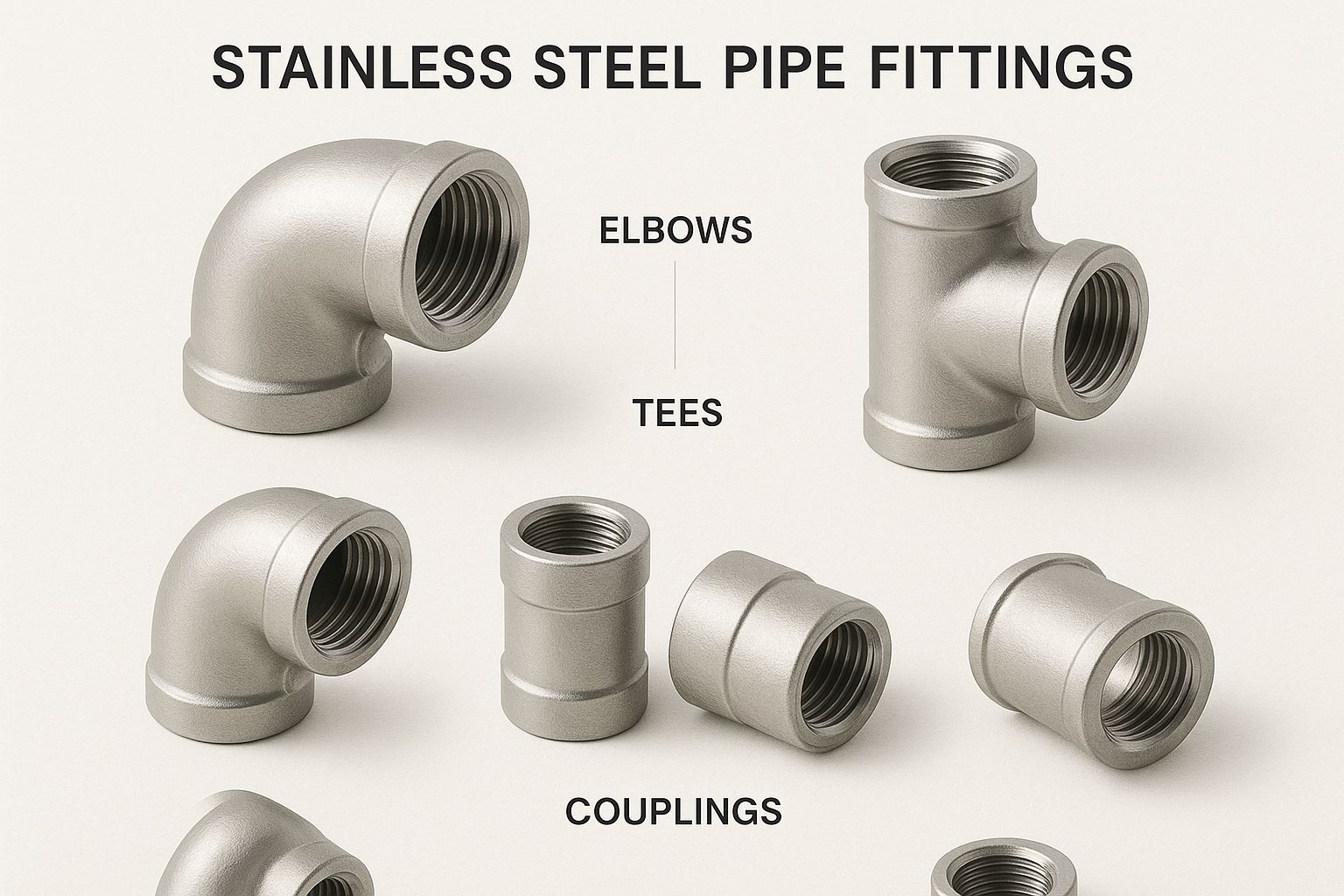
This image shows some of the most common stainless steel fittings you’ll work with. These are the building blocks of any solid piping system.
From the 90-degree turn of an elbow to the three-way junction of a tee, each fitting has a unique job. Understanding what these basic components do is the first step toward designing a system that’s both efficient and leak-proof.
The Science Behind Stainless Steel's Durability
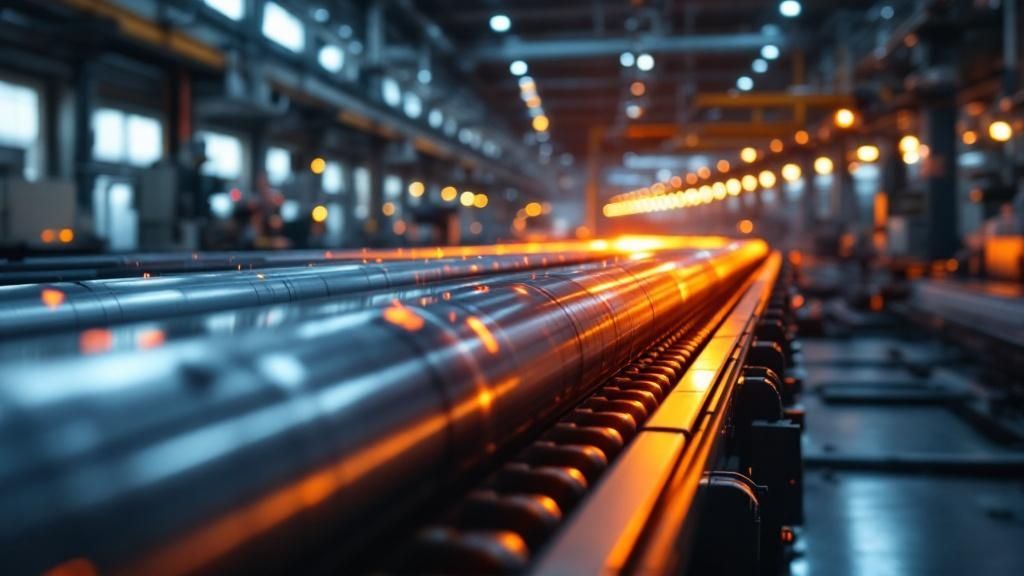
The incredible resilience of stainless steel isn't magic; it's a perfect example of material science in action. While we see a shiny, solid metal, its real power lies in an invisible, microscopic shield that constantly protects it. This is what makes it a cornerstone of modern industry.
Once you understand the science, you see why stainless steel pipe and fittings aren’t just components—they're a long-term investment in your operation's integrity. It’s a story of smart chemistry meeting rugged engineering.
The Self-Healing Protective Layer
The secret ingredient in stainless steel is chromium, which must make up at least 10.5% of the alloy. When chromium meets oxygen from the air or water, it instantly forms a thin, transparent, and non-reactive layer of chromium oxide on the surface. This process is called passivation.
Think of it as a smart, self-repairing shield. If the surface gets scratched or dinged, the newly exposed chromium immediately reacts with oxygen and "heals" the breach. This dynamic, self-regenerating barrier is what gives stainless steel its legendary resistance to rust and corrosion.
This passive chromium oxide layer is the key to stainless steel's longevity. It's a built-in defense system that actively fights off environmental attacks, keeping the material stable and reliable for decades.
In harsh industrial environments full of moisture and chemicals, this protective layer is the difference between a system that lasts and one that quickly fails.
Remarkable Performance in Extreme Temperatures
Stainless steel’s durability goes far beyond just fending off corrosion. Its unique metallurgical structure allows it to perform exceptionally well across a massive range of temperatures—a critical feature for countless industrial processes.
High-Temperature Strength: Austenitic grades like 304 and 316 hold onto their strength and resist scaling even in extreme heat. This makes them perfect for high-pressure steam lines, furnace parts, and chemical reactors.
Cryogenic Toughness: On the flip side, those same grades remain tough and ductile in freezing, cryogenic conditions. You’ll find them in systems handling liquefied natural gas (LNG) and other super-cooled industrial fluids where other metals would become dangerously brittle.
This amazing versatility means you can use the same trusted material for systems that swing between extreme hot and cold, simplifying both design and inventory.
Strength-to-Weight Ratio and Hygienic Properties
Beyond its environmental resilience, the physical makeup of stainless steel brings some major practical advantages. Its fantastic strength-to-weight ratio is a huge one. It lets engineers design piping systems with thinner walls that can still handle high pressures, which saves on material weight and cost without sacrificing safety.
On top of that, the surface of stainless steel is completely non-porous. This incredibly smooth finish gives bacteria, viruses, and other contaminants nowhere to hide or grow.
This hygienic quality is absolutely non-negotiable in certain fields:
- Food and Beverage: Guarantees product purity by preventing contamination and meeting strict health codes.
- Pharmaceuticals: Essential for sterile manufacturing environments where microbial control is paramount.
- Water Treatment: Ensures purified water stays clean as it moves through the distribution network.
This combination of brawn and cleanliness makes it an irreplaceable material.
A Smart Investment in Total Cost of Ownership
When you add it all up, the science behind stainless steel translates directly to your bottom line. While the upfront cost might be higher than some alternatives, its incredibly long life and near-zero maintenance needs result in a much lower total cost of ownership (TCO).
Investing in a system built with quality stainless steel pipe and fittings means fewer repairs, less downtime, and no worries about frequent replacements. That reliability keeps your operations running smoothly, making it the most cost-effective and dependable choice for any serious industrial project.
Stainless Steel Applications in Middle East Industries
The true value of stainless steel pipe and fittings really hits home when you see them in action, especially in some of the world's most demanding environments. Across the Middle East, this isn't just another material—it's a critical piece of the puzzle for economic growth and diversification, supporting the region's most vital industries.
From the dizzying heights of modern skyscrapers to massive industrial plants, stainless steel brings the muscle and resilience needed to transform ambitious blueprints into reality. Its unique properties are a perfect match for the specific environmental and operational hurdles found here, making it the go-to material for the projects defining the UAE's modern landscape.
The Backbone of Oil and Gas Operations
When you're working in the oil and gas sector, there's absolutely no room for error. The industry is a pressure cooker of extreme conditions: high pressures, scorching temperatures, and seriously corrosive substances like hydrogen sulfide (sour gas). This is exactly where seamless stainless steel pipes prove their worth.
Their solid, joint-free construction offers unmatched structural integrity, which is essential when you’re safely moving volatile materials. On top of that, the natural corrosion resistance of grades like 316L stops rapid decay in its tracks, protecting operations and preventing disastrous leaks. This kind of reliability is fundamental for maintaining production and keeping both people and the environment safe.
You can see this reliance reflected in the market. The Middle East's stainless steel seamless pipe market is on a path of steady growth, with projections estimating its value will hit around $431 million by 2035. That growth is tied directly to the expansion of oil and gas projects that simply can't function without these high-performance materials. You can find more details in this Middle East seamless pipe market overview on indexbox.io.
Securing the Region's Water Future
In this part of the world, water is the most precious resource, and stainless steel plays a huge part in securing it. Take desalination plants, which turn seawater into fresh drinking water—the process is incredibly corrosive. The combination of high salinity and high temperatures creates an environment where most other materials would fail in no time.
Stainless steel, especially duplex and super-duplex grades, is the perfect solution. Its incredible resistance to chloride-induced corrosion ensures these critical facilities can run reliably for the long haul, supplying fresh water to millions every single day.
This role doesn't stop at desalination. It extends right through the water treatment and distribution networks. Using stainless steel pipe and fittings guarantees:
- Purity is maintained: The clean, non-porous surface of stainless steel prevents contamination as water travels to homes and businesses.
- Leaks are minimized: The material is tough, which cuts down on water loss—a massive factor in water conservation.
- System longevity is guaranteed: It holds up against disinfectants like chlorine without breaking down, meaning a longer service life and lower maintenance bills.
A Fusion of Strength and Style in Construction
The Middle East's architecture is famous for its ambition and sleek, modern style. Stainless steel is one of the key ingredients that brings these iconic buildings to life, offering a powerful mix of structural integrity and aesthetic flair.
Architects and engineers use it for everything from load-bearing structures to elegant finishing touches. You'll spot it in the gleaming facades of skyscrapers, the smooth handrails in modern metro stations, and the durable fixtures in world-class hotels and airports. Its clean lines and polished look fit perfectly with contemporary design, while its ability to resist sun and sand ensures buildings look great for decades.
At the end of the day, the impact of stainless steel pipe and fittings across the Middle East is immense. It's a foundational material that powers energy production, secures water supplies, and helps shape the skylines of tomorrow, proving its value time and time again in the region’s most important projects.
A Practical Guide to Selecting and Installing Piping
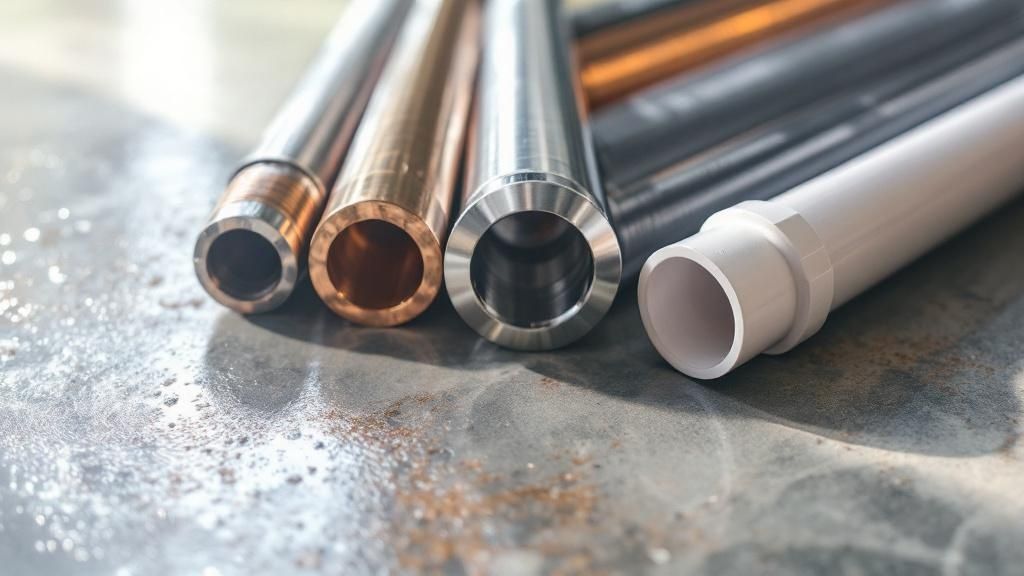
Choosing the right stainless steel pipe and fittings isn't just about matching up sizes. It’s about building a reliable system that’s engineered for safety and a long service life. Get this part right, and you prevent expensive failures down the road. Nail the installation, and you guarantee the system works exactly as it was designed to.
Think of it like laying the foundation for a house. A solid plan starts with a deep understanding of what the system needs to do. If you get the groundwork right, you save yourself from some major headaches later. Every detail matters, from the fluid inside the pipe to the air outside, because these components have to stand up to stress every single day.
How to Choose the Right Components
Before you even think about placing an order, you need to dig into four critical factors. If you miss just one, you could undermine the integrity of the entire system. Answering these questions will point you straight to the right material grade and component type for your job.
- Fluid Type and Composition: What's actually going through the pipes? Is it clean drinking water, an aggressive chemical, or a food product that needs to stay pure? The fluid itself is your first clue to which stainless steel grade—like 304 or 316—will give you the corrosion resistance you need.
- Operating Pressure: How much force is the system under? High-pressure hydraulic lines require a different approach than a simple, low-pressure drainage system. For high-pressure jobs, you'll be looking at seamless pipes and forged fittings to get that maximum strength.
- Temperature Range: Will the system be exposed to extreme heat or cryogenic cold? Some stainless steel grades are built to handle wild temperature swings, holding their structure firm while others would become brittle or weak.
- External Environment: Where will the piping live? Is it sitting outdoors near the coast, getting blasted by salt spray? Or is it tucked away inside a climate-controlled facility? The environment on the outside is just as critical as the one on the inside for preventing rust and corrosion.
Best Practices for Flawless Installation
Proper installation is where your blueprints become a functioning reality. This is where meticulous work really pays off, ensuring you don't lose the built-in advantages of stainless steel. Cutting corners at this stage can create weak spots in what should be a rock-solid system.
The most crucial step is joining everything together. Whether you’re welding joints or using threaded connections, precision is everything. To get a better handle on all your options, exploring the different pipe connectors available in Dubai can offer some great insights, especially for local projects.
"The integrity of a weld is paramount. A poor weld not only creates a potential leak point but can also become the primary site for corrosion, undoing all the benefits of using stainless steel in the first place."
Avoiding Common Installation Mistakes
Even seasoned professionals can make small mistakes that lead to a system failing way too soon. Knowing what these common pitfalls are is the first step to making sure you avoid them.
- Using the Wrong Tools: This is a classic blunder. Cutting stainless steel with a tool you just used on carbon steel can transfer tiny iron particles onto the surface. That contamination is a breeding ground for rust spots. Always keep dedicated, clean tools just for your stainless steel work.
- Improper Handling and Storage: Keep stainless steel materials separate from carbon steel to avoid cross-contamination. Dragging pipes across the ground might seem harmless, but it can scratch and damage the passive layer that protects the steel, opening the door for corrosion.
- Failing to Passivate Welds: The heat from welding burns away the protective chromium oxide layer that makes stainless steel "stainless." Passivation is a chemical treatment that rebuilds this invisible shield. Skipping it leaves your weld joints exposed and vulnerable to rust.
- Overtightening Fittings: It’s tempting to crank down on threaded fittings to make sure they’re tight, but going too far can cause stress fractures or strip the threads. This leads to leaks. Always follow the manufacturer's torque specifications for a seal that’s secure but not damaged.
Navigating Essential Industry Standards and Certifications
In any serious industrial or construction project, just claiming a product is good enough won't cut it. You have to be able to prove it. This is where industry standards and certifications for stainless steel pipe and fittings become absolutely critical. They're the universal language of quality, safety, and reliability, ensuring every component has been put through its paces and meets strict global benchmarks.
Think of these standards as the official rulebook for manufacturing. When a pipe or fitting is certified, it’s a promise—a guarantee that it was made to exact specifications covering everything from its chemical makeup to its physical dimensions and pressure tolerance. It completely removes the guesswork and gives you the documented proof you need for project compliance and, most importantly, operational safety.
Understanding Key Standards Bodies
Several international organizations are the gatekeepers of these vital standards. You'll see their acronyms stamped or marked on any quality stainless steel product you handle. Knowing who they are is your first step to verifying the quality of your components.
- ASTM International: You’ll see ASTM everywhere. Formerly the American Society for Testing and Materials, they develop standards for a massive range of materials. For our purposes, a key one is ASTM A312, which covers seamless, straight-seam welded, and heavily cold-worked welded austenitic stainless steel pipe.
- ASME (American Society of Mechanical Engineers): When pressure is involved, ASME is the name to know. Their ASME B16 series, for example, sets the dimensional standards for fittings, flanges, and valves. This ensures everything connects perfectly and can handle the design pressures of the system without a hitch.
- ISO (International Organization for Standardization): ISO standards are recognized worldwide, making international projects and trade much simpler. Their standards are incredibly comprehensive, covering everything from material quality to manufacturing processes, laying out a complete framework for excellence.
Sticking to these standards isn't just about checking a box on a form. It's about building a system with parts that are guaranteed to fit together, perform under stress, and last for years without unexpected failures.
How to Verify Compliance on Site
So, how do you check this in the real world? The compliance markings are your direct window into a product's history and quality. Manufacturers often use laser marking techniques for stainless steel to permanently etch this crucial info right onto the components. You should be able to clearly see the manufacturer's name, the material grade (like 316L), the size, and the specific ASTM or ASME standard it meets.
Ultimately, the most reliable path is to work with reputable suppliers who provide full documentation for their products. And if you're working in the UAE, you also need to be on top of local rules. Our guide to understanding UAE construction supply regulations is a great resource for getting familiar with regional requirements. Arming yourself with this knowledge means you can confidently source and install stainless steel pipe and fittings that meet every single safety and legal obligation.
Your Top Stainless Steel Piping Questions, Answered
Any time you work with a material as capable as stainless steel, you're bound to have a few questions. That's a good thing. Asking the right questions is the first step to getting your project done right, whether you're designing a new piping system from scratch or figuring out an issue with an old one.
Let's cut through the noise and get straight to the practical answers you need. Getting a handle on the differences between grades or knowing the right installation tricks can save you from big headaches and costly fixes down the road.
What’s the Real Difference Between 304 and 316 Grade Steel?
It all boils down to one key ingredient: molybdenum. Grade 304 is your workhorse—a fantastic, all-around choice with solid corrosion resistance. It’s what you’ll find in everything from food processing plants to architectural details and standard water lines.
But when you're up against chlorides—think saltwater, de-icing salts, or harsh industrial chemicals—Grade 316 is the undisputed champ. That little bit of molybdenum gives it an extra shield against pitting and crevice corrosion. It’s the non-negotiable choice for marine environments, coastal construction, and chemical plants where Grade 304 just wouldn't last.
When Should I Choose Seamless Over Welded Pipe?
This decision really hangs on two things: pressure and risk.
Seamless pipe is made from a single, solid piece of steel. There are no weld seams, which means no potential weak spots. This built-in integrity makes it the only real option for high-pressure, high-stakes jobs. We're talking oil and gas pipelines or critical steam lines where a failure is simply not an option.
Welded pipe, on the other hand, starts as a flat sheet that's rolled and welded together. It's incredibly reliable for the vast majority of applications and is much friendlier on the budget. For lower-pressure fluid transport, structural projects, and general plumbing, it’s more than up to the task.
How Do I Keep Stainless Steel from Rusting?
Stainless steel is tough, but it's not invincible. Its secret is a passive layer on the surface that protects it from rust, but that layer can be damaged. The best defense is a good offense. For visible stainless steel, like on a building's exterior, a simple cleaning with mild soap and water is enough to wash away contaminants that could cause corrosion.
In an industrial setting, it’s all about the installation. Proper welding techniques are crucial, but the follow-up step of passivation is just as important. This chemical treatment restores the protective chromium oxide layer at the weld joints—the most vulnerable part of the system—and stops rust before it can even start.
Can You Mix Different Grades of Stainless Steel in One System?
Technically, you can, but it’s a risky move that’s usually not recommended without an engineer signing off on it. When you connect, say, a Grade 304 pipe to a Grade 316 flange, you create the perfect conditions for galvanic corrosion.
This happens when two different metals touch while wet, causing the less "noble" metal (Grade 304, in this case) to rust away at the connection point. To ensure your system lasts as long as it should, the best practice is always to stick with one consistent grade for all your stainless steel pipe and fittings, especially if the environment is corrosive or requires high purity.
For all your projects requiring premium building hardware and construction essentials, trust Yasu Trading Co. LLC. We provide a comprehensive range of certified stainless steel components to ensure your systems are built for safety and durability. Explore our offerings and request a quote today.