Steel Cutting Disc Guide: Sizes, Speeds and UAE Rules
There's a box in the site store with six steel cutting discs in it. Three sizes, two brands, and one label worn down to bare metal. The grinder they'll go on is a 115 mm unit four crews have shared for months, and the next job is trimming a bundle of 12 mm rebar that's already marked up.
The 125 mm disc gets fitted because it's the last one on the shelf. The cut happens. Nothing bursts, so everyone moves on.
That habit is where the cost sits, and it has nothing to do with the price per disc.
What a Steel Cutting Disc Is and Where It Fits
A steel cutting disc is a thin bonded abrasive wheel: aluminium oxide grain, a phenolic resin bond and a glass fibre mesh pressed into a plate a few millimetres thick. It wears away as it works. Think of a saw blade made of sand glued together. The teeth are microscopic, the disc is the consumable, and the tool that survives is the grinder.
The volume of metal being processed explains why the product matters here. MEsteel puts UAE crude-steel production at 3.7 million tonnes in 2024, and every rebar length, pipe trim, channel fixing and handrail adjustment behind that figure needs a disc suited to both the metal and the machine.
Crews meet these discs in four places: rebar preparation before a pour, steel framing and fabrication, MEP pipe and support work, and maintenance repairs in hotels and apartment buildings. Whatever the job, the disc is defined by three numbers on its label, diameter, thickness and maximum speed, and matching those to the metal and the grinder is the whole discipline.
Before reading further, get the grinder model, its rated rpm and the metals your crews cut most often. Everything below depends on those three answers.
Sizes, Speed Ratings and Arbor Specs at a Glance
Speed ceiling follows diameter, so the size you buy decides the rating you can legally run.
| Diameter | Thickness | Max RPM (80 m/s) | Typical job |
|---|---|---|---|
| 115 mm | 1.0–1.2 mm | 13,300 | Thin cut-off and handheld trimming |
| 125 mm | 1.0–1.6 mm | 12,200 | Thin cutting and light fabrication |
| 150 mm | 1.6–2.0 mm | 10,200 | General site cutting of sections and pipe |
| 180 mm | 2.0–3.0 mm | 8,500 | Heavy sections and rebar bundles |
| 230 mm | 2.5–3.0 mm | 6,600 | Large-grinder heavy-duty cutting |
Read a label in four steps.
- Diameter. Confirm it clears the guard on your grinder. A 230 mm disc will not sit under a 115 mm guard, and it shouldn't be forced to.
- Thickness. 1.0 mm to 1.2 mm suits sheet, tube and fast trimming. 2.0 mm and above is for sections and rebar bundles where the wheel takes real load.
- Arbor. Most 115 mm, 125 mm and 180 mm discs run a 22.2 mm bore. Check your spindle and flanges take it before you order a box of fifty.
- Maximum rpm. Compare the printed figure with the rating plate on the grinder. The marked disc speed must never be lower than the machine speed.
That last point is not paperwork. A 115 mm disc at 80 m/s is rated to roughly 13,300 rpm and a 125 mm disc to about 12,200 rpm, and the EN 12413 safety guidance published by NovoAbrasive notes that a 10% overspeed lifts rotational stress by about 21%, because centrifugal stress climbs with the square of speed.
To check any size yourself, divide 4,800 by pi times the diameter in metres. A 150 mm disc lands near 10,200 rpm and a 180 mm disc near 8,500 rpm at the same ceiling. Reject any disc whose markings are illegible, however cheap it looks.
One further rule: chop-saw discs are governed by the saw's own rating. A grinder disc in a chop saw, or the reverse, is a mismatch, not an upgrade.
Disc Types and the Metal Each One Suits
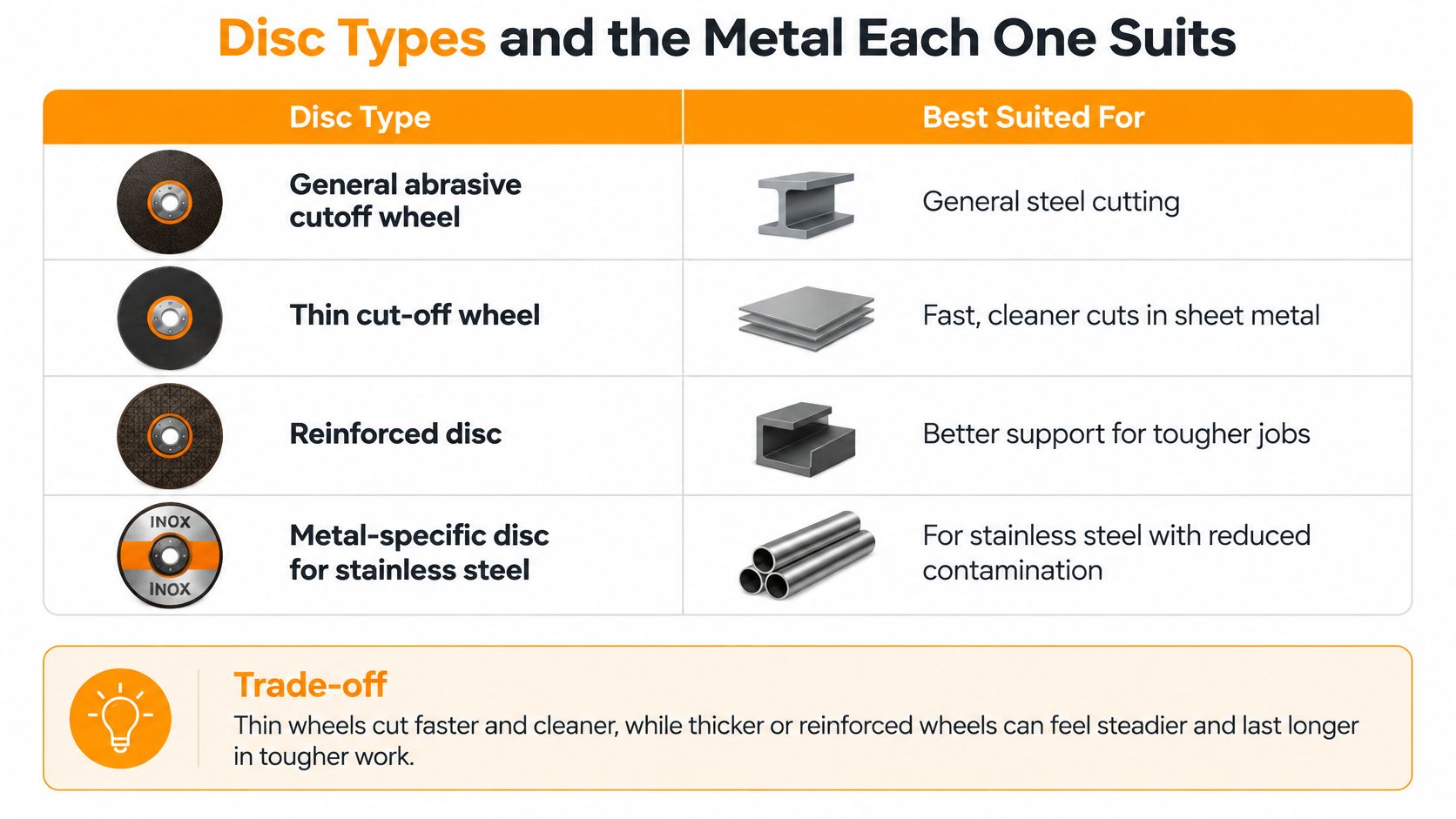
| Type | Best for | Main strength | Main trade-off |
|---|---|---|---|
| General abrasive cutoff | Carbon steel bars, sections and general fabrication | Balanced cut speed and wear | Heavier and slower on thin sheet |
| Thin cut-off wheel | Sheet, tube and light sections | Fast cut with narrow kerf | Flexes under side load and wears faster |
| Reinforced disc | Rebar, pipe and heavy sections on site | Tolerates side pressure and rough handling | Wider kerf and higher price |
| Metal-specific (stainless) | Stainless finishes and visible pipework | Controlled iron, sulphur and chlorine contamination | Costlier and must be kept apart from carbon steel |
A thin disc behaves like a fine kitchen knife: quick, precise, and unforgiving the moment you lean it sideways. A reinforced disc is the cleaver. It sits wider in the cut, costs more, and takes the rough handling that a fabricator gives it when a rebar bundle shifts under the guard.
The difference shows up in the kerf and in the finish. Thin wheels remove less metal per cut, generate less heat and leave a cleaner edge on sheet and tube, which is why they dominate cable tray and ductwork. Reinforced wheels with multiple fibreglass layers hold their shape when the operator pushes, so they survive pipe and heavy section work where a thin disc would flex, glaze and fail early.
Stainless is its own category. Dedicated discs carry controlled levels of iron, sulphur and chlorine, and they should never share a rack with carbon steel discs, because transferred contamination shows up later as staining or corrosion on a visible handrail or balustrade.
Buy the type, not the badge. A mid-priced disc of the correct type beats a discounted disc of the wrong one on kerf, heat and rework every time. The same selection logic applies to concrete cutting discs, where segment specification matters more than branding.
Matching Discs to Rebar, Stainless, Sheet Metal and Pipe
A bundle of bar can turn a bargain thin wheel into the most expensive disc on site: it flexes, the kerf wanders, the bar gets re-cut, and the pour waits. Four metal groups cover most UAE site work. Each has a default disc, a main risk and one check before the grinder starts.
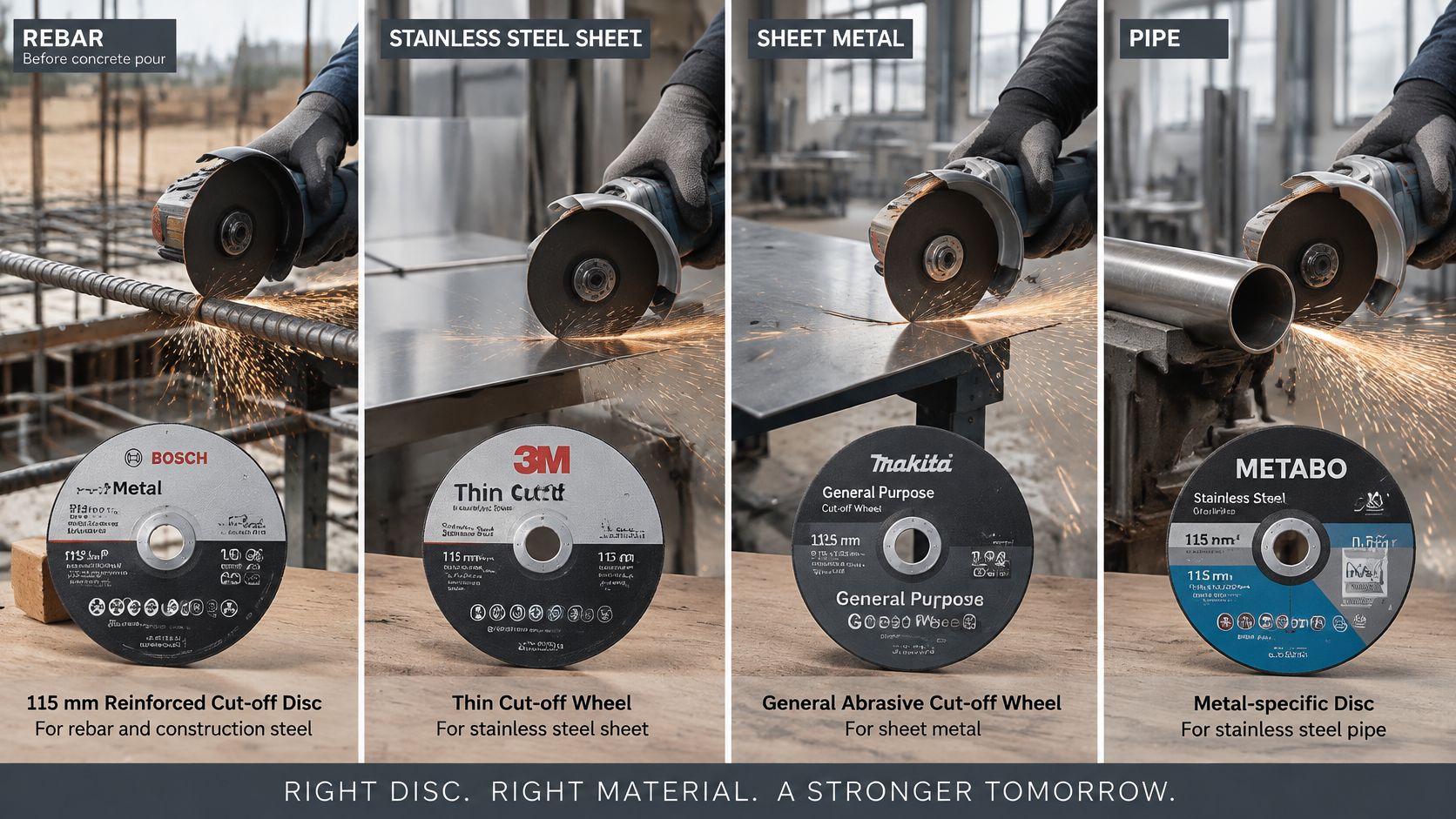
Rebar before a pour. Use a reinforced cutoff disc of 2.0 mm or thicker in 180 mm for sections and rebar bundles; thin 115 mm or 125 mm wheels are not for rebar bundles. Stack the bars on timber so the cut stays square and the disc never takes side load from a bar sagging under its own weight. The scale is real: the USGS Minerals Yearbook entry for the UAE reports Emirates Steel supplied about 60%, roughly 160,000 tonnes, of reported rebar requirements in 2019, against national raw-steel production of approximately 3.3 million tonnes that year.
Stainless handrail repair in a hotel lobby. Dedicated stainless disc only, light pressure, short passes. Heat tint on a brushed finish means polishing a metre of rail to match, and a disc that has previously touched carbon steel will leave rust spots within weeks.
The clip below shows the entry angle that keeps a cut square.
Sheet metal for a cable tray or duct. A thin cut-off wheel, the sheet clamped flat to stop chatter and tear-out, and the burr dressed afterwards. Unclamped sheet whips, pinches the disc and ruins the edge. If you shear or slit coil before it reaches the bench, browse James Way slitters to handle the stock upstream of the grinder.
MEP steel pipe riser. Choose thin or reinforced by wall thickness, support the pipe on both sides, and cut square so the thread or weld prep stays true. Keep heat off galvanised coatings.
Run selection as site control, not habit. Issue the disc against the work order, mark separate stock for stainless, and pull undocumented wheels off the rack before they reach a grinder. Pick the disc for the metal you cut weekly and keep enough of it on hand; the cheap odd wheel usually costs a re-cut, a failed edge or a delayed inspection.
How to Cut Steel Safely and Cleanly
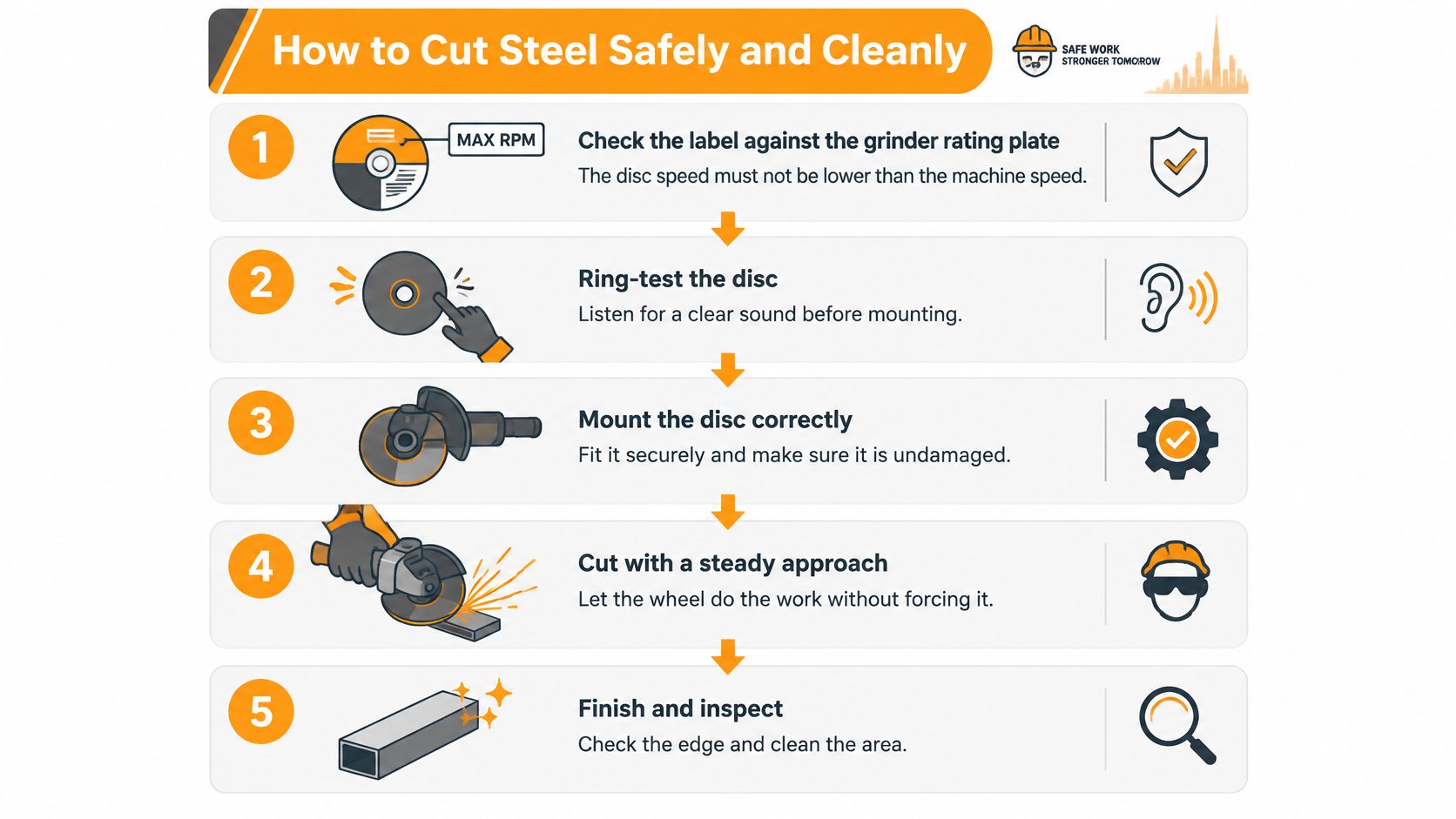
A disc that fails at the spindle has already cost more than it saved. The grinder sits idle, the cut gets reworked, and an undocumented wheel reaching the tool is how site inspections go wrong. Run the same eight checks in the same order every time and the cheap-versus-dear argument settles itself, because a disc that survives inspection and cuts at rated speed is the cheaper option whatever the ticket price.
- Check the label against the rating plate. Disc speed must be at or above machine speed, or the wheel is wrong for the tool. An unmarked disc goes back to the store.
- Ring-test the disc. Hold it on a fingertip or hang it on a nail and tap it lightly with a non-metal object. A clear ring means intact. A dull thud means a crack, and it goes in the reject bin.
- Fit the guard, flanges and hood. Confirm the spindle lock has released and the nut is tight, and run the tool briefly with no load to check for wobble.
- Dress for the job. Eye or face protection, cut-resistant gloves, hearing protection, a dust mask or respirator matched to the dust, and closed footwear. No loose sleeves.
- Clamp or support the workpiece. Free material moves into the disc, and that pinch is what shatters wheels.
- Reach full speed before contact. Loading a disc while it accelerates puts torque through a spinning wheel with no cut to absorb it.
- Cut square with a controlled feed. Let the grains do the work. The CGW Abrasives safety guide is blunt about the consequence of forcing it: excess pressure slows the machine and overheats the workpiece, so the disc should be replaced when the cut stays slow despite more push.
- Switch off, lift clear, let it cool. Hot offcuts and hot discs both burn hands.
A clean cut shows a square edge, even sparks along the kerf and minimal discolouration. Railings and gates live or die on that standard, and any wrought iron fence installation guide will tell you a square cut decides how the finished run lines up. For the rest of the kit, our site safety equipment guide for contractors sets out what to keep on site.
Fixing Common Cutting Problems and Extending Disc Life
A crew that buys the cheapest box usually pays for it twice: once in discs that glaze early, then again in rework, slow feeds and stock nobody can document. Use the symptom table to correct the cause before the next wheel goes on the grinder.
| Symptom | Likely cause | Fix |
|---|---|---|
| Fast wear or glazing | Excess pressure or wrong disc for the metal | Ease the feed and use a disc graded for the material |
| Blue or brown heat marks on stainless | Overheating or contaminated disc | Use a dedicated stainless disc and cut at lighter pressure |
| Wobble or vibration | Damaged flange, poor seating or cracked disc | Refit flanges and replace the disc |
| Slow or stalled cutting | Dull disc or underpowered grinder | Replace the disc and confirm grinder power |
| Chipping or cracking in use | Side load, overspeed or moisture-damaged storage | Stop, replace the disc, check rpm and storage |
Storage decides half of that list.
- Keep discs flat and dry. Indoors, off concrete floors, away from direct sun and heat. Resin bonds absorb moisture in humid store rooms and lose strength.
- Leave them in the original packaging until the grinder is ready. Stacked naked discs chip at the rim.
- Hold one disc family per metal group, labelled and separated, so a stainless disc never gets used on painted steel.
- Log replacements by job. Two weeks of records shows which discs die fastest and which crew is leaning on the tool.
- Record the failure, not only the count. Mark each spent disc as glazed, cracked, chipped, worn flat or contaminated; that turns purchases into a control loop instead of a guess.
A disc is a consumable, and a worn or cracked one should be retired rather than pushed through a last cut. Most premature failures trace back to pressure and storage, not to the disc.
End-of-life handling matters too. Collect worn, cracked and damaged discs plus their packaging separately from general site waste and hand them to a licensed waste contractor, because the UAE federal waste-management framework treats construction and demolition waste processing and recycling premises as regulated facilities, not informal skip-bin destinations. A bonded abrasive with fibreglass and metal contamination is not scrap steel. Machining benchmarks such as tool life guidance for machining shops track life through wear and time in cut. On site, borrow the logging discipline and keep disc-specific retire triggers: glaze, cracks, moisture and rim chips.
Confirm Compliance Before You Order Discs
An undocumented disc costs more than a premium one once rejected inspections and dust-control problems land on the programme. Run this checklist before the purchase order and again at goods-in.
- Marking. Every disc shows EN 12413 conformity and a printed maximum rpm at or above the grinder's rated speed.
- Fit. Diameter matches the guard, hood and flanges fitted to the grinder, not the guard that came in the box.
- Hood. Keep the manufacturer-supplied hood on every abrasive cut-off wheel, since it supports dust removal. Equipment without it should not run.
- Pre-mount controls. Dubai's Code of Construction Safety Practice requires abrasive wheels to be inspected and ring-tested before mounting, cracked or damaged wheels removed, and suitable eye protection worn around grinding equipment.
- Authority. Name in writing who inspects and mounts discs on each crew, in Arabic and English if the toolbox talks are bilingual.
- Evidence. Keep a dated log of pre-use inspections, toolbox talks and disc replacements by job, so an inspector sees records rather than assurances.
- Rejection. Any disc failing steps 1 to 4 on receipt goes back to the supplier the same day.
Steps 5 to 7 are where most site controls fail. A disc can arrive compliant and still end up mounted by whoever happened to be holding the grinder, with no record of the checks it passed. Naming the mounter and logging every replacement turns compliance into a routine, not a scramble the morning an inspector shows up.
The cheapest disc is rarely the lowest-cost option. A wheel that can't be documented, guarded or safely used buys you rejected inspections, dust-control problems and delay.
Bring us the grinder model, rated rpm, diameters and metals. We stock power tools and safety gear under one roof in Deira, so power tools and PPE can ship on one order, and every power tool carries full manufacturer warranty support.
Yasu Trading Co. LLC supplies power tools, safety gear and municipality-compliant building materials from Naif, Deira, with same-day or next-day site delivery across Dubai, Abu Dhabi, Sharjah and the Northern Emirates. Send your grinder model, its rated rpm and the diameters your crews use, and we'll match power tools and PPE to the work, with full manufacturer warranty support on the power tools and equipment. Visit Yasu Trading Co. LLC to confirm stock and place the order before your next pour.