
Understanding the Steel Rate in UAE
When you're trying to budget for a project, you'll quickly find there's no single, fixed steel rate in the UAE. It's not like buying something off a shelf with a price tag. Instead, think of it as a moving target, a dynamic figure that shifts based on the exact steel product you need, its grade, what’s happening in the global markets, and of course, your supplier. The price difference between standard rebar and heavy-duty structural I-beams can be huge.
Your Guide to Current UAE Steel Prices
Trying to navigate the steel market without a clear price baseline is like trying to build without a blueprint—it’s a recipe for costly surprises. Prices are always in motion, so getting a solid grasp of the current landscape is absolutely essential for accurate project costing and keeping your finances in check. This section is designed to give you that practical snapshot, a baseline to start from.
The scale of this market is massive. To put it in perspective, the UAE's structural steel market alone brought in revenues of around USD 493.8 million back in 2022. That figure is expected to climb to nearly USD 569.5 million by 2030, a jump fuelled mostly by big non-residential construction projects.
And that's just structural steel. If you look at the wider long steel products market, the number skyrockets to an incredible USD 2.8 billion in 2022. Rebar sales alone accounted for over 40% of that share. Digging into these market dynamics really helps you appreciate the sheer size of the industry you're operating in.
Indicative Price Range for Common Steel Products in the UAE
To give you a concrete starting point, it helps to look at some real numbers. The table below lays out some typical price ranges you might see for key steel products here in the UAE.
Remember, these are just estimates to get you in the right ballpark. The final price on your invoice will always shift based on daily market movements, the size of your order, and your negotiations with the supplier.
| Steel Product | Grade | Estimated Price per Tonne (AED) |
|---|---|---|
| Deformed Rebar | BS 4449 Grade 500B | 2,400 - 2,650 |
| Structural I-Beams | S275JR | 2,800 - 3,100 |
| Hollow Sections (CHS/SHS) | S235JR | 2,900 - 3,250 |
| Hot Rolled Sheets | S275JR | 2,600 - 2,900 |
As you can see, the price differences from one product to the next are significant. This is exactly why a "one-size-fits-all" approach to the steel rate in the UAE just doesn't work. The specific engineering requirements for your project have a direct and immediate impact on your material costs. This is where partnering with a knowledgeable supplier like Yasu Trading Co. becomes invaluable—we provide the clarity and up-to-the-minute pricing you need to navigate these complexities and keep your project on track.
The Recipe for Steel Prices in the UAE
Ever found yourself wondering what makes the steel rate in UAE jump up one week and dip the next? It's not random. Think of it less like a chaotic stock market and more like a complex recipe, where a mix of global, regional, and local "ingredients" all blend together to create the final price you see on a quote.
Knowing what goes into this recipe is powerful. It moves you from simply reacting to price changes to proactively anticipating them.
Let's start with the base of the dish: the global ingredients. The international market prices for raw materials—your iron ore and scrap metal—set the fundamental cost floor for everything that follows. When a mine in Australia faces a disruption or demand suddenly spikes in China, you can be sure the ripple effect will be felt right here in Dubai and Abu Dhabi.
This isn't a minor detail; it’s a huge part of the story. In 2023 alone, the UAE imported iron and steel valued at around US$6.24 billion. This heavy reliance on imports means the health of the global supply chain has a direct and immediate impact on local steel costs. You can get a clearer picture of these figures and UAE's import trends on Trading Economics.
Regional and Geopolitical Flavours
Now we start adding some regional and geopolitical spices to the mix. These factors can completely change the character of the pricing recipe. A construction boom in a neighbouring GCC country, for instance, can tighten up the regional supply, pushing prices up for everyone.
Then you have geopolitics and trade policies, which add another, often unpredictable, layer. International tariffs can scramble established trade flows, forcing suppliers to find new, and often more expensive, sources. If you want to go deeper on this particular topic, we’ve broken down the impact of tariffs on the UAE construction industry in another guide.
A sudden shift in international trade policy is like throwing an unexpected spice into the recipe—it can either enhance the flavour or completely overwhelm it, changing the final outcome in ways that are hard to predict without real expertise.
These external pressures are a constant variable in the equation, making it critical to stay plugged into more than just what’s happening down the road.
The Final Local Stir
Finally, we stir in the ingredients that give steel prices their distinctly local UAE character. These are the factors closest to home, and they’re just as important.
- Domestic Production: The output from our own mills, like Emirates Steel, is a massive stabilising force. When local production is strong and meets demand, it acts as a buffer against some of the wilder global swings.
- Mega-Projects: When a huge government or private sector project gets the green light, it creates a massive, sustained appetite for steel. This can influence the steel rate in UAE for months, or even years, to come.
- Logistics and Overheads: Don't forget the final mile. The cost of getting steel from the port or mill to your actual project site, plus supplier overheads and their current inventory levels, all add those final percentage points to your quote.
By understanding how all these global, regional, and local ingredients come together, you gain a massive strategic advantage. You stop being a price-taker and become an informed buyer, one who can plan and strategise procurement around these powerful market forces.
Where Your Steel Comes From
If you really want to get a handle on the steel rate in UAE, you first need to know where the steel itself comes from. It's a fascinating story, really, with two main characters: the UAE's powerful domestic mills and a sprawling network of international suppliers. Getting your head around this dual-source system is the first step to predicting price shifts and making smarter buys for your projects.
Right at the heart of the local scene are the UAE’s own steel producers. Think of them as the engine room for the country's entire construction boom, churning out enormous volumes of critical products. They’re especially dominant when it comes to rebar—the literal backbone of just about every building and infrastructure project you see.
This local muscle is a big deal. Back in 2022, the UAE cranked out about 3.2 million metric tons of crude steel, which really cemented its spot as a major force in the region. This output comes from highly advanced facilities that are constantly turning raw materials into the top-notch steel the market demands. You can dig deeper into the numbers on the UAE's steel production on Statista.com.
The Role of Domestic Production
Having such a strong local manufacturing base gives the market a huge advantage. It acts as a buffer, shielding us from some of the wild swings you see in global shipping and supply chains. When you buy from a local mill, you're usually looking at shorter delivery times and, quite often, more predictable pricing—especially for the common, high-volume stuff.
The main players here are modern, efficient mills that can cover a huge slice of the country's needs. Their laser focus on core construction materials ensures there’s a steady stream of steel to fuel the nation’s ambitious vision.
Think of the UAE's steel mills as the bedrock of the supply chain. They provide the fundamental, high-demand materials that form the bulk of what’s used every day in construction, creating a stable foundation for the entire market.
Why Imports Still Matter
But here's the thing: no country can make every single type of steel it needs. That’s where imports become absolutely essential. The UAE brings in a whole host of products from the global market, either because they aren't made here or because local supply needs a top-up.
This dependence on imports becomes crystal clear when you start looking at things like:
- Specialised Steel Grades: Some projects demand steel with very specific properties, like insane tensile strength or superior corrosion resistance, that local mills just aren't set up to produce.
- Unique Structural Shapes: While our mills are fantastic at standard rebar and sections, those more complex or unusual structural steel shapes often have to be sourced from overseas.
- Raw Materials: Even the steel-making process itself needs certain ingredients, like high-grade iron ore or specific types of scrap metal, which are frequently imported to feed the furnaces of our local producers.
This reliance on imports ties the local steel rate in UAE directly to what’s happening in the rest of the world. Any shift in international commodity prices, global freight costs, or currency exchange rates will ripple through and affect the final price tag on imported steel. And because of that, even a project using mostly local steel can feel the knock-on effects of these global economic tides.
Choosing the Right Steel Without Overspending
Not all steel is created equal, and neither is its price tag. The secret to a cost-effective project is knowing how to match the right steel to your specific engineering needs.
Think of it like buying a car. You have your reliable family sedan and your high-performance sports car. Both will get you from A to B, but their engineering, materials, and costs are in completely different leagues. You wouldn't pay for a finely tuned racing engine if all you need to do is the weekly shop, would you?
This exact logic applies to buying steel. Different rebar grades or structural steel types come with costs directly tied to their performance. A higher steel rate in UAE often means you're paying for enhanced strength, greater flexibility for earthquake-resistant designs, or superior protection against corrosion for coastal builds. The real skill is in avoiding over-engineering.
Your goal is to find that perfect sweet spot where the engineer’s structural demands meet your budget. You need to be sure you’re paying for the performance you actually need—and not a cent more for specs that add no real value to your particular project.
Balancing Cost Against Performance
One of the most common and costly mistakes we see is the assumption that "stronger is always better." While technically true, it’s not always better for your bottom line. Using a higher-grade, more expensive steel than a project actually calls for is one of the fastest ways to blow your materials budget.
For instance, a standard Grade 500B rebar is perfectly adequate for most residential buildings. Choosing a specialised, coated rebar designed for extreme marine environments would be a complete waste for a structure built far inland. Understanding these details is everything. It's also vital to work within local building codes, which you can learn more about in our guide on the regulations for building materials in the UAE.
The chart below gives you a clear picture of how the average steel price per tonne in the UAE stacks up against the global average and neighbouring Saudi Arabia. It’s a great visual for understanding the local market.
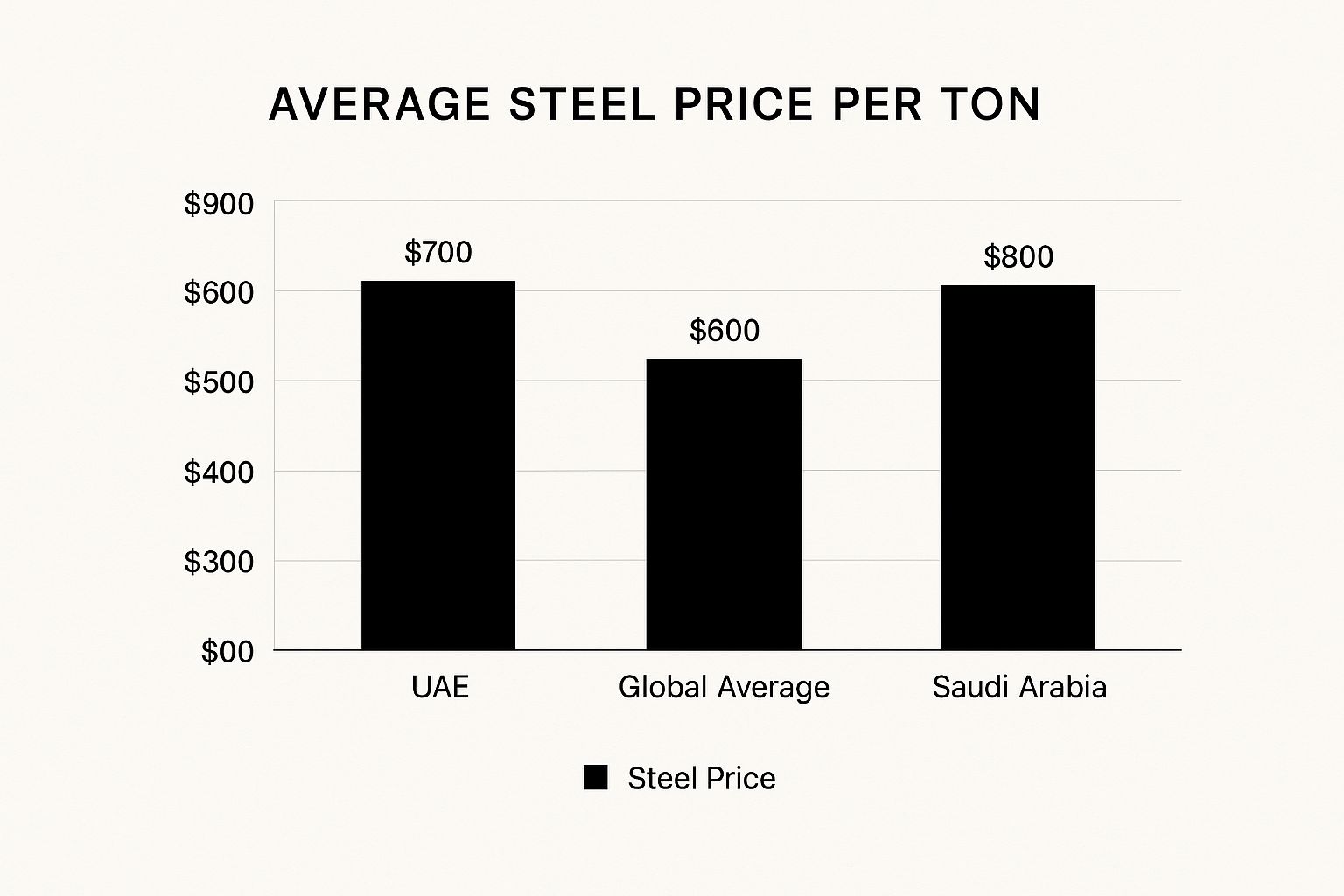
As you can see, regional and local market forces create a unique pricing environment. This is exactly why a localised strategy is non-negotiable for getting the best price.
A Look at Common Steel Grades
To help you make sense of the options, here’s a quick comparison of the steel grades you'll most often encounter in the UAE construction scene.
Comparison of Common Steel Grades Used in the UAE
| Steel Grade/Type | Primary Application | Key Characteristic | Relative Cost Index |
|---|---|---|---|
| Grade 460B Rebar | Standard residential and commercial construction | Good balance of strength and ductility | $$ |
| Grade 500B Rebar | High-rise buildings, infrastructure projects | Higher yield strength, allows for less steel usage | $$$ |
| Epoxy-Coated Rebar | Coastal structures, bridges, car parks | Excellent corrosion resistance | $$$$ |
| Galvanised Steel | Outdoor structures, roofing, cladding | Good corrosion resistance, durable coating | $$$ |
| S355 Structural Steel | Beams, columns, general structural fabrication | High strength and excellent weldability | $$$ |
This table shows that the "best" steel is always the one that fits the job's specific demands—from a standard rebar for a villa to coated steel for a seafront development.
Key Specification Considerations
When you're sifting through steel options, zoom in on the properties that will directly impact your project's success and lifespan. These factors are the main drivers behind the cost, so pay close attention:
- Tensile Strength: This is simply how much pulling force the steel can take before it breaks. It's essential for skyscrapers but might be overkill for a two-storey building.
- Ductility: Think of this as the steel’s ability to bend or stretch under pressure without snapping. It's a critical safety feature, especially in regions with any seismic risk.
- Corrosion Resistance: For any project near the coast or in high-humidity areas, paying a bit more for galvanised or epoxy-coated steel upfront can save you a fortune in long-term rust damage and repairs.
- Weldability: How easily can the steel be welded? This directly affects your labour time and costs on-site. Some high-strength alloys need special (and more expensive) welding techniques.
By carefully weighing these factors against your project's blueprints, you can confidently select the most suitable and economical steel grade. This smart, informed approach ensures you get a competitive steel rate in UAE without ever cutting corners on safety or quality.
Of course. Here is the rewritten section, crafted to sound like it was written by an experienced industry expert, following the specific style and formatting requirements.
How to Secure a Better Steel Rate
Knowing the market is one thing. Actually saving money is another game entirely. Getting a better steel rate in the UAE isn't about luck or timing the market perfectly. It’s about being smart with how you buy and, crucially, who you buy from.
Think of it like this: you could spend days studying maps and weather reports for a long road trip, or you could just turn on a GPS that gives you live traffic updates and the fastest route. A seasoned supplier like Yasu Trading Co. is your project's GPS for the steel market. We take all that complicated data and give you a clear, cost-effective path forward.
This goes way beyond just asking for a price list. A true procurement partner gets into the nitty-gritty of your project to find savings you might have missed.
The Power of a Strategic Supplier
The real advantage of an expert supplier is tapping into their network and buying power. You're essentially using their market influence to benefit your own bottom line. It's a direct route to tangible savings.
Here’s how a partner like Yasu Trading Co. can take the headache out of steel procurement and make it a budget-friendly part of your project:
- An Extensive Mill Network: We’ve built solid, long-term relationships with a huge range of mills, both here in the region and internationally. This means we can source the exact grade you need from the most economical source at any given time, sidestepping those frustrating supply chain jams.
- Bulk Purchasing Power: We don’t just buy steel for one project; we consolidate orders for many. This means we purchase in massive quantities, unlocking preferential pricing that a single contractor simply can't access. We then pass those savings right on to you.
- Expert Logistics Management: Getting steel from the mill to your site is a massive hidden cost. Our logistics team are masters at this, handling the complexities of shipping, customs, and transport to ensure your steel arrives on time while keeping those costs to a minimum.
It’s this powerful combination of network, volume, and logistics that really brings down the final price you pay for steel.
The heart of smart procurement is understanding that the cheapest upfront quote isn't always the best value. A reliable supplier guarantees quality and on-time delivery, protecting you from what really hurts: costly project delays and rework.
From Quote to Delivery
At Yasu Trading Co., we don’t believe in surprises. When you ask us for a quote, you won't just get a single number. We'll give you a transparent cost breakdown and make sure the steel we’re quoting meets every single quality and compliance standard your project demands.
This clears up any guesswork. It gives you the confidence that you're getting a competitive steel rate in the UAE without cutting corners on quality. We look after the entire process—from sourcing and negotiating to quality control and final delivery—so your project stays on track and on budget. It frees you up to focus on what you do best: building.
The Future of Steel in the UAE

If you're in the construction game, you know that looking ahead is everything. The UAE steel market isn't just growing; it's transforming. For contractors and developers, getting a handle on what's coming next is crucial for building a procurement strategy that won't just work today, but will keep you competitive for years to come.
What's driving this change? It’s a powerful combination of ambitious sustainability goals and a seemingly endless pipeline of new mega-projects. These two forces are fundamentally reshaping everything from demand patterns to the very way steel is made.
This isn't just about adapting; it's about seizing an opportunity. Getting ahead of the curve now means setting up your business to thrive in a market that's putting a premium on innovation and environmental stewardship.
The Rise of Green Steel
"Green steel" is quickly moving from a buzzword to a core industry principle. With major initiatives like the UAE Net Zero 2050 plan setting the agenda, steel mills are under real pressure to clean up their act.
This means embracing new technologies—think green hydrogen and renewable energy—to slash the carbon footprint of steel production. While we're still in the early days, this shift will inevitably ripple through the entire supply chain, affecting sourcing, logistics, and, of course, pricing.
As environmental regulations become stricter, steel with a verified low-carbon footprint will start to fetch a higher price. For construction firms that are thinking ahead, making sustainable procurement a priority now could become a major competitive advantage down the line.
Future Projects and Demand Dynamics
On the other side of the coin, demand isn't going anywhere. In fact, it's as strong as ever. The UAE's vision is built on bold new developments, smart cities, and groundbreaking infrastructure. All of these require massive amounts of high-quality steel, guaranteeing healthy demand for the foreseeable future.
But here's the twist: the type of steel in demand is changing. More and more, project tenders will specify materials that meet tough sustainability benchmarks. This means your ability to source and prove you're using eco-friendly steel products is about to become a non-negotiable part of the job.
Keeping your projects aligned with these new standards is critical. You can get a deeper understanding of these shifting requirements by checking out the latest building materials quality standards in the UAE.
To navigate this new landscape successfully, you need more than just a supplier; you need a partner who gets it. A knowledgeable team can help you lock in steel that meets the standards of tomorrow, ensuring your projects are not just cost-effective, but genuinely future-proof.
Your Top Questions About Steel Rates in the UAE, Answered
If you're working in construction in the UAE, you've probably got questions about steel pricing. It's a complex market. We've put together some straightforward answers to the questions we hear most often from contractors on the ground.
How Often Do Rebar Prices Change in the UAE?
Honestly? They can change daily, sometimes even faster. Rebar prices are incredibly sensitive to what's happening both globally and locally. The price you see today is directly influenced by international scrap metal costs, the immediate demand from local construction projects, and how much stock suppliers are currently holding.
This is why getting a fresh, up-to-the-minute quote before you lock in your project budget is non-negotiable. Stale numbers can wreck your bottom line.
Is It Cheaper to Use Local or Imported Steel?
That's the million-dirham question, and the answer is always: it depends.
For everyday essentials like rebar, local mills are usually very competitive. They have the home-turf advantage. But if your project requires specialised structural steel or a less common grade that isn't produced here, then importing is your only real option.
A good supplier won’t just give you two prices. They’ll help you weigh the true cost, factoring in availability and lead times for both local and imported options to figure out what makes the most sense for your specific timeline and budget.
The best value isn't just about the lowest price per tonne. The real savings come from sourcing the right steel—whether local or imported—that meets quality standards and prevents expensive project delays.
How Does Bulk Purchasing Affect the Steel Rate?
Buying in bulk will almost always get you a better price. It's simple maths. When suppliers can move larger volumes, their own costs for sourcing and logistics go down, and they can pass those efficiencies on to you.
At Yasu Trading Co., we take this a step further. We pool the demand from all our clients, giving us significant purchasing power to negotiate excellent rates directly from the mills. This means you benefit from our scale, getting a price that's hard to beat.
For transparent quotes and expert guidance on sourcing the right steel for your project, contact Yasu Trading Co. today. Visit us at https://yasutrading.com to streamline your procurement process.