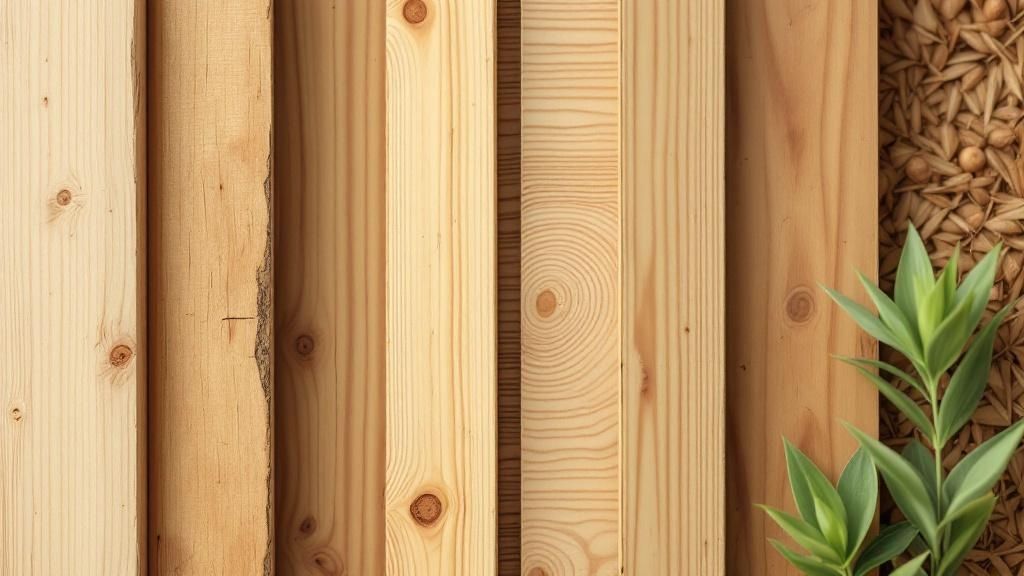
A Guide to Sustainable Construction Materials
When we talk about sustainable construction materials, we're looking at far more than just the finished product. It's not about a single item, but a holistic process. We're judging a material based on its entire life story—from where it came from and how it was made, to how long it lasts and what happens to it at the end of its useful life.
What Makes Construction Materials Sustainable
Before we dive into specific examples like recycled steel or bamboo, let's get on the same page about what "sustainable" really means in our industry. It’s not just a feel-good marketing term. It’s a tough, honest look at a material's journey from its origin to its eventual fate.
Think of it less like a straight line from factory to landfill, and more like a continuous circle. This circular thinking is key. It starts with the very first step: how the raw components are gathered. Are they responsibly harvested from a well-managed forest? Pulled from the earth with minimal disruption? Or even better, salvaged from an old building ready for a new life? This first step really sets the tone for a material's entire environmental impact.
To really get to the bottom of a material's green credentials, we need to look at its full lifecycle. Breaking it down this way helps you see past clever marketing and find the products that genuinely make a difference.
The Pillars of Sustainable Materials
This table gives you a quick rundown of the core principles that define a material as truly sustainable.
| Principle | What It Means | Real-World Example |
|---|---|---|
| Responsible Sourcing | The raw materials are obtained in a way that minimizes environmental harm and supports ecosystems. | Using reclaimed wood from an old barn instead of logging new trees. |
| Low-Impact Manufacturing | The process of turning raw material into a building product uses minimal energy, water, and creates little waste. | Cork flooring, which is harvested from tree bark without harming the tree itself. |
| Long-Term Durability | The material is built to last, reducing the need for frequent replacements and repairs over the building's lifespan. | High-quality steel that resists corrosion for decades, even in harsh climates. |
| End-of-Life Options | When the building is retired, the material can be easily reused, recycled, or returned to the earth without pollution. | Drywall (gypsum board) that can be ground down and used as a soil amendment. |
Each of these pillars is a chance to build smarter and reduce our footprint.
The demand for these materials is surging. The global market is expected to jump from $286.85 billion in 2024 to $322.81 billion in 2025. Here in the Middle East and Africa (MEA), the trend is even more pronounced, with a huge focus on resilience. In fact, by 2025, about 33% of stakeholders in the Middle East see resilience against harsh climates as a top priority for sustainable projects. You can dig deeper into these market dynamics and regional priorities from recent industry analysis.
Adopting this lifecycle mindset is fundamental. It empowers architects, builders, and developers across the UAE to choose materials that are not just good for the planet, but are also engineered to perform and last, delivering powerful benefits for both the environment and the bottom line.
Key Categories of Eco-Friendly Building Materials
Alright, now that we have a handle on the lifecycle principles, let’s get our hands dirty. It’s time to move from the abstract to the actual sustainable construction materials you’ll see on a modern job site.
To keep things from getting overwhelming, it helps to think about these materials in a few distinct categories. This makes the selection process much simpler and lets you see how different choices can work together to build something that's both durable and genuinely green. A smart strategy isn't about just one-for-one swaps; it’s about mixing and matching from these groups to gain a whole spectrum of benefits, from slashing waste to cutting down on embodied carbon.
Recycled and Reclaimed Materials
This is where the old saying, “one person’s trash is another’s treasure,” really comes to life. These materials give existing products a second chance, drastically reducing our reliance on virgin resources and keeping massive amounts of waste out of landfills. It's the ultimate expression of recycling in the construction world.
Take recycled steel, for instance. Making steel from scratch is a notoriously energy-hungry process with a heavy CO2 price tag. The beauty of steel, though, is that it can be melted down and reformed again and again without ever losing its structural integrity. Using recycled steel for beams, rebar, or framing delivers the exact same strength you need but with a fraction of the energy cost.
Other great examples in this category include:
- Recycled Plastics: Instead of clogging up oceans, old plastics can be transformed into tough, long-lasting decking, fencing, and insulation that stand up brilliantly to moisture and wear.
- Crushed Concrete: Old foundations and slabs can be broken down and reborn as aggregate for new concrete mixes or as a solid base for roads, sidestepping the need to quarry new stone.
Rapidly Renewable Resources
This group is all about nature's fast growers. These are materials that replenish themselves far quicker than traditional timber, which makes them a fantastic choice for taking pressure off our forests and supporting biodiversity. As a bonus, they pull carbon out of the atmosphere as they grow.
Bamboo is the undisputed star of this category. It's technically a giant grass, and some species can shoot up an astonishing 91 cm in a single day. Its unique blend of lightweight flexibility and serious tensile strength makes it a go-to for everything from beautiful flooring to structural supports.
Another key player here is cork. It’s harvested by peeling the bark off the cork oak tree—a process that doesn't harm the tree at all. These trees can live for over 200 years, with their bark harvested every 9-12 years. Cork’s natural properties make it a brilliant insulator and flooring material; it’s resistant to fire, moisture, and does a great job of deadening sound.
Low-Impact and Innovative Materials
Our final category covers materials that are either naturally gentle on the environment or have been cleverly engineered to minimize their footprint. This is where you see the real forward-thinking of sustainable construction.
Reclaimed wood is a perfect example. Pulled from old barns, warehouses, or dismantled buildings, this timber often comes from old-growth forests and has a character and density that new wood just can't match. Using it not only keeps it out of a landfill but also means another tree doesn't have to be cut down. You can learn more about how materials like these are changing the game in our guide to eco-friendly construction.
On the innovation side, we're seeing some truly exciting developments:
- Hempcrete: A fascinating mix of hemp hurd, lime, and water, this bio-composite is light, a fantastic insulator, and is actually carbon-negative. The hemp plant absorbs more CO2 as it grows than is produced during the manufacturing process.
- Low-VOC Concrete: Modern concrete mixes can be formulated to drastically cut the emission of volatile organic compounds (VOCs). This leads to much healthier indoor air for the building’s occupants without sacrificing structural performance.
By carefully selecting a mix of materials from these different categories, you can design a building that isn't just good for the planet but is also healthy, resilient, and built to last.
Analyzing the Cost and Performance of Green Materials
Let's tackle a common myth head-on. There's a persistent idea in our industry that choosing sustainable construction materials automatically means you're signing up for higher costs and subpar performance. Frankly, that notion is not just outdated—it’s a financially shortsighted view that could be costing you money.
When you take a closer look, green materials often meet and even exceed the performance of their conventional cousins, especially when you zoom out from the initial price tag.
The real secret is shifting your thinking from upfront cost to lifecycle costing. It's a lot like buying a new car. You could buy the cheaper model off the lot, but if it’s a gas-guzzler that’s always in the shop, it ends up costing you far more over the years than the slightly pricier, more efficient, and reliable option. That exact same logic applies to building materials.
A smart, initial investment in a superior sustainable product can pay for itself many times over through lower energy bills, reduced maintenance, and even higher property values driven by the growing demand for green buildings.
Beyond the Initial Price Tag
So, how does this actually play out on a project? While it’s true that some green alternatives once came with a premium, that's changing fast as the technology gets better and supply chains expand. More importantly, that initial purchase price is just one small piece of a much bigger financial puzzle.
You have to weigh the performance side of the coin. For instance, mass timber can provide strength comparable to steel, but with a drastically smaller carbon footprint and faster on-site assembly, which cuts down on labor costs. In the same way, insulation made from recycled denim or sheep's wool can deliver far better thermal and acoustic performance than traditional fiberglass. That translates directly into lower heating and cooling bills for the life of the building.
This chart really puts the long-term financial and environmental wins into perspective.
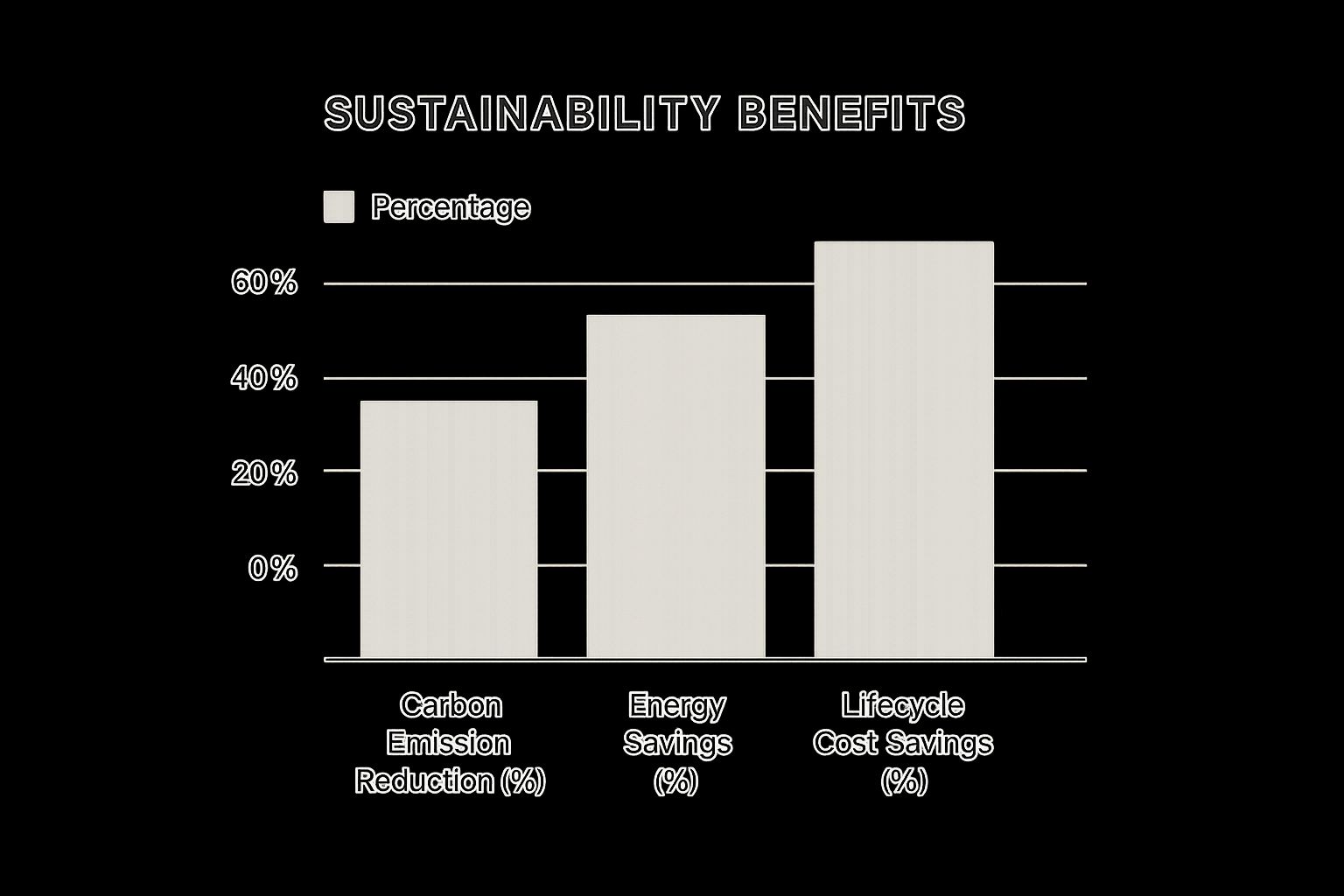
As you can see, the savings from energy efficiency and overall lifecycle costs often dwarf any initial price difference, making sustainable materials a truly intelligent investment.
Cost-Benefit Analysis of Sustainable vs. Conventional Materials
To make this even more tangible, it helps to put some common material choices side-by-side. The following table highlights the trade-offs between what you pay now versus what you save later.
| Material Type | Conventional Option | Sustainable Alternative | Upfront Cost Difference | Long-Term Financial Benefit |
|---|---|---|---|---|
| Insulation | Fiberglass Batts | Sheep's Wool or Hempcrete | Can be 15-25% higher | Significant reduction in energy bills due to superior thermal performance and moisture management. |
| Structural Frame | Traditional Steel Beams | Mass Timber or Recycled Steel | Can be comparable or slightly higher | Faster construction times reduce labor costs; recycled steel reduces resource expenditure. |
| Flooring | Vinyl (PVC) Flooring | Bamboo or Cork | Often lower or comparable | Much greater durability and longevity, reducing replacement costs; improves indoor air quality. |
| Exterior Cladding | New Wood Siding | Reclaimed Wood or Recycled Plastic | Varies widely by source | Dramatically lower maintenance costs and exceptional durability, avoiding frequent repairs and replacements. |
This comparison makes one thing crystal clear: focusing only on the initial quote can be a costly mistake.
The decision to use sustainable construction materials is not just an ethical one; it's a strategic financial move. Buildings constructed with these materials are not only cheaper to operate but are also more attractive to tenants and buyers, leading to increased asset value and a stronger market position.
At the end of the day, you simply can't argue with the performance benefits. Materials engineered for sustainability are purpose-built for durability, resilience, and efficiency. Whether it's bendable concrete that slashes the need for resource-heavy repairs or mycelium bricks offering incredible fire resistance, these innovations are built to last. It’s this built-in longevity that becomes the cornerstone of long-term savings, proving that what’s good for the planet is also very, very good for your bottom line.
How to Verify and Source Sustainable Materials
So, you’ve decided to use sustainable materials. That’s a fantastic start, but the real work begins now. Simply choosing a product with a “green” sticker on it won’t cut it. You need proof. To protect your project's integrity and long-term value, you have to verify that your sustainable construction materials genuinely meet recognized standards.
This is where green building certifications come in. Think of them as the official passport for your materials, proving their environmental credentials. They provide the impartial, third-party validation you need to ensure your building isn’t just marketed as sustainable, but actually is sustainable.
Without this step, you’re essentially just taking a manufacturer at their word. Certifications are what separate genuine sustainable performance from clever greenwashing.
Understanding Key Certification Programs
When you dive into sustainable building, you’ll quickly run into a few key acronyms. They might seem like alphabet soup at first, but each one represents a framework for creating better buildings. Knowing what they stand for is the first step toward making informed choices for your project.
Here are the big ones to know:
- LEED (Leadership in Energy and Environmental Design): This is a globally recognized seal of approval. LEED provides a complete framework for healthy, efficient, and cost-saving green buildings. It’s one of the most common certifications you'll see worldwide.
- BREEAM (Building Research Establishment Environmental Assessment Method): Originating in the UK, BREEAM has grown into an international standard. It takes a holistic look at a building's sustainability, covering environmental, social, and economic performance.
- Estidama (Arabic for 'sustainability'): Developed by Abu Dhabi's Urban Planning Council, this is a homegrown rating system. It's specifically designed for the unique climate and culture of the region, making it incredibly relevant for any project in the UAE.
These certifications are far more than just a plaque on the wall. They're powerful tools that prove a building’s superior performance. That proof often translates directly to higher rental income, increased asset value, and significantly lower operating costs over the building’s entire life.
Of course, for any project in the UAE, you have to be in tune with local rules. It's critical to understand how these global and regional certifications fit with municipal codes. You can get a much clearer sense of the landscape by navigating the regulations for building materials in the UAE.
The Importance of Local Sourcing
Beyond certifications, there’s another critical factor: proximity. The logic is simple—the shorter the distance a material travels, the smaller its carbon footprint. Sourcing materials from nearby suppliers massively cuts down on transportation-related emissions.
This isn't just an environmental win. Buying local also injects life into the regional economy, supports businesses in your community, and often means shorter delivery times, which helps keep your project on track. This push for local, eco-friendly products is reshaping the market. Just look at the flooring market in the Middle East and Africa, which was valued at US$44.78 billion in 2024 and is expected to hit US$68.06 billion by 2031, thanks to a growing demand for options like bamboo and reclaimed wood. You can dig into more data on this trend in a recent report from Cognitive Market Research.
When you’re talking to local suppliers, don't be shy. Ask for their credentials and demand proof of certification. A trustworthy partner will be completely transparent and ready to provide documentation like Environmental Product Declarations (EPDs), which lay out a product's full lifecycle impact. This ensures your project is not just certified, but truly responsible from the ground up.
Sourcing Your Materials with Yasu Trading Co
Knowing the theory behind sustainable materials is one thing. Actually getting them to your job site on time and on budget? That's a whole different ball game. The path from a blueprint to a standing, resilient structure is paved with logistical challenges, and it all hinges on a supply chain you can trust. This is where a dedicated partner makes all the difference, closing the gap between your sustainable vision and the physical materials needed to bring it to life.
At Yasu Trading Co., we’re not just another name on a purchase order. Think of us as your hands-on partner for sustainable construction across the UAE and the broader MEA region. We’re here to help you turn ambitious green building targets into reality by untangling the complexities of procurement. Our job is to make sure you get the right materials for your project’s unique demands.
Your Practical Pathway to Sustainable Procurement
Getting your hands on the right sustainable construction materials isn't about luck; it's about having a clear, smart plan. It starts with figuring out which products will perform best for your specific application and ends with a smooth, timely delivery to your site. We’ve built our process to be straightforward and supportive every step of the way.
It all begins with a conversation. We sit down with you to get a real sense of your project's performance needs, budget realities, and sustainability goals. Whether you’re looking for recycled steel with a specific load-bearing capacity or low-impact flooring that meets tough indoor air quality standards, our team helps you find the perfect match in our portfolio.
We truly believe sourcing should be a team effort. Our goal is to work like an extension of your own project team, providing the material expertise and logistical muscle needed to make your sustainable build a success—from the first sketch to the final walk-through.
This partnership approach takes the guesswork out of the equation. You get access to a handpicked selection of certified materials and the know-how to use them effectively, ensuring your project hits both its performance and compliance targets.
From Recycled Steel to Advanced Insulation
It’s in real-world projects where a reliable sourcing partner proves their worth. We’ve been privileged to help countless clients across the region bring their sustainable visions to life, with each solution tailored to solve a specific construction puzzle.
Take a recent commercial project that needed a strong structural frame but with the lowest possible carbon footprint. We stepped in to source high-grade recycled steel, making sure every piece met the engineering specs and certification demands. The result? The developer hit their structural targets while drastically cutting the project's embodied carbon compared to using new steel.
Here are a few other ways we help clients make it happen:
- Low-Impact Flooring: A hospitality client was laser-focused on guest wellness. We sourced and delivered a variety of durable, low-VOC flooring options. This move not only created a healthier indoor space but also ensured the floors could handle heavy foot traffic, slashing long-term replacement costs.
- Advanced Insulation Systems: We collaborated with a residential developer to find high-performance insulation made from recycled materials. This was a direct answer to the need for top-tier energy efficiency in our region's tough climate, translating into major energy savings for homeowners down the line.
- Efficient Water Management: For numerous projects, we’ve supplied modern plumbing fixtures designed for serious water conservation. This helps buildings meet Estidama and other local green building codes, turning a simple requirement into a practical, resource-saving feature.
Each of these examples drives home a key point: choosing the right sustainable construction materials is a make-or-break decision that ripples through your project's cost, performance, and environmental legacy.
When you work with Yasu Trading Co., you’re not just buying products. You’re gaining a dedicated guide for your entire sustainable building journey. We handle the heavy lifting—from chasing down certifications to managing the supply chain—so you can focus on what you do best: building a better, more sustainable future.
Building a Greener Tomorrow, Today
As we've journeyed through the world of sustainable construction, one powerful truth becomes clear: building a better future isn't some far-off dream. It's a tangible goal we can reach right now. This isn't a niche idea for experimental side projects anymore. It’s a smart, practical, and financially sound strategy for the here and now.
The real shift happens when we change how we think. It’s about looking beyond the initial price tag and embracing the entire lifecycle of a building. When you factor in long-term durability, energy savings, and lower maintenance needs, the true financial picture comes into focus. It’s time to move past the old myths and see materials like mass timber, recycled steel, and low-VOC concrete for what they are: top-tier performers.
The Real-World Impact of Smarter Choices
Every single decision to use sustainable construction materials creates a ripple effect that extends far beyond the construction site. Choosing these materials directly impacts the health and well-being of the people who will one day live and work inside these buildings. You’re literally building better indoor air quality and more comfortable spaces.
These choices also represent a direct contribution to meeting our regional environmental goals. By prioritizing materials with low embodied carbon and sourcing locally, we shrink our collective footprint, bolster local economies, and create more resilient communities prepared for whatever the future holds.
Choosing to build sustainably is more than just a trend; it's a statement. It shows a deep commitment to quality, responsibility, and forward-thinking design that ultimately boosts a project's market value and cements its legacy as a positive landmark for generations.
Your Next Step
The knowledge and the tools are all within reach. The materials are ready, the certifications are clear, and the benefits are impossible to ignore. The only thing left is to act. For architects, developers, and builders, the challenge is simple: take these principles and weave them into your very next project.
Start by asking your suppliers the right questions. Insist on transparency, look for certified products, and don’t be afraid to explore the innovative options that are reshaping our industry. For a head start, check out the top trends in building materials for sustainable construction in Dubai and see what the leaders in our region are already doing.
The way forward is clear. By consciously selecting materials that are healthier for people and kinder to our planet, you aren't just putting up a building. You're actively constructing a more resilient, responsible, and prosperous future—one project at a time. The power to build that future is in your hands.
Frequently Asked Questions
Diving into sustainable building for the first time? It's natural to have questions. We've heard plenty from architects, builders, and developers across the UAE, so we’ve put together some straight answers to the most common ones we get.
Are Sustainable Materials Always More Expensive?
This is probably the biggest myth we have to bust. While some materials might have a higher price tag at the checkout, that's a very shortsighted way to look at it. The real metric to watch is the lifecycle cost.
Think of it this way: high-performance insulation made from something like sheep's wool or hempcrete might cost more upfront than your standard fiberglass. But its ability to keep a building cool in the desert heat means you're looking at massive, year-after-year savings on energy bills. Add in the reduced need for maintenance and replacement on durable, rot-resistant materials, and the "more expensive" option often ends up being the smarter financial choice over the building's entire life.
How Can I Confirm a Material Is Genuinely Sustainable?
You have to be careful out there—"greenwashing" is a real problem. The best way to cut through the marketing noise is to look for solid, third-party certifications.
- Global Standards: Look for names like LEED (Leadership in Energy and Environmental Design) or BREEAM. These are the gold standard, recognized worldwide for their rigorous environmental frameworks.
- Regional Programmes: Here in the UAE, Estidama is essential. It’s a certification system designed specifically for our climate and local building conditions.
Your best friend in this process is the Environmental Product Declaration (EPD). Think of it as a nutrition label for your building material. It’s a transparent, data-packed document that details a product’s environmental footprint from cradle to grave. Always ask your supplier for it.
Are Sustainable Options Suitable for Large Commercial Projects?
Absolutely. The old idea that green materials are just for boutique homes or small-scale builds is completely outdated. Today's sustainable materials are engineered for serious performance and structural integrity, ready for the most ambitious commercial developments.
We're seeing mass timber and high-strength recycled steel used to build everything from towering office blocks to massive industrial facilities and public stadiums. In fact, many of the world's most impressive and iconic green buildings are large-scale commercial structures, proving that sustainability and scale go hand-in-hand.
Does Using Sustainable Materials Limit My Design Choices?
It’s actually the other way around. The modern world of sustainable materials opens up a whole new toolbox for designers, offering incredible aesthetic range and unlocking creative freedom.
You're not stuck with one "earthy" look. Want a sleek, industrial vibe? There's recycled metal and glass. Aiming for a warm, biophilic feel? You have reclaimed wood, beautiful bamboo, and textured cork at your fingertips. These materials often bring a unique character and story that you just can't get from their conventional counterparts.
Ready to bring these solutions to your next project? The team at Yasu Trading Co. LLC is here to connect you with the certified, high-performance materials you need to build smarter and more sustainably. Explore our offerings and get in touch for a consultation today.