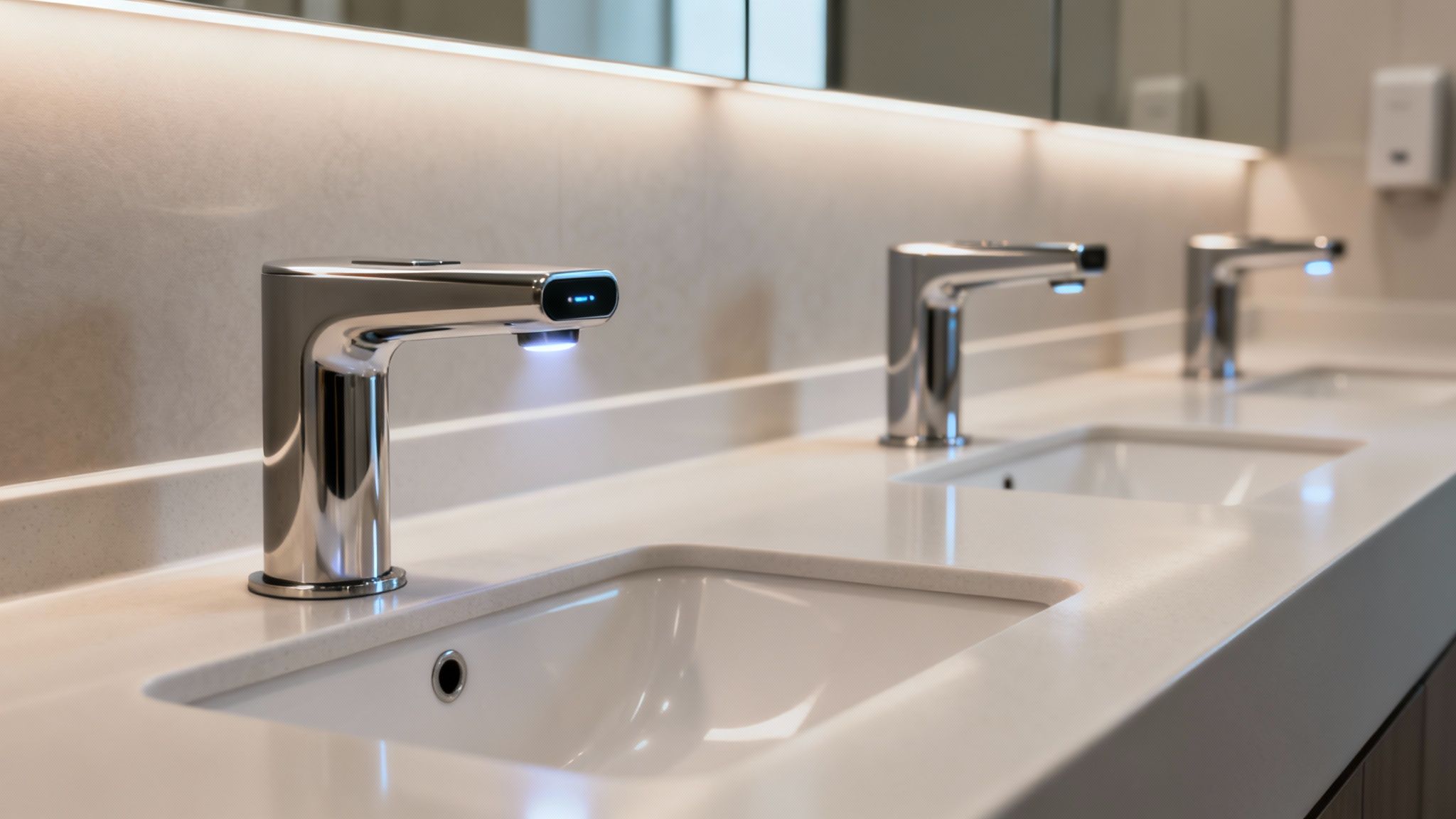
Touchless & Voice‑Controlled Faucets: Hygiene & Efficiency
In today's commercial spaces, touchless and voice-controlled faucets are quickly becoming the new norm, and for good reason. They directly boost both hygiene and efficiency. By getting rid of a major touchpoint, these smart fixtures slash germ transmission and seriously cut down on water waste, making them a smart upgrade for any facility.
The Hands-Free Revolution in Commercial Restrooms
There’s a quiet but significant shift happening in commercial restrooms. What was once seen as a high-end luxury, the hands-free faucet, is now a must-have for busy places like offices, hotels, and public venues. This isn't just a trend; it's a response to a much greater focus on public health and the real need for sustainable business practices.
Think of smart fixtures as more than just a sleek design choice. They're a strategic investment in safety, smarter resource management, and a better experience for every visitor. By ditching traditional handles, businesses are creating cleaner, more efficient, and far more welcoming environments.
Key Drivers of Adoption
The move toward touchless technology didn't happen by chance. It's a direct answer to some very clear and pressing demands from the commercial world, especially in regions where health and sustainability are top priorities.
- Heightened Hygiene Awareness: After recent global health events, everyone is more aware of shared surfaces. Faucet handles are notorious breeding grounds for germs, and getting rid of them breaks a critical link in the chain of cross-contamination.
- Operational Efficiency and Savings: Water isn’t cheap, and utility costs add up. Smart faucets put an end to taps left running, which translates into real, measurable savings on water consumption and lower monthly bills.
- Modern Brand Perception: The small details in a facility say a lot about a brand. Installing modern, hygienic technology shows a real commitment to the well-being of guests and to environmental responsibility. It's a simple way to build trust and improve public perception.
This trend is particularly strong in the UAE and the wider GCC region. Here, the commercial sector—from hotels and offices to shopping malls—needs fixtures that can handle high-frequency use while championing hygiene and water conservation. These demands have made touchless tech a fundamental part of modern building design. You can learn more about the growth of the GCC faucet market to see just how quickly this is taking off.
How Smart Faucet Technology Actually Works
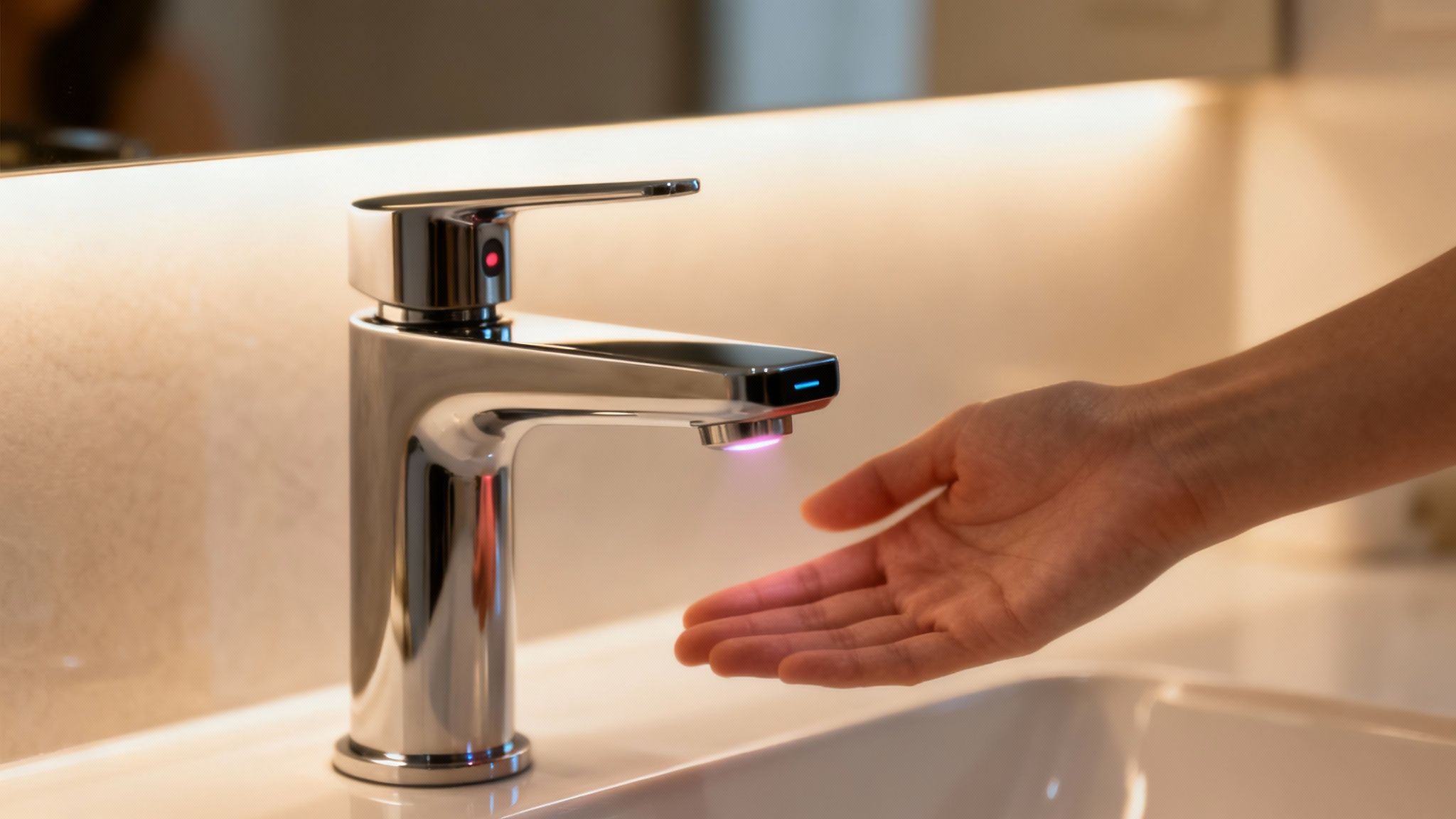
The way a touchless or voice-controlled faucet springs to life can feel a bit like magic, but it's all based on some pretty straightforward and reliable tech. When you understand what’s going on behind the scenes, you can really appreciate just how practical these systems are for busy commercial spaces.
At the heart of it all is a sensor—the faucet's eyes and ears. This isn't overly complex gadgetry; it's a simple, responsive system designed to deliver water exactly when needed, without anyone having to touch a thing. Let's pull back the curtain on how each type works.
The Invisible Tripwire of Infrared Sensors
Most of the touchless faucets you see use an active infrared (IR) sensor. The easiest way to picture it is as an invisible tripwire. The faucet is constantly sending out a beam of infrared light that you can't see.
When you bring your hands under the spout, they bounce that beam right back to a detector in the faucet. This instantly triggers a solenoid valve—think of it as a tiny, electronic gatekeeper for the water. The valve opens, and you get water. Pull your hands away, the beam is no longer broken, and the valve shuts off immediately. Simple as that.
This on-demand functionality is the secret sauce behind their efficiency. It's why touchless faucets can slash water consumption by 30% to 50% in commercial restrooms. Water only runs when hands are present, completely eliminating waste from a tap left running by mistake.
The Power of Voice Recognition
Voice-controlled faucets take things a step further. Instead of a sensor, they rely on a small, built-in microphone and a smart processor that's trained to listen for specific commands, even in a noisy environment.
Here’s a breakdown of how it operates in a real-world setting:
- Command Recognition: The system is programmed to recognize simple, direct phrases like "turn water on."
- Noise Filtering: This is the clever part. Smart algorithms help the processor ignore background noise—like conversations, flushing toilets, or loud hand dryers—to prevent it from turning on accidentally.
- Precise Control: Some models offer even more control, responding to commands for specific temperatures or amounts of water, which adds another layer of customization and efficiency.
These systems are part of a bigger picture in smart building technology. To see where this is all headed, it’s worth exploring the latest trends in smart plumbing and connected faucets that are changing the game for facility management. By blending simple hardware with smart programming, both touchless and voice-activated faucets offer a dependable, modern experience that’s quickly becoming a staple in commercial design.
Eliminating Touchpoints to Maximize Hygiene
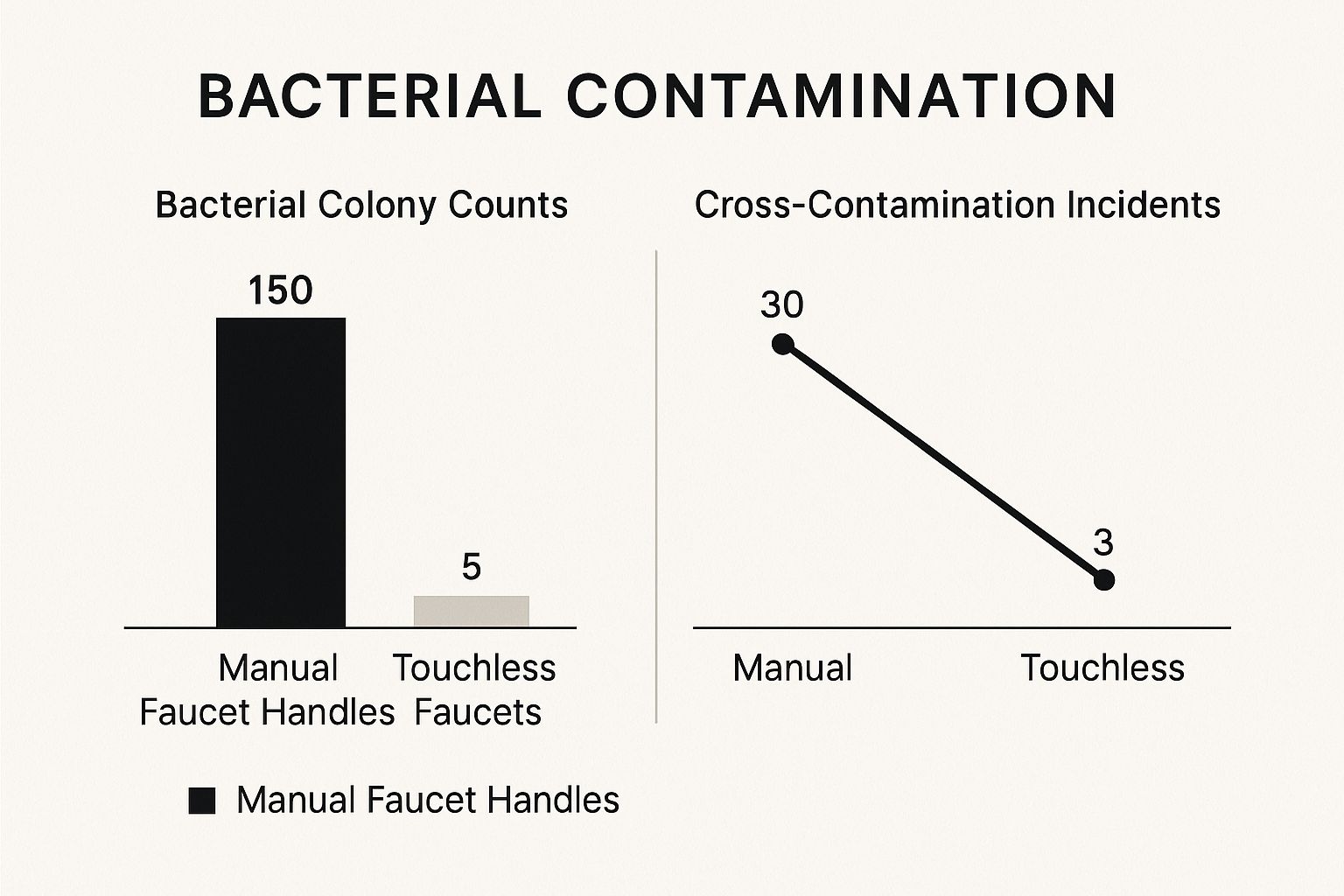
This chart really drives the point home—you can see a dramatic drop in bacterial load and cross-contamination events when a facility swaps out manual faucets for touchless ones. The data shows that when you take away the handle, you directly create a cleaner, safer restroom for everyone.
Think about it: traditional faucet handles are one of the biggest culprits for germ transfer in any busy commercial restroom. A person touches the handle to turn the water on, washes their hands, and then touches that same handle again to turn it off. In that final touch, they can easily pick up whatever germs the last person left behind, completely undoing the handwashing.
This constant back-and-forth is known as cross-contamination, and it’s why shared surfaces are such a major focus in public health. By getting rid of the need to touch anything, touchless and voice-controlled faucets completely break this cycle. The result is a restroom that doesn’t just feel cleaner but is measurably safer for employees, customers, and visitors.
Building Trust Through a Healthier Environment
Putting hygiene first does more than just stop the spread of germs; it sends a powerful message to everyone who walks through your doors. It shows you genuinely care about their well-being, which is a huge factor in building trust and a positive brand reputation. A clean, modern facility is a direct reflection of a business that is thoughtful and well-managed.
It’s no surprise, then, that the automatic faucet segment is steadily replacing manual models in commercial buildings. This shift is a key driver in the market's projected growth. Adopting touchless technology slashes the risk of cross-contamination, a critical concern in any public space. You can read more about how this trend is shaping the faucet market.
By investing in hands-free solutions, you are making a tangible investment in public health. This proactive approach not only elevates the user experience but also positions your brand as a responsible leader in a health-conscious world.
Of course, advanced fixtures are just one piece of the puzzle. It’s also worth looking into broader strategies for workplace hygiene, including resources on mitigating the business impact of sick days through cleanliness. At the end of the day, focusing on hygiene is simply smart business, paying off in both better health outcomes and stronger customer confidence.
Unlocking Big Savings on Water and Costs
While better hygiene is what first comes to mind, the financial case for switching to touchless and voice-controlled faucets is just as compelling. These aren't just modern gadgets; they are serious efficiency tools that can deliver a surprisingly fast return on investment by cutting down on water use. For facility managers and business owners, it's a smart move for both the budget and sustainability goals.
The biggest way touchless faucets save money is by making it impossible to leave the water running. We’ve all seen it in a busy public restroom—someone rushes out and leaves the tap on, or just doesn't turn it off all the way. A standard faucet can waste gallons of water every minute this happens.
Smart faucets stop this problem cold. Their built-in infrared sensors only turn the water on when hands are directly under the spout, and shut it off the second they move away. This simple on-demand system means not a single drop is wasted, which adds up to massive savings over thousands of uses a day.
Putting Numbers on the Savings
To see what this looks like in the real world, it helps to compare a typical manual faucet with a touchless one in a regular commercial office. The difference is night and day, and it impacts not just the water bill but also the energy needed to heat all that wasted water.
Here’s a quick look at how a medium-sized office could see a significant drop in water consumption just by making the switch.
Manual vs Touchless Faucets Water Usage Comparison
| Feature | Manual Faucet (Average) | Touchless Faucet (Average) |
|---|---|---|
| Water Flow | Stays on until someone physically turns it off. Often left running by accident. | Activates only when hands are under the sensor and stops instantly. |
| Typical Usage Per Person | Averages 2.2 gallons per minute of continuous flow. | Averages 0.5-1.0 gallons per minute, and only runs when needed. |
| Potential Daily Waste | High. A single running tap can waste hundreds of gallons a day. | Almost zero waste from faucets being left on. |
| Estimated Water Savings | Baseline | Up to 70% or more compared to older manual models. |
The numbers don't lie. For any building with more than a few sinks, upgrading to touchless technology can mean saving thousands of gallons of water every month, which translates directly into lower utility bills.
Getting Precise with Voice Control
Voice-controlled faucets add another layer of efficiency by letting you ask for exactly the amount of water you need. This is a game-changer in places like commercial kitchens or medical labs. A chef or lab technician can simply say, "dispense 16 ounces," and get a precise measurement without any guesswork or overflow.
This level of accuracy cuts down on waste in any task that requires specific volumes, making daily operations smoother and more cost-effective.
When you add it all up, the impact is huge. By upgrading to touchless and voice-controlled faucets, a business doesn't just improve its hygiene—it makes a real, measurable dent in its operational costs and water footprint. It's a clear win for both the bottom line and modern sustainability practices.
Choosing the Right Features for Your Commercial Space
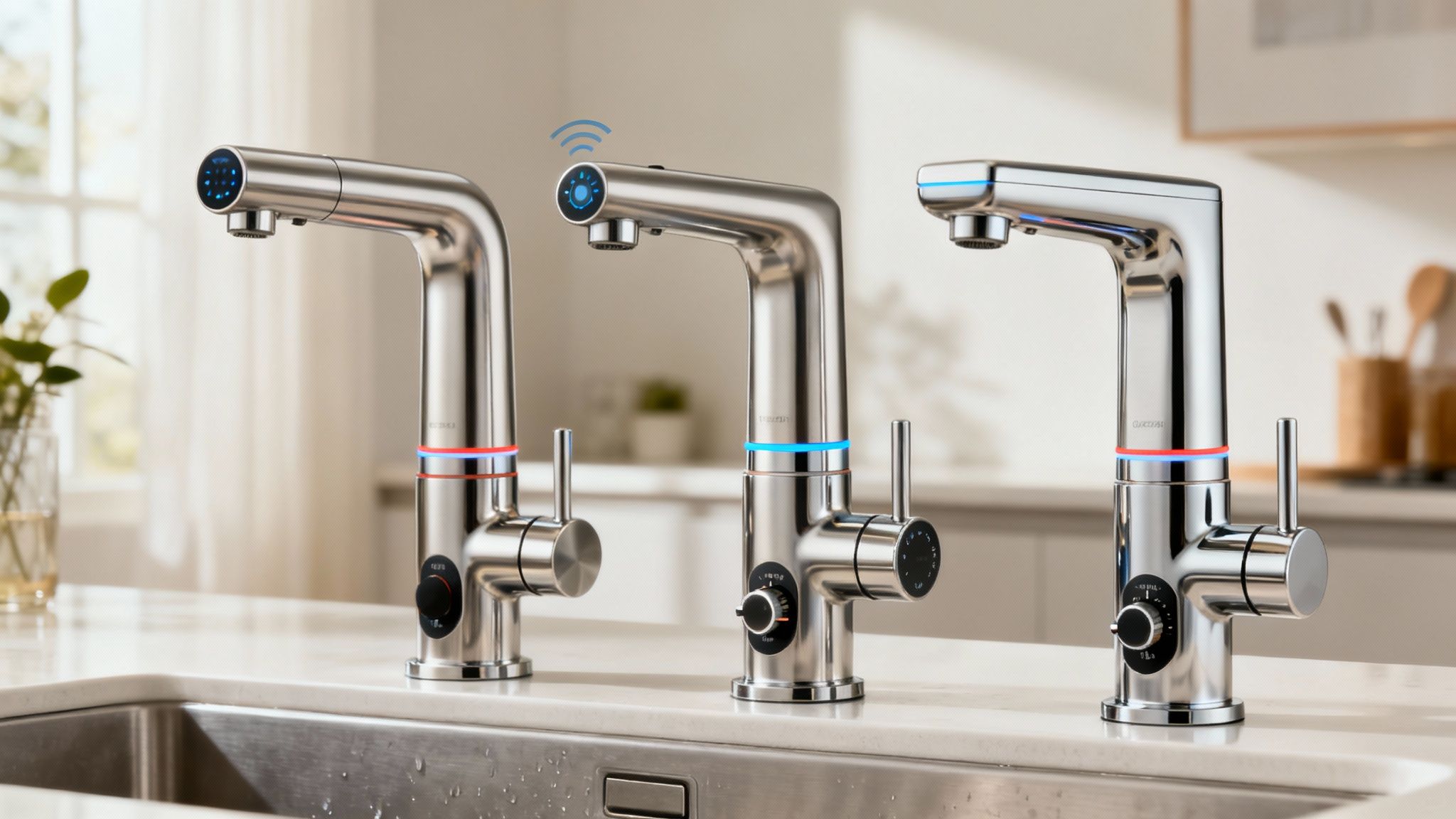
Picking the right touchless or voice-controlled faucet isn’t just about aesthetics. It’s about finding a workhorse that can stand up to the daily grind of a busy commercial setting.
A smart faucet designed for a home kitchen just won't cut it in a high-traffic office or hotel restroom. The key is to choose wisely from the start to make sure your investment pays off in hygiene, efficiency, and pure, simple reliability.
First things first: think durability. Commercial fixtures have to endure constant use—and sometimes, misuse. That’s why you should always look for models built from heavy-duty materials like solid brass or stainless steel. They hold up against corrosion and damage far better than plastic. In public spaces, vandal-resistant designs are also a must to keep the faucet working as it should.
Essential Operational Features
Once you’ve got durability covered, it’s time to look at the features that make or break the user experience and your maintenance schedule. Getting these right is critical.
- Adjustable Sensor Range: We've all seen it—the faucet that turns on when someone just walks by. That’s a sensor set too sensitively. On the flip side, one that isn't sensitive enough leaves users waving their hands in frustration. The solution? Find a model with an adjustable range you can dial in perfectly for your sink.
- Power Source Options: You’ll generally find two choices: battery-powered or hardwired (AC). Batteries make for an easier installation, especially in older buildings, but they need changing. Hardwired faucets are more of a "set it and forget it" option, providing steady power without the extra upkeep. They’re perfect for new construction or major remodels.
- Default Time-Out Setting: What happens if a piece of paper falls into the sink and blocks the sensor? Without a fail-safe, you’d have a flood on your hands. Commercial faucets need an automatic shut-off feature, typically set for 30 to 60 seconds, to stop the water flow and prevent a massive waste of water.
Advanced Capabilities for Facility Management
Today's smart faucets can do a lot more than just turn on and off. Some of the more advanced features give facility managers incredible control over resources and can even simplify maintenance. If you want a deep dive into what's available, it's a great idea to talk with experienced faucet suppliers in Dubai who really know the local market demands.
Think about features like preset temperature controls. You can lock in a safe, consistent temperature to prevent scalding and cut down on energy costs. Some of the top-tier models even send out maintenance alerts for low batteries or other issues, letting your team fix problems before they start.
The demand for these smarter controls is definitely on the rise. It’s driven by a greater focus on hygiene, the need for better water efficiency, and the seamless integration of IoT features like voice commands. In the UAE, these technologies are helping commercial properties, especially in hospitality and corporate settings, meet incredibly high standards. By picking the right features, you’re not just installing a faucet; you’re adding an intelligent, long-lasting asset to your facility.
Getting Installation and Maintenance Right
To really get the most out of your touchless and voice-activated faucets, a solid installation and a simple care routine are absolutely key. You've invested in some impressive technology, but the good news is that keeping it in top shape is surprisingly easy. It all starts with a smooth setup.
A few quick checks during installation can save you a world of trouble down the road. If you're hardwiring the faucets, make sure the power source is stable and reliable to prevent them from cutting out. Sensor placement is another big one. You want to position it away from shiny surfaces like mirrors or polished chrome that can bounce the infrared beam back and trigger the water when nobody's there.
A Simple Care Routine
Keeping these faucets running perfectly isn't complicated. A little proactive attention goes a long way, ensuring they last for years while upholding the hygiene and efficiency of your space.
- Keep the Sensors Clean: A quick wipe with a soft, damp cloth is all it takes. Just be gentle and avoid abrasive cleaners that could scratch the sensor lens.
- Check for Leaks: Every so often, take a peek under the sink. Look for any drips around the faucet base or the water lines. A tiny leak caught early can prevent a lot of damage and wasted water.
- Know How to Reset: If a faucet ever acts up, the fix is often as simple as a reset. For most models, this just means unplugging the power for a moment and then plugging it back in to clear any minor electronic hiccups.
The secret to maintaining this technology isn't about being a tech wizard. It’s about consistent, simple checks. A regular schedule for these quick tasks will keep your faucets working like new, protecting both your hygiene standards and your bottom line.
Remember, the faucet is just one part of a larger system. For everything to work together seamlessly, you'll also want to pay attention to your building's plumbing, including things like efficient hot water system maintenance. Taking a comprehensive view is always best. To really formalize your process, creating a preventive maintenance plan can help your team stay on top of everything and keep your facilities running smoothly.
Answering Your Key Questions
When you're thinking about upgrading to a touchless or voice-controlled faucet, a few practical questions always come up. As a facility manager or business owner, you need to know you're making a sound investment that can handle the rigors of a busy commercial space. Let's tackle some of the most common concerns.
First up, reliability. This is a big one, especially for voice-activated models. Can they really work properly with all the background noise in a public restroom?
Are Voice-Controlled Faucets Reliable in Noisy Commercial Restrooms?
Yes, the good ones are. High-quality commercial-grade models are built specifically for these challenging environments. Think of it like the noise-cancellation technology in high-end headphones; they use sophisticated microphones and software to filter out ambient sounds like flushing toilets, chattering visitors, and roaring hand dryers.
The faucet's processor is also programmed to listen for very specific command phrases. This precision means it won't just turn on randomly, ensuring it only activates when it's supposed to.
Another key question revolves around how long these fixtures will actually last.
A well-maintained commercial touchless faucet is built like a tank. Constructed from robust materials like solid brass or stainless steel, its typical lifespan can easily extend from 10 to 15 years, even with constant daily use.
What Is the Typical Lifespan of a Commercial Touchless Faucet?
The faucet body itself is incredibly durable. Beyond the metal, the electronic components—like the infrared sensor and the solenoid valve that controls water flow—are also engineered for high-traffic use.
For battery-powered units, the main upkeep is just swapping out the batteries every one to three years, which depends entirely on how busy your restrooms are.
Finally, what about the installation process? Is it a major headache?
Can Touchless Faucets Be Retrofitted into Existing Sink Setups?
Absolutely. Most touchless faucets are designed with retrofitting in mind. They come with standard plumbing connections and are sized to fit the existing holes in your sinks or countertops. This means you can usually swap out your old manual faucets without needing to call in a plumber for major modifications.
The only real consideration is how you'll power it. You just need to decide whether a simple battery-operated model is best or if you have an electrical outlet nearby for a hardwired version.
For premium, durable fixtures that enhance both hygiene and efficiency in your commercial space, trust the experts at Yasu Trading Co. LLC. Explore our extensive selection of building and plumbing hardware designed for the demands of the UAE market at https://yasutrading.com.