A Guide to Water Proofing Material
At its core, a waterproofing material is any substance used to stop water from getting where it shouldn’t. Whether applied as a coating, laid down as a membrane, or mixed directly into concrete, its job is to create an impermeable barrier. Think of it as essential armor for your building, defending it against the relentless assault of moisture.
This barrier is what keeps a structure dry, protecting it from the kind of damage that can compromise its stability and safety over the long haul.
Why Effective Waterproofing Is Non-Negotiable
Picture your building as a boat. Even a tiny, seemingly insignificant leak can, over time, lead to disaster. Water is a persistent force, and it can silently eat away at a structure's integrity, turning a solid investment into a money pit. That’s why choosing the right water proofing material isn't just a technical detail—it’s a fundamental decision for the health and longevity of any construction project.
Waterproofing is the unseen shield working 24/7. It protects everything from the deepest foundations buried underground to the sprawling roofs battered by the elements. Without it, a building is wide open to a whole host of problems.
Protecting Structural Integrity
First and foremost, a water proofing material is there to maintain the building’s structural soundness. When water seeps into concrete and reaches the steel rebar inside, rust begins to form. That rust causes the rebar to expand, creating immense internal pressure that leads to cracks, spalling, and a seriously weakened structure.
A strong foundation is everything, and a waterproof one is even better. This crucial barrier prevents:
- Foundation Weakening: Persistent moisture can soften the surrounding soil and degrade the concrete itself.
- Material Corrosion: It’s not just rebar. Water will also corrode metal pipes, structural anchors, and other essential components.
- Mold and Mildew Growth: Damp spaces are perfect breeding grounds for mold, which doesn't just damage materials but also poses serious health risks to anyone inside.
Averting Costly Long-Term Repairs
It’s a huge mistake to see waterproofing as just another expense. In reality, it’s one of the most important investments you can make in prevention. The cost of fixing water damage is always, always higher than the initial cost of a proper waterproofing system. To get a sense of the financial hit, just look at typical UK damp proofing costs—it’s clear how quickly those remediation bills can pile up.
Water damage isn’t a one-and-done event. It's a progressive problem that gets worse over time, creating a domino effect of issues that are far more expensive and disruptive to fix than simply preventing them from the start.
The demand for these materials is skyrocketing, especially in regions with heavy construction. The waterproofing chemicals market in the Middle East and Africa, for example, is on track to blow past USD 2 billion by 2028, fueled by massive urban development projects. This just goes to show how critical it is to protect new infrastructure from water damage. Ultimately, a well-thought-out waterproofing strategy is one of the smartest financial moves you can make on any construction timeline.
Understanding the Core Types of Waterproofing
Picking the right waterproofing material is a lot like choosing the right armor for a fortress. You wouldn't use the same light protection for a massive stone gate that you'd give a swift archer, right? It's the same with buildings. Different areas demand completely different waterproofing solutions, each with its own set of strengths and a specific job to do.
To make a smart decision, you have to get familiar with the main categories. While the market is flooded with specialized products, nearly all of them fall into just a few core groups. Thinking of them in these distinct families makes the selection process much simpler and ensures you're matching the right material to the mission at hand.
This diagram breaks down the primary families of waterproofing materials, showing how they branch out into membranes, coatings, and sealants.
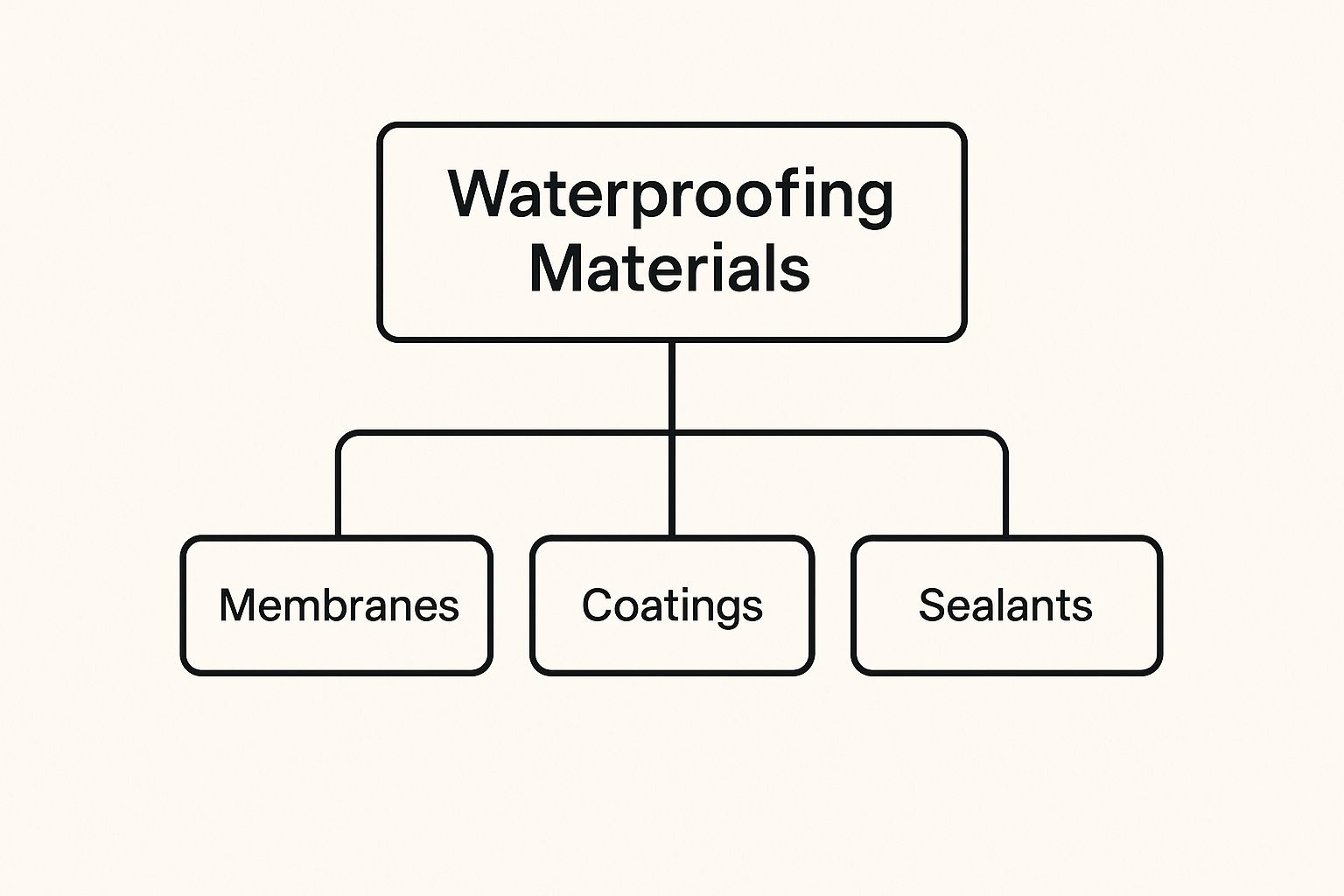
This helps visualize how all these different products are organized. Each branch represents a fundamentally different way of creating a watertight barrier.
Quick Comparison of Waterproofing Material Types
To get a quick lay of the land, this table offers a high-level overview of the main waterproofing categories. Think of it as a cheat sheet to guide your initial thinking, highlighting their form, typical uses, and what makes each one stand out.
| Material Type | Common Form | Primary Application Areas | Key Advantage |
|---|---|---|---|
| Liquid-Applied Membrane | Paint-like Liquid | Complex roofs, balconies, detailed areas | Seamless, flexible, and perfect for odd shapes |
| Sheet-Based Membrane | Pre-formed Rolls | Foundations, large flat roofs, tunnels | Tough, puncture-resistant, uniform thickness |
| Cementitious | Cement-based Powder | Basements, water tanks, wet areas | Extremely durable and resists high pressure |
| Integral System | Liquid/Powder Admix | New concrete structures (foundations, slabs) | Makes the concrete itself inherently waterproof |
While this is a starting point, the real magic is in understanding the nuances of each type. Let's dive a bit deeper.
Liquid-Applied Membranes
Picture painting a seamless, rubber-like shield directly onto a surface. That’s the easiest way to think about liquid-applied membranes (LAMs). You apply them as a liquid, and they cure to form a single, continuous, elastic layer that’s fully bonded to the substrate. No seams, no joints—which are almost always the weakest points in any other system.
This "paint-on" approach makes them perfect for complex shapes and tricky areas with lots of protrusions like pipes, vents, or drains. Got a complicated roofline or a balcony with decorative railings? A liquid membrane can coat every single nook and cranny without a single gap.
The market certainly reflects this flexibility. The waterproofing membranes market in the Middle East and Africa hit a staggering USD 1.65 billion in 2022, and the liquid-applied segment was the undisputed leader, claiming a 67.58% revenue share. Its popularity comes down to its incredible adaptability and how easy it is to apply, especially on roofs that have to endure our harsh climate.
Sheet-Based Membranes
Now, moving away from liquids, we have sheet-based membranes. These are like rolling out a heavy-duty, factory-made carpet of protection. Materials like Bitumen or PVC are manufactured to a precise thickness and quality, so you know exactly what you’re getting with every roll.
These are the workhorses for big, flat, uninterrupted surfaces—think commercial flat roofs, massive foundations, and tunnels. Their biggest selling point is sheer toughness and puncture resistance. A properly installed sheet membrane is a formidable physical barrier that can take a serious beating.
The catch? Installation is key. It takes a skilled crew to properly weld or seal the seams between each sheet, because that’s precisely where leaks can start if you're not careful.
The core trade-off is simple: liquid membranes give you seamless flexibility for complex jobs, while sheet membranes offer rugged, uniform protection for vast, simple surfaces. The right choice is all about the geometry and demands of your specific structure.
Cementitious Waterproofing
Think of cementitious waterproofing as a super-powered, waterproof plaster. It’s a special blend of cement, sand, and proprietary additives that you mix with water and apply just like a render. The result is a hard, rigid, and completely impenetrable barrier.
This makes it an outstanding solution for structures that are constantly damp or even fully submerged. It’s the go-to choice for:
- Basements and foundations holding back groundwater
- Water tanks and reservoirs
- Tunnels and subway systems
Because it chemically bonds with and becomes an integral part of the concrete, cementitious waterproofing is incredibly durable and fantastic at resisting hydrostatic pressure. It isn’t flexible like a membrane, but for certain applications, its raw toughness is exactly what you need. Of course, this kind of robust protection is just one piece of the puzzle; a strong build relies on a whole suite of essential building materials, and knowing how they interact is crucial for any project in Dubai.
Integral Waterproofing Systems
Finally, what if you could make the concrete itself waterproof from the inside out? That's the whole idea behind integral waterproofing. Instead of adding a layer on top of the concrete, you add special chemical admixtures into the concrete mix before it’s even poured.
These admixtures work in one of two ways: they either physically clog the microscopic pores and capillaries within the concrete, or they trigger a chemical reaction that grows water-repelling crystals. The end result is that the entire mass of concrete becomes inherently resistant to water getting in. It’s the ultimate proactive approach—building the defense right into the structure itself.
A Closer Look at Waterproofing Membranes
When you need a frontline defense against water, waterproofing membranes are the undisputed champions. Think of them as the high-tech, impenetrable skin of your building, engineered to create a continuous, unbroken shield against moisture. This category of water proofing material is absolutely essential for protecting large, exposed areas like roofs, foundations, and podium decks from the constant threat of water infiltration.
These membranes fall into two main families, and each takes a different strategic approach to forming that watertight seal. The choice isn't just a matter of preference; it’s a critical decision driven by the project’s shape, exposure, and long-term performance goals. Getting this right is the key to a system that lasts for decades.
Sheet-Based Membranes: The Robust Pre-Formed Shield
Sheet-based membranes are the heavy-duty soldiers of the waterproofing world. They show up on site as factory-made rolls, manufactured to a precise, consistent thickness. This level of factory control is a massive advantage—it guarantees a uniform layer of protection across the entire job.
These membranes are valued for their exceptional toughness and resistance to punctures, making them the go-to choice for large, uniform surfaces that have to endure significant physical stress.
You’ll typically see them used in places like:
- Commercial Flat Roofs: Their durability easily handles foot traffic and harsh weather.
- Below-Grade Foundations: They form a powerful barrier against hydrostatic pressure from groundwater.
- Tunnels and Plaza Decks: They can withstand the heavy loads and constant exposure in these demanding environments.
The most common types you'll encounter are Bitumen and PVC. Bituminous sheets, often reinforced with polymers like APP or SBS, are known for being incredibly robust and cost-effective. PVC membranes, on the other hand, offer fantastic chemical resistance and flexibility, with seams that are heat-welded to create one single, monolithic barrier. No matter the type, the installation is everything—the seams between sheets must be perfectly sealed to eliminate any potential weak points.
Liquid-Applied Membranes: The Seamless Custom Fit
Where sheet goods are pre-formed and rigid, liquid-applied membranes (LAMs) are the chameleons of waterproofing. Applied as a cold liquid with a simple roller, spray, or squeegee, they cure into a seamless, elastic, and fully bonded waterproof layer that molds itself perfectly to any shape.
Picture trying to gift-wrap a complex balcony with multiple columns and drains using a stiff sheet of paper. You'd be left with a mess of awkward folds and gaps. A liquid membrane, however, acts like paint. It flows into every nook, cranny, and corner, creating a single, continuous film with no joints or seams—which are almost always the first place other systems fail.
The greatest strength of a liquid-applied system is its ability to create a truly monolithic and seamless barrier. This eliminates the risks associated with faulty seam work, providing a fully adhered shield that moves with the structure.
This adaptability makes them the perfect water proofing material for geometrically complex areas where a sheet membrane just wouldn't work. We're talking about detailed balconies, planters, and rooftops cluttered with pipes, vents, and HVAC units. The most popular chemistries are polyurethane and acrylics, each offering a different mix of flexibility, UV stability, and overall durability.
The market here in the Middle East shows a clear demand for both approaches. Valued at around USD 1.2 billion in 2024, the regional waterproofing membrane market is growing steadily. Traditional bitumen still dominates the sheet category thanks to its proven track record in our extreme climate. At the same time, polyurethane-based liquid membranes are the fastest-growing segment, prized for their seamless application and energy-efficient, reflective properties.
Making the Right Choice: A Practical Comparison
The decision between a sheet or a liquid membrane often boils down to a simple trade-off: uniform toughness versus seamless flexibility. Let’s look at how they stack up in the real world.
Scenario A: The Large Commercial Warehouse Roof
A contractor building a massive, flat-roofed warehouse would almost certainly choose a PVC or Bitumen sheet membrane. The roof is a huge, simple plane, perfect for rolling out long sheets quickly. The top priorities here are extreme durability, puncture resistance from maintenance crews, and a guaranteed thickness—all hallmarks of a high-quality sheet system.
Scenario B: The Residential Balcony with Intricate Details
For a residential balcony with several drainage points, railing posts, and tricky corners, a liquid-applied polyurethane membrane is the obvious winner. A liquid can be easily worked around every one of these obstacles, guaranteeing a perfectly sealed, seamless finish with no weak spots. The cured membrane’s flexibility also helps it accommodate the minor structural movements common in residential buildings. This same logic applies to interior wet areas; a seamless barrier is crucial before installing finishes. For instance, it's a key step in preparing a substrate before installing materials like waterproof gypsum board in a bathroom or kitchen.
Exploring Coatings, Sealants, and Additives
While membranes are the broad, continuous shields of a waterproofing system, a whole crew of specialized materials steps in to handle the finer details. Think of a membrane as the main wall of a fortress. Coatings, sealants, and additives are the mortar in the joints, the gaskets on the gates, and the reinforced stone that makes the wall itself stronger. These supporting players are absolutely essential for a truly comprehensive defense.
Each of these materials plays a very different role. Coatings give you a tough, seamless layer of protection on surfaces taking a constant beating. Sealants provide flexible protection where things move and shift. Admixtures, on the other hand, work from the inside out, changing the very nature of the concrete to make it resist water. Knowing how and when to deploy each water proofing material is what really separates a good system from a great one.
Cementitious Coatings for a Rigid Defense
Imagine being able to paint a layer of waterproof concrete directly onto a surface. That’s pretty much the idea behind cementitious coatings. These are pre-packaged, cement-based compounds that you mix with water or a liquid polymer. The result is a slurry you can apply with a simple brush or trowel, and once it cures, it forms a hard, durable, and completely seamless waterproof barrier.
Because this coating chemically fuses with the concrete underneath, it literally becomes one with the structure. This is a huge advantage when you’re up against high hydrostatic pressure—that relentless push of water you find in basements and below-grade structures.
This kind of rigid defense is perfect for places like:
- Basements and Foundations: It creates a tough barrier that stops groundwater from seeping through porous concrete block walls.
- Water Tanks and Reservoirs: It forms an impenetrable lining that’s ideal for holding massive volumes of water.
- Tunnels and Elevator Pits: It offers durable, long-lasting protection in subterranean spots that are always damp.
The Critical Role of Flexible Sealants
Every building moves. It’s a fact of life. Concrete expands and contracts with the temperature, and different parts of a structure settle over time. All this movement creates joints, gaps, and cracks—which are basically open doors for water. This is exactly where waterproofing sealants come in, acting like flexible gaskets to protect these vulnerable points.
A sealant’s main job is to create a tough, watertight seal that can stretch and move with the structure without breaking. Think of the flexible caulk around your window frame, but on a much bigger, more heavy-duty scale. Without good sealants, even the most advanced membrane system can be totally undermined by a single leaking joint.
Sealants are the unsung heroes of waterproofing. They bridge the gaps where rigid materials would fail, ensuring that the entire building envelope can flex and shift without springing a leak.
These materials are vital for sealing control joints in concrete slabs, filling gaps around pipe penetrations, and securing the perimeters of windows and doors. They come in a wide variety of chemistries, from silicones and polyurethanes to polysulphides, with each offering a different mix of flexibility, durability, and adhesion. For really demanding applications, products like Soudal Silirub Aq Sealant are designed specifically for continuous water immersion, making them a great choice for pools or water features.
Integral Admixtures for Built-In Protection
What if you could make concrete waterproof from the moment it's mixed? That’s the brilliant idea behind integral waterproofing admixtures. Instead of applying a protective layer to the surface of cured concrete, these chemical additives are tossed right into the concrete batch at the plant.
These admixtures get to work deep inside the concrete. There are two main types:
- Hydrophilic (Crystalline) Admixtures: These chemicals react with moisture and leftover cement particles to grow non-soluble crystals. These crystals spread out to fill the tiny pores and micro-cracks in the concrete, effectively plugging the pathways water would otherwise take.
- Hydrophobic (Pore-Blocking) Admixtures: These use water-repellent chemicals that line the capillaries inside the concrete, almost like waxing a car. This coating dramatically reduces the concrete's ability to suck up water.
This "built-in" approach has a powerful advantage: the waterproofing becomes a permanent part of the structure itself. It can’t be punctured, peeled, or worn away like a surface-applied membrane. That makes it an incredible first line of defense for foundations, slabs, and any concrete element where you need long-term, hassle-free performance.
How to Choose the Right Water Proofing Material
Picking the right water proofing material isn’t a guessing game—it's a diagnosis. Just like a doctor wouldn't prescribe medicine without understanding the ailment, you can't choose a waterproofing product without first understanding the problem you need to solve. Get it wrong, and you’re looking at system failure, expensive repairs, and potentially serious structural damage down the road.
A successful job comes down to one thing: matching the material’s strengths to the specific challenges of your project. This simple framework will walk you through the key factors, so you can make a choice that’s both confident and correct.
Analyse the Structure and Substrate
First things first, you have to know where you're working. A basement foundation fighting back constant groundwater pressure needs a completely different defense than a rooftop getting blasted by UV rays and foot traffic.
The substrate—the actual surface you're waterproofing—is just as crucial. Are you working with concrete, wood, or metal? Some materials, like cementitious coatings, create an incredible bond with concrete, while others are designed for different surfaces entirely.
- Below-Grade (Foundations, Basements): The enemy here is hydrostatic pressure. You need something tough and seamless. Think hot-applied rubberized asphalt or heavy-duty sheet membranes.
- Above-Grade (Roofs, Balconies): The main threats are sunlight, wild temperature swings, and physical wear. Liquid-applied membranes with high elasticity and UV stability are perfect for these exposed spots.
- Interior Wet Areas (Bathrooms, Kitchens): Here, it’s all about flexibility and creating a perfect seal before the tiles go on. Liquid membranes or specialized sheet systems designed for under-tile use are the go-to.
Evaluate Exposure and Environmental Conditions
Next, think about the environment. A system that works great in a mild climate could break down in a hurry under the intense heat of the UAE. It's absolutely vital to pick a product that’s engineered for the local conditions it will face.
Ask yourself these questions:
- Will the area be hit with direct sunlight? If yes, UV stability is non-negotiable. Otherwise, the material will turn brittle and crack.
- Is there regular foot or vehicle traffic? The material needs excellent abrasion resistance so it doesn't get worn down to nothing.
- Will it be exposed to chemicals, like in a factory or a planter box? Chemical resistance becomes a make-or-break property.
For a deeper dive into handling these challenges, especially in tough climates, our guide to effective https://yasutrading.com/blog/waterproofing-dubai/ offers some fantastic regional insights and best practices.
Assess Project Requirements and Lifespan
Finally, you need to sync the material with the project's practical needs and long-term goals. If a seamless, monolithic application is a must to eliminate weak points, liquid-applied membranes are the clear winner. Is the building expected to shift or vibrate? Then you need something with high elongation and crack-bridging abilities.
The "best" waterproofing material is not the most expensive one, but the one most suited to the job. The goal is to find the optimal balance of performance, durability, and cost-effectiveness for your specific application.
Of course, budget matters. But you have to weigh it against the system's expected lifespan. A cheaper product that needs redoing every five years can end up costing you more than a durable system that lasts for twenty. As you think about the bigger picture of water management, exploring things like permeable driveway options and materials can also provide smart, complementary solutions for protecting your property.
By asking these targeted questions, you stop guessing and start making a strategic, informed decision.
Decision Matrix for Selecting Your Material
To help pull it all together, use this matrix to match your project needs with the most suitable waterproofing material based on these critical selection criteria.
| Project Area | Key Challenge | Recommended Material Type | Reasoning |
|---|---|---|---|
| Basement Foundation | High hydrostatic pressure, constant dampness | Bentonite or Crystalline Admixture | Provides a robust, self-healing barrier against persistent water ingress from the soil. |
| Exposed Rooftop Deck | UV exposure, foot traffic, temperature swings | Polyurethane (PU) Liquid Membrane | Offers excellent UV stability, flexibility to handle movement, and abrasion resistance. |
| Bathroom Floor (Under Tile) | Sealing joints and corners, creating a tile-ready surface | Liquid-Applied Acrylic Membrane | Creates a seamless, flexible layer that is easy to apply around complex shapes and bonds well with tile adhesive. |
| Concrete Water Tank | Constant water immersion, needs to be potable water safe | Cementitious Coating | Bonds directly with the concrete substrate and can be NSF-certified for safe contact with drinking water. |
This table is a starting point, but it shows how a methodical approach ensures you're not just buying a product—you're investing in the right solution.
Common Questions on Waterproofing Materials
Getting a handle on the different types of waterproofing is one thing, but the real questions pop up when you're trying to apply that knowledge to a job site. It can feel like a maze of details, but the answers are usually pretty straightforward once you break them down.
Let's clear the air on some of the most common questions we hear. Think of this as your quick-reference guide for moving from theory to confident action on your next project.
What Is the Difference Between Damp Proofing and Waterproofing?
This is a big one, and getting it wrong can lead to costly mistakes. The two terms are thrown around interchangeably, but they are worlds apart in what they're designed to do. It all boils down to pressure.
Damp proofing is all about blocking moisture that creeps up from the ground through capillary action. It’s a barrier against dampness, but it’s not designed to hold back standing or flowing water—what we call hydrostatic pressure. Think of it as a water-resistant jacket. It’ll keep you dry in a light mist, but it won’t do you any good if you jump in a pool.
Waterproofing, on the other hand, is the real deal. It creates a seamless, tank-like barrier that can stand up to serious hydrostatic pressure. This is absolutely essential for structures like basements, foundations, and water tanks that are in constant, direct contact with water. It’s the submarine hull of moisture protection—built for total immersion.
How Long Does Waterproofing Typically Last?
There's no single answer here, as the lifespan of any waterproofing system depends heavily on the material itself, the quality of the installation, and the environment it has to put up with. But for a professional job, you can get a pretty good idea.
Here’s a general breakdown of what to expect:
- High-Quality Sheet Membranes: Top-tier materials like PVC, TPO, or rubberized asphalt can easily last 20-30 years, sometimes even longer, as long as they’re installed correctly and protected from punctures.
- Liquid-Applied Membranes: Depending on the specific type (polyurethane, acrylic) and how much sun and foot traffic they see, these systems generally give you 10-20 years of solid performance before needing a fresh coat.
- Cementitious Coatings: These tough, rigid systems can last well over 10 years, especially in stable, below-grade applications where they aren't exposed to a lot of movement.
Remember, the biggest factors in how long your waterproofing lasts aren't just the materials. It's proper surface preparation and a professional application. A premium product installed poorly will fail much faster than a standard product installed by a pro.
Can I Apply New Waterproofing Over an Old Layer?
The classic answer here is: "it depends." Slapping a new layer over an old one can work, but only if the existing layer is still clinging tightly to the surface, is perfectly clean, and is chemically compatible with the new product you're putting down. For example, you can often apply a new coat of an acrylic liquid membrane over an older, weathered acrylic layer once it's been thoroughly cleaned.
That said, this is more the exception than the rule. If the old layer is peeling, cracked, blistering, or showing any sign of giving up, it has to come off completely. Trying to waterproof over a failing system is just asking for trouble—the new layer is only as good as the unstable foundation it’s sitting on. When in doubt, always check the manufacturer's specs or bring in a professional.
Is More Expensive Waterproofing Material Always Better?
Not at all. The "best" material isn't the one with the biggest price tag; it's the one that’s right for the job. You should always be guided by suitability and value.
For instance, it would be a huge waste of money to use a high-performance membrane designed for a massive commercial roof on a tiny residential balcony. On the flip side, trying to save a few bucks by using a cheap sealant for a critical foundation joint is a mistake that will almost certainly lead to failure and much more expensive repairs down the road. It always comes down to choosing the right tool for the job.
For all your construction projects in the UAE, from large-scale developments to targeted renovations, Yasu Trading Co. LLC provides a comprehensive range of high-quality building materials, including premium waterproofing solutions. We offer expert guidance to help you select the ideal product for your specific needs, ensuring long-lasting protection and performance.