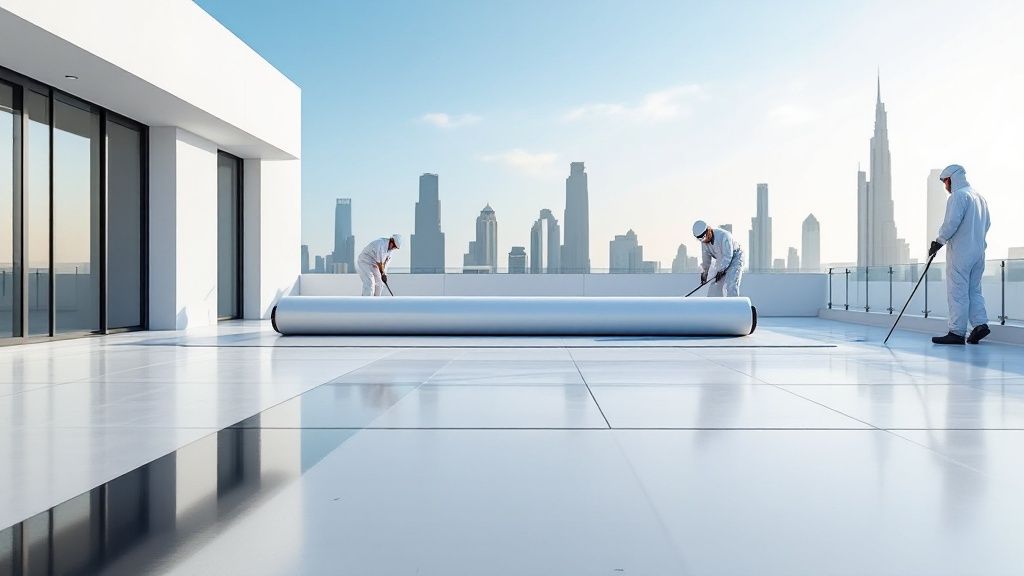
Choosing Waterproofing Companies in Dubai
In a climate like Dubai’s, where intense heat and coastal humidity are the norms, picking the right waterproofing company isn't just another task on the project checklist—it's a critical investment. This decision will directly affect the building's lifespan, shielding it from expensive structural damage and preserving its value against the relentless environment.
Why Your Choice of Waterproofing Company Matters in Dubai
For any construction professional here, hiring a top-tier waterproofing specialist is one of the most important risk management moves you can make. The city's unique mix of extreme temperatures, high humidity, and the occasional torrential downpour puts building envelopes under constant attack. If you don't tackle this with genuine expertise, the consequences can be both disastrous and incredibly expensive.
We’ve all seen or heard the horror stories that come from subpar waterproofing. A luxury villa’s basement suddenly floods after a rare storm because of a badly installed membrane. Or a high-rise balcony starts showing concrete spalling and corroded rebar from constant moisture getting in, putting the entire structure at risk. These aren't minor hiccups; they are huge financial liabilities that can destroy a contractor's reputation.
The Specialist Versus the Generalist
I know it’s tempting to just bundle waterproofing into the general contractor’s scope—it seems easier. But that shortcut often turns into a very costly mistake down the road. A dedicated waterproofing company brings a depth of specialised knowledge that a generalist just can’t replicate. They live and breathe this stuff. They understand the intricacies of local building codes and know exactly how different materials will behave under Dubai's specific climate stresses.
A true specialist, for instance, can tell you precisely which liquid-applied membrane will handle the massive thermal expansion and contraction on an exposed rooftop baked by the UAE sun. They have the technical skill to properly apply complex systems, whether it’s crystalline waterproofing for foundations or flexible bituminous sheets for podium decks. This level of expertise ensures the solution isn't just slapped on, but properly engineered for decades of performance.
The market reflects this need for specialisation. The UAE's construction chemicals industry, valued at around USD 1.4 billion in 2024, is expected to climb to USD 1.81 billion by 2030, largely because of the demand for reliable moisture protection.
A professional waterproofing contractor doesn't just sell you a product; they provide a complete system designed to protect the entire building. Their work is the bedrock of preventing future problems that could escalate into major, budget-breaking structural repairs.
A Foundation for Long-Term Building Health
At the end of the day, selecting a top waterproofing company in Dubai is about future-proofing your project. It’s about avoiding the disruptive and eye-wateringly expensive remedial work later on.
By investing in a qualified, experienced specialist from the start, you ensure the building’s first line of defence against water is solid and dependable. This is a fundamental part of protecting the asset and a crucial piece of any long-term building maintenance strategy in Dubai. The right partner allows you to build with confidence, knowing your structure is secure against its most persistent threat.
A Practical Framework for Vetting Waterproofing Specialists
Finding the right waterproofing partner in Dubai goes far beyond a quick once-over of a generic checklist. You need a deliberate, structured approach to confirm their credentials, on-the-ground experience, and technical know-how. The end goal is to find a team whose expertise is a perfect match for your project, whether you're building a sprawling villa community or a high-rise tower.
First things first, let's cover the absolute fundamentals. Any waterproofing company worth its salt must hold a valid trade licence from the Dubai Municipality. This is your initial, non-negotiable quality check. If they can't produce this, they're not a serious contender.
With that out of the way, it's time to dig into their track record. Ask for a portfolio showcasing projects that mirror yours in both scale and complexity. A company that excels at waterproofing residential villas might not have the logistical chops to tackle a 50-storey commercial building, and you don't want your project to be their learning curve.
Verifying Experience and Technical Proficiency
Don't just take their word for it. You need to see proof. Ask if you can speak with a few past clients or, even better, visit a completed project site that's a few years old. Seeing how their work has held up against Dubai’s punishing climate will tell you more than any glossy brochure ever could.
Next, look into their material partnerships. The best waterproofing companies in Dubai usually have long-standing relationships with leading suppliers like Sika, Fosroc, or BASF. This often means their teams are formally trained and certified to apply specific high-performance systems—a critical factor for ensuring your warranty is valid.
When you hire a certified applicator, you're not just getting skilled labour; you're securing a guarantee that the materials are being installed exactly to the manufacturer's specifications. This is the only way to ensure the long-term material and workmanship warranties will be honoured.
Assessing Methodologies and Innovation
A company’s process speaks volumes about its commitment to quality. A thorough inspection is the bedrock of any successful waterproofing job. The following process flow chart shows you what a quality-driven service should look like, from start to finish.

As you can see, a true professional moves methodically from inspection to application and, finally, to rigorous quality testing. No corners are cut. Pay close attention to companies that embrace better diagnostic tools, like modern drone inspection techniques, for detailed assessments of facades and other hard-to-reach areas. It shows they're serious about getting the initial diagnosis right.
When you're talking to potential hires, get specific with your technical questions.
- Which waterproofing systems do you specialise in (e.g., liquid-applied membranes, bituminous sheets, crystalline admixtures)?
- How do you decide on the best system for a specific substrate and its environmental exposure?
- What is your standard procedure for surface preparation? After all, surface prep is 80% of a successful application.
Their answers will quickly reveal their technical depth. A real expert will explain why a certain system is best for your project—for instance, why a high-elongation polyurethane membrane is the right choice for a rooftop dealing with extreme thermal movement. This is the kind of detail that separates the true specialists from the generalists and helps you find a partner who will deliver a solution that lasts.
To help you stay organised during this process, I've put together a simple checklist to guide your evaluations.
Waterproofing Contractor Vetting Checklist
Use this checklist to systematically evaluate and compare potential waterproofing companies in Dubai based on critical performance criteria.
| Vetting Criteria | What to Look For | Red Flags to Watch Out For |
|---|---|---|
| Licensing & Certification | Valid Dubai Municipality trade licence. Manufacturer certifications (e.g., Sika, Fosroc). | Expired licence, no certifications, or vague answers about their legal status. |
| Relevant Experience | A portfolio of projects similar in scale and complexity to yours. Minimum 5-10 years of local experience. | Portfolio consists only of small, simple jobs. No experience with your type of building. |
| Client References | Willingness to provide 2-3 recent, relevant client contacts. Positive feedback on communication and quality. | Hesitation to provide references. Inability to connect you with past clients. |
| Material Partnerships | Established relationships with reputable material suppliers. Proof of authorised applicator status. | Use of generic, unbranded, or low-quality materials. No supplier relationships. |
| Technical Expertise | Clear, detailed explanations of system choices. In-depth knowledge of surface preparation. | Vague, one-size-fits-all solutions. Downplaying the importance of prep work. |
| Warranty & Guarantees | Clear, comprehensive warranty covering both materials and workmanship for 10+ years. | Ambiguous warranty terms, short guarantee periods, or refusal to provide a written warranty. |
Using this table will ensure you cover all your bases and make a well-informed decision, rather than just going with the cheapest quote.
Decoding Waterproofing Technologies for the Dubai Climate
Before you can properly vet a proposal from a waterproofing company in Dubai, you need to speak their language. It's crucial to understand the what and the why behind the solutions they’re suggesting. Dubai's unique climate—with its relentless UV radiation, high humidity, and wild temperature swings—calls for very specific technologies.
Not every waterproofing system can handle these conditions. The right choice is never a one-size-fits-all solution; it depends entirely on where and how it’s being used. Getting familiar with the main players will help you ask the right questions and ensure the proposed system is genuinely the best fit for your project.
Liquid-Applied Membranes: The Seamless Solution
Liquid-applied membranes, particularly those based on polyurethane (PU) or polyurea, are incredibly versatile. Think of it like painting a thick, rubbery coating directly onto a surface. It cures into a single, seamless, joint-free barrier. That’s their biggest strength: no seams mean no weak points for water to sneak through.
Picture a complicated roof cluttered with pipes, vents, and skylights. Trying to use traditional sheet membranes here would be a nightmare of cutting, fitting, and sealing around every single obstacle. A liquid-applied system, on the other hand, simply flows around everything, creating a monolithic, custom-fit layer. Their high elasticity is another huge plus, allowing them to expand and contract with the building during Dubai's temperature extremes without cracking.
Bituminous and Thermoplastic Sheet Membranes
Sheet membranes have been a reliable workhorse in the industry for years, especially bituminous ones. These are essentially big rolls of waterproof material that are laid out and sealed together. Often, this is done with a torch to melt the seams, fusing them into a continuous barrier.
They are incredibly tough and resist punctures well, making them a great choice for areas that will have foot traffic, like podium decks or terraces. Modern bituminous and thermoplastic membranes are leaders in the UAE market, with bituminous options especially popular for their flexibility and proven performance. These products are essential for meeting Dubai’s strict construction standards.
But here’s the catch: the entire system is only as good as its weakest seam. The success of a sheet membrane is 100% dependent on the quality of the seam welding. One bad joint can cause the whole system to fail.
When a contractor suggests a sheet membrane, your first question should be about their team's experience and certification in torch-on application. Don't be shy. Ask to see photos of their seam work from past jobs. A clean, consistent weld is the mark of a true professional.
Crystalline Waterproofing for Concrete Integrity
This is a totally different approach. Instead of a surface coating, crystalline waterproofing works inside the concrete. It's a chemical treatment applied as a slurry or mixed directly into the concrete batch. Once in, it penetrates the pores and capillaries, reacting with moisture and cement by-products to grow insoluble crystals.
These crystals permanently block the pathways for water, turning the concrete structure itself into the waterproof barrier. This technology is a game-changer for anything below ground, like basements and foundations, that has to deal with constant hydrostatic pressure. Its most impressive feature? It's "self-healing." If minor cracks form over time, any new moisture that seeps in just triggers more crystal growth, sealing the gap automatically.
For a closer look at the different options, check out our guide on selecting the right water-proofing materials.
How to Analyse Quotes and Find the True Project Cost
Getting a stack of quotes from different waterproofing companies across Dubai is the easy part. The real work—and where you protect your project—is in learning how to read between the lines. I've seen it countless times: the cheapest offer is rarely the best value. In fact, a suspiciously low bid is usually a warning sign that they're cutting corners on materials, prep work, or guarantees.
A truly professional quote is a roadmap for the entire job, not just a single number at the bottom of a page.
You should be able to see everything broken down clearly. Look for individual line items for materials, specifying the exact brand and system they plan to use (for instance, Sika Sikalastic®-612 polyurethane membrane). The quote must also detail the labour costs, outline the full scope of surface preparation, and spell out the warranty terms. That kind of transparency is the first and most important sign of a contractor who knows what they're doing.
Spotting the Red Flags in a Lowball Offer
Let’s walk through a common scenario. You get a quote that's way cheaper than all the others. It might just have a single line: "Rooftop Waterproofing - AED X." That kind of vagueness is a massive red flag. A quote like that leaves the door wide open for surprise costs and arguments down the road.
A low bid without a detailed scope of work isn't a bargain; it's a liability. It often means the contractor is using inferior materials, skipping critical surface preparation steps like grinding or priming, or has no intention of providing a meaningful warranty.
To avoid falling into this trap, you have to compare every quote "apples-to-apples." Take a moment to lay out the key components from each one side-by-side. This simple step quickly reveals what's actually included versus what’s been conveniently left out.
A Quick Quote Comparison
| Feature | Quote A (The Professional) | Quote B (The Vague & Cheap) |
|---|---|---|
| Material Specified | Yes (Brand, product name, thickness) | No ("Waterproofing material") |
| Surface Preparation | Included (Crack repair, priming) | Not mentioned |
| Labour Breakdown | Yes (Itemised per task) | No (Lump sum) |
| Warranty | Yes (10-year joint material & workmanship) | Not mentioned |
When you see it laid out like this, the right choice becomes obvious. Quote A gives you accountability and a guarantee of quality, while Quote B is a pure gamble.
Asking the right questions is central to effective construction cost management and is the best way to prevent your budget from spiralling. Before you sign anything, always circle back and ask the contractors to clarify any grey areas in writing. A true professional will be happy to explain their process. A dodgy one will get evasive. This process ensures you're choosing a partner based on real, long-term value—not just a cheap price today.
Securing Your Investment with Solid Contracts and Warranties

You’ve done the hard work of vetting specialists and comparing quotes. Now comes the most critical step: locking in the agreement. In this business, a handshake and a promise won't cut it. A detailed, ironclad contract is your only real protection and the key to ensuring everyone is on the same page from day one.
Think of the contract as your ultimate safeguard. A project isn't truly done until the guarantees are in writing. I’ve seen it happen—a vague agreement leads to major headaches when a leak springs up years down the line. You need absolute clarity on what’s covered, for how long, and who is responsible for fixing it.
Differentiating Material and Workmanship Warranties
First things first, you need to understand the guarantees you're getting. They aren't all the same. For any high-quality waterproofing job, there are two separate warranties you must have, and they serve very different purposes.
Material Warranty: This guarantee comes straight from the product manufacturer, like Sika or Fosroc. It’s their promise that the waterproofing membrane or coating itself won't fail and will perform as advertised for a specific duration, often 10 years or more.
Workmanship Warranty: This one is on the contractor you hire. It covers the quality of their installation. It's their assurance that they applied the material correctly, following the manufacturer’s exact specifications.
Getting both is completely non-negotiable. A top-of-the-line material is useless if it's installed poorly, and even the most skilled application can't save a defective product. The best waterproofing companies in Dubai will provide a joint warranty covering both, which means you have a single point of contact if anything goes wrong.
In Dubai’s demanding construction environment—from soaring high-rises to complex villa communities—a robust warranty is a true sign of a contractor's belief in their work. Reputable firms will confidently offer warranties for up to 10 years, aligning with global best practices and giving you lasting peace of mind. You can find more details about the UAE's most reliable waterproofing contractors and their guarantees to see what the market leaders offer.
Essential Clauses for Your Waterproofing Contract
Your contract needs to be more than just a price and a signature; it should be a comprehensive blueprint for the entire project. Don't be afraid to insist on specific clauses that eliminate any grey areas.
A well-defined contract is your most powerful tool for accountability. It transforms verbal promises into legally binding commitments, ensuring your investment is protected long after the final payment is made.
Make sure your agreement clearly spells out these critical points:
- A Detailed Scope of Work: This must specify every area to be waterproofed, the exact system and materials being used (down to the product name), and a full breakdown of the surface preparation and application process.
- Project Timeline: Lock in a firm start date, key milestones for progress checks, and a target completion date. Vague timelines are a red flag.
- Payment Schedule: Link every payment directly to the successful completion of specific project milestones. Never pay the full amount upfront.
- Unambiguous Warranty Terms: The contract must explicitly state the duration of both material and workmanship warranties. It should also detail the exact procedure for making a claim—who you call, what the response time is, and what's covered.
Your Top Waterproofing Questions Answered
If you've spent any time on a construction site in Dubai, you know that when it comes to waterproofing, the same questions pop up time and time again. Getting straight answers is the only way to protect your project, your budget, and your professional reputation. Let's cut through the noise and tackle the questions I hear most often from fellow construction pros.
Think of this as a quick field guide to understanding the costs, the technical jargon, and the real value you should expect from a top-tier waterproofing partner.
So, How Much Does Professional Waterproofing Actually Cost in Dubai?
This is always the first question, and the honest answer is: it depends. There’s no simple price list for waterproofing in Dubai. The cost is a moving target based on the size of the area, the specific system being installed, and, crucially, the state of the surface we're working with.
As a rough ballpark figure, for a straightforward flat roof, you’re likely looking at a range of AED 40 to AED 90 per square metre. But treat that as a starting point. The moment you get into areas under constant hydrostatic pressure—think basements, podium decks, or water tanks—the price will climb. These jobs demand more advanced materials and a far more technical application process.
My best advice? Get at least three detailed, itemised quotes from reputable firms. Make sure they break everything down: materials, labour, and warranty. Only then can you make a proper apples-to-apples comparison and see who’s offering real value versus just a low price.
What’s the Real Difference Between Damp Proofing and Waterproofing?
This is a big one. I’ve seen these terms used interchangeably, and that confusion can lead to disastrous, costly failures down the line. They both manage moisture, but that's where the similarity ends.
- Damp Proofing: This is a basic barrier designed to stop moisture from wicking up from the ground. It can handle damp soil, but it’s not built to hold back actual standing water. It has zero resistance to hydrostatic pressure.
- Waterproofing: This is the heavy-duty solution. It creates a completely sealed, impervious membrane that can withstand water under pressure. It's designed to keep liquid water out, period.
For any structure below ground level, or for critical wet areas like pools and roofs, anything less than a full waterproofing system is a gamble you can't afford to take. Using a damp-proofing course where a waterproofing membrane is needed is asking for trouble.
How Long Should a Waterproofing Warranty Last in the UAE?
A warranty tells you everything you need to know about a company's faith in their own work and the products they use. For a quality system installed by a certified team in the UAE, you should be looking for a warranty of at least 10 years.
A solid warranty isn't just a piece of paper. It should be a joint guarantee from both the material manufacturer and the contractor. This dual-coverage is one of the clearest signs you're dealing with one of the best waterproofing companies in Dubai.
Can I Just DIY the Waterproofing and Save Some Money?
Look, I get the temptation to cut costs, but waterproofing is one area where this is a terrible idea. For a tiny, non-critical patch-up, maybe. But for a roof, foundation, or basement? Absolutely not.
The risk of failure is massive, and the cost of fixing water damage, mould, and structural issues will dwarf what you would have paid a professional in the first place.
Specialists have the right equipment, years of hands-on experience, and access to commercial-grade materials you simply can’t buy at a hardware store. Most importantly, a professional installation is the only way to get a manufacturer's warranty. Without that, your entire investment is unprotected.
Getting the right specialists on site is half the battle; the other half is equipping them with the right gear. For any construction project in the UAE, Yasu Trading Co. LLC is a trusted source for high-quality building hardware, safety equipment, and all the essential supplies that keep a job moving forward. Take a look at our extensive product catalogue at https://yasutrading.com and find a reliable partner for your project's supply chain.