
What is Preventive Maintenance? Boost Asset Reliability & Efficiency
Think of preventive maintenance like a regular health check-up for your most important machinery and equipment. It’s the simple practice of carrying out regular, scheduled work to stop things from breaking down unexpectedly, rather than waiting for a disaster to strike.
This approach is all about catching small issues before they snowball into major, expensive emergencies.
Moving Beyond Breakdowns to Proactive Care
For far too long, many in our industry have been stuck in a "fire-fighting" cycle. An essential HVAC unit gives out during a sweltering Dubai summer, or a critical piece of machinery grinds to a halt right in the middle of a high-stakes project. This reactive strategy, also known as run-to-failure maintenance, inevitably leads to panicked phone calls, premium rates for emergency repairs, and crippling operational downtime.
Preventive maintenance completely flips that script. It’s a strategic, forward-thinking approach that chooses consistency over crisis. Instead of just reacting to problems, you actively work to prevent them from ever happening. Making this work requires a real grasp of the differences between proactive versus reactive maintenance.
To truly understand the shift, it helps to see the two approaches side-by-side.
Preventive Maintenance vs Reactive Maintenance at a Glance
| Aspect | Preventive Maintenance (Proactive) | Reactive Maintenance (Run-to-Failure) |
|---|---|---|
| Strategy | Fix it before it breaks. | Fix it when it breaks. |
| Timing | Scheduled, planned, and predictable. | Unscheduled, unpredictable, and urgent. |
| Cost | Controlled, budgeted, and lower overall. | High emergency rates and overtime costs. |
| Operational Impact | Minimal disruption, planned downtime. | Severe disruption, unplanned shutdowns. |
As you can see, the choice isn't just about repairs—it's about gaining control over your entire operation.
The Core Philosophy of Proactive Care
At its heart, this strategy is built on one simple, powerful idea: scheduled upkeep is always more efficient and far less costly than unscheduled chaos. By committing to a regular maintenance calendar, you take control of your assets, your schedule, and your budget.
This proactive stance brings several key advantages, which are especially vital in the fast-paced UAE market:
- Enhanced Reliability: Equipment that gets regular attention is far less likely to fail out of the blue, keeping your projects and facilities running smoothly.
- Extended Asset Lifespan: You'd be amazed how simple tasks like cleaning, lubricating, and making minor adjustments can add years to the life of expensive machinery.
- Improved Safety: A well-maintained site is a safer site. You dramatically reduce the risk of equipment malfunctions that could lead to serious workplace accidents.
This shift from a reactive mindset to a strategic maintenance culture is not just an operational tweak; it is a foundational business decision. It builds a more resilient company, capable of meeting tight deadlines and protecting its bottom-line from the high costs of unplanned downtime.
Across the UAE’s key sectors like manufacturing and energy, industrial maintenance services are the bedrock of operational continuity. The ever-present need to minimise downtime and safety risks has spurred steady market growth. Preventive measures are a huge part of this, helping companies extend asset life and slash emergency repair costs by servicing equipment before it fails.
The True Business Impact of Preventive Maintenance

Knowing the definition of preventive maintenance is one thing. Truly understanding its massive impact on your bottom line and operational stability is something else entirely. It’s far more than just keeping a facility tidy; it's a powerful engine for profitability, especially in the demanding construction and facility management worlds here in the UAE.
The most obvious win? A huge drop in emergency repairs. When you service equipment on a set schedule, you swap "crisis management" for controlled, budgeted work. Forget paying a premium for emergency call-outs and rush-ordered parts. Instead, you're handling maintenance within planned, cost-effective windows.
That immediately translates into real cost savings, freeing up capital that would otherwise get eaten up by chaotic, last-minute fixes. But the financial perks go much deeper than that.
Maximising Uptime and Protecting Investments
In a market where project deadlines are everything, unplanned downtime is a killer. A solid preventive maintenance plan ensures your most critical assets—whether it's heavy machinery on a construction site or the main HVAC system in a skyscraper—are ready to go when you are.
Keeping your equipment running is non-negotiable for hitting tight schedules and building a reputation for reliability. What’s more, consistent upkeep dramatically extends the life of your machinery. A simple task like regular lubrication or a filter change can add years to an asset's life, giving you a much better return on your biggest investments. This is especially true when you're working with the diverse range of essential building materials for construction projects in Dubai, as the equipment handling them needs to perform without a hitch.
A single power outage or a critical equipment failure can halt operations for hours, causing a domino effect of delays and financial penalties. Preventive maintenance is your insurance policy against this exact risk, protecting your operational flow.
Enhancing Safety and Efficiency
The benefits don't stop at machines and money. A well-maintained facility is a safer one, plain and simple. It drastically cuts the risk of equipment malfunctions that could lead to workplace accidents and serious liability issues. Showing you’re committed to safety also creates a far more positive and productive culture on-site.
On top of that, equipment that runs properly is also more efficient. That means lower energy consumption. The knock-on effects are huge:
- Reduced Energy Bills: Clean filters, calibrated systems, and lubricated parts mean your machinery isn't working overtime. This directly slashes your utility costs.
- Improved Occupant Experience: For facility managers, reliable systems like HVAC and lighting directly impact the comfort and satisfaction of tenants and visitors.
- Compliance and Reputation: A documented maintenance schedule helps you meet regulatory standards and builds a solid reputation for quality and safety.
At the end of the day, preventive maintenance isn't just another line item on a budget. It's a strategic investment that pays you back across every part of your business. You get lower operating costs, higher productivity, a safer workplace, and a healthier bottom line.
Finding the Right Maintenance Approach for Your Assets
Knowing what preventive maintenance is gets you in the door, but the real work starts when you realise not all proactive strategies are the same. You just wouldn’t use the same service plan for a massive tower crane as you would for a simple water pump. The secret to building a truly efficient programme—one that saves resources instead of wasting them—is picking the right approach for each asset.
The idea is to get away from a "one-size-fits-all" mindset and start thinking more strategically. This means matching the type of maintenance to how valuable the equipment is, what it does, and how likely it is to break down. Let’s break down the main methods you can blend together for your own plan.
Time-Based Maintenance
This is the classic, most straightforward form of preventive maintenance. Here, tasks are scheduled based on the calendar, plain and simple. It doesn’t matter how much the asset has been used; it’s all about hitting those fixed intervals.
Think about the annual service for your building's fire safety systems or the twice-yearly deep clean of the HVAC ducts. These jobs happen like clockwork—every six months, every year—to make sure you’re compliant and everything is in good working order.
- Best for: Assets with predictable failure patterns or where regular checks are needed to meet regulations.
- Example: A facility manager scheduling a full generator test every quarter, making sure it’s ready to go the moment a power outage hits.
Usage-Based Maintenance
Taking things a step further, we have usage-based maintenance. With this approach, maintenance isn't triggered by a date on the calendar but by how much the equipment has actually been working. This is often measured in hours run, kilometres driven, or the number of cycles completed.
This method is a lot more precise because it ties maintenance directly to actual wear and tear. For instance, a delivery vehicle that’s driven 10,000 kilometres gets its oil changed, or a backup pump that’s run for 500 hours gets serviced. It lines up the maintenance effort with real-world use, so you avoid servicing equipment too often or, even worse, not often enough.
Usage-based maintenance is a smart step up from time-based schedules. It ensures that heavily used assets get the attention they need, while assets that see less action aren't serviced unnecessarily, saving both time and money.
Condition-Based Maintenance
Now we're getting into a more sophisticated strategy. With condition-based maintenance, work is only done when an asset starts showing early signs of trouble or a drop in performance. It’s all about using real-time data from sensors and regular inspections to keep an eye on the actual "condition" of the equipment.
For example, a technician might use vibration analysis on a large industrial motor and detect a tiny imbalance. This triggers a work order to check the bearings long before they could fail and shut down a production line. Another great example is using an infrared camera to spot an overheating connection in an electrical panel.
This data-first approach allows for incredibly precise, just-in-time repairs. It represents a major leap in maintenance efficiency and is the natural bridge to the next level: predictive technologies.
The Next Frontier of Maintenance Technology

As effective as scheduled checks are, what if you could know exactly when a component was on the verge of failing? This isn’t a concept from a sci-fi movie; it's the reality of predictive maintenance (PdM). It represents the next logical leap forward, moving beyond simply preventing failures to actively predicting them with stunning accuracy.
Think of it like getting a highly detailed, real-time health report for your most critical equipment. Instead of servicing an HVAC unit every six months just to be safe, PdM might use live data to tell you that a specific compressor bearing will likely give out in the next 45 days. This allows for incredibly efficient, just-in-time servicing that stretches both the asset’s lifespan and your maintenance budget.
How Predictive Maintenance Works
At its heart, predictive maintenance relies on a sophisticated suite of tools all working together. It starts with Internet of Things (IoT) sensors, which are fitted onto key assets to constantly gather real-time data on everything from vibration and temperature to oil quality and power usage.
This flood of information is then channelled into Artificial Intelligence (AI) and machine learning platforms. These powerful systems sift through the data, spotting subtle patterns and anomalies that a human could never detect. By comparing this live data against historical failure information, the system can flag when a breakdown is imminent and automatically alert your team.
This proactive approach is changing the game for industries across the UAE, especially as it aligns perfectly with the nation's push towards Industry 4.0 and smart infrastructure. To see how these modern techniques are being put to work locally, our guide on https://yasutrading.com/blog/building-maintenance-dubai/ offers some fantastic real-world context.
Predictive maintenance fundamentally changes the question from "What is the best service schedule for this machine?" to "What is this machine telling us right now?" It's a truly data-first approach that removes the guesswork.
The Future of Asset Management
The rapid adoption of this technology speaks volumes. The predictive maintenance market in the Middle East and Africa was valued at USD 497.15 million in 2021. By 2029, it’s projected to skyrocket to an incredible USD 25.88 billion. This explosive growth shows just how much value businesses see in having these predictive insights.
By embracing these tools, companies here in the UAE are unlocking new levels of reliability and achieving major cost savings. It’s a powerful combination. For a closer look at how these systems operate, exploring AI-driven predictive maintenance and automated sensor data processing reveals just how much the field has evolved. This is no longer the future; it's the new benchmark for excellence.
Right, let's move from theory to action. Understanding what preventive maintenance is is one thing, but actually putting it into practice is where the real value lies. To do that, you need a clear, structured roadmap.
Trying to launch a maintenance programme without a proper plan is a bit like starting a construction project without blueprints. It's messy, risky, and almost guaranteed to end in costly mistakes. This guide will walk you through building a solid plan, step by step, from the ground up.
Step 1: Know Your Assets Inside and Out
First things first: you can't maintain what you don't know you have. The starting point is always a complete inventory of every piece of equipment you plan to include in your programme. This isn't just a simple list. For each asset, you need to detail its location, age, current condition, and, most importantly, how critical it is to your day-to-day operations.
Once you have this inventory, you can start prioritising. Let's be honest, not all equipment is created equal. The main HVAC chiller in a Dubai mall is leagues more important than the microwave in the staff breakroom. Your job is to identify the mission-critical assets—the ones whose failure would cause the biggest safety headache, financial hit, or operational shutdown—and focus on them first.
Step 2: Set Clear Goals and Define the Scope
With your priorities straight, you need to define what success actually looks like. Are you aiming to slash equipment downtime by 15% over the next year? Maybe you want to cut your emergency repair budget by 25%. Setting specific, measurable, achievable, relevant, and time-bound (SMART) goals gives your team a clear target and a way to prove the programme's value.
These goals are especially vital here in the UAE, where our industrial sectors are booming. The regional Maintenance, Repair, and Operations (MRO) market—which covers all this preventive work—is set to grow from USD 201.83 billion in 2025 to over USD 310.80 billion by 2032. That 5.87% compound annual growth rate shows just how much businesses are relying on proactive upkeep to keep their operations running smoothly.
Step 3: Develop Checklists and Create a Schedule
Now for the practical part. It's time to create detailed maintenance checklists for your high-priority assets. These are the step-by-step instructions your technicians will follow every single time. A good checklist is clear and to the point, with specific tasks like "Inspect fan belts for wear," "Clean condenser coils," or "Verify fluid levels."
A well-structured checklist is the foundation of consistent maintenance. Here's a look at the key components you should include for any critical asset.
Key Components of a Preventive Maintenance Checklist
| Checklist Component | Description | Example Action |
|---|---|---|
| Asset Identification | Clearly state the equipment name, ID number, and location. | "HVAC Chiller #3, Rooftop, Tower B" |
| Safety Precautions | List all necessary safety checks and required PPE before work begins. | "Lockout/Tagout procedure initiated. Safety glasses and gloves required." |
| Task List | A sequence of specific maintenance actions to be performed. | "1. Check refrigerant levels. 2. Clean condenser coils. 3. Test sensor accuracy." |
| Measurement/Reading | Fields to record specific data points like pressure, temperature, or voltage. | "Operating Pressure: ___ psi; Coolant Temp: ___ °C" |
| Pass/Fail/Notes | A section to note the condition of components and any issues found. | "Fan Belt Condition: Pass. Note: Minor fraying observed on edge." |
| Sign-off | Space for the technician's name, date, and signature to confirm completion. | "Technician: ___________ Date: ___________" |
Having these detailed checklists ensures no steps are missed and provides a valuable record of the asset's health over time.
To keep everything organised, you'll need a realistic schedule that dictates when these checks happen. This could be based on time (e.g., a generator test every month), usage (a vehicle service every 10,000 km), or condition (triggered by a sensor alert). You can make this whole process much easier by using a preventive maintenance schedule template to keep everything on track.
The image below gives you a bird's-eye view of how these pieces fit together when launching your programme.
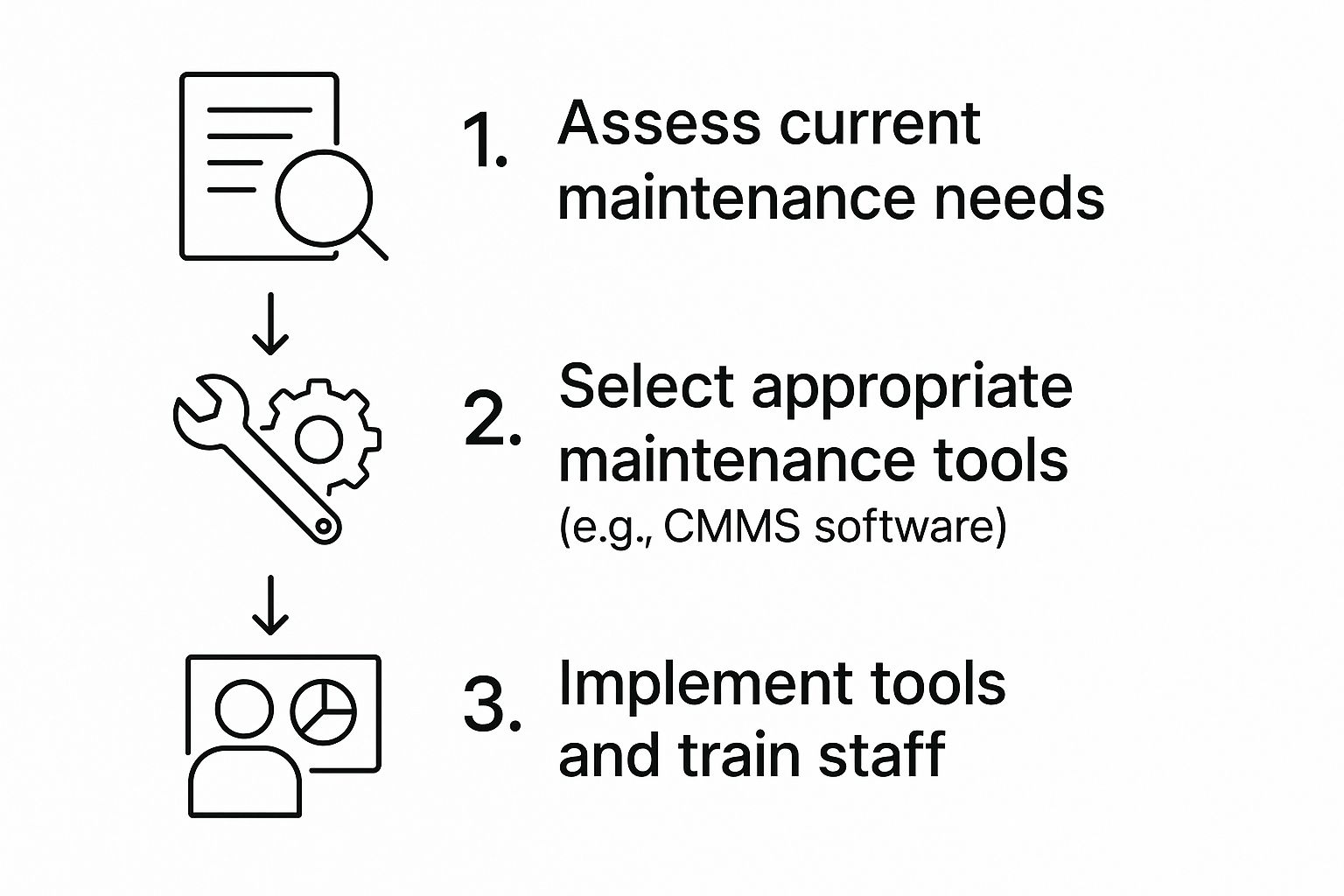
As you can see, it all starts with a thorough assessment, which then informs the tools you need and the training you provide before you can successfully execute the plan.
Step 4: Assign Roles, Select Tools, and Train Your Team
A plan is just paper without the right people to bring it to life. Be crystal clear about who does what. Who’s in charge of scheduling? Who carries out the inspections? Who manages the spare parts inventory? This clarity eliminates confusion and creates accountability. For specialised equipment, like the drones used for site inspections, a detailed drone maintenance log becomes a critical tool for both tracking and compliance.
To manage all these moving parts—your asset inventory, checklists, schedules, and work orders—modern facilities lean on a Computerized Maintenance Management System (CMMS). Think of a CMMS as the digital brain of your entire operation, automating tasks and giving you the data you need to track progress and prove your ROI.
Finally, never underestimate the power of continuous training. Make sure your team understands the new procedures, knows their way around the CMMS, and has the skills to perform every task safely and correctly. An empowered team is an effective team.
Your Top Preventive Maintenance Questions Answered
When you're thinking about shifting to a preventive maintenance strategy, a few questions always come up. Let's tackle them head-on with some straight-talking, practical answers to help you see the path forward.
What's the Real Cost of a Preventive Maintenance Programme?
There's no single price tag. The cost really depends on the scale of your operation—the size of your facility, how complex your equipment is, and which software you end up choosing. Yes, there's an initial investment for planning, getting your team up to speed, and implementing a tool like a CMMS.
But here’s the crucial part: that upfront cost is almost always dwarfed by the long-term savings. You’re spending a little now to avoid massive bills from emergency repairs, crippling downtime, and having to replace expensive equipment years before you should have to.
Think of it less like an expense and more like an investment in operational stability. You're buying insurance against the huge, unexpected costs that can really hurt a business.
Is It Really Better Than Just Fixing Things When They Break?
For most businesses in the UAE that rely on heavy machinery and critical assets, the answer is a definite yes. The "if it ain't broke, don't fix it" approach might seem thrifty, but it’s a costly illusion. The hidden price of unplanned downtime, rush-job labour rates, and the risk of a complete system failure is always higher.
That said, you have to be smart about it. Preventive maintenance is essential for your critical assets—the equipment that brings your operations to a standstill if it fails. For a small, cheap, non-essential item that’s easy to swap out? A reactive approach can still make sense. It’s all about a balanced, risk-based maintenance plan that protects what matters most.
What’s the Difference Between Preventive and Predictive Maintenance?
This is a great question, and getting the distinction right is key to understanding where maintenance is heading.
Preventive Maintenance (PM): This is all about routine, scheduled care. You work on a fixed schedule—either based on time (like every three months) or usage (like every 1,000 hours of operation)—to prevent problems. Think of it like changing the oil in your car every 10,000 kilometres, whether it looks dirty or not.
Predictive Maintenance (PdM): This is the next level. It's a much smarter, data-led approach. Using sensors and clever analytics, PdM monitors equipment in real-time to predict precisely when a failure is likely to happen. You only step in when the data tells you it's necessary, not a moment sooner or later. It’s the evolution of PM, designed for maximum efficiency.
At Yasu Trading Co. LLC, we provide the high-quality hardware, tools, and materials you need to execute your maintenance plan effectively. From durable plumbing fittings to certified safety equipment, we supply the essentials that keep your assets running and your operations on schedule. Explore our comprehensive product range and request a quote today at https://yasutrading.com.