
Adhesives and Sealants in Construction: A UAE Guide
You're on site with a curtain-wall joint, a wet-area tile edge, and a supplier pushing one multipurpose tube for both. That shortcut usually comes back as a split bead or a rejected delivery. Adhesives and sealants in construction have to be chosen against movement, exposure, and the compliance pack before anyone orders. I would lock those three first. Price comes after, not before.
Which Product Fits Each Construction Job
| Application | Product family | Why it fits |
|---|---|---|
| Tile fixing on walls and floors | Cementitious or polymer tile adhesive | Bonds ceramic and stone to concrete or screed under load |
| Façade and curtain-wall perimeters | Silicone or hybrid sealant | Accepts movement and resists UV and heat |
| Wet areas: showers, basins, kitchens | Neutral-cure, mould-resistant silicone | Water resistance and fungicide protection |
| Window and door perimeters | Polyurethane sealant or expanding PU foam | Airtightness and insulation at openings |
| Floor and paving expansion joints | Polyurethane or hybrid sealant | Traffic wear and joint movement |
| Metal roof and panel laps | Butyl sealant or tape | Long-term weatherproofing at metal seams |
| Interior trim and drywall joints | Acrylic latex sealant | Paintable and low movement, dry interiors only |
| Structural panel bonding | Epoxy or structural adhesive | High load transfer between substrates |
Read it as a shortlist, not a verdict. The family names the chemistry. The right-hand column names the property that decides the choice. The data sheet confirms the exact grade.
Tile adhesive stops tiles shearing off under foot traffic. Façade sealant has to flex in sun and heat. Neutral-cure silicone resists mould where a shower stays wet. PU foam or sealant closes window and door perimeters against air. Traffic-grade PU or hybrid survives paving joints that move. Butyl stays tacky on metal laps. The same seam logic is why flat-roof guides such as TPO roofing Arizona treat lap sealing as part of the roof, not a finish coat. Acrylic latex paints well on dry trim and fails if the joint moves or stays wet. Epoxy is for panels that must carry load.
Fire-stopping needs the fire rating on the sheet. Pool joints need a continuous-immersion rating. If the joint moves, sits in water, or carries load, acrylic is out.
Sealants and Adhesives Are Not Interchangeable
A curtain-wall perimeter expands and contracts each day in UAE heat. It needs a sealant that can stretch with the joint. An adhesive, by contrast, bonds two parts and transfers load.
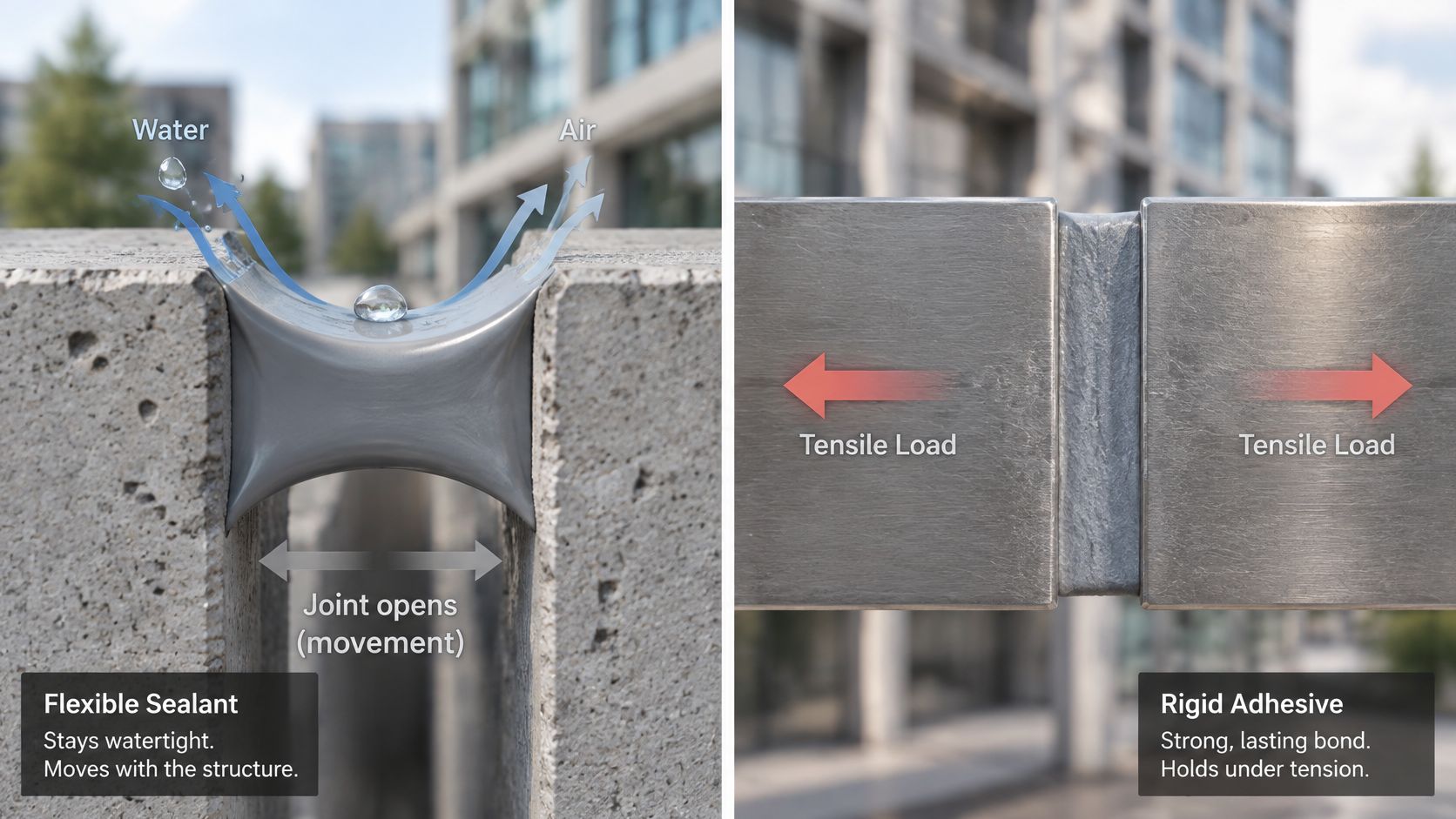
Start with the joint's job: must it accommodate movement, carry a load, or both? A shower joint needs water and mould resistance, while the tile bed requires an adhesive selected for the tile and substrate. For the latter, see tile adhesive explained for bathrooms.
A sealant closes a joint against water and air while allowing movement. An adhesive bonds materials and transfers load.
Some hybrid products can seal and bond, but the specified use and product data sheet must support both functions. A bead bonded on three sides can tear because the back face restricts stretching. Use a bond-breaker or backing material where specified so the sealant adheres to the two joint sides, not the back.
Matching Joints to UAE Heat, UV and Movement
A façade joint can experience repeated movement as temperatures change, so select the sealant class against the calculated movement, not just the joint's appearance. ASTM C920 ±25% and ±50% are useful reference classes: the figures indicate movement of up to 25% or 50% of the joint width. A ±25% sealant is unsuitable if calculated movement approaches that limit.
| Movement class | Joint movement accepted | Where it is typically specified |
|---|---|---|
| ASTM C920 ±25% | Up to ±25% of joint width | Lower-movement joints, including interior and moderate-movement façade joints |
| ASTM C920 ±50% | Up to ±50% of joint width | Joints with greater movement, including high-movement façade joints |
| Hybrid sealants | Varies by product; check the manufacturer's stated movement class | Use the class stated on the product data sheet when specifying |
Calculate movement from the temperature swing, the expansion of the adjoining materials and the joint length. Allow a margin below the sealant's rated limit rather than designing the joint to operate at the class boundary. For façade-specific joint layout, see this guide to expansion joint sealant for façades in the UAE.
Sizing the bead
A width-to-depth ratio near two to one is a common starting point, with depth about half the width. Set the final dimensions alongside the expected movement and installation temperature. Dubai façades bring aluminium, glass, concrete, stone and masonry together, each responding differently to heat, UV, humidity and coastal salt.
Check adhesion and compatibility on the actual substrates, including laminated-glass edges, powder-coated aluminium, membranes and stone. A project mock-up can reveal adhesion or compatibility failures before full installation.
Sealing Gaps for Airtightness and Cooling Loads
A year-long UAE residential case study measured annual energy use falling from 64,287 kWh to 62,341 kWh, a reduction of about 3.0%. Polyurethane foam produced the largest airflow reduction among the measures studied. The result shows why continuous sealing matters: a few tidy joints do little if openings elsewhere leave the pressure boundary incomplete.
Outdoor air entering through gaps adds cooling and dehumidification load, especially in humid coastal conditions. Specify the zone to be sealed, such as a window perimeter, service penetration, façade joint, or internal partition. The case study cites a Dubai Green Building Regulation limit of no more than 10 m³/h/m² at 50 Pa for buildings with cooling loads of 1 MW or greater.
Seal openings and penetrations first. Then inspect or pressure-test where energy performance is contractual, before considering a larger HVAC plant. Even when teams compare attic fan options for Florida, that does not change the sequence for a UAE building: close envelope leaks before adding air movement. Sealant quality depends on preparation and continuity. Clean the joint, set the backer rod, and apply an unbroken bead.
Why the Cheapest Product Costs More Over Time
The lowest unit price is often the most expensive joint on the job.
Service life first: a cheap tube that fails on a façade costs more than the cartridge you skipped.
Thermal cycling can strip adhesion, and the bill is access equipment for a re-seal. UV embrittlement on an exposed façade can force full remediation. Movement past the class opens the joint and brings water-damage repairs inside the wall. Damp cure, stone staining, and clash with coatings or plastics mean tenant disruption in an occupied building.
UAE climate legislation now requires climate-performance indicators to cover emissions in construction and operation, plus adaptation. Dubai's green-building rules also cap VOC, so an uncertified bargain can be unusable however low the price. Certification is a threshold, not an extra.
Ask three things of each joint. How much does it move? How hard do sun, water, and salt hit it? How difficult is the reach if it fails? A premium, certified grade earns its price when replacement needs cradles or opened ceilings. A standard acrylic is still the right cheap choice on dry interior trim that never moves. Track two numbers: the sealant cost, and the access cost if it fails.
How to Apply a Sealant Joint Step by Step
A sealant fails at joint preparation more often than at the product itself.
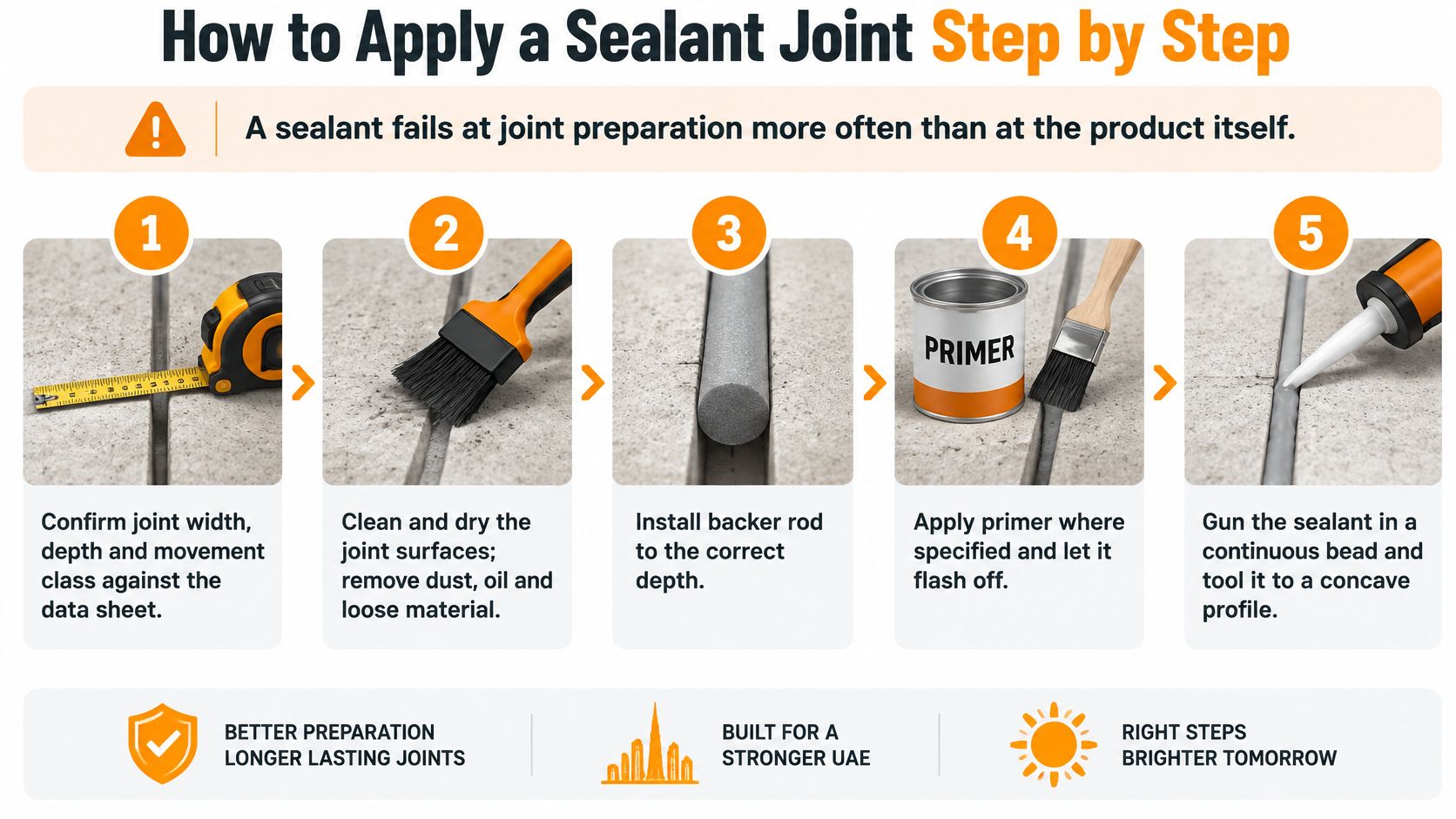
- Confirm the joint. Match width, depth, and movement class to the data sheet before you buy. The slip is ordering first and discovering the joint is too narrow.
- Clean it. Remove dust, oil, old sealant, and loose mortar. Residue is why a new bead lets go.
- Check the conditions. Air temperature, substrate moisture, and dew point must sit inside the sheet's range. Cold or damp slows the cure and weakens the bond.
- Fit the backer rod to the design depth so the bead takes the right shape. Skipping it lets the sealant bond where it shouldn't.
- Prime only where the sheet says so, and let it flash off for the stated time. Skipping primer, or gunning over wet primer, is a common miss.
- Gun one continuous bead and tool it inside the skin time, pressing so it wets both edges. Tooling after the skin forms leaves a hollow bond.
- Pull the masking tape before the skin sets, and keep rain and traffic off for the stated cure. Tape left on tears the edge.
- Record the batch number and photograph the joint for the file. Without that, a later dispute has no proof.
A sound joint is flush or slightly concave, bonded on two faces, free of bubbles and voids, and smooth from end to end. The sequence in this clip matches that order on site.
Compliance and Order Checks Before Purchase
Compliance is decided before the product reaches site, not on inspection day.
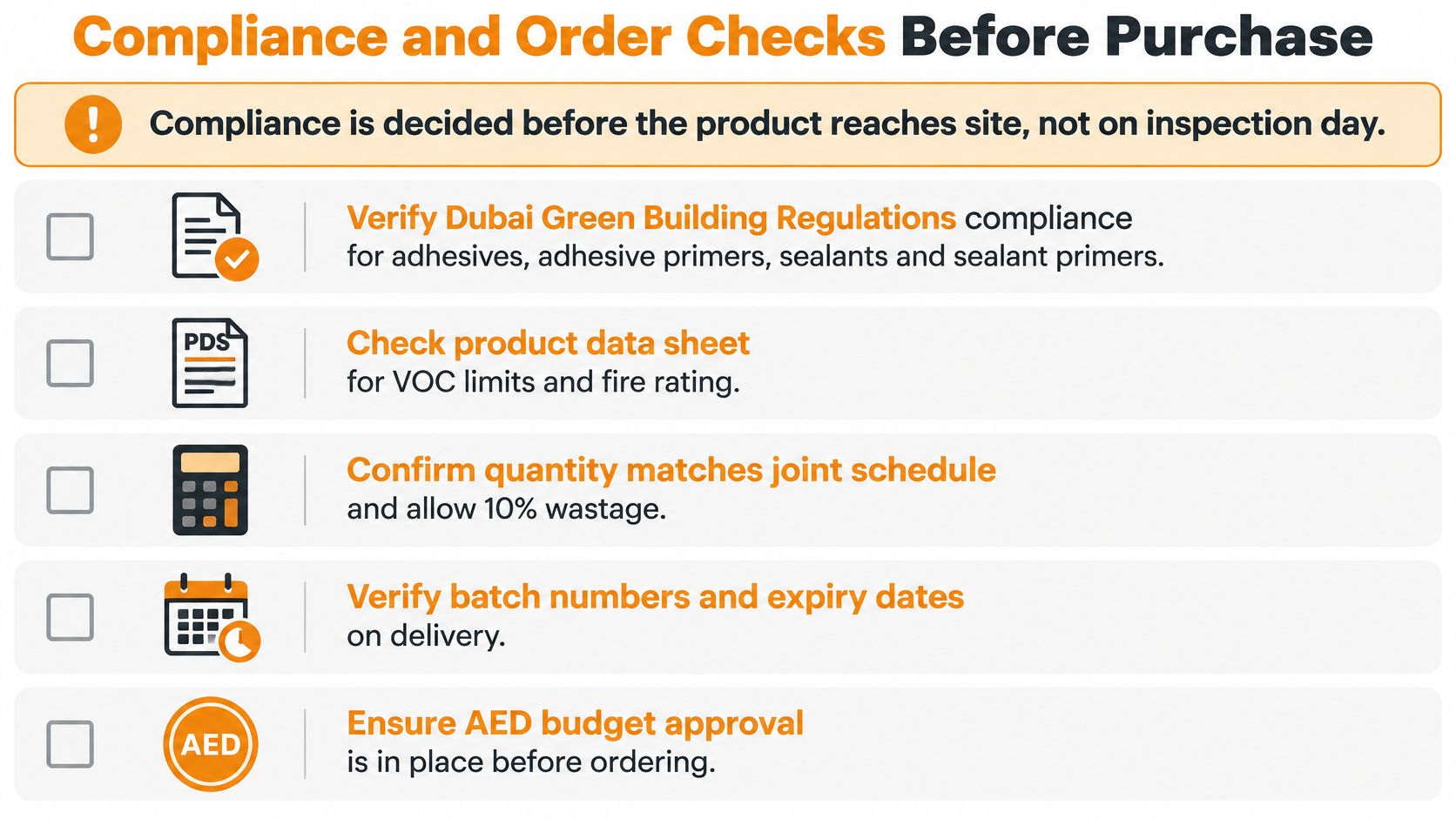
Dubai's Green Building Regulations require adhesives, adhesive primers, sealants, and sealant primers to stay within specified VOC limits and to be accredited by Dubai Central Laboratory or another Dubai Municipality-approved source. Match the exact product code and its current sheet to movement class, substrate, and exposure. The brand name on the box is not enough.
Before you purchase, ask for:
- Technical data sheet and safety data sheet: current issues, not a generic family brochure.
- VOC certificate and approved-use limits: proof the exact code is covered.
- Batch number and shelf life: reject stock you can't trace.
Dubai Municipality and DCL rules govern Dubai. Abu Dhabi and the other emirates can set their own project specifications, so confirm which authority applies. We supply municipality-compliant building materials, and the adhesive and sealant lines we stock are listed as municipality compliant, alongside fasteners.
Check the crew has the primer, backer rod, and tools the sheet names. File the submittal before installation: sheets, ASTM or ISO methods, movement class, service temperature, cure chemistry, substrate limits, and mock-up results. Fire-rated penetrations belong in that same pack. Our firestop sealing guide lists what to hold before a service is closed.
No product replaces the approved one on site without written approval. Send the supplier the joint schedule, the movement class, and the document list in one request, and wait for written confirmation of the exact product and its compliance pack before dispatch. The right product matches the joint, the exposure, and the paperwork, not the cheapest line on the quote.
Yasu Trading Co. LLC supplies adhesives, sealants, and related construction hardware from Deira, with municipality-compliant lines for UAE contractors. If you need the grade, the paperwork, and delivery lined up before the joint is cut, send the joint schedule through Yasu Trading Co. LLC and ask for a quote on the approved product.