Best Electrical Consumables for Panels
A panel build rarely fails because of the switchgear alone. More often, delays and call-backs start with the small items - ferrules that loosen, cable ties that turn brittle, markers that fade, glands that do not seal properly, or lugs that were selected for price instead of load and environment. That is why choosing the best electrical consumables for panels is not a minor procurement decision. For contractors and MEP buyers, it directly affects installation speed, inspection outcomes, and long-term reliability.
In practice, panel consumables need to do three jobs at once. They must support safe termination, keep the layout organized for maintenance, and hold up under actual site conditions such as heat, dust, vibration, and frequent access. Buying purely on unit cost usually creates problems later, especially on projects where multiple panels must be assembled and delivered on schedule.
What counts as panel consumables
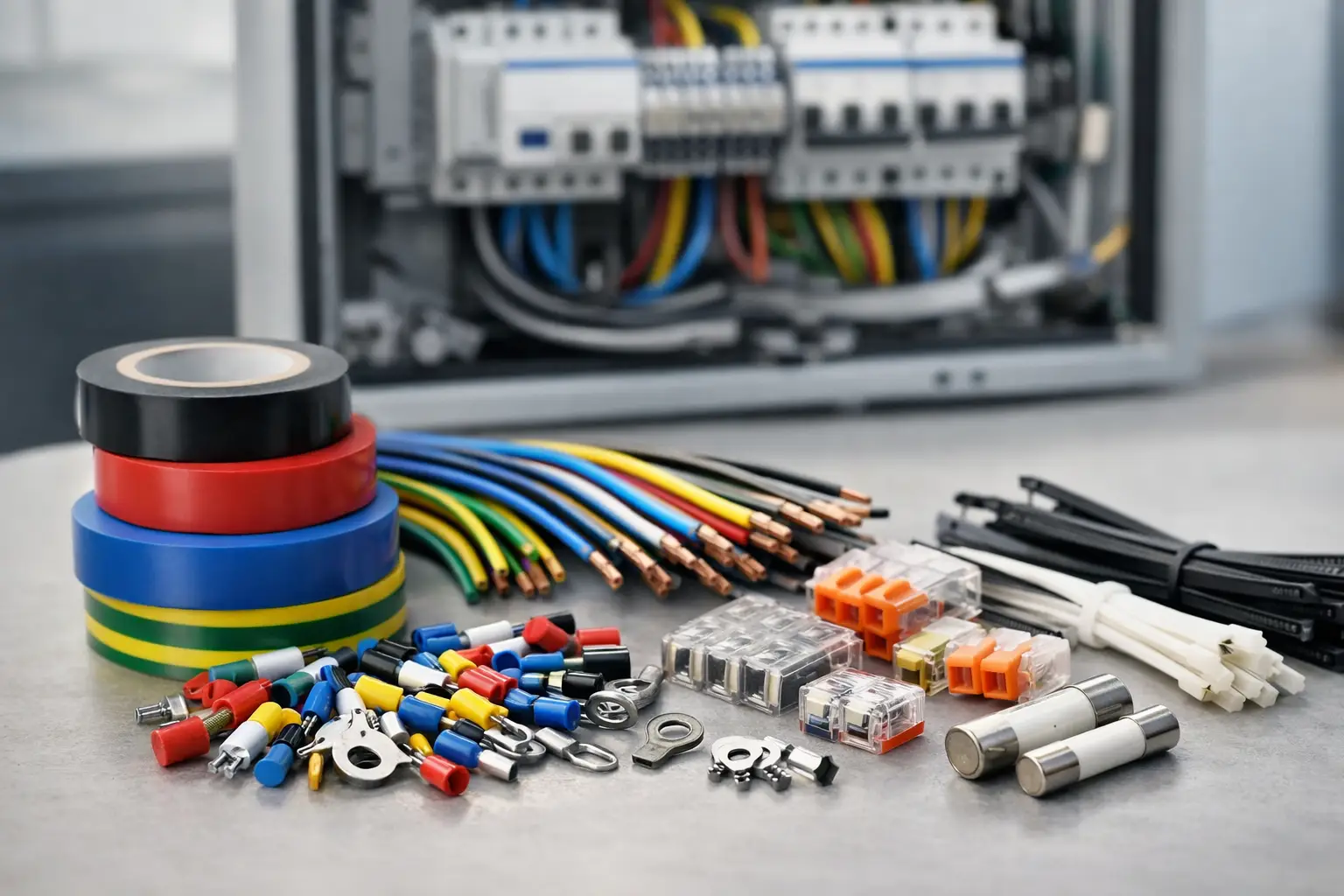
Electrical consumables for panels are the supporting items used during assembly, termination, identification, protection, and finishing. They sit around the core devices, but they are essential to panel performance. This category typically includes cable lugs, ferrules, cable glands, cable ties, wire markers, heat shrink sleeves, insulating tapes, terminal accessories, mounting hardware, and panel locking or sealing accessories.
For procurement teams, the practical question is not whether these items are needed. It is which grades, sizes, and material types make sense for the panel type, cable entry method, current load, and operating environment. A clean bill of materials saves time only when the selected consumables match the application.
Best electrical consumables for panels by function
Cable lugs and ferrules
If there is one area where shortcuts are expensive, it is terminations. Copper lugs and bootlace ferrules help create low-resistance, mechanically secure connections. In control panels with fine-stranded conductors, ferrules reduce strand damage and produce a more reliable terminal fit. In power panels, correctly sized lugs are critical for current handling and heat control.
The best choice depends on conductor class, terminal type, and installation method. Tinned copper is commonly preferred because it resists corrosion better than plain copper, especially in demanding environments. Thickness and barrel quality matter too. A cheaper lug may crimp, but it may not maintain the same mechanical hold over time.
This is also where tool compatibility matters. Good consumables paired with poor crimping tools still lead to poor results. Buyers sourcing from a single supplier often reduce this risk because termination accessories and the related electrical components can be aligned from the start.
Cable glands and entry accessories
A panel can look complete and still be vulnerable at every cable entry point. Cable glands provide strain relief, sealing, and protection against dust or moisture ingress. On indoor control panels, nylon glands are often sufficient if the environment is dry and the mechanical load is moderate. For industrial areas, external installations, or higher mechanical stress, brass glands usually make more sense.
The decision should reflect ingress protection requirements, cable type, and site conditions. An oversized gland weakens sealing. An undersized gland slows installation and can damage the sheath. Where armoring is involved, using the correct gland type is not optional.
This is one of the most common areas where specification support saves time. A panel serving a clean electrical room does not need the same gland selection as a panel feeding rooftop equipment or exposed outdoor services.
Wire markers and labeling consumables
Fast installation is valuable, but traceability during testing and maintenance is just as important. Clear cable and terminal identification reduces troubleshooting time and supports handover quality. Good markers also help when future modifications are required.
For panel work, the best marking consumables are the ones that stay legible under heat and handling. Sleeve markers, self-adhesive labels, clip-on markers, and terminal tags all have their place. The right option depends on cable size, expected abrasion, and how permanent the identification needs to be.
Poor labeling often shows up late - during commissioning, snag rectification, or maintenance. By then, the labor cost of fixing it is much higher than the cost of choosing durable identification materials at the procurement stage.
Cable ties, tie mounts, and routing accessories
Cable management affects more than appearance. Proper routing reduces strain on terminations, keeps segregation clear, and improves airflow inside the enclosure. Good-quality cable ties and mounts help maintain that order over time.
This category looks simple, but material grade matters. Standard nylon ties may work in many indoor applications, but elevated temperatures, UV exposure, or chemical contact can shorten service life. In some installations, stainless steel ties or higher-performance polymer options are the better fit.
For panel builders, consistency is also important. Mixed tie quality across a project creates uneven installation standards and avoidable maintenance issues. The better approach is to standardize approved tie types by application.
Heat shrink, insulating tape, and insulation supports
Insulation consumables are often used as finishing materials, but they also provide functional protection. Heat shrink sleeves support identification, insulation reinforcement, and cable joint finishing. Electrical tape can be useful for temporary bundling or minor insulating support, but it should not be used to compensate for poor termination or missing accessories.
The trade-off here is simple. Basic insulation products may be acceptable for light-duty internal work, while higher-grade, flame-retardant, or adhesive-lined products are more appropriate when durability and environmental resistance matter. On commercial and industrial jobs, using municipality-compliant materials helps reduce approval and safety risks.
Terminal block accessories and mounting hardware
Panel reliability depends heavily on order and retention. End stops, separators, marker strips, jumpers, DIN rail accessories, gland plates, screws, washers, and support hardware all contribute to a panel that can be assembled efficiently and maintained without disturbance.
These parts are easy to under-specify because they are low-value line items. Yet missing or incompatible accessories can stop assembly just as quickly as a missing breaker. Procurement teams managing multiple projects usually benefit from stocking these items in standard project packs rather than buying them reactively.
How to choose the right grade for the job
The best electrical consumables for panels are not always the most expensive. They are the ones that fit the panel duty, pass inspection, and avoid rework. That means evaluating four factors before ordering.
First, consider environment. Indoor electrical rooms, outdoor service areas, humid basements, and dusty industrial spaces place very different demands on glands, ties, labels, and insulation materials.
Second, consider compliance. If a project requires municipality-compliant materials or approved brand documentation, that should shape the shortlist from the beginning, not after submittal rejection.
Third, consider labor efficiency. A lower-cost consumable that slows crimping, labeling, or routing can raise installed cost across dozens of panels. Contractors usually feel this most on repetitive work such as residential towers, hospitality projects, and large fit-outs.
Fourth, consider continuity of supply. A consumable that performs well but is hard to replenish creates another problem. For project buyers, consistency across phases matters as much as first-purchase price.
Common buying mistakes that create panel problems
One common mistake is treating consumables as generic equivalents. Some are interchangeable. Many are not. Ferrule dimensions, gland thread compatibility, lug barrel quality, and label adhesive performance can vary enough to affect installation and inspection.
Another mistake is buying panel consumables from multiple low-visibility sources just to trim line-item cost. That can create mixed quality, weak traceability, and delays when warranty or technical clarification is needed. On active sites, time lost coordinating replacements often costs more than the original savings.
A third issue is ordering exactly to theoretical quantity. Panel work nearly always needs some contingency for testing changes, routing adjustments, damaged pieces, or minor design revisions. Smart procurement builds in enough buffer to keep assembly moving without overstocking heavily.
Why consolidated sourcing helps contractors
Panel consumables are rarely purchased alone. They usually sit alongside electrical components, fasteners, hand tools, cable management items, and site-use installation materials. Sourcing them together reduces coordination, improves compatibility, and keeps deliveries aligned with the build sequence.
For contractors handling projects across Dubai, Sharjah, Abu Dhabi, Fujairah, and Ras Al Khaimah, speed matters as much as specification. A supplier with inventory readiness and on-time site delivery can protect the schedule when a panel package needs urgent replenishment or when last-minute quantity revisions happen after installation starts.
This is where a distributor such as Yasu Trading Co. LLC adds practical value beyond supply. The advantage is not only access to approved products, but also project-based quoting, technical guidance on selection, and a procurement process built around execution rather than one-off counter sales. When panel consumables, electrical components, tools, and related site materials move through one supply channel, the job is easier to manage.
The best panel consumables are the ones nobody has to think about after installation. They fit correctly, hold their performance, support clean inspections, and arrive when the site needs them. If your next panel package is under schedule pressure, choose consumables with the same discipline you apply to the main equipment. That is usually where the real savings start.