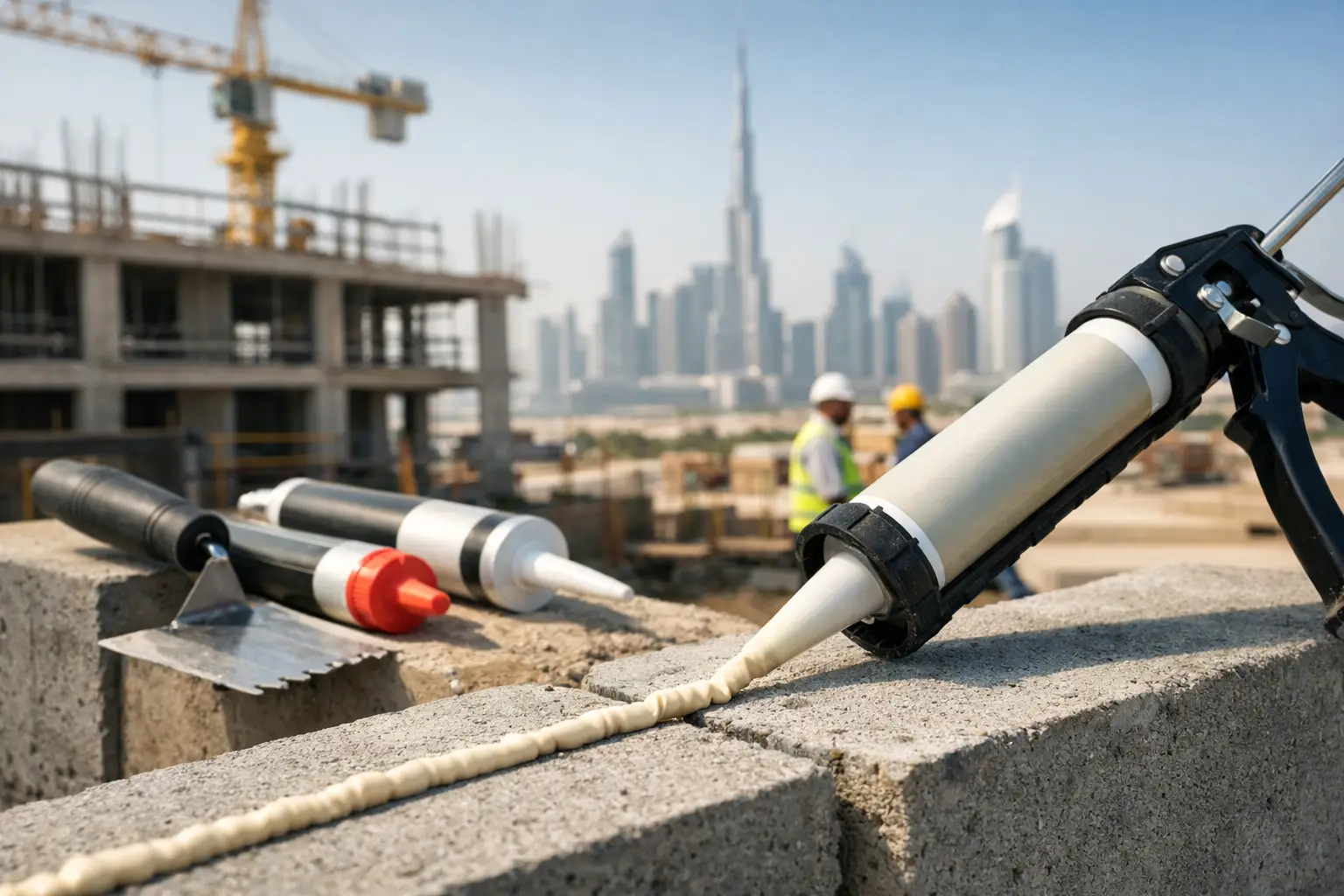
Construction Adhesive Performance Review for UAE Sites
A construction adhesive performance review should begin before the cartridge reaches the site. For contractors, the question is not whether an adhesive can bond two materials in a controlled test. The question is whether it will hold under substrate movement, heat exposure, moisture, installation tolerances, and the actual loading conditions of a project.
Adhesive failure can create more than a finishing defect. Loose wall panels, debonded skirting, failed mirror installations, or improperly fixed MEP supports can stop follow-on trades, trigger rework, and complicate handover. Selecting the correct product class, confirming approved substrates, and allowing the stated cure time are practical controls that protect schedule and compliance.
What Adhesive Performance Means on a Jobsite
Construction adhesives are evaluated by more than initial grab. A product that feels secure within minutes may still require several days to reach its stated final strength. Procurement teams and site engineers should assess performance across the full installation cycle: surface preparation, application, positioning, curing, service exposure, and long-term movement.
Initial grab matters when fixing vertical materials such as decorative panels, lightweight trims, and skirting. Higher grab reduces the need for temporary mechanical support, but it does not replace fasteners where the specification requires them. Final bond strength matters more for loaded components, while flexibility determines whether the adhesive can accommodate expansion, vibration, and differential movement between dissimilar materials.
The UAE environment adds another layer of consideration. High ambient temperatures, dusty substrates, humidity in wet areas, and thermal movement around external openings can change results significantly. An adhesive suitable for a conditioned interior may not be appropriate for an exposed façade detail or a constantly wet service area.
Construction Adhesive Performance Review by Product Type
Different adhesive chemistries solve different site problems. Treating all cartridges as general-purpose bonding products is a common source of failures.
Polyurethane Construction Adhesives
Polyurethane adhesives are widely selected for strong, flexible bonds across wood, concrete, metal, masonry, and many common construction boards. They are useful where minor movement is expected and where a more durable bond is required than a basic acrylic adhesive can provide.
Their main trade-off is application control. Polyurethane products can expand slightly during curing, may require moisture to cure correctly, and can be difficult to remove once set. Installers should avoid over-applying the bead, confirm compatibility with coated surfaces, and use gloves and appropriate cleanup materials. For heavy assemblies, temporary bracing or mechanical fixing may still be necessary until the adhesive reaches handling strength.
Hybrid Polymer and MS Polymer Adhesives
Hybrid polymer adhesives are a strong option for interior and exterior bonding where flexibility, weather resistance, and lower odor are priorities. They commonly adhere well to concrete, aluminum, painted metals, timber, ceramics, and certain plastics. Their ability to remain elastic makes them particularly useful around materials with different expansion rates.
Performance depends heavily on the substrate. Powder-coated aluminum, low-energy plastics, oily metals, and painted surfaces may require a primer or a site adhesion test. A product may bond firmly to the coating while the coating itself separates from the base metal. That is not adhesive failure, but it produces the same costly outcome.
Solvent-Based Contact Adhesives
Contact adhesives are suitable for laminates, rubber, leather, certain floor finishes, and applications requiring immediate bonding after both surfaces are coated and allowed to flash off. They are valued for speed, especially in fit-out work where clamping is impractical.
They leave little room for repositioning. Once the prepared surfaces meet, correction is difficult. Ventilation, fire safety controls, and manufacturer instructions are essential because solvent-based products can have strong fumes and flammability considerations. They should not be selected simply because they bond quickly.
Acrylic and Water-Based Adhesives
Acrylic adhesives are commonly used for lighter-duty interior applications, including polystyrene moldings, wall trims, some decorative panels, and porous substrates. They are often easy to apply and clean, but they are generally less suitable for permanent wet exposure, high-load fixing, or demanding exterior conditions.
Their performance is closely linked to drying conditions. Thick beads, nonporous materials, low ventilation, and high humidity can extend cure times. If a project needs early loading or is installing nonporous materials on both sides of the joint, a different adhesive class may be the safer specification.
The Substrate Decides the Bond
Most adhesive issues begin with the surface, not the product. Concrete must be sound, dry as required by the product data, and free from curing compounds, laitance, dust, or loose paint. Metal needs to be free from oil and oxidation. Timber moisture content must be appropriate for the intended environment. Tiles and glazed surfaces often need cleaning and abrasion to create a reliable bonding profile.
A visible surface can also hide a weak layer. Fresh paint, gypsum skim coats, waterproofing membranes, and decorative coatings should be assessed as part of the bond system. If the adhesive is stronger than the surface finish, the finish can peel away under load.
For critical applications, conduct a representative site trial using the actual materials, expected bead size, and service conditions. This is particularly valuable for stone cladding, mirrors, large-format panels, insulated boards, and mixed-material assemblies. A small trial can prevent a large-scale replacement program.
Check These Performance Factors Before Ordering
When comparing construction adhesives for a project, procurement teams should request technical data rather than relying on a broad label claim. The key checks are:
- Approved substrates: Confirm the product is intended for every material in the assembly, including coatings and membranes.
- Tensile and shear strength: Match bond capacity to the direction and level of loading, not just a general strength description.
- Movement capability: Select a flexible adhesive where thermal expansion, vibration, or dissimilar materials are involved.
- Cure profile: Review skin time, handling strength, full cure time, and the effects of temperature and humidity.
- Service resistance: Check suitability for water, heat, UV exposure, chemicals, and intermittent or permanent wet conditions.
- Compliance requirements: Verify relevant municipality approvals, fire-performance requirements, VOC restrictions, and project specifications.
The stated coverage rate also deserves attention. A cartridge that appears lower priced can cost more per installed meter if it requires wider beads, wastes material through poor application, or needs additional temporary supports.
Avoiding Common Installation Failures
The fastest adhesive is not always the fastest installation method. Teams often lose time by applying product to dusty concrete, joining surfaces after the open time has passed, or loading an assembly before full cure. These errors can remain hidden until the project is nearing completion.
Control the installation with a simple method statement. Confirm substrate preparation, bead pattern, minimum and maximum joint dimensions, temporary support requirements, and cure protection. Store cartridges within the manufacturer’s recommended temperature range and rotate stock by expiry date. Expired or heat-damaged adhesive can become difficult to dispense and may not perform as specified.
For applications involving mirrors, natural stone, or sensitive finishes, verify that the adhesive will not stain, bleed through, attack backing layers, or discolor the material. For fire-rated assemblies, use only the exact tested system identified in the approved detail. A high-strength general adhesive is not a substitute for a firestop or rated construction joint sealant.
Procurement Decisions That Protect the Schedule
A reliable adhesive supply plan is based on more than choosing a brand. Contractors need consistent batch availability, compatible applicator tools, primers where required, and enough stock to complete continuous installation areas without changing products midway. Substituting adhesive types mid-installation can create inconsistent cure behavior, color differences, or warranty issues.
For multi-site or phased work, consolidate the adhesive, sealant, fastening, and application-tool requirements under one controlled material schedule. This gives site teams clearer substitution rules and reduces last-minute purchasing from unverified sources. Yasu Trading supports this approach with jobsite-ready adhesives and sealants, supporting tools, technical product guidance, and direct delivery for active UAE projects.
Before releasing the purchase order, align the product data sheet with the consultant specification, confirm shelf life at delivery, and reserve enough material for mockups and site testing. The right adhesive is the one that performs predictably on the actual substrate, fits the installation sequence, and keeps the next trade moving without rework.