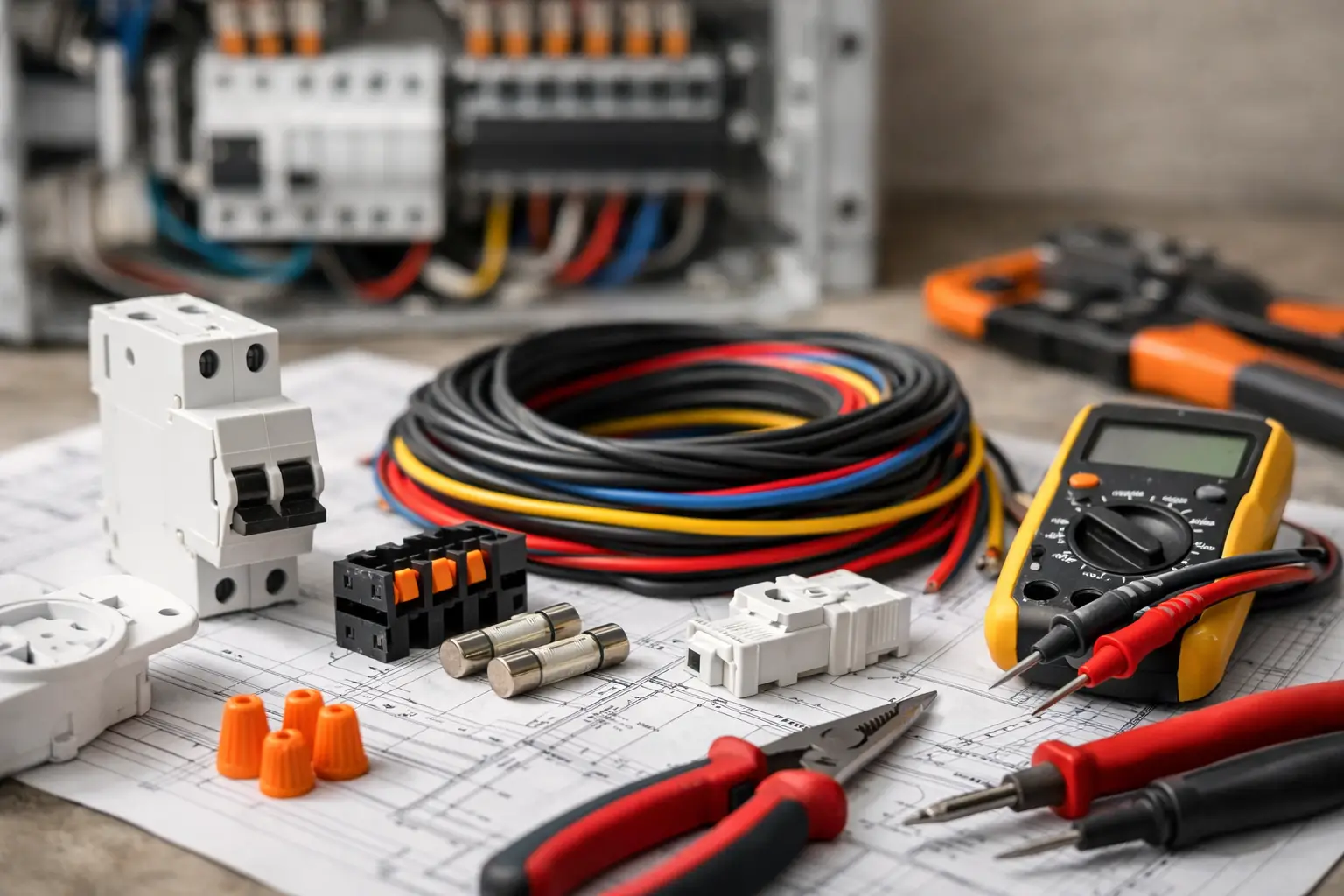
Contractor Guide to Electrical Components
A missing gland, an incorrect breaker curve, or cable delivered without the required approvals can stop an otherwise ready workfront. This contractor guide to electrical components is built for the procurement decisions that affect installation quality, authority inspections, and handover dates. For UAE projects, the lowest unit price is rarely the real saving if it creates rework, replacement orders, or a failed inspection.
Electrical materials should be bought as a coordinated system, not as separate line items. Cable must suit the load and installation method; protection must coordinate with the circuit; containment must protect and route the wiring; and accessories must match the environment and drawing requirements. The practical objective is simple: get approved, correctly specified materials to site when the work crew needs them.
Start With the Approved Electrical Specification
Before releasing a purchase order, procurement teams should work from the latest approved material submittal, single-line diagram, load schedule, and coordinated shop drawings. A generic description such as “MCB 20A” is not enough. The required poles, breaking capacity, trip curve, mounting arrangement, manufacturer approval, and panel compatibility can all change the acceptable item.
The same applies to cables. Confirm conductor material, insulation type, voltage rating, core count, cross-sectional area, fire-performance requirement, sheath type, and whether the cable will run indoors, outdoors, underground, in trunking, or in a riser. A cable size selected from a basic load calculation may still be unsuitable after derating for ambient temperature, grouping, thermal insulation, or installation method.
For public, commercial, and high-rise work, align every electrical component with project specifications and the relevant local authority requirements before bulk ordering. Requirements vary by project location, consultant, building type, and client standard. Ask for product data, test documentation, certificates where required, and clear identification of the approved brand and model. Substitutions can be useful when a specified item has an extended lead time, but only when technical equivalence is documented and approved before installation.
Core Electrical Components Contractors Need
Cables, Wires, and Termination Materials
Cables form the permanent connection between design intent and operating equipment. Common site requirements include building wires, flexible cables, low-voltage power cables, control cables, armored cables, and earth conductors. The correct choice depends on voltage, current, voltage drop, fault level, route conditions, and the equipment being supplied.
Do not treat cable accessories as minor purchases. Cable lugs, ferrules, glands, heat-shrink sleeves, junction boxes, cleats, cable ties, markers, and termination kits determine whether the finished connection remains safe and serviceable. A gland must match the cable diameter, armor arrangement where applicable, enclosure entry, and environmental rating. Using an oversized or unsuitable gland can compromise enclosure protection and make a clean inspection difficult.
For large pulls, plan the cable order around drum lengths and routing sequence. This reduces unnecessary joints, handling damage, and wasted offcuts. It also helps site teams stage material by floor, zone, or distribution board rather than searching through mixed deliveries.
Circuit Protection and Distribution Equipment
Circuit breakers, residual-current devices, isolators, contactors, overload relays, surge protection devices, and distribution boards protect people, equipment, and the electrical installation. Their selection is a coordination task, not a catalog exercise.
An MCB or MCCB must have suitable current rating, poles, breaking capacity, trip characteristics, and compatibility with the panelboard or distribution board. The available fault current at the installation point matters. Selecting a device with inadequate interrupting capacity can create a serious compliance and safety issue even when its ampere rating looks correct.
Residual-current protection requires similar care. Sensitivity, device type, selectivity, and the loads served all affect selection. Electronic equipment, variable-speed drives, and certain specialist loads may need a device type that differs from a standard general-purpose application. Confirm the engineer’s design and approved schedule rather than making assumptions based on a prior project.
For distribution boards and control panels, verify incomer rating, busbar capacity, outgoing ways, IP rating, metering requirements, labeling, spare capacity, and enclosure material. A board that fits the electrical schedule but cannot accommodate the actual cable entry or site environment creates avoidable modification work.
Containment and Cable Support
Conduit, trunking, cable tray, ladder systems, flexible conduit, fittings, supports, and fasteners protect cable routes and keep installations organized. Containment is often where coordination failures become visible first, especially above ceilings and in crowded service corridors.
Choose the containment material and finish for the environment. Indoor dry areas may have different needs from plant rooms, rooftops, parking areas, coastal locations, and chemically exposed spaces. Confirm corrosion resistance, load capacity, cover requirements, bend radii, earthing continuity, and the support spacing specified for the system.
A good procurement package includes matching bends, couplers, tees, reducers, cover plates, clamps, threaded rods, channel supports, anchors, and bonding accessories. Ordering only the main tray or trunking lengths creates urgent site requests later and often leads to mismatched fittings. Consolidating these related items under one electrical materials schedule gives the site team a complete installable system.
Switches, Sockets, and Final-Fix Accessories
Final-fix accessories are highly visible to clients, but the procurement risk is not only cosmetic. Switches, sockets, dimmers, isolators, junction boxes, floor boxes, weatherproof outlets, and mounting plates must suit the load, mounting condition, finish schedule, and required ingress-protection rating.
Wet areas, external locations, kitchens, workshops, and plant rooms need particular attention. An accessory appropriate for an air-conditioned office may not be suitable where moisture, dust, washdown, or mechanical impact is expected. Keep approved samples and finish references available so the final-fix package remains consistent across the project.
A Contractor Guide to Electrical Components: Buying for Site Readiness
The strongest electrical procurement process separates long-lead decisions from routine replenishment. Switchgear, specialized panels, fire-rated cable systems, branded accessories, and project-specific enclosures may require early approval and production planning. Standard conduit fittings, cable management hardware, fasteners, tapes, hand tools, and common protection devices can often be supplied from stock, but should still be forecast against the construction program.
Issue purchase requests in workfront packages. For example, a floor rough-in package may include conduits, boxes, fittings, supports, wire pulling tools, labels, and consumables. A riser package may include cable, tray, cleats, glands, lugs, earthing materials, and identification products. This approach prevents the common problem of delivering cable to a site without the containment or termination materials needed to install it.
Receiving checks should be as disciplined as ordering checks. Verify quantities, manufacturer, part numbers, ratings, physical condition, batch or drum details where relevant, and supporting documents before materials are distributed. Store cable drums upright and protected, keep breakers and accessories dry, and separate approved project materials from unapproved alternatives or returns.
Where Trade-Offs Require Judgment
Not every project needs the highest specification available. A premium enclosure in a protected indoor room can add cost without adding meaningful value. Conversely, choosing a low-grade outdoor fitting because it is immediately available can lead to corrosion, water ingress, and replacement work. The right decision depends on the installation environment, approved specification, warranty expectations, maintenance access, and lifecycle cost.
Brand consistency also has practical value. Standardizing approved breaker ranges, accessory series, cable glands, and containment systems simplifies installation, spare parts, warranty handling, and maintenance training. However, standardization should not prevent an approved equivalent from being considered when availability threatens the program. The key is controlled substitution, supported by technical data and consultant approval.
For contractors managing multiple sites, a B2B supplier with electrical components, plumbing materials, fasteners, tools, adhesives, and safety equipment can reduce supplier coordination and delivery gaps. Yasu Trading supports this procurement model with inventory-backed wholesale supply, specification guidance, and site-directed dispatch for projects that need materials without adding another purchasing cycle.
Questions to Ask Before You Release the Order
Use these checks for high-value or safety-critical electrical packages:
- Does the item exactly match the approved make, model, rating, and project specification?
- Is it suitable for the actual installation environment, including heat, moisture, dust, corrosion, and exposure?
- Are all fittings, terminations, supports, labels, and consumables included for a complete installation?
- Have authority, consultant, client, and warranty documentation requirements been confirmed?
- Can the supplier deliver by workfront, with the right quantities and packing for site handling?
Electrical procurement works best when the material schedule is treated as part of the construction plan, not an administrative task after mobilization. Get a quote against your approved bill of quantities and submittals early, then schedule releases around the workfront. The right component is valuable only when it arrives approved, complete, and ready for installation.