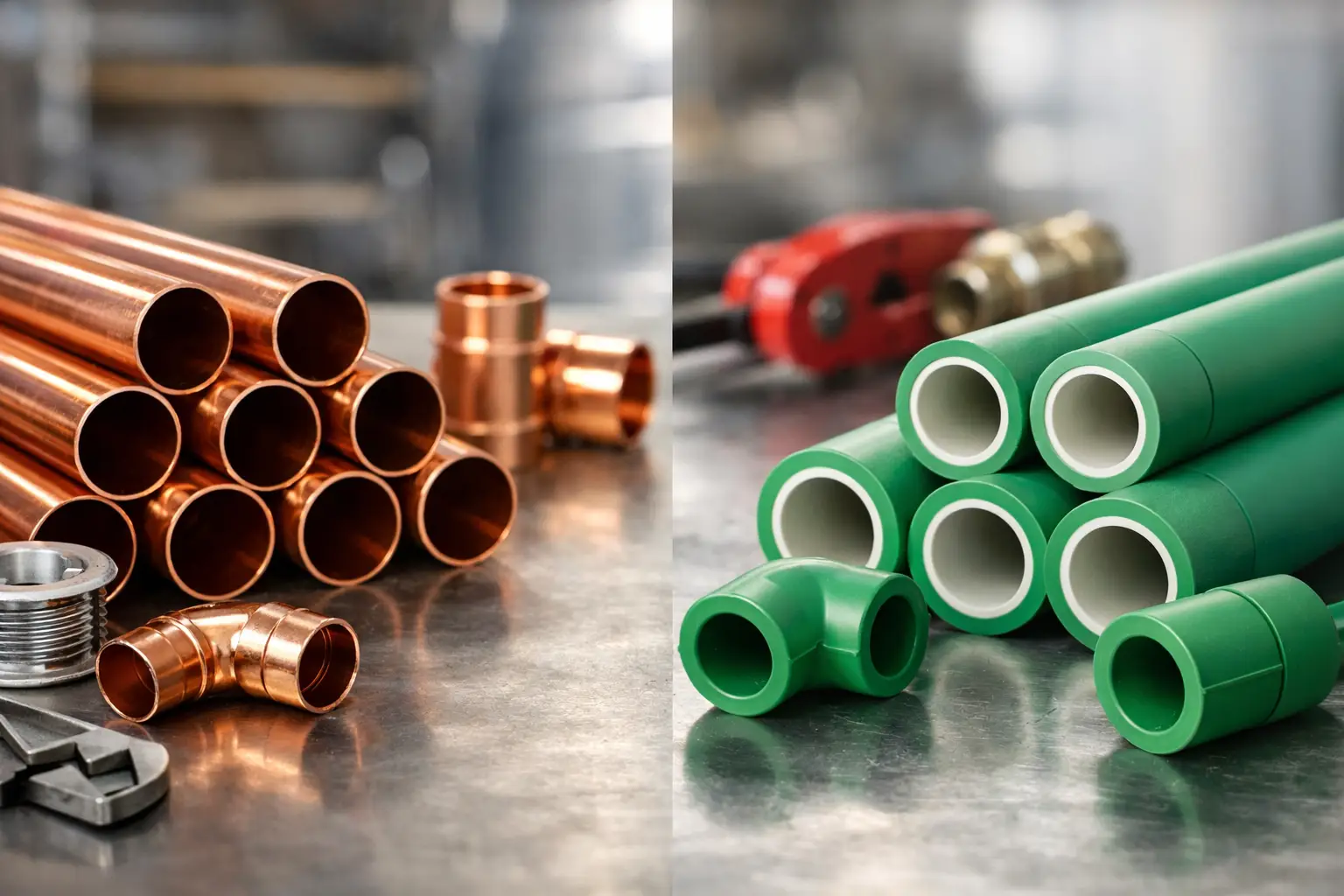
Copper Versus PPR Piping for UAE Projects
A piping decision can affect far more than the plumbing package. It changes labor planning, pressure-testing procedures, ceiling coordination, maintenance exposure, and the likelihood of rework after inspection. When comparing copper versus PPR piping, contractors should look beyond material cost and assess the full operating conditions of the building, the approved specification, and the installation capability available on site.
For UAE projects, neither material is automatically the better choice. Copper remains a proven option for demanding hot-water and specialist applications. PPR, or polypropylene random copolymer, has become a common choice for domestic hot and cold-water distribution because it is corrosion-resistant, efficient to install, and cost-effective at project scale. The right selection depends on the system duty, project type, client requirements, and compliance documentation.
Copper Versus PPR Piping: The Decision Factors
The first procurement question should be simple: what is the pipe expected to carry, at what temperature and pressure, for how long? A domestic cold-water branch line in a residential tower has different demands from a recirculating hot-water system in a hotel, a commercial kitchen line, or a plant-room connection.
Copper is a metallic pipe with high temperature tolerance and a long performance record when it is correctly specified, supported, insulated, and connected. It is often selected where the design calls for a compact pipe profile, strong mechanical protection, high-temperature service, or compatibility with existing copper installations.
PPR is a thermoplastic system joined by heat fusion. The pipe and fitting are heated, then fused into a continuous joint. There is no thread sealant, solder, or mechanical compression joint at the connection. Properly completed fusion joints are reliable, but the installation quality depends heavily on trained technicians, clean tools, correct heating time, and accurate alignment.
In practical terms, copper is usually chosen for performance requirements that justify its higher material and labor cost. PPR is usually chosen for economical, corrosion-resistant water distribution where approved system temperatures and pressures are within the manufacturer’s published limits.
Material Cost Is Only Part of the Project Cost
Copper generally carries a higher upfront cost because the raw material is more expensive and the installation requires skilled labor. Joining methods such as brazing, soldering, press connections, or compression fittings can also increase the cost of fittings, equipment, testing, and labor supervision. Copper pricing may fluctuate with commodity markets, which can affect a long project’s procurement budget.
PPR pipe and fittings are typically more economical for large domestic water networks. The material is lightweight, easier to move through congested sites, and fast to assemble with the correct fusion equipment. This can reduce handling time and support efficient installation across repetitive apartment, hotel-room, and villa layouts.
However, a lower purchase price does not excuse poor system design. PPR requires allowance for thermal expansion, especially on hot-water runs. Long exposed or concealed lines need correctly positioned supports, anchors, and expansion provisions. If these details are missed, pipe movement can create noise, stress at fittings, or poor finishes around shafts and ceilings.
For a fair comparison, procurement teams should price the full bill of materials: pipe, fittings, valves, insulation, supports, joining tools, labor, pressure testing, and expected maintenance. Comparing only the per-meter pipe rate often produces the wrong commercial decision.
Temperature, Pressure, and Water Service Conditions
Copper performs well across a broad temperature range and has strong resistance to physical damage. It is a familiar choice for hot-water and recirculation lines, particularly where high operating temperatures or frequent temperature changes are expected. It also has low thermal expansion compared with plastic piping, simplifying routing in constrained service areas.
PPR is suitable for many hot and cold-water applications, but its pressure capacity changes with water temperature and service life. A pipe rated for one pressure at room temperature will have a lower allowable pressure at elevated temperatures. The selected pipe series, wall thickness, temperature rating, and manufacturer documentation must therefore match the approved design conditions.
This point matters for central hot-water systems. Before purchasing PPR, confirm the design supply temperature, recirculation temperature, pressure, disinfection cycle requirements, and expected operating life. Do not assume that any green PPR pipe is suitable for every hot-water service. Approved product data and the consultant’s specification should control the selection.
Water chemistry also deserves attention. Copper can be affected by aggressive water conditions, poor grounding practices, or unsuitable connections to dissimilar metals. PPR does not corrode internally, which is a major advantage for water quality and long-term flow performance. Yet PPR should still be protected from direct UV exposure unless the selected system is specifically designed for it or appropriately shielded.
Installation Speed and Jobsite Control
PPR offers a clear advantage when installation speed and labor efficiency are priorities. Fusion welding can be performed quickly by trained crews, and the lightweight pipe reduces lifting and transportation effort. On repetitive MEP works, this can help contractors maintain production targets without compromising joint integrity.
The key phrase is trained crews. Overheating can restrict the bore, while insufficient heating can create a weak joint. Misalignment during fusion can also cause stress and poor appearance. Contractors should use calibrated fusion machines, correct sockets, clean cutting tools, and documented installation procedures. Random fittings and pipe from different systems should not be mixed without manufacturer approval.
Copper installation can take longer, particularly when brazing is required. Hot works permits, fire-watch procedures, ventilation, and access restrictions can add time in finished areas or occupied facilities. Press-fit systems may reduce installation time and avoid some hot-work risks, but they still require correct tool calibration, fitting compatibility, and visual inspection.
For fast-track projects, the best option may depend on site conditions rather than pipe performance alone. PPR can accelerate new-build domestic water distribution. Copper or press-fit copper may be more practical for tie-ins, restricted plant rooms, exposed services, and locations where mechanical protection is a priority.
Durability, Maintenance, and Repair Planning
Both systems can provide long service when they are correctly designed and installed. The common causes of failure are often not the pipe material itself. Unsupported runs, poor joints, unsuitable valves, excessive pressure, damaged insulation, and incorrect coordination with other trades create more problems than the material choice.
Copper is highly resistant to impact and can be a good fit for exposed installations, service rooms, and areas at risk of accidental damage. It can be repaired by qualified plumbers using established methods, although repair work may require hot-work controls or specialized press tools.
PPR has smooth internal walls and will not suffer internal rust or scale in the same way metal piping can. It is well suited to concealed distribution routes when protected from physical damage and installed with expansion movement in mind. Repairs require the correct fusion process and sufficient working space around the damaged section, which should be considered before closing shafts or installing ceilings.
Maintenance teams should also consider identification and spare availability. A building handover package should record pipe material, pipe class, fitting system, valve locations, pressure-test results, and approved repair method. This reduces response time when a future modification or emergency repair is required.
Compliance and Specification Control
Municipality-compliant materials are not simply a purchasing preference. They protect the contractor from rejected submittals, inspection delays, and disputes at handover. Before issuing a purchase order, confirm that the pipe system meets the consultant-approved specification and applicable local authority requirements for the project.
Submittals should include manufacturer data sheets, test certificates where required, pressure and temperature ratings, warranty terms, and fitting compatibility information. For copper, verify the pipe standard, temper, wall thickness, and approved joining method. For PPR, verify the pipe classification, SDR or wall thickness, operating limits, and approved fusion procedure.
Brand consistency matters. A piping system is tested as a system, not as unrelated pipe and fittings collected from multiple sources. Using compatible plumbing pipes and fittings from an authorized supply channel helps protect warranty coverage and makes technical verification easier during procurement and inspection.
Which Pipe Should Your Project Use?
Choose copper when the design requires high-temperature capability, compact routing, strong mechanical resistance, exposed installation performance, or continuity with an existing copper system. It can be the stronger long-term choice where its higher installed cost is justified by the operating environment.
Choose PPR when the application is approved domestic hot or cold-water distribution, corrosion resistance is a priority, and the project benefits from fast installation and lower total material cost. It is particularly effective when the installation team understands fusion welding and the design includes correct support and expansion details.
For mixed-use developments, the answer may be both. A project can use PPR for risers and domestic distribution while using copper in plant rooms, equipment connections, or specific high-demand areas. This approach should be driven by the approved design, not by a one-material rule.
A dependable procurement plan starts with approved drawings, pressure and temperature data, and a complete takeoff of pipes, fittings, valves, insulation, supports, and testing accessories. Yasu Trading Co. LLC can support contractors with jobsite-ready plumbing material supply, specification guidance, and project-based quotes that help keep purchasing aligned with the installation sequence. Choose the pipe system that your project can install, test, protect, and maintain with confidence - that is what keeps handover dates intact.