Corrugated PP Sheet: A UAE Buyer's Selection Guide
You've laid the protection, the crew has walked it for three days, and now the marble under the trolley lane shows a dull grey track that won't wipe off. The sheet hasn't torn. It has crushed at the flutes and pressed the grit it collected into the polish.
That's how corrugated PP usually fails on a UAE fit-out. Not dramatically, and rarely on day one. It fails because somebody bought thickness by price, put the sheet where the fire code doesn't allow it, and had no plan for what happens when the hoarding comes down.
Three decisions carry nearly all the risk: which thickness goes in which load zone, whether the location permits a plastic sheet at all, and where the material goes after handover. Get those right and this is one of the cheapest, most reusable items on site. Get them wrong and you're paying for a marble re-polish.
What Corrugated PP Sheet Actually Is
On a hotel fit-out in Deira, the crew unrolls 3 mm corrugated PP sheet over polished marble, tapes the joints and moves on. Within a week, trolley runs along the service corridor leave permanent creasing in the flutes, and the polish shows a grey track where grit worked underneath. The sheet didn't tear. It crushed, and then it behaved like a sanding block.
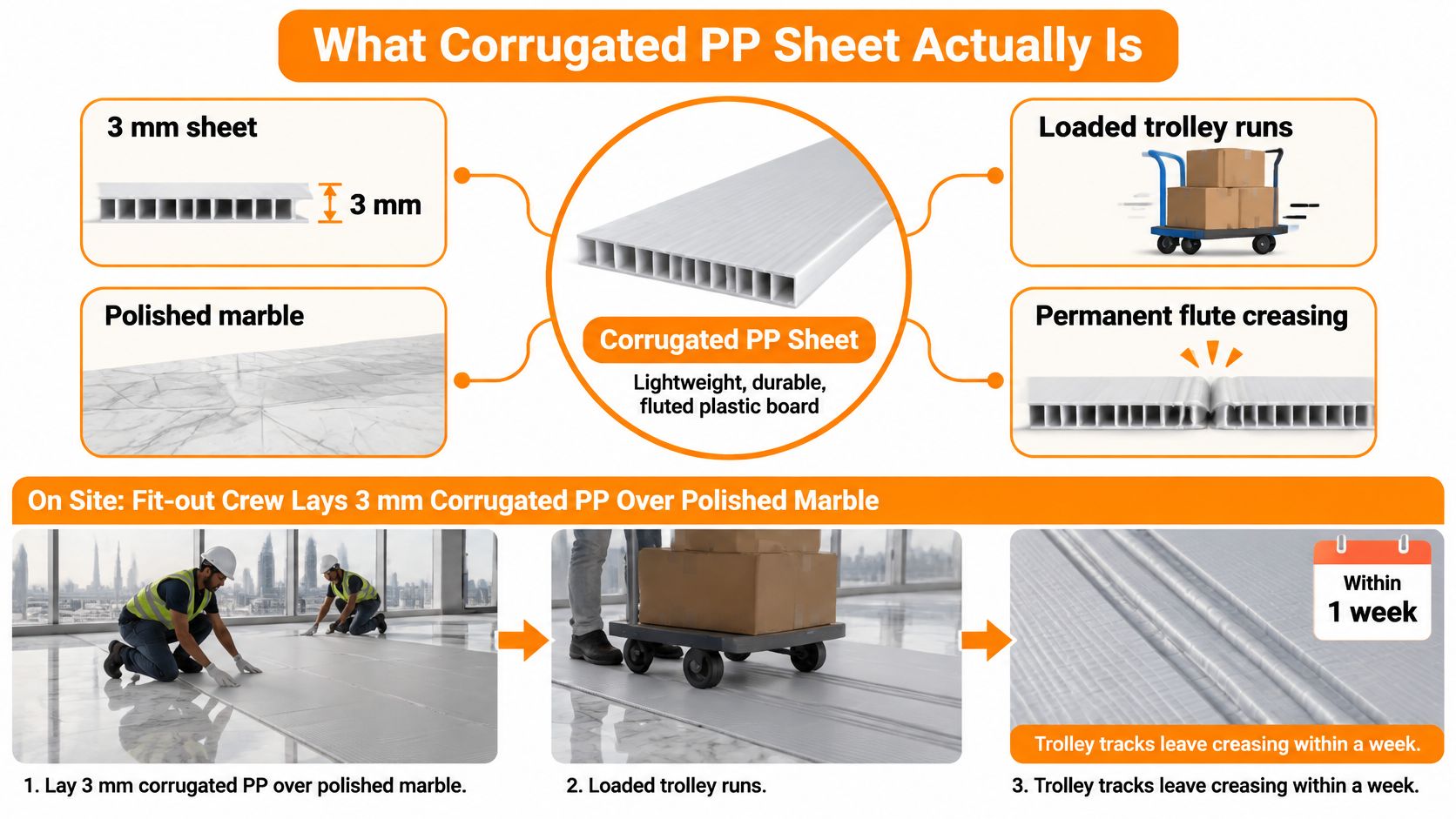
Corrugated PP sheet is a twin-wall or fluted polypropylene panel: two thin skins joined by a continuous rib structure that gives stiffness at very low weight. There's no paper core and no fibre reinforcement, which is why the material doesn't readily absorb water and why a clean sheet can be shredded and reprocessed instead of landfilled.
The properties that matter on site are few and practical:
- Lightweight and rigid: one person carries a full sheet up a stair core without a trolley.
- Impact and moisture resistant: wash-down, spills and air-conditioning condensate don't soften it.
- Knife-cuttable: trimming around columns, door frames and risers takes seconds with a fresh blade.
- Printable and weldable: useful for signage and for permanent joints on reusable partitions.
- Reusable: a sound sheet moves from a corridor to a store to a loading bay across several phases.
The application map runs wider than floor protection. Twin-wall sheet covers temporary floor and surface protection, concrete protection, hoarding and signage, temporary partitions, packaging inserts and reusable transport trays.
UAE supply isn't a thin import story either. Borouge's start-up of its fifth polypropylene unit at Ruwais added 480,000 tonnes per year of polypropylene capacity in 2021 and took the company's total PP capacity to 2.24 million tonnes per year, an increase of more than 25 per cent. That's polymer capacity rather than sheet output, but it tells you regional converters have standard grades close by. Dataintelo puts the global corrugated polypropylene sheet market at USD 7.8 billion in 2025, with a dedicated Middle East and Africa analysis behind the figure.
Corrugated PP Sheet Thickness Chart by Load Zone
Read this chart by load zone, not by preference. Pick the row that matches the heaviest load the sheet will ever see, not the average day, then treat that thickness as a starting point for a site trial.
| Load zone | Typical site use | Recommended thickness | Common sheet size | Reuse outlook |
|---|---|---|---|---|
| Light duty | Signage, temporary partitions, packaging, non-walked zones | 2-3 mm | 0.9 × 2.0 m (3 mm stock) | Often single use |
| Medium duty | Pedestrian floor protection during fit-out and renovation | 4 mm twin-wall | 1 × 2 m or larger | Reusable across zones |
| Heavy duty | Loaded trolleys, scaffolding feet, forklift routes | 6-8 mm | 1 × 2 m or larger formats | Highest reuse if undamaged |
| Wet-trade protection | Concrete pours, tiling and painting works | 4-6 mm | 1 × 2 m or larger | Reusable if cleaned before storage |
The 4 mm twin-wall line is the default medium-duty specification in UAE supply channels, and it handles most pedestrian fit-out routes. The moment wheels enter the picture, the answer changes. Loaded trolleys, scaffolding feet and forklift lanes belong in the 6 to 8 mm band, and a 4 mm sheet on a forklift route is a false economy dressed up as a saving.
Why nominal thickness is not a load rating
Two sheets can both read 4 mm and behave very differently. Flute geometry determines how load transfers from the top skin into the ribs and out to the substrate. Sheet density, usually quoted in GSM, decides how much material is in those walls. Support spacing matters, because a sheet bridging a gap between two pallets performs differently from one laid flat. Wheel loads matter, and so does whether the joints are taped: an untaped butt joint under a turning trolley opens and then catches.
Procurement rule: never approve a thickness because the last project used it. Approve it because a mock-up on your substrate survived your traffic.
Then there's coverage. A nominal 1 × 2 m board is not 2 m² of protected floor once you've allowed for a 100 mm overlap, perimeter returns and the cuts around columns. Order by usable area, add 10 per cent for waste and damaged sheets, and brief the storeman on which stack is which zone.
How to Assess Suitability in Five Steps
Work through the routine below for every zone, and keep the record. It's short enough to paste into a method statement and specific enough to defend in a submittal review.
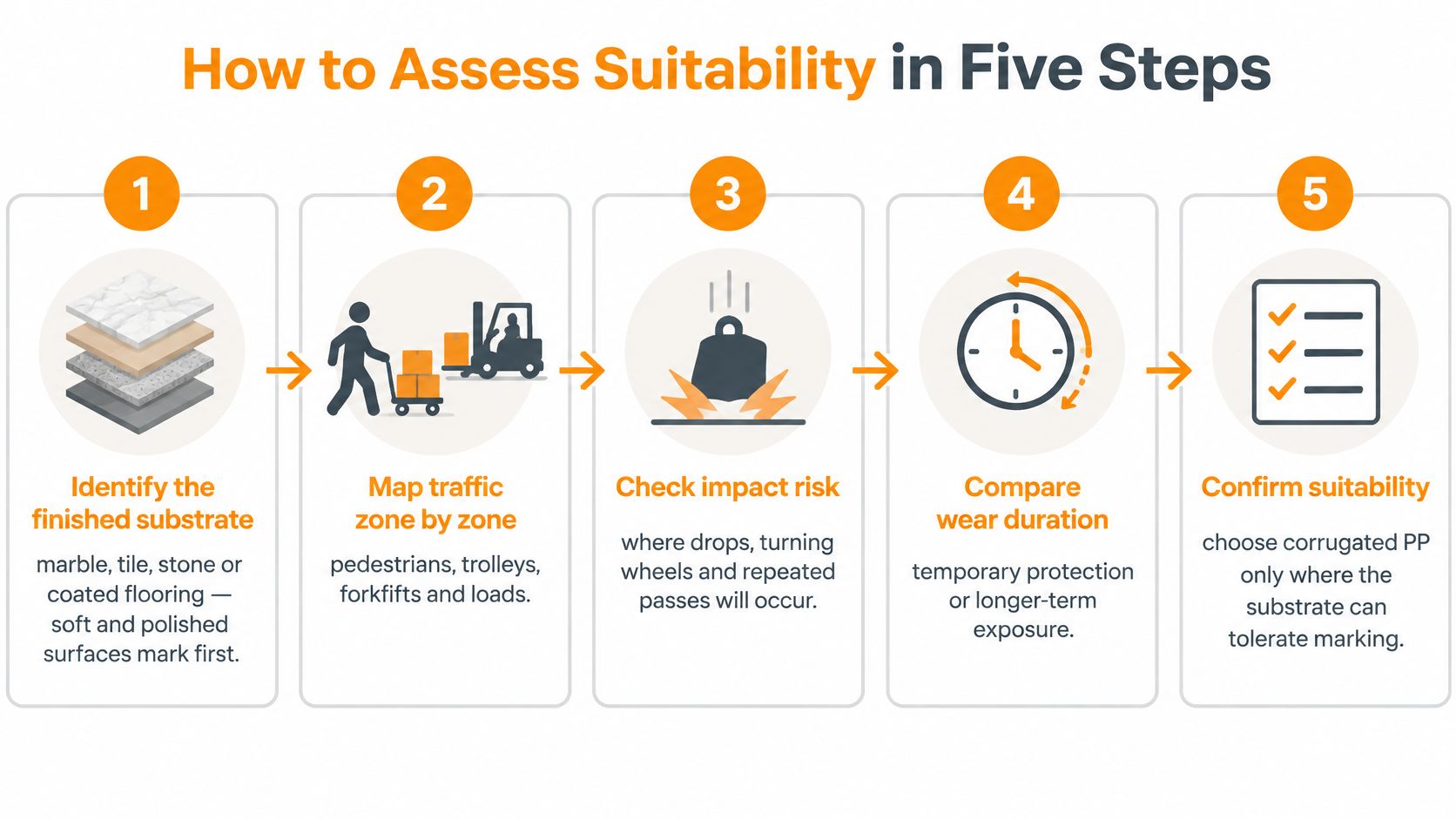
- Identify the finished substrate. Marble, polished tile, sealed stone and coated flooring mark first, and they mark permanently. A scratched screed is a snag. A scratched marble lobby is a re-polish invoice.
- Map traffic zone by zone. Pedestrians along the corridor, loaded trolleys at the service lift, scaffolding feet by the façade, forklifts in the back-of-house yard. Note the wheel types and the loads, because a 50 kg delivery cart and a pallet truck don't do the same damage.
- Select a trial thickness. Take it from the load-zone chart for each zone, and don't let one specification drift across the whole floor plate because it's simpler to order.
- Run a mock-up under real equipment. Lay a small area, put the actual trolley or access equipment over it, and leave it for representative traffic rather than one polite pass. UAE-market technical guidance treats the mock-up as the point where nominal thickness stops being theory.
- Inspect and upgrade or reject. Where you see crushing or point-loading, go up a thickness. Where you see visible flute collapse, permanent creasing, substrate marking or sheet migration, reject the installation and change the specification rather than adding more tape.
The documents to demand before approval
UAE supplier technical guidance is blunt about this: ask for declared thickness, GSM, cell structure and batch information, then approve a physical sample. Get written confirmation that any UV or flame-retardant claim applies to the actual supplied grade, not to the polypropylene resin family in general.
That last point catches more contractors than any other. A resin supplier's data sheet saying the polymer can be formulated for flame retardancy tells you nothing about the pallet sitting in your store. If the sheet is going into a corridor, you need the converter's document, for that grade, with that batch.
Installation and Moisture Control That Holds Up
Laying the sheet is quick. Laying it so it survives a fit-out takes a sequence.
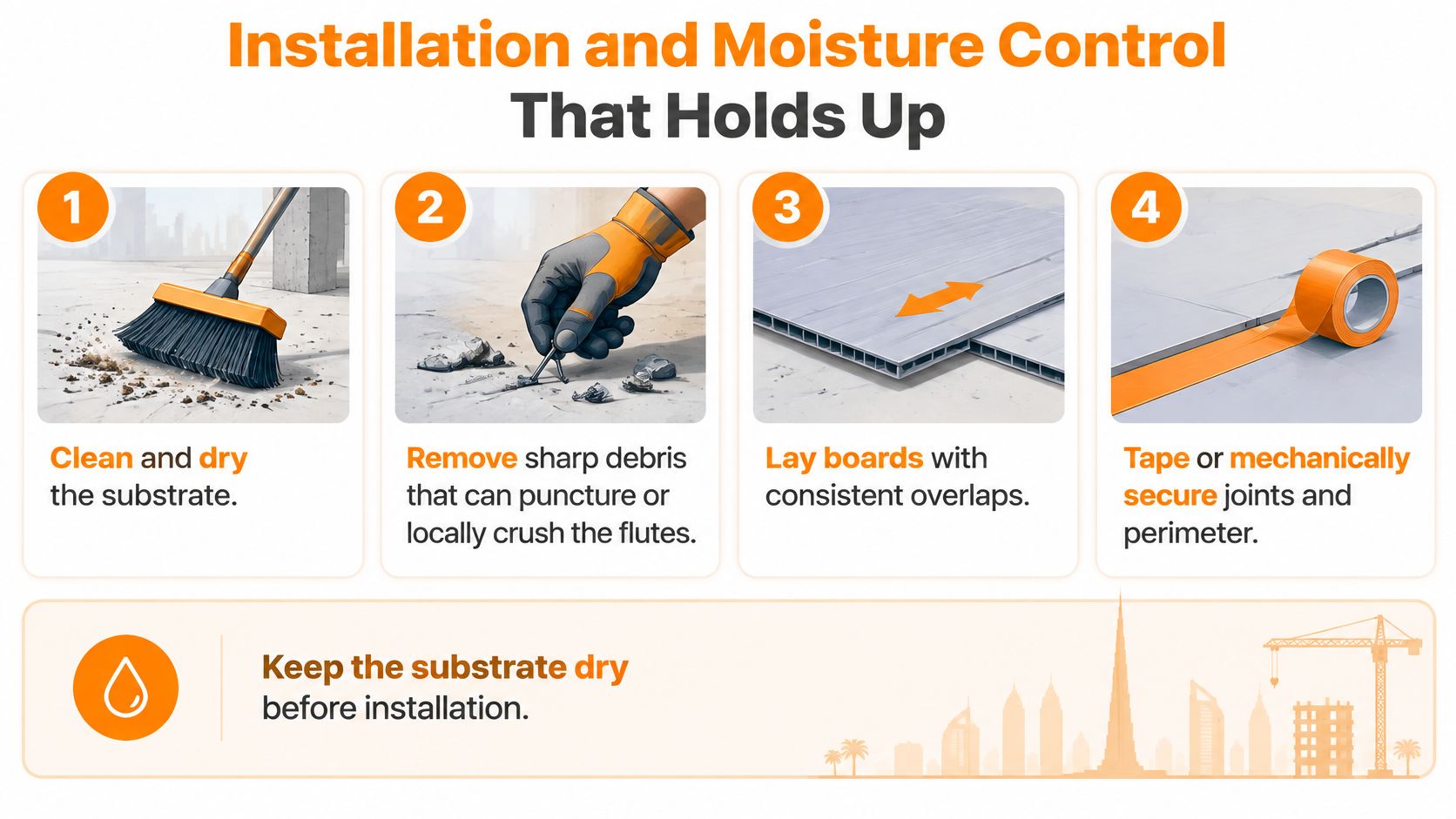
- Clean and dry the substrate. Dust under a panel becomes lapping paste under a trolley.
- Remove sharp debris. Offcuts, tile shards and fixing tails puncture or locally crush the flutes, and a crushed flute is where creasing starts.
- Lay boards with consistent overlaps. Consistent means the same direction and the same width throughout, so the joints behave predictably.
- Tape or mechanically secure joints and perimeter edges. An unsealed edge catches feet, trolleys and mops, and it lifts.
- Keep seams away from drains and expected water paths. Water finds the joint, not the middle of the panel.
- Inspect after cleaning, spills and high-traffic shifts, recording overlap width, tape adhesion, visible gaps and edge condition.
Now the correction that matters most. PP itself doesn't readily absorb water, but joints let water through. The panel protects against impact and dirt, not water. Dubai installation guidance for PP floor protection makes the same distinction, and it's the one that gets lost on site in Dubai and Abu Dhabi, where wet trades, wash-down water and condensate are routine.
The recurring failure modes are open seams, unsealed perimeter edges, trapped abrasive particles, and somebody signing off a plastic sheet as a waterproofing membrane. Follow the same discipline you'd apply to any temporary floor protection system during construction and keep the sheet in its lane.
Three habits that save rework. Cut against a straightedge so edges line up and overlaps stay honest. Label the thickness on the sheet edge in marker, because once the pallet wrap is gone nobody can tell 3 mm from 4 mm by eye. And mark damaged sheets for removal instead of taping over a crushed zone, which hides the problem until handover.
Fire Rules That Decide Where You Can Use It
Impact resistance and moisture resistance tell you nothing about fire performance. A sheet can shrug off dropped scaffold fittings and still be the wrong product for a corridor, a riser or a façade edge.
UAE municipalities enforce unified building codes covering construction safety and fire protection, as set out in the UAE Government's building safety guidance. In practice, "moisture-resistant and impact-resistant" is an insufficient specification for enclosed corridors, escape routes, hot-work areas, façade-adjacent systems or anything permanent.
The distinction to keep in mind: fire-retardant is not fire-rated. Additives, thickness, installation method, and location all change the outcome, so a test report only counts if it matches the grade and the fixing method you're installing. Ask for the paperwork in that exact configuration, then trial a small mock-up with the same tape, overlaps and fasteners before the full run.
| Application | Corrugated PP suitability | What to demand |
|---|---|---|
| Open-area floor protection away from escape routes | Generally suitable | Standard or flame-retardant grade; keep clear of hot works |
| Occupied corridors and escape routes | Restricted | Documented flame-spread and smoke data, consultant and Civil Defence acceptance |
| Risers, plant rooms, façade-adjacent systems | Often unsuitable | Fire-rated evidence or a different material entirely |
| Permanent internal linings | Not recommended | Compliant permanent lining materials instead |
Get the answer from the project consultant and the local Civil Defence office before you order. Code interpretation shifts by emirate and by building type, and no supplier's product page can approve a location for you.
I'd match the sheet to the location before anyone compares price. A flame-retardant sheet in an open, hot-work-free protection area is sensible. The same sheet in a hotel corridor with an occupied escape route needs paperwork, or a different material. If the consultant cannot place it in writing, treat the answer as no.
Recycling and Disposal After Handover
Most product pages stop talking at delivery. Once hoarding, floor protection and partitions come down, the sheets pile up at the loading bay and somebody has to decide where they go.
The technical answer is straightforward. Corrugated PP is a thermoplastic with no paper or fibre content, so clean, separated sheets can be mechanically shredded, washed and reprocessed. UAE policy points the same direction: the federal framework for integrated waste management lists polypropylene among regulated plastic materials, and the integrated recyclable-materials policy directs plastic waste to recycling factories alongside used tyres, electronic waste and used cooking oils, as published in the UAE waste management legislation.
The operational answer is messier. Dubai Municipality's January 2025 bulletin on waste processing and recycling premises confirms active non-hazardous plastic recycling premises in the emirate. What it does not publish is a corrugated-PP-specific collection route, acceptance specification, contamination threshold or chain-of-custody process. A sheet counts as recycled only when a facility accepts the load and the paperwork proves it moved, so never write automatic recyclability into a tender or sustainability report without a named route behind it.
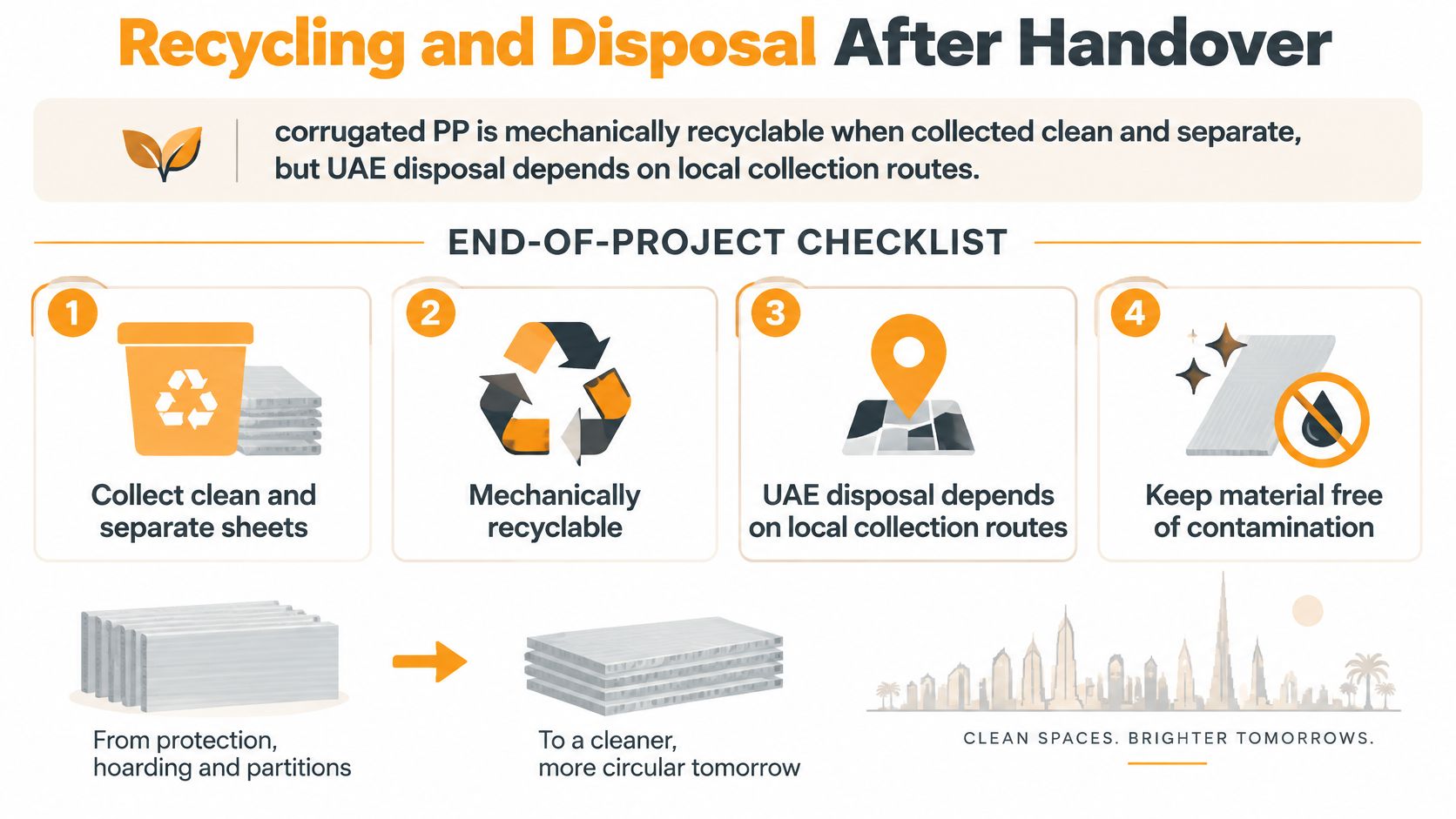
Recovery checklist: treat the end-of-project route as a procurement item, not an afterthought.
- Segregate PP from wood, gypsum, metal and general waste at the point of uplift.
- Strip tapes, fixings and adhesive residue before stacking.
- Keep reusable sheets intact, stored flat, off the ground and out of sand.
- Identify a recycling or take-back route before demolition or fit-out begins, not after.
- Ask the waste contractor what documentation they issue per load, and file it.
Clean offcuts and undamaged sheets are a recoverable stream. Sheets caked in cement, paint or adhesive are a lower-value stream that may not be accepted at all, which is exactly why segregation at uplift matters more than any phone call afterwards. Plan the construction waste disposal sequence the same week you plan the strip-out.
Order the Right Sheet for Your Site
The buying decision ends at the pallet: the sheet has to match the worst wheel path, prove itself in a mock-up, arrive with batch paperwork, and be acceptable where Civil Defence rules apply.
- Match thickness to the heaviest load zone, rather than the average or the last project.
- Run a mock-up under the actual trolley, scissor lift or access equipment before any bulk order.
- Ask for declared thickness, GSM, batch data and written grade claims, then approve a physical sample.
- Confirm fire suitability for the exact location, with consultant and Civil Defence acceptance where the code requires it.
Buy from a supplier that hands over the sample and the paperwork without being chased. If a grade claim is vague, treat it as unproven. If the location has a fire limit, a cheap extra millimetre will not make a non-compliant sheet acceptable.
For the package around the sheet, Yasu Trading Co. LLC supplies municipality-compliant building materials, fasteners, adhesives and sealants, power and hand tools, plumbing and electrical supplies, and safety equipment and PPE, with same-day or next-day site-direct delivery across Dubai, Abu Dhabi, Sharjah and the Northern Emirates. It can also source custom materials for unusual project requirements. Send the load-zone map and consumables take-off to Yasu Trading Co. LLC for a consolidated quote, and list any odd specification as a sourced item so the order is priced before strip-out starts.