Drain Floor Trap Guide: Seals, Types and Fixes
A guest bathroom on the fourth floor smells of drains every morning. The grate is clean, the floor is dry, and the water runs away fast when housekeeping rinses the tiles. Someone has already poured a bucket down it twice this month.
By the time that complaint reaches a maintenance desk, the usual assumption is that the drain needs cleaning. It rarely does. What has failed is the water seal inside the drain floor trap, and once the seal is gone the pipe below is an open connection to the sewer.
A floor trap isn't interchangeable hardware. In the UAE it's a compliance item with a measured seal depth, a maintenance requirement and, in hospitals, an infection-control function. Get the depth and the arrangement wrong for the room and the same smell comes back next month.
Floor Trap Seal Depths and Specifications at a Glance
A floor trap is the water-holding bend beneath a floor drain. Water rests in the dip and plugs the opening between the room and the drainage network, much like the water left in a bath plughole. Empty that dip and the room is joined to the drain pipe by an open hole.
For UAE projects working to Dubai/Trakhees drainage requirements, specify a minimum 75 mm water-seal depth for a floor drain, as the Trakhees drainage regulation sets out. The same regulation puts a 25 mm minimum retained seal on traps generally under working and test conditions. That 25 mm is why a shallow waste trap can look compliant on paper and still fail on site: it's the general trap benchmark, not the floor-drain one.
Dubai Municipality's drainage guidance works to a 50 mm water seal as the benchmark protecting occupied spaces from sewer gases and particulates, and places floor gullies at the head of a branch drain with access through or beside the gully for inspection (Dubai Municipality drainage guidance).
The row that matches your room sets the seal depth:
| Situation | Minimum seal depth | What the specification must state |
|---|---|---|
| Standard floor drain on Dubai Trakhees projects | 75 mm | Seal depth, rodding access and ventilated downstream pipework |
| Dubai Municipality general drainage benchmark | 50 mm | Water seal that protects occupied spaces from sewer gas |
| Traps generally, under working and test conditions | 25 mm retained | General trap benchmark, not a floor-drain substitute |
| Negatively pressurised healthcare room | 90-100 mm | Trap primer or sealed drain, coordinated with room ventilation |
| Floor drain in a space that dries out | Seal kept full | Trap primer valve fed from potable water, or special sealed drain |
Wherever the trap sits, whether a home bathroom, hotel guest room, commercial kitchen, plant room or hospital treatment area, three items belong in the specification in writing: the seal depth, rodding or cleanout access, and confirmation that downstream pipework is ventilated. Check the drawing and the supplier quote against those three lines before you order.
Parts and Materials Inside a Floor Trap
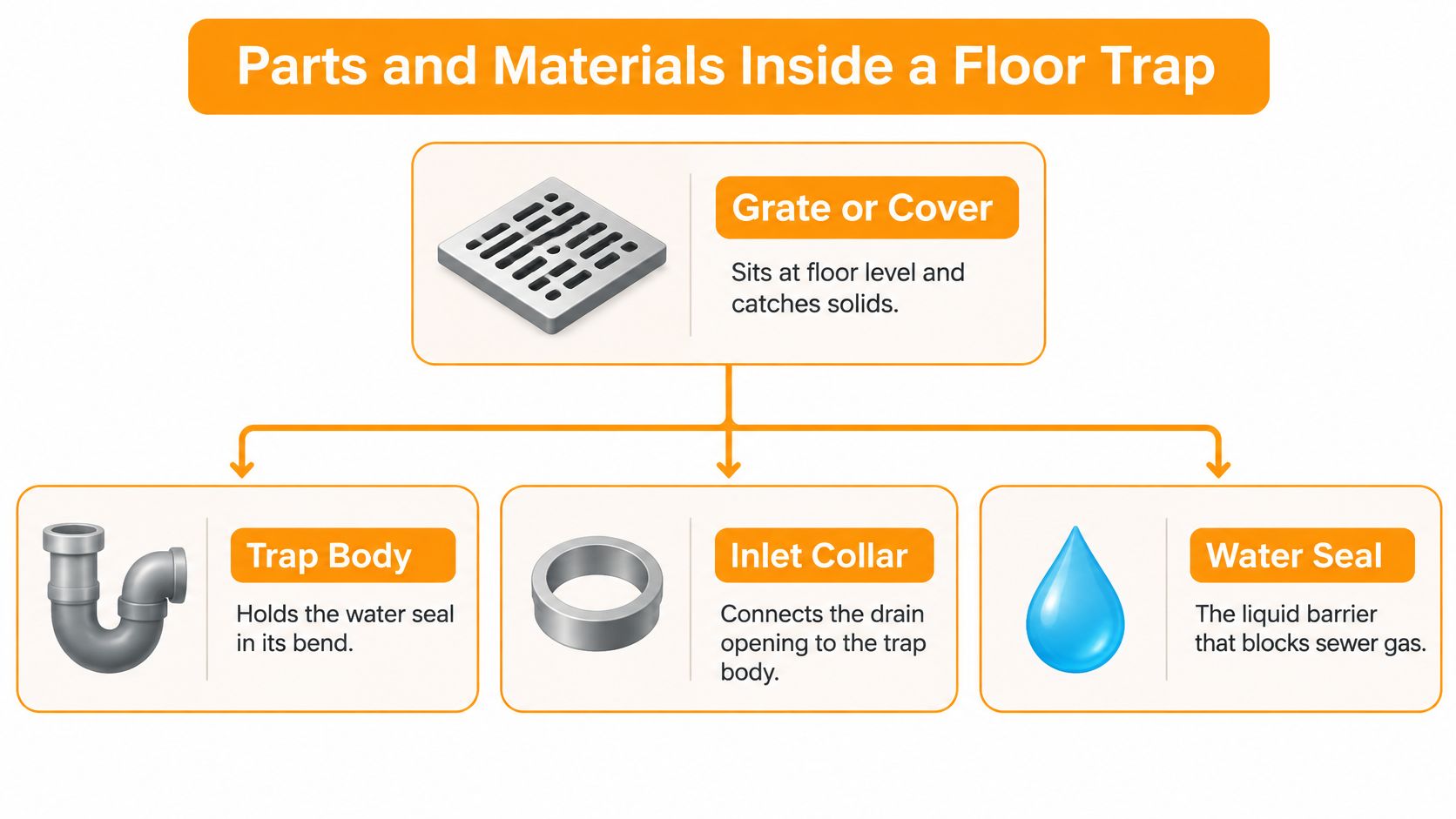
Water meets the assembly in a fixed order, and each part does one job. The grate or cover sits flush with the finished floor and stops solids entering. Underneath, the inlet collar joins the floor opening to the trap body. The trap body holds the seal in its dip. The outlet carries flow into the branch drain or stack. Rodding access comes through the grate, a removable body or a cleanout beside it, and where the room dries out, a primer connection goes in at first fix rather than after handover.
The four components and how they relate:
Material choice follows traffic and cleaning regime, not the price list.
| Material | Typical use | Main strength | Watch for |
|---|---|---|---|
| UPVC | Homes and light commercial drainage | Light, corrosion resistant, low cost | Brittle under heavy loads |
| Stainless steel | Kitchens, wash-down and hygienic areas | Corrosion resistant and easy to clean | Higher cost; grate must suit the floor finish |
| Cast iron | Heavy-duty and older commercial drainage | Very strong and durable | Heavy; needs skilled installation |
| Brass or chrome-plated | Decorative bathrooms | Good finish and moderate durability | Plating wears; check outlet fit |
A good material with the wrong fit still leaks. Check the grate size against the floor finish and the outlet diameter against the pipe, because a 15 × 15 cm grate won't sit in a 10 × 10 cm recess however good the steel is. Two 2025 Dubai listings show the spread: a 15 × 15 cm stainless-steel trap at AED 9.98 including VAT from ZARA Tools, and a UPVC trap sized 4 × 3 × 2 × 1.5 inches at AED 17.50 from Plaza Middle East. Price says nothing about the seal, so compare seal depth and fit first.
A trap is also only as good as the floor around it. Water that bypasses the grate and tracks under the screed finds the ceiling below long before the seal fails, so the sequence for waterproofing before installing shower tile matters as much as the fitting itself.
Sizing, Flow and Access Rules for Floor Traps
A trap can have the right outlet size and still restrict flow if its grate or body narrows the bore. Match the full drainage path, then set the trap close to the outlet and maintain continuous fall to the branch drain. Poor positioning or a flat section can leave water and solids sitting upstream.
Use these dimensions as starting points, then confirm the fitting against the fixture discharge, floor finish and expected traffic:
| Area | Typical outlet | Grate size |
|---|---|---|
| Small wet area | 50 mm | About 15 × 15 cm, light duty |
| Commercial or plant-room floor | 100 mm | Heavy-duty cast or stainless grate on a bolted frame, sized to traffic |
| Kitchen or wash-down area | 75 mm on heavy wash-down, 50 mm on light duty | Confirm against floor finish |
Show the layout on the drawing before pipework starts. These practices help keep the drain serviceable:
- Use one trap per appliance discharge. Avoid placing two traps on the same discharge run.
- Keep gullies separate. Do not connect one floor gully directly to another.
- Connect to a stack or separate branch. Provide an appropriate route from the gully to the drainage system.
- Allow access at the gully. Make rodding or removal possible through or beside it.
- Maintain continuous fall. Avoid flat sections and backfall between the trap and branch drain.
Before setting the trap in screed, check that the grate opening does not reduce the effective bore. A restriction can catch debris and slow drainage before water reaches the seal, so confirm grate and outlet dimensions together.
For positioning a bathroom floor drain, check the trap location against the shower outlet before fixing floor levels. Downstream, choosing plumbing fittings that preserve the required bore and fall helps maintain flow through the branch connection.
Why a Floor Trap Loses Its Seal and How to Fix It
The water in the bend is a liquid lid. Below it, the drain pipe carries sewer gas, and a charged trap keeps that gas under the floor. Empty the trap and nothing separates the room from the pipe.
Here's where the seal sits and what opens it:
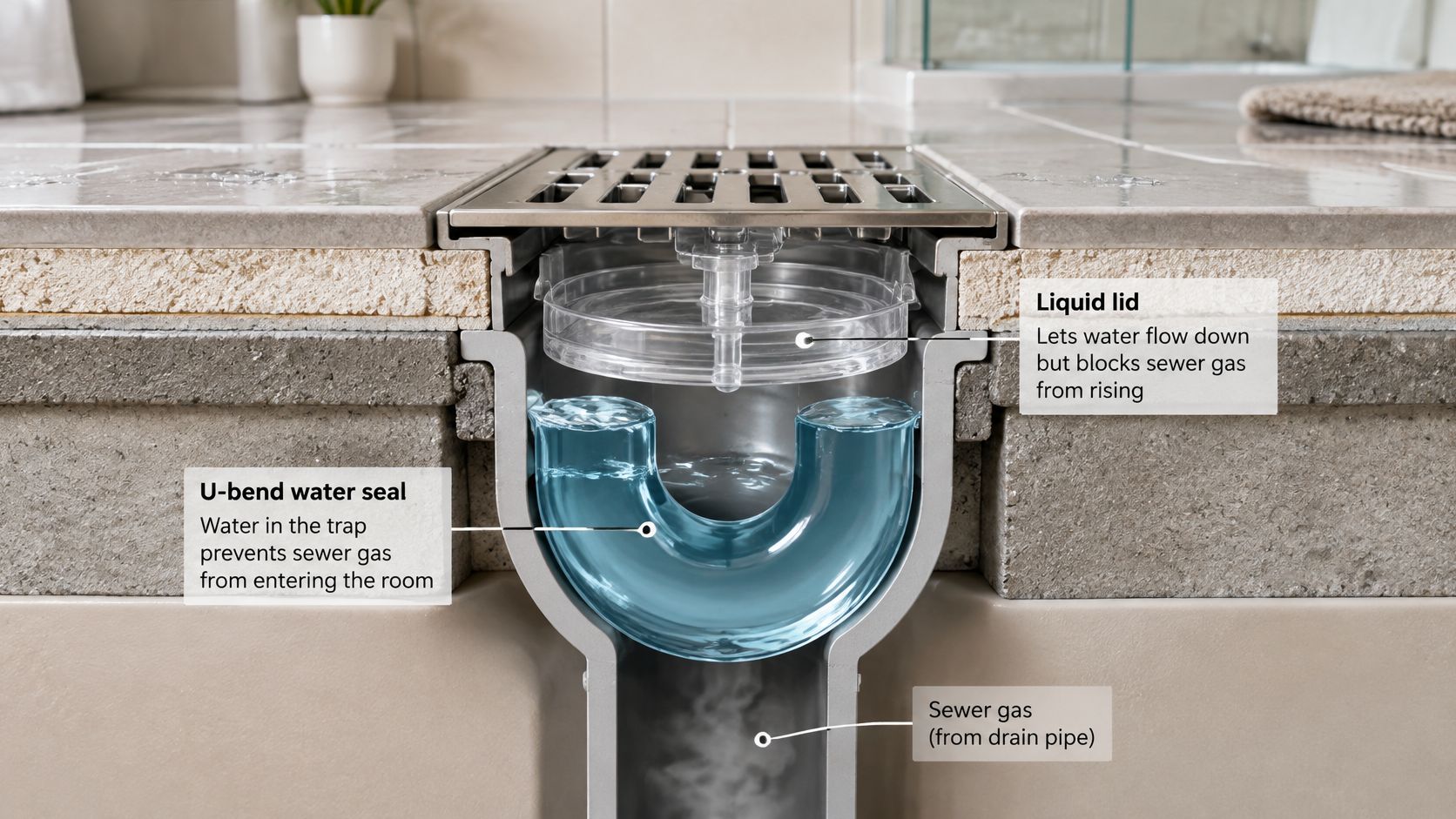
Three failures empty the lid, and each has its own fix.
Evaporation is the commonest cause in homes and hotels. A guest bathroom, a spare WC or a plant room mopped once a month dries out over weeks and nothing refills it. Siphonage happens when a slug of water pulls the seal out of the bend as it passes, and weak venting is usually behind it. Pressure difference works more slowly in rooms held under mechanical pressure, where air movement drags water out of the trap.
| Symptom | Likely cause | Fix |
|---|---|---|
| Smell after weeks of no use | Seal evaporated | Pour water monthly or fit a trap primer valve |
| Smell with a full seal | Negative pressure or siphonage | Review venting and ventilation before deepening the seal |
| Smell from a trap joined to another trap | Trap-to-trap connection | Reconnect to a stack or a separate branch drain |
| Slow drain with odour | Deposits in trap body | Remove grate, clear body, confirm continuous fall |
| Odour from balcony or air-conditioning drain | Drain routed into floor trap | Route to a proper branch drain instead |
Trap-to-trap connections earn their own line because they're prohibited. Dubai's Trakhees drainage rules for facilities ban connecting one floor trap directly to another (Trakhees drainage regulation for facilities/Rules%20&%20Regulations/02.24regulationdd-9.0drainage.pdf)), and the reason is physical: two traps sharing a seal can both be pulled dry by a single gulp of water. Balcony and air-conditioning condensate drains hit the same failure when someone routes them into a floor trap.
Prevention is a schedule, not a repair. Pour a litre into every drain that isn't used weekly, check the seal monthly in dry areas, lift the grate and clear hair and grease from the trap body every few months in kitchens, and confirm the fall is still continuous after any building works. Test a seal by pouring water in and looking again a week later.
One visit or two: a refill, a cleared body or a reseated grate is a single visit. A recurring smell with a full seal is a ventilation or pressure question, so send it to a designer rather than a plumber with a bucket.
If the smell arrives with a damp patch on the ceiling below, the seal isn't your problem, and these common plumbing leaks in commercial buildings are worth ruling out. When the odour sits at a WC rather than a floor gully, Eagle Restoration's notes on troubleshooting bad toilet wax seals cover the pan connector case.
For the geometry itself, this walkthrough shows the bend, the seal and where deposits gather:
Special Cases for Healthcare and Dry Rooms
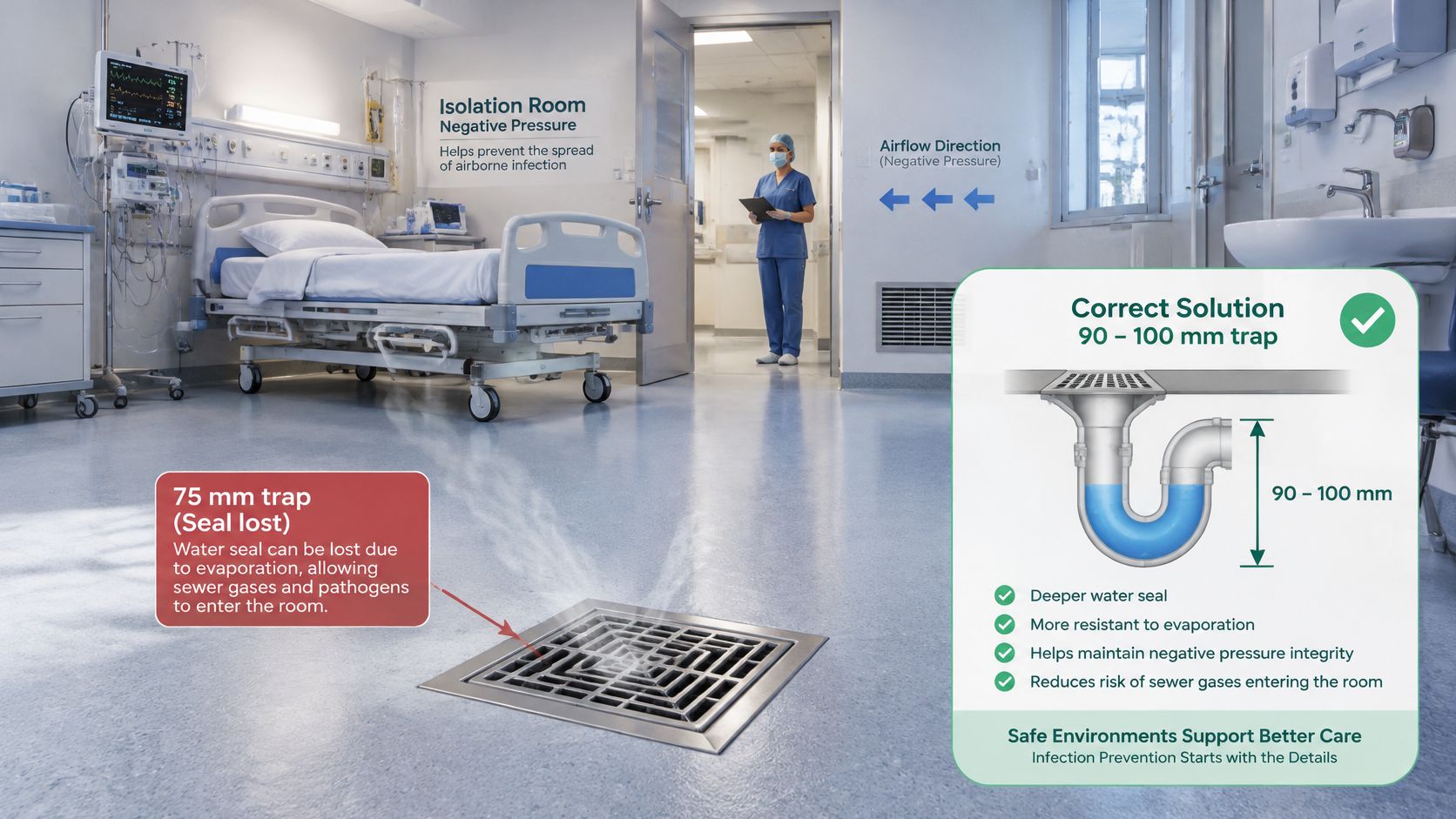
Take a treatment room held at negative pressure. A floor trap with an ordinary seal loses water to air movement faster than a bathroom does, and nothing on the drawing looks wrong. Abu Dhabi health-facility guidance recognises it, identifying 90-100 mm trap-seal depth for certain negatively pressurised HVAC areas where room pressure accelerates seal loss through air movement and trap pressure differentials (Abu Dhabi sanitary drainage system design guidance)).
The same guidance covers the drain that isn't used often enough, the laundry bay or riser-base gully that dries between clean-downs. Floor drains in areas subject to drying should be connected to a trap-primer valve supplied from the potable-water system, so the trap refills automatically after evaporation, or fitted as a specially sealed floor drain. Sensitive healthcare areas also call for sealed or disinfectable drains, which puts trap selection inside infection control rather than drainage hardware.
Deciding Between a Deeper Seal, a Primer and a Sealed Drain
Work through three checks in this order and the arrangement picks itself:
- What is the room? Ordinary occupied space, wet area, healthcare, laboratory, plant room or kitchen. That sets the baseline seal depth.
- Is the room under negative pressure? If yes, the seal has to be deeper and the ventilation regime reviewed, because the pressure will keep pulling water out.
- Does the drain dry out between uses? If yes, plan a primer valve with a potable supply, or a sealed drain where priming pipework isn't practical.
A deeper trap on its own fixes nothing if the cause is pressure or neglect. The submittal should show seal depth, primer provision, odour control, cleanability and ventilation compatibility together, so the reviewer sees one engineered system rather than four unrelated product sheets.
Confirm the Trap Specification Before You Order
Before the purchase order leaves your desk, confirm five things against the earlier criteria: the seal depth for the room type, the material suited to the area, the outlet and grate fit to floor finish and pipe, the layout rules for branch drains and access, and the primer or sealed arrangement where the space dries out or runs under negative pressure. Each maps to a line on the drawing and a line on the quote.
Timing catches people out on Dubai projects. Local Order No. 8 of 2002 requires approval before a private sewerage network connects to the public network, and the connection application must be submitted at least three months before the building's scheduled completion date (Local Order No. 8 of 2002%20of%202002%20Concerning%20Sewerage,%20Irrigation,%20and%20Water.html?)). A trap specification still being argued over in month eleven is a handover risk, not a procurement delay.
The written request to send: room type, pipe size and required seal depth, in one message, asking for the matching trap specification in writing before you buy.
Send that message and hold the reply against the table. The team at Yasu Trading Co. LLC stocks plumbing, power tools, electrical, fire protection, safety gear, and adhesive and sealant under one roof in Deira, Dubai, and can put the confirmation in writing so the quote can be checked line by line.
Yasu Trading Co. LLC supplies municipality-compliant construction hardware and plumbing materials to contractors across Dubai, Abu Dhabi, Sharjah and the Northern Emirates, with the range held in stock in Naif, Deira and dispatched to site the same or next day. Send over your room type, pipe size and required seal depth, and the technical team will come back with matching trap options and a written specification you can check against the seal-depth table before you commit. Visit Yasu Trading Co. LLC to review the plumbing range or to place an order.