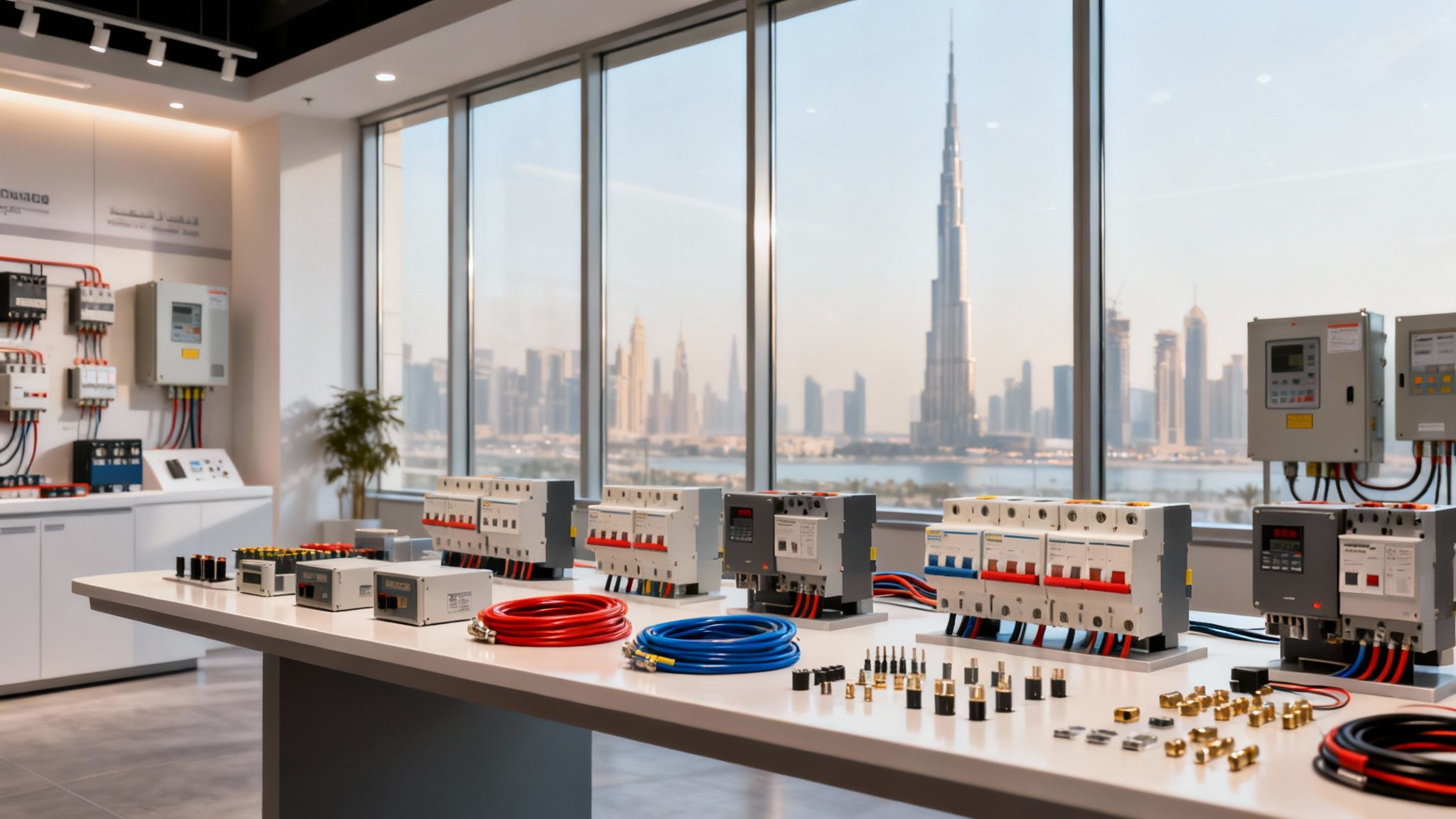
Electrical Equipment Suppliers in UAE: Your Guide to Top UAE Projects
Finding the right electrical equipment suppliers in the UAE is one of the most crucial decisions you'll make for any construction or development project. These aren't just vendors; they're the partners who supply the very lifeblood of a modern building—from the simplest wiring and circuit breakers to sophisticated control systems that power the nation's incredible infrastructure. Get this choice right, and you ensure compliance, safety, and a project that stays on schedule.
Navigating the UAEs Electrical Supply Market
The success of any major construction project in the United Arab Emirates rests squarely on the quality of its components. Think of it like this: sourcing electrical supplies is like casting the foundation for a skyscraper. Every single part must be perfect to guarantee the structure's integrity and long-term safety. Finding a top-tier supplier in Dubai or Abu Dhabi goes far beyond a simple transaction; it's about building a relationship that underpins your project from the initial blueprint right through to final handover.
This is a market defined by two things: massive growth and incredibly strict regulations. The Middle East's electrical equipment market, where the UAE is a major player, hit a massive USD 32,003.1 million in sales revenue in 2024. Projections show a strong compound annual growth rate (CAGR) of 6.7% from 2025 to 2033, all thanks to the region's ambitious construction projects and urban masterplans. You can explore more data on this expanding market to get a feel for its upward trajectory.
Why is a reliable supplier non-negotiable?
A dependable supplier acts as your project's first line of defence against expensive delays, dangerous safety hazards, and frustrating compliance failures. They are much more than just a name on an invoice; they're specialists who get the fine print of UAE construction standards.
The real value a first-rate supplier brings to the table is immense:
- Guaranteed Compliance: They ensure every product meets local regulations from authorities like DEWA (Dubai Electricity and Water Authority) and ESMA (Emirates Authority for Standardisation and Metrology).
- Consistent Quality: You get authentic, high-performance materials that prevent system failures down the road.
- Logistical Efficiency: They are pros at managing inventory and delivery schedules, which is essential for keeping your project moving forward without a hitch.
Choosing the right building materials distributor is one of the most critical decisions a project manager makes. It directly impacts budget adherence, worksite safety, and the final asset's operational reliability for years to come.
What is the modern procurement advantage?
The old way of doing things is gone; project managers no longer have to waste time with clunky, manual methods for getting quotes and placing orders. Today's leading suppliers have embraced digital tools that make the entire process simpler and more efficient.
For example, companies like Yasu Trading Co. LLC offer integrated online quotation platforms. These systems let you request, compare, and manage quotes for a huge range of products—from electricals to plumbing and safety gear—all in one organised space. This new approach not only saves countless hours of administrative work but also boosts transparency and helps you secure competitive pricing without ever having to compromise on quality.
This guide will give you a clear roadmap, helping you make sharp decisions and select the ideal partner to power your project's success.
What Certifications Matter for Electrical Equipment in the UAE?
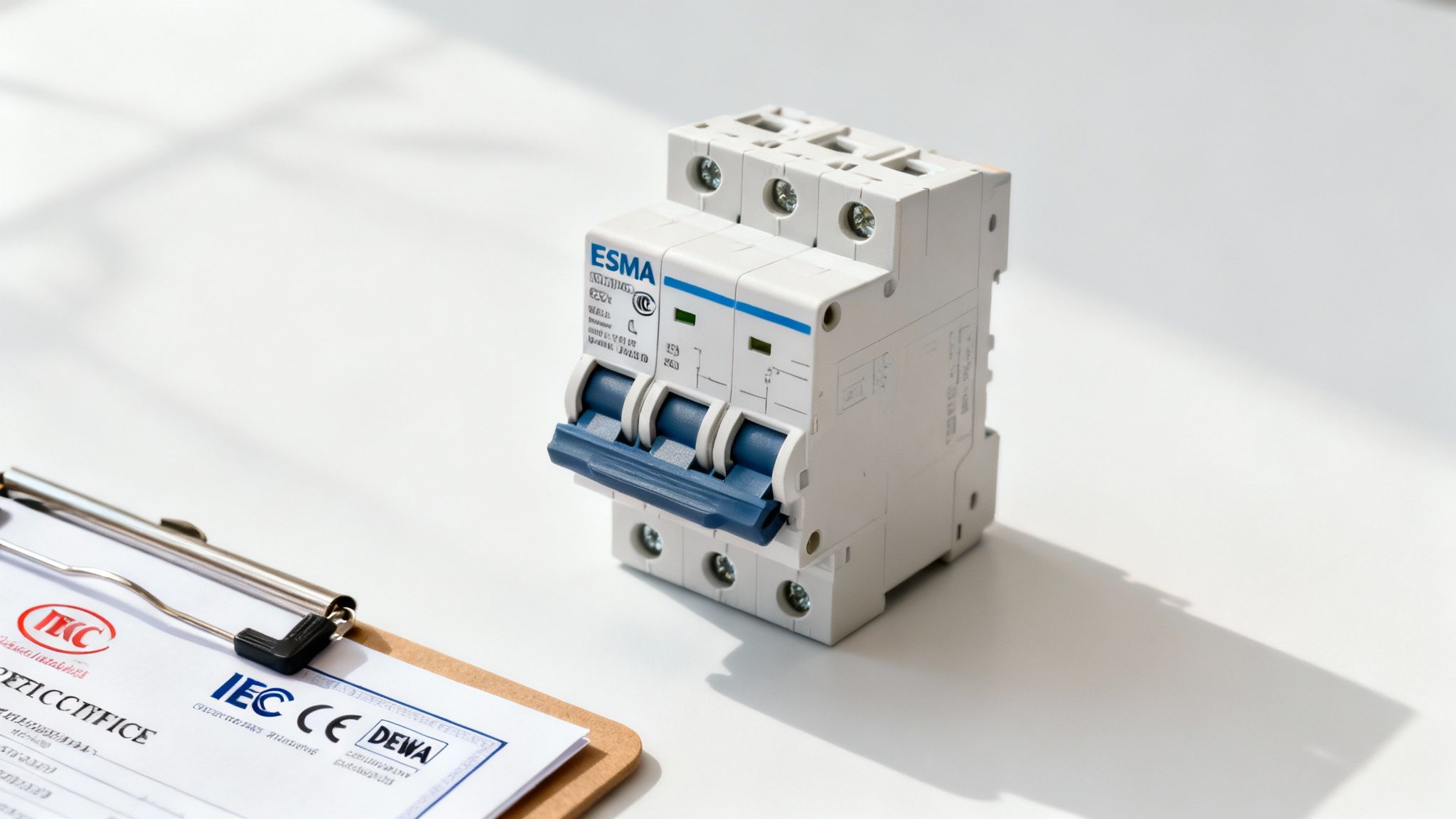
When you’re sourcing electrical equipment in the UAE, it's not just about picking an item from a catalogue; every single component needs the right certifications to be legally used. Think of these certifications as a passport for your equipment. Without the correct stamps, it simply won't be allowed on site.
That means costly delays, frustrated clients, and serious safety risks. Getting to grips with these mandatory approvals is your first line of defence against project headaches. These aren’t just bureaucratic hoops to jump through; they’re designed to guarantee safety, quality, and compatibility across the entire national grid. This is precisely why a knowledgeable building materials distributor is your most important partner—they need to be able to vouch for every certificate.
What is the Emirates Conformity Assessment Scheme (ECAS)?
The Emirates Conformity Assessment Scheme (ECAS) is a mandatory programme run by the Ministry of Industry and Advanced Technology (MoIAT) that covers most electrical equipment sold in the UAE. Its whole purpose is to make sure products meet national safety and quality standards before they even hit the market.
Any credible supplier in Dubai will readily provide an ECAS Certificate of Conformity for their products. This certificate is your proof that the equipment has been properly tested and is safe to install. Anything without ECAS approval is prohibited, and if it’s found on-site during an inspection, you'll face serious penalties. Always ask for the ECAS documents right at the start.
Why is DEWA approval crucial for Dubai projects?
For projects in Dubai, approval from the Dubai Electricity and Water Authority (DEWA) is non-negotiable for anything connecting to the grid. DEWA has its own strict set of rules, which often go above and beyond the federal standards to protect the integrity and stability of their own infrastructure.
Working with electrical equipment suppliers in the UAE who are experts in DEWA's requirements will save you a world of pain. They’ll know which products are already pre-approved and can help you navigate the paperwork for any new or specialised equipment you need. To dive deeper, it's worth understanding the Compliance and Safety Standards for Electrical Equipment in Dubai and how they align with Dubai Municipality rules.
Navigating the maze of local and federal certifications can be complex. A supplier’s expertise in UAE construction standards is just as valuable as the products they sell. Their guidance ensures every component you install is safe, approved, and built to last.
What other certifications should you look for?
Beyond essential local approvals, international certifications like IEC, ADQCC, and ISO 9001 are strong indicators of quality and reliability. Think of them as an extra layer of confidence in a product's performance and durability.
When you're looking through a supplier's inventory, keep an eye out for these marks of quality:
- IEC Standards: The International Electrotechnical Commission sets the global gold standard for electrical components. If a product is IEC-compliant, you know it meets internationally recognised benchmarks for safety and performance.
- ADQCC Certificate: For projects in Abu Dhabi, the Abu Dhabi Quality and Conformity Council (ADQCC) issues its own conformity mark. This shows a product has met the Emirate's specific criteria.
- ISO 9001: This isn't a product certification itself, but it’s just as important. It proves the manufacturer follows a certified quality management system, which points to consistent and reliable production processes.
At the end of the day, checking for these certifications is a fundamental part of your due diligence. When you insist on fully certified products, you aren't just ticking boxes—you're protecting your investment, your project timeline, and the safety of everyone who will use that building for years to come.
How to Evaluate Electrical Equipment Suppliers in Dubai
Choosing the right electrical supplier is less like a simple purchase and more like bringing on a new project partner. It’s a decision that goes far beyond a quick price comparison. You need to dig deep into their inventory, their quality control systems, their delivery capabilities, and what happens after the sale. This is about finding a partner who genuinely adds value, not just another line item on an invoice.
This evaluation is absolutely critical. The right partner can save you from costly delays and ensure every single component meets the UAE's strict construction standards. The wrong one? They can introduce risk at every single stage. Let's break down the key areas you need to scrutinise to build a solid evaluation plan.
What makes a supplier’s product range truly comprehensive?
A genuinely comprehensive product range is about having both breadth and depth, effectively becoming a one-stop-shop for your entire project. It is the difference between a supplier who stocks one type of circuit breaker and one who offers multiple brands, various specifications, and all the related components.
A truly valuable supplier in Dubai will have a portfolio that covers:
- Breadth of Categories: Think beyond just electricals. The best suppliers are often complete building materials distributors, offering everything from plumbing and safety gear to hand tools.
- Depth of Products: Within each category, you want to see a real choice. Look for different brands and technical specs that can fit various project budgets and complex requirements.
- Stock Availability: A massive catalogue means nothing if the products aren't actually in the warehouse. Your priority should always be suppliers with large, local stockholdings, as this is what cuts down lead times from weeks to days.
Consolidating your procurement with one such supplier saves an incredible amount of administrative time, makes logistics a breeze, and often helps you negotiate better overall pricing. A partner who can deliver everything from conduits to safety harnesses in a single order is a massive asset.
How do you assess quality control and authenticity?
You assess quality by verifying certifications, requesting technical data sheets, and confirming that the supplier has official relationships with the manufacturers they represent. In a market where a single counterfeit component can lead to catastrophic failure, a supplier's commitment to quality assurance is not something you can compromise on.
Look for a partner who is completely transparent about their quality control. They should be able to show you proof of certifications like ECAS and DEWA approvals for every relevant product. A reliable supplier, like Yasu Trading Co. LLC, has established systems to trace products right back to the original manufacturer, giving you total peace of mind that what you're installing is the real deal.
A supplier’s price is temporary, but the quality of their materials is permanent. Investing in a partner with rigorous quality control is the single best way to protect your project's integrity and your professional reputation.
What questions should you ask about logistics and lead times?
You should ask pointed questions about stock levels, the size and capability of their delivery fleet, and typical lead times for both local and imported items. A supplier's logistical strength has a direct and immediate impact on your project timeline, making it a critical point of evaluation.
Don't be shy about getting into the nitty-gritty. While the global supply chain can be unpredictable, a well-organised supplier has systems in place to manage and mitigate these risks. For a more detailed look at this, you can explore our guide on finding the best electrical equipment suppliers in the UAE.
Here are the essential logistical questions to ask:
- What is your average delivery time for locally stocked items within Dubai? (You’re looking for an answer in the 24-48 hour range).
- What are the lead times for specialised or non-stock items? (This reveals how efficient their international sourcing is).
- Do you have a dedicated delivery fleet, or do you rely on third-party couriers? (An in-house fleet means far more control and reliability).
A supplier who is serious about your business will give you clear, honest answers. This information is gold for accurate project planning and helps you avoid that dreaded, costly downtime on site.
Why is after-sales support so important?
After-sales support is your project's safety net because it protects you from issues that pop up after installation, from handling warranty claims to providing technical troubleshooting. A product is only as good as the support that stands behind it, and this is where a supplier proves they are a long-term partner, not just a seller.
The level of support is what separates a mere vendor from a dedicated project ally. Before you sign anything, get clarity on the warranty terms, what the claim process looks like, and who your dedicated point of contact will be for any technical help. A strong local presence is absolutely key here; it ensures that if a problem does arise, there’s an accessible team ready to step in and find a solution quickly.
The demand for high-quality, certified components is only growing. For instance, the UAE's electrical conduit market was valued at USD 83.1 million in 2024 and is expected to climb to USD 131.5 million by 2033. This growth underscores the industry's reliance on certified materials to meet safety standards. You can discover more insights about the electrical conduit market on Grand View Research.
What is the Standard Procurement Process for Electrical Supplies?
Getting the procurement process right for electrical supplies can feel like conducting an orchestra. Every single step has to be perfectly timed and executed to keep your project running smoothly, on schedule, and within budget.
If you don't have a structured workflow, you risk incorrect orders, expensive delays, and a mountain of compliance headaches. A well-oiled process, however, ensures you get the right materials at the right price, right when you need them.
Let's break down the standard procurement journey into four key stages. It starts with pinning down your project's exact needs and finishes with the materials arriving safely and correctly on-site. Getting this flow down is non-negotiable for any project manager dealing with electrical equipment suppliers in the UAE.
How do you initiate the procurement workflow?
The procurement workflow begins with a crystal-clear list of requirements, as you simply can't get accurate quotes if your initial request is vague or incomplete. The first move is to sit down with your engineering team and hammer out a detailed Bill of Quantities (BOQ).
This document needs to be specific—we’re talking everything from the exact type and rating of a circuit breaker down to the required lengths and gauges of wiring. The more detail, the better. This level of precision is absolutely critical for meeting UAE construction standards and ensuring the bids you receive are actually comparable, leaving no room for guesswork.
What is a Request for Quotation (RFQ)?
A Request for Quotation (RFQ) is the formal document you send out to potential suppliers once you have your BOQ. A solid RFQ is more than just a shopping list; it should also lay out your project's timeline, delivery location, payment terms, and any specific certifications you need. Think of it as your primary tool for communicating your needs clearly and professionally.
After you've sent the RFQ to your shortlisted suppliers, the evaluation phase kicks in. Here, you're not just comparing quotes based on price. You need to look at lead times, product authenticity, and whether the supplier can handle your logistical needs. Rushing this step is a classic mistake that can cause major headaches down the line.
A crucial part of managing costs and staying on the right side of the law is having a firm grasp of VAT rates and compliance in the UAE. This financial due diligence protects your budget from unexpected tax hits.
After a thorough review, you'll select the best supplier in Dubai (or whichever emirate you're operating in). The next step is to issue a formal Purchase Order (PO), which acts as a legal confirmation of the order and locks in all the terms you've agreed on. From there, it's all about managing the delivery logistics to make sure the materials arrive on time and are exactly what you ordered.
The flow chart below breaks down the key stages of evaluating a supplier, from their inventory all the way through to logistics and after-sales support.
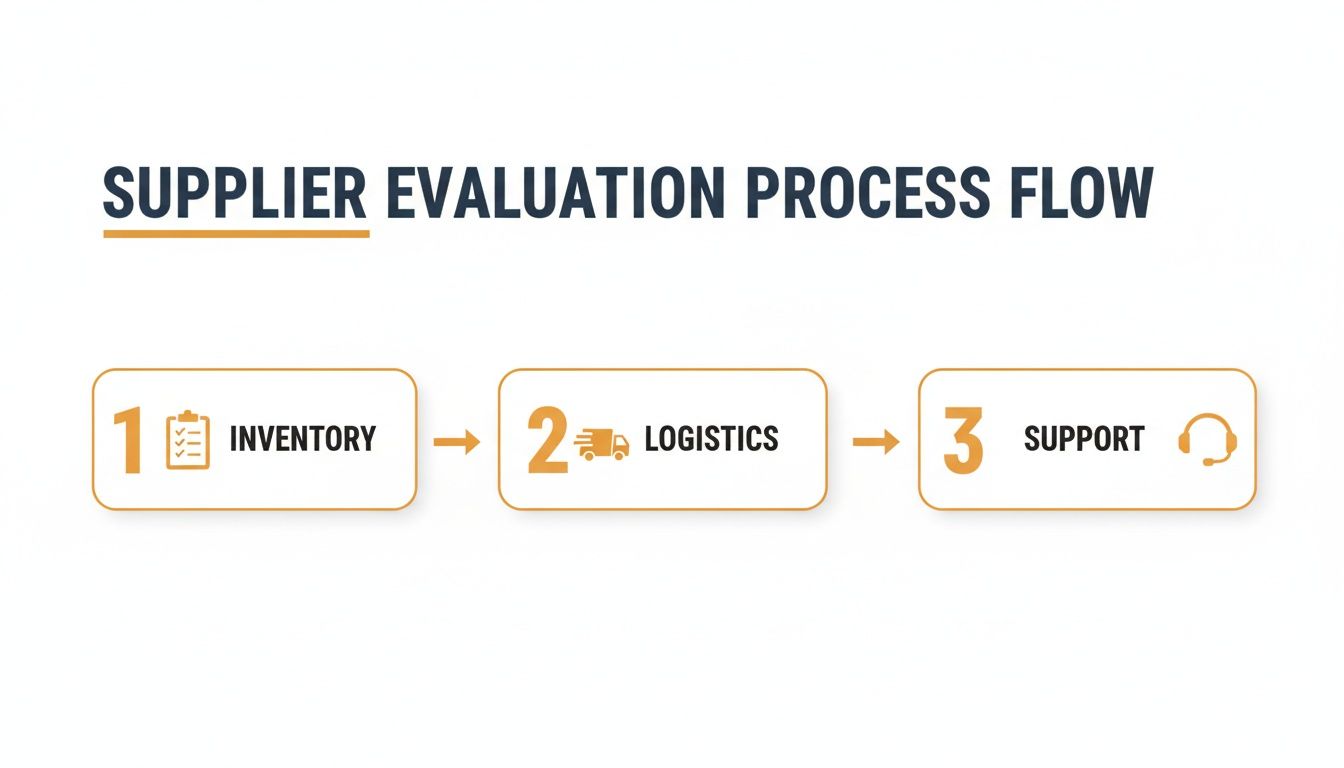
This visual drives home the point that a supplier’s true value is about much more than their product catalogue—it’s about their entire operational strength, from the warehouse to your worksite.
How are digital platforms changing procurement?
Digital platforms are changing procurement by replacing old-school, paper-heavy processes with smarter, integrated solutions. Modern platforms bring the entire workflow—from RFQ to final delivery—under one digital roof, completely changing how project managers and buyers work with a building materials distributor.
Take integrated online quotation systems, like the one offered by Yasu Trading, for instance. They bring some serious advantages to the table:
- Speed and Efficiency: You can create and fire off RFQs to multiple suppliers in just a few clicks, cutting down your admin time dramatically.
- Improved Transparency: Every quote, message, and document is stored in one central place. This makes it incredibly easy to track, compare, and audit your procurement decisions.
- Reduced Errors: Digital systems slash the risk of human error that plagues manual data entry, leading to far greater accuracy in your orders.
This move to digital procurement gives project managers the power to make faster, more informed decisions. By automating the tedious admin, you can focus your energy on the bigger picture: strategic supplier management and flawless project execution.
How to Ensure Product Quality and Authenticity
Making sure every single electrical component is genuine and up to standard is probably the most important part of procurement. This goes way beyond just ticking compliance boxes; it’s about ensuring safety, guaranteeing performance, and preventing the kind of catastrophic failures that come from counterfeit or subpar materials. You really have to get forensic with it, looking past the surface to scrutinise everything that lands on your site.
Think of it this way: quality assurance is an upfront investment in performance you can count on. A solid supplier in Dubai won't just tolerate this level of inspection—they'll welcome it. They should have transparent systems in place that make the whole verification process simple for you. In a market swimming with options, your ability to tell the real deal from the fakes and confirm compliance with UAE construction standards is what protects your project's integrity and, frankly, your professional reputation.
What documents should you always request?
You should always request a Technical Data Sheet (TDS), a Certificate of Conformity, and proof of origin for any major component. These documents are like a product’s passport, giving you a clear paper trail right from the factory floor to your job site. Never just take a supplier's word for it; insist on the documentation that proves their claims.
A building materials distributor you can trust will have these files ready to go.
- Technical Data Sheets (TDS): This is the nitty-gritty. It breaks down the product's exact performance specs, the materials it’s made from, and its operational limits. Use this as your blueprint to confirm the item matches your project's engineering needs.
- Certificates of Conformity: This is your proof that the product meets local and international standards, like those from ECAS, DEWA, or the IEC.
- Proof of Origin: This helps you confirm the product actually came from the manufacturer it claims to, significantly cutting the risk of getting stuck with counterfeit goods.
Checking this documentation upfront is your first, and best, line of defence against problems down the road.
How can you visually inspect for authenticity?
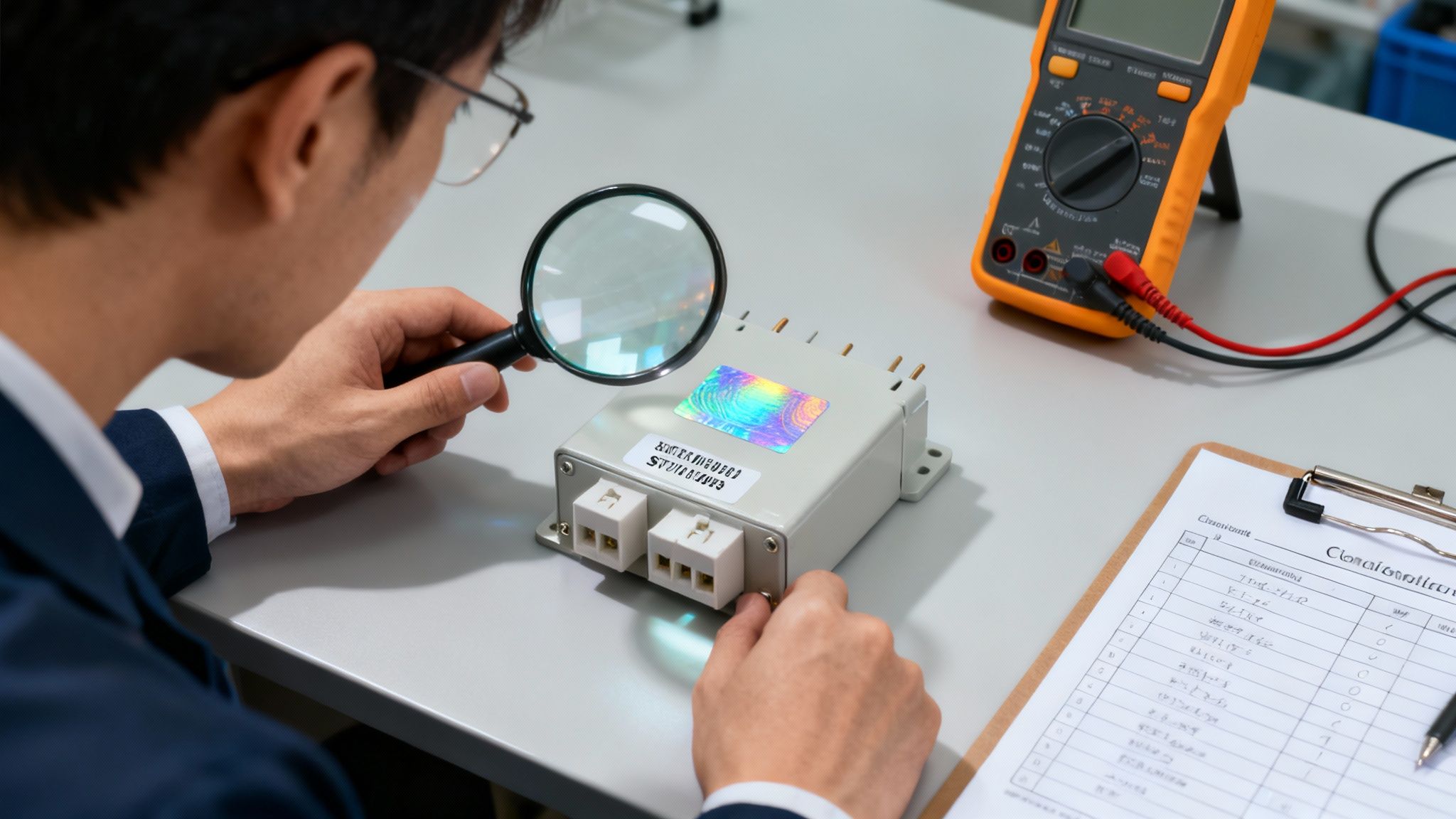
You can visually inspect for authenticity by getting hands-on with the product and looking for small details like manufacturer holograms, crisp laser-etched serial numbers, and high-quality branding. Counterfeiters often cheap out on the packaging and finishing touches, so any inconsistencies in logos, colours, or even the font should be a massive red flag. A good practice is to pull up official images from the manufacturer's website and compare them side-by-side with what you’re holding.
Don't forget to check the batch numbers. These codes are vital for traceability, allowing you to track a product back to a specific production run. A reputable supplier will have a proper system for managing and recording these numbers, adding another layer of confidence. For more specific tips, especially on complex items, our guide to sourcing high-quality wires and cables in Dubai is a great resource.
Verifying authenticity isn't about mistrust; it's about professional diligence. In an industry where a single faulty component can compromise an entire system, taking the time to confirm product legitimacy is a non-negotiable part of risk management.
This focus on quality is a big deal across the industry. The UAE’s electrical and electronic test equipment market is expected to hit USD 450 million by 2030, a clear sign of how critical verification has become, especially with the construction sector's growth and stricter safety rules. You can discover more insights about the test equipment market on Ken Research.
Ultimately, your best bet is to partner with established electrical equipment suppliers in the UAE who live and breathe quality control. They invest in rigorous verification processes because their name is on the line, which gives you peace of mind that every component you install is safe, genuine, and built to last.
Got Questions About Sourcing Electrical Equipment in the UAE?
When you’re deep in the trenches of a major construction project, the same practical questions always seem to pop up. Navigating the procurement landscape means you need clear, quick answers to common hurdles. From unexpected delays to confusing standards, getting the right information is what keeps a project on track.
Think of this section as your on-the-ground playbook. We’ve rounded up the most frequent questions project managers and engineers ask when dealing with electrical equipment suppliers in the UAE and laid out direct, actionable answers to help you sidestep common traps.
What’s a realistic lead time for electrical equipment orders here?
For standard, locally stocked items from a major supplier in Dubai, a realistic lead time is often within 24-48 hours. However, for specialised or custom-ordered equipment that has to be imported, you should expect to wait anywhere from 4 to 12 weeks.
This detail is non-negotiable and something you must lock down during the quotation stage. A supplier with a massive, well-organised local inventory is worth their weight in gold for hitting tight deadlines. Always, always confirm stock levels and delivery schedules before you sign that PO. It’s the difference between a smooth-running site and a project grinding to a halt.
Are there special electrical standards for Dubai's hospitality projects?
Yes, hospitality projects in Dubai operate under much stricter electrical standards enforced by DEWA and Dubai Municipality. The focus here is squarely on guest safety and energy efficiency, and the rules go way beyond what’s required for a typical commercial building.
You’ll be dealing with highly specialised systems, including:
- Guest Room Management Systems (GRMS): These are the brains of the room, controlling lighting, temperature, and services. They must meet specific energy-saving and safety protocols.
- Emergency Lighting: Hotels need far more complex and robust emergency lighting and exit sign systems to guarantee a safe evacuation route for every guest.
- Fire Alarm and Detection Systems: The fire safety standards in hospitality are exceptionally high, demanding advanced, addressable alarm systems that leave no room for error.
Your supplier must be able to provide products that are explicitly certified for these uses. Partnering with someone who’s not familiar with these codes is just asking for failed inspections and expensive rework down the line.
For hotels and resorts, working with a supplier who has a proven track record in the hospitality sector isn't just a good idea—it's essential. Their expertise in these niche UAE construction standards ensures your project is compliant from the get-go.
How should I handle warranties and after-sales support?
You should handle warranties by getting everything in writing before issuing a purchase order, including the exact warranty period, what it covers, and the step-by-step claim process. A handshake deal just won’t cut it.
A top-tier supplier will give you clear, detailed documents and have a dedicated local team for technical support. This is where choosing a supplier with a physical presence and service centre in the UAE really pays off. A local team can jump on post-installation issues much faster and more effectively, even providing on-site help when needed. That kind of support is what separates a simple vendor from a true project partner.
Can I get one quote for all my building materials?
Yes, and working with a comprehensive building materials distributor to get a single, consolidated quote is one of the smartest ways to handle procurement. The amount of time and admin work this saves is huge.
Instead of juggling a dozen different suppliers, RFQs, and delivery schedules, you can funnel everything through one point of contact. Not only does this simplify your logistics, but you can often get better pricing because of the larger order value. Many modern suppliers even have online platforms where you can build a multi-category quote yourself, giving you a crystal-clear, itemised overview of your project costs. Choosing a versatile supplier is a strategic move that makes your entire project run more efficiently.
Ready to partner with a supplier that simplifies your procurement process and guarantees quality? Yasu Trading Co. LLC offers a comprehensive portfolio of certified electrical equipment, plumbing supplies, and safety gear, all supported by an expert team and a seamless online quotation platform. Request your consolidated quote today!