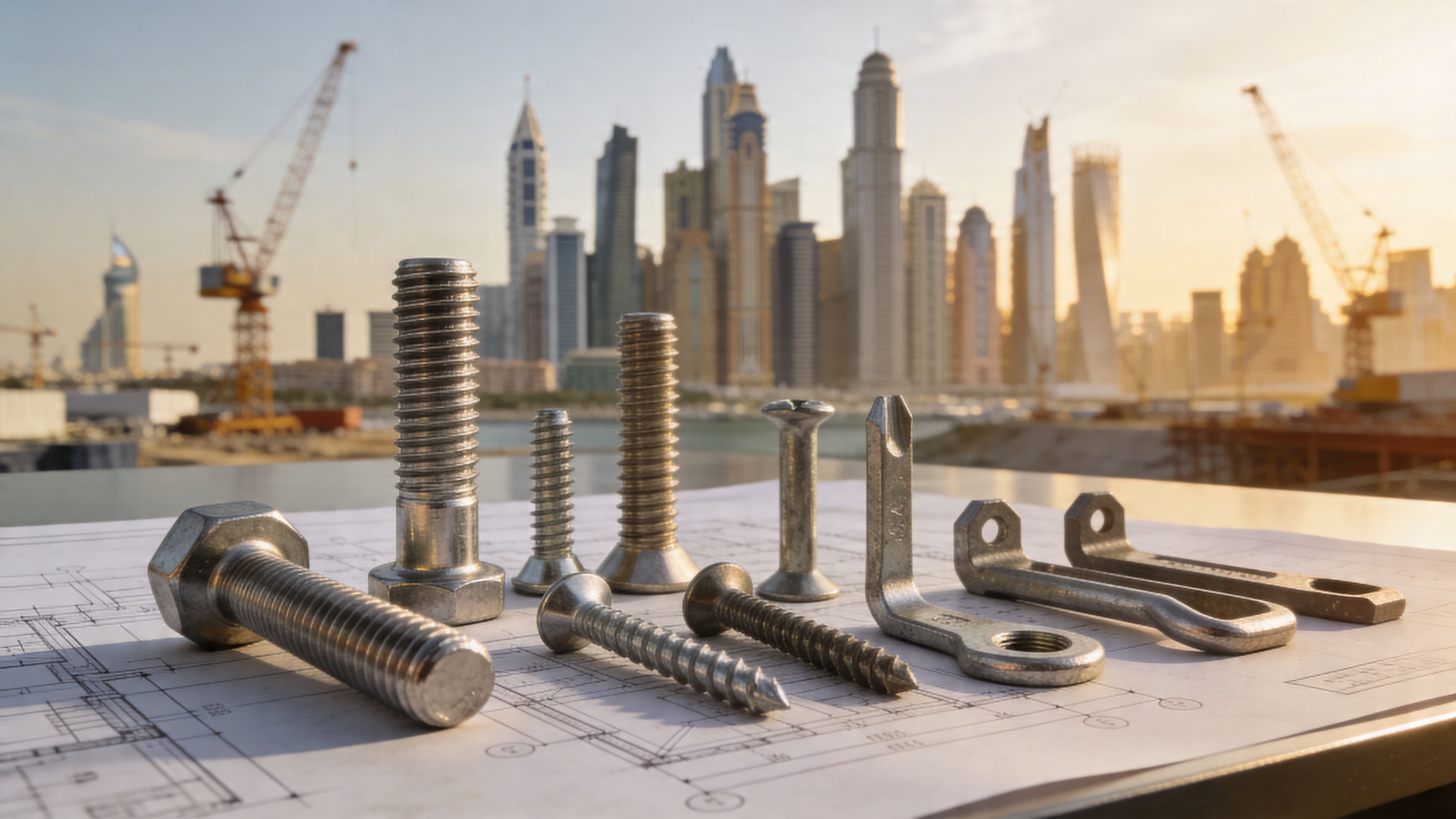
Fasteners Manufacturers in UAE: A Buyer's Guide (2026)
A fastener problem rarely starts with the fastener. It starts with a rushed approval, a vague RFQ, a substitution made to save a few fils per piece, or a box arriving on site with no paperwork anyone wants to defend in front of the consultant. Then the inspector asks for traceability, the site team scrambles for certificates, and a small line item turns into a programme issue.
That’s why sourcing from fasteners manufacturers in uae isn’t just a catalogue exercise. In this market, procurement decisions sit right in the middle of compliance, logistics, corrosion risk, and labour productivity. A bolt that’s technically available but wrongly graded, poorly coated, or unsupported by proper documents can slow installation, fail inspection, and create expensive rework long after the purchase order is closed.
Beyond the Bolt Why Fastener Sourcing Derails UAE Projects
A common site problem in the UAE looks deceptively simple. Structural or MEP works are ready to proceed, pallets are delivered, and installation starts. Then the consultant or municipality reviewer asks for grade confirmation, test certificates, or approval documentation. If the supplied fasteners don’t match the approved submittal, the issue isn’t limited to one package. Access equipment is tied up, labour sits idle, and follow-on trades lose their slot.
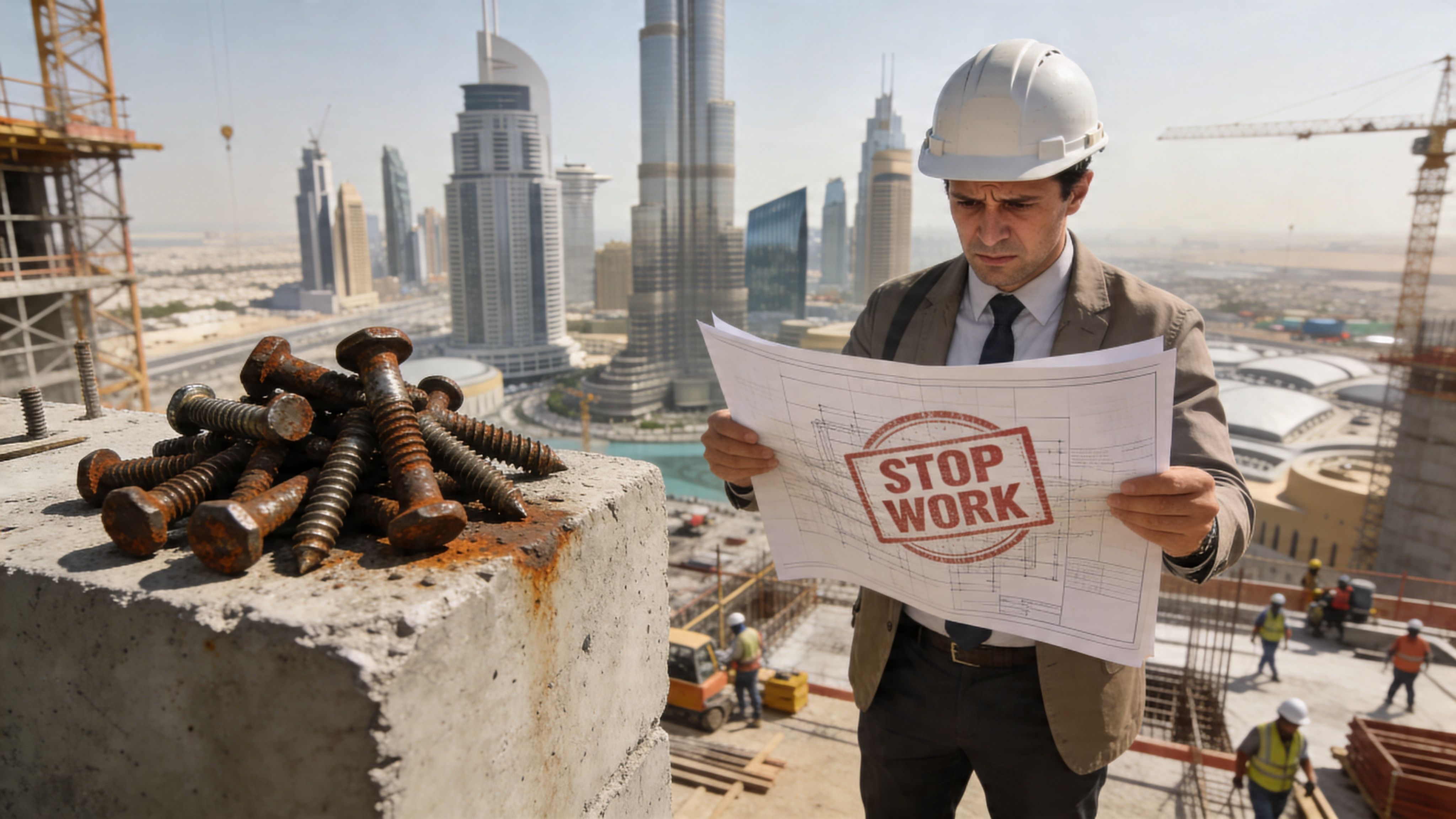
That risk is growing because the market itself is growing. The UAE industrial fasteners market is projected to expand from USD 216.74 million in 2024 to USD 290.03 million by 2032, at a 3.71% CAGR, supported by infrastructure work such as metro construction, airport expansion, and smart city projects, according to Credence Research’s UAE industrial fasteners market report. More projects mean more demand, but also more pressure on buyers to source quickly without losing control of specification and documentation.
Why small procurement errors become major site problems
Fasteners are often treated as consumables. That’s the mistake.
A project manager usually reviews steel sections, pumps, ductwork, cable trays, and finishes in detail. Fasteners get compressed into a short schedule line, grouped under hardware, and pushed to procurement late. When that happens, three failures show up again and again:
Compliance gaps
The delivered item may be usable in a general sense, but not acceptable for the submitted method statement, consultant approval, or municipality requirement.Material mismatch
Carbon steel gets used where stainless steel should have been specified, or an indoor-grade fixing gets carried into a humid plant room or coastal external area.Logistics mismatch
The supplier can sell the product but can’t support split deliveries, batch traceability, or urgent replenishment to multiple sites.
Fasteners don’t usually fail in the quotation stage. They fail at inspection, installation, or after exposure.
Procurement teams that want fewer surprises usually build the fastener package earlier, not later. That means locking the grade, finish, compliance documents, and delivery format before the first urgent call from site. Buyers handling mixed packages often benefit from working through a bulk fasteners supplier for construction because consolidation reduces the number of partial approvals and mismatched deliveries.
The UAE market has its own pressure points
The UAE rewards speed, but only when speed is organised. Projects move quickly, consultants expect complete documentation, and coastal or high-humidity environments punish bad material choices. In practice, the buying decision isn’t “Who has bolts?” It’s “Who can supply the right bolt, with the right paper trail, in the right sequence, without causing a hold point?”
That’s the difference between buying hardware and protecting programme.
Decoding Fastener Specifications for the UAE Climate
The first filter for fastener selection in the UAE isn’t price. It’s exposure. Before comparing brands or pack rates, ask where the fixing will live: inside conditioned space, on a roof, in a plant room, near the coast, in a parking structure, or in a washdown area. The answer usually narrows the right material faster than any catalogue search.
Start with function, then choose the material
Different fasteners solve different site problems. A few practical examples:
- Bolts and nuts suit structural connections, equipment bases, support frames, and mechanical assemblies where disassembly may be needed.
- Screws are common in sheet metal, access panels, light supports, cladding interfaces, and finishing packages.
- Anchors matter when the base material is concrete or blockwork and pull-out performance matters as much as the fastener itself.
- Studs and threaded rods are widely used in MEP support systems, suspended services, and equipment mounting.
Once the type is clear, material becomes the decisive issue. Carbon steel remains the mainstream stock item in the regional market, but UAE conditions regularly push buyers towards corrosion-resistant options in the wrong place to economise. That’s short-term thinking.
Corrosion resistance matters more than many buyers assume
A coating is not magic. It helps, but it doesn’t turn the wrong base material into the right one.
UAE-based MKM Fasteners Industry LLC operates a 44,000 sq ft manufacturing unit in Dubai focused on stainless steel fasteners, and technical details cited for stainless variants such as A4-80 note that chromium-nickel alloying forms passive oxide layers that can reduce pitting corrosion rates by 90% in saline UAE conditions. The same source notes that inadequate fasteners can corrode through crevice attack in humid 40°C+ climates, contributing to 15-20% of MEP failures in regional audits, as described in this UAE fasteners manufacturing overview.
That matters in real jobs. On coastal sites, exposed rooftops, wet service zones, and marine-adjacent developments, stainless steel often saves money by avoiding replacement labour, access cost, and remedial work. Buyers comparing only unit price usually miss that.
Think of coating as sunscreen for steel. It helps, but if the exposure is severe enough, base material still decides how long the fixing lasts.
For teams dealing with marine air, roof plant, or external support systems, this guide on sustainable fasteners coatings for UAE coastal corrosion is useful because it frames coating choice around actual exposure, not generic product claims.
What works and what usually doesn’t
A practical selection pattern looks like this:
Internal dry areas
Standard carbon steel options may be acceptable if the application isn’t structural and the approved specification allows them.External but non-marine exposure
Coated carbon steel can work when the finish, maintenance expectations, and service life line up with the project requirement.Coastal, humid, washdown, or corrosive environments
Stainless steel is often the safer call, especially where access for replacement will be difficult later.
What usually doesn’t work is a blanket rule such as “use galvanised everywhere” or “stainless is too expensive for this package”. The UAE climate isn’t uniform. A hotel fit-out corridor, an underground pump room, and a beachfront façade support frame don’t need the same answer.
Don’t ignore movement and temperature
Heat changes behaviour. Metal expands, contracts, and cycles under load. In the UAE, that becomes more important on roofs, external steel interfaces, and MEP supports around plant.
When buyers pick a fastener only by diameter and length, they miss two practical questions:
- Will the assembly stay tight under temperature cycling?
- Will the finish or material hold up where condensation, chlorides, or trapped moisture are likely?
Those questions prevent a lot of nuisance failures.
Navigating UAE Fastener Standards and Compliance
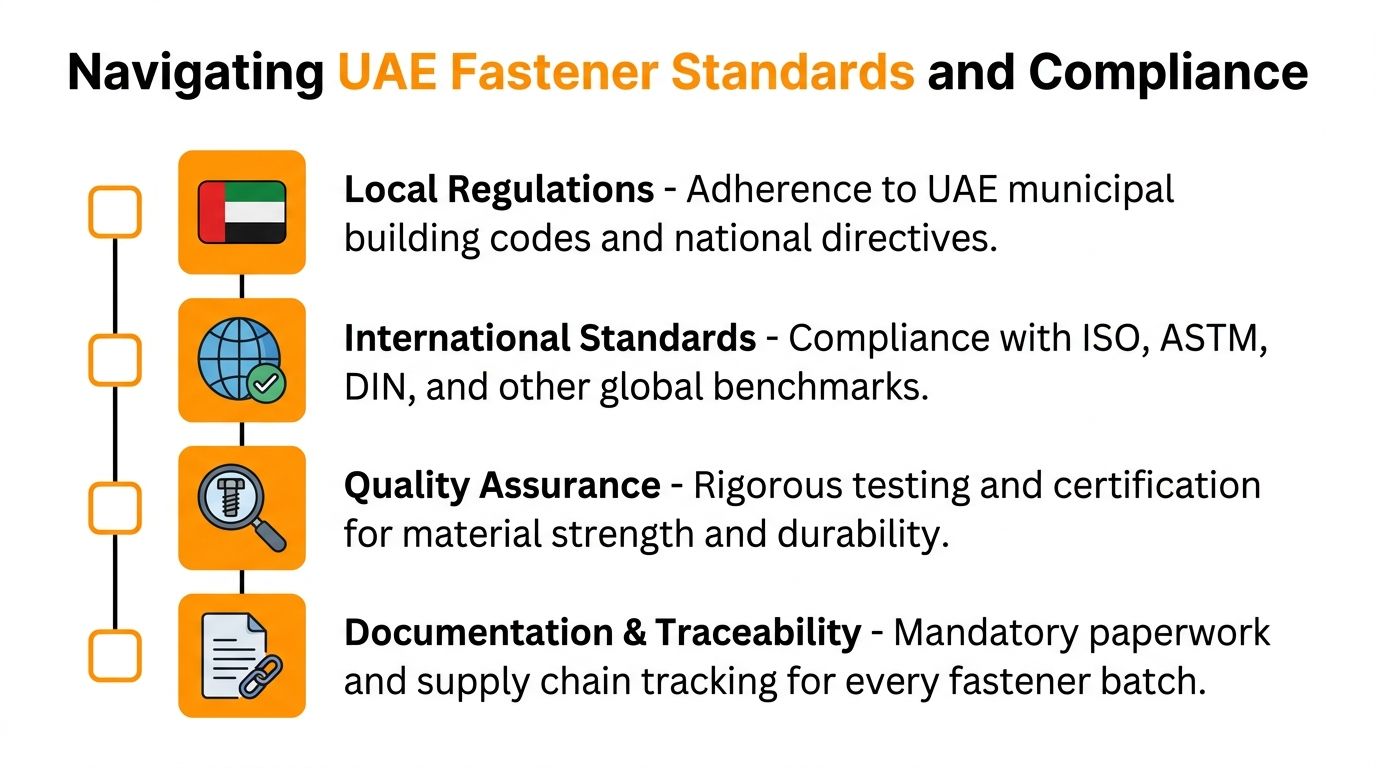
In the UAE, a fastener can be physically correct and still be commercially useless. If the grade, standard, or documentation doesn’t align with project requirements, it won’t pass review cleanly. That’s why compliance has to be checked at enquiry stage, not after delivery.
What the grade actually tells you
In the UAE, fastener grades commonly follow ISO 898-1. The grade many contractors encounter most often is 8.8, which has a tensile strength of 800 MPa and yield strength of 640 MPa. It is widely used for bridges and construction work, and the same source notes that it enables 20-30% higher load capacities versus lower grades in municipality-compliant MEP and civil applications, based on Blue Con’s guide to fastener grades in the UAE.
That doesn’t mean Grade 8.8 is the answer for every package. It means the buyer needs to understand the engineering intent. Grade is about mechanical performance. Material is about what the fastener is made from. Finish is about surface protection. Those three are related, but they’re not interchangeable.
Municipality compliance is more than a label
“Municipality-approved” gets used loosely in the market. On site, that phrase only helps if the supporting documents match the approved submission and the delivered batch. A buyer should expect to check:
Standard reference
ISO, DIN, ASTM, or other listed benchmark in the approved specification.Mechanical grade and material
The product description must align with the application, especially in structural and MEP support packages.Traceable paperwork
Batch-linked documentation matters because a generic brochure won’t satisfy an inspector reviewing installed material.Submittal alignment
Even compliant stock can cause rejection if it differs from the consultant-approved item.
Practical rule: If the supplier can’t tie the box on your site to the certificate in your file, you don’t have a documentation package. You have a paperwork risk.
Where buyers usually get caught out
The most common compliance mistakes aren’t dramatic. They’re administrative and avoidable:
Substitution without revised approval
Procurement swaps brand or origin based on availability, but the project documents still point to the original submittal.Generic certificates
The file contains a standard test sheet, not paperwork linked to the delivered item.Confusion between civil and finishing needs
Site staff treat all bolts or screws as equivalent, even when the approval basis is very different.
A simple review sequence for project teams
Before releasing an order, ask four questions in this order:
- What standard does the project specification call for?
- What grade and material does the application need?
- What documents will the consultant or authority ask for?
- Can the supplier deliver the same approved item repeatedly across the project duration?
That sequence is far more reliable than starting with “Who has stock today?” Stock matters, but approved stock matters more.
Sourcing Strategy Manufacturers vs Authorized Distributors
There isn’t one correct purchasing model for every project. Some packages suit direct buying from manufacturers. Others are better handled through authorised distributors that can consolidate brands, documents, and deliveries. The mistake is assuming the lower quoted unit price always produces the lower procurement cost.
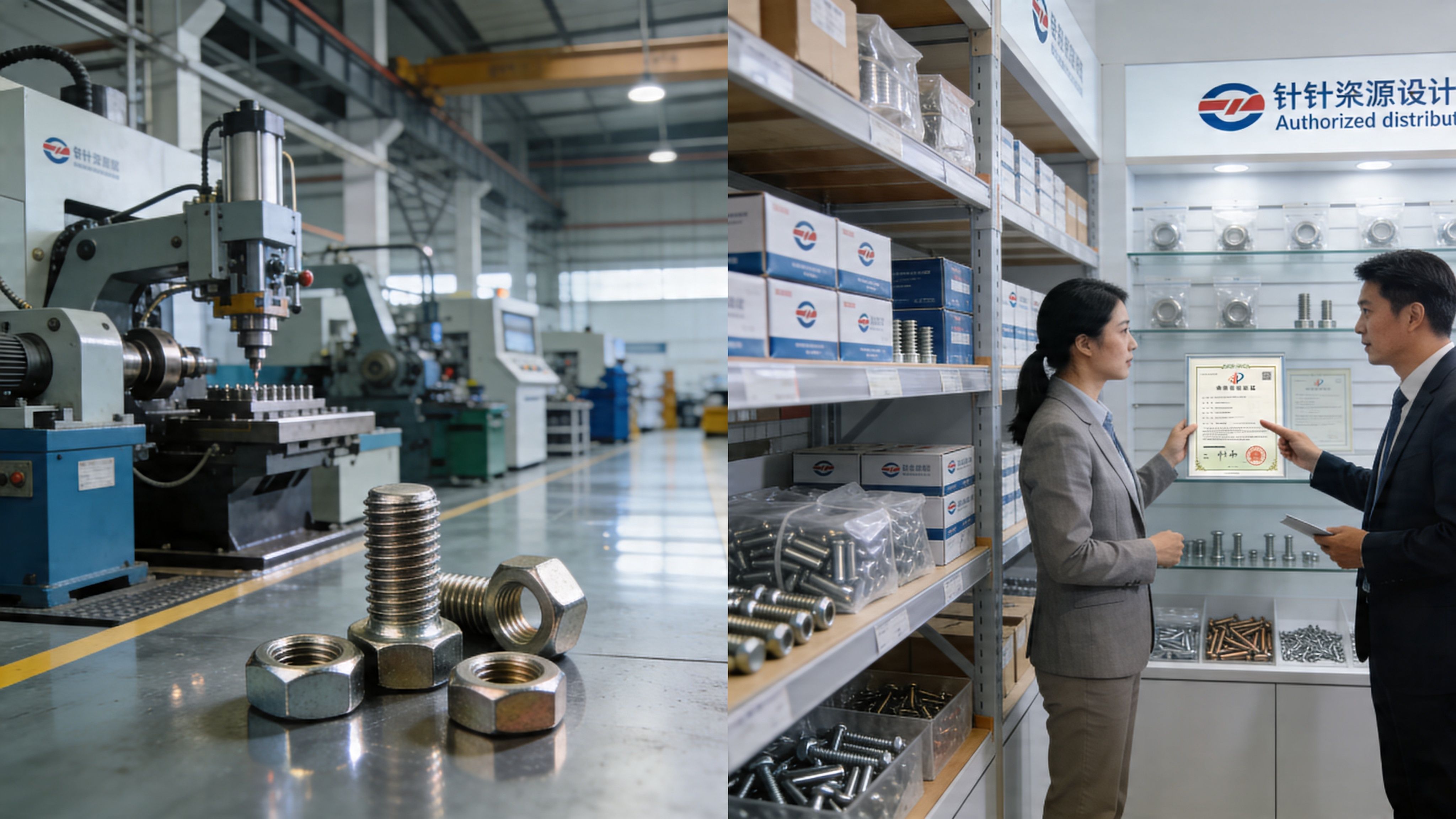
The UAE has a strong trade position in the region. It holds a commanding role in Middle East fastener imports and exports, with established names such as Hilti Middle East FZE, Fischer Middle East FZE, and Fastenal Middle East active in the market. Across the broader Middle East, carbon steel accounted for 54.9% revenue market share in 2024, which helps explain why mainstream inventories often lean heavily towards those products, according to Fact.MR’s Middle East and Africa industrial fastener analysis.
When buying direct from a manufacturer makes sense
Direct manufacturer sourcing usually works best when the package is narrow, repetitive, and planned early.
Typical examples include:
- Large-volume standardised orders for one project package
- Custom or non-standard production where factory input is needed
- Longer planning windows where lead time can be absorbed into the programme
The trade-off is rigidity. Manufacturers often suit buyers who know exactly what they need, in what quantity, and by what schedule. They are less forgiving when the site starts asking for split lots, mixed specifications, or emergency top-ups in small quantities.
When a distributor is the better operational fit
Distributors are often more useful for contractors running multiple fronts at once. A mid-sized contractor may need anchor bolts for civil works, threaded rods for MEP supports, stainless fixings for roof equipment, and assorted screws for fit-out, all in different release dates.
That’s where distribution solves real site problems:
- Consolidated purchasing across several product categories
- Mixed quantities without waiting to build factory-scale volume
- Documentation support for approved and traceable stock
- Faster replenishment when site consumption changes unexpectedly
One practical market option is Yasu Trading Co. LLC, a Dubai-based B2B distributor that supplies municipality-compliant construction materials and hardware, supports specification queries, and provides same-day or next-day site-direct delivery across much of the UAE.
For buyers comparing supply models, this overview helps visualise how production and QA fit into the chain:
Compare total procurement cost, not just piece price
A fastener package that looks cheaper on paper may cost more after:
- partial deliveries,
- duplicated transport,
- resubmissions,
- site idle time,
- and emergency purchases outside the original order.
The right sourcing channel depends less on who manufactures the item and more on who can keep your approved material flowing without disruption.
That's the key comparison.
Mastering Procurement and Logistics for On-Time Delivery
Procurement discipline matters most when the fastener package looks routine. That’s when teams tend to relax controls, issue vague RFQs, and assume replacement stock will always be available. In the UAE, that approach creates delay risk fast.
Recent construction data cited in market commentary says 15% of project delays are tied to non-compliant materials, and post-2024 Dubai Building Code updates have led to a 25% rise in compliance audits, making clean procurement and documentation more important than before, as noted in this UAE fastener market article discussing compliance and delays.
Build RFQs that suppliers can answer properly
Many RFQs are too vague to produce a reliable quote. “Send your best price for bolts and anchors” almost guarantees back-and-forth, substitutions, or mismatched assumptions.
A usable RFQ should state:
Application
Structural steel, cable tray support, façade bracket, equipment base, gypsum partition, or roofing.Base material
Concrete, block, steel, aluminium framing, sheet metal, or timber.Required standard and grade
If the project has approved references, list them exactly.Material and finish
Carbon steel, stainless steel, galvanised, or other specified requirement.Documentation needed
Material test certificates, batch traceability, compliance sheets, or submittal attachments.Delivery format
Bulk, floor-wise, area-wise, or site-sequenced dispatch.
The more precise the RFQ, the fewer commercial surprises later.
Treat delivery planning as part of specification
Buyers often separate technical approval from logistics. On live sites, they’re linked. Even the correct fastener becomes a problem if it arrives too early, gets stored badly, or lands in mixed cartons that waste installer time.
A practical procurement routine usually includes:
- Approving standard items early.
- Segregating special or long-lead items.
- Mapping delivery to work fronts, not just to purchase order dates.
- Confirming what documents must travel with each batch.
Hidden costs sit outside the unit rate
The unit price matters, but it isn’t the whole buying decision. UAE contractors lose money when they ignore the costs around the product:
- Storage risk if site receives too much too soon
- Rehandling when mixed materials must be sorted manually
- Wasted labour when installation teams wait for missing sizes
- Rejection cost when documents don’t match delivered material
A practical logistics rule for live projects
Short, frequent, controlled deliveries usually outperform one large drop for mixed-use fasteners, especially on urban sites with restricted storage and changing priorities. That reduces site clutter and makes traceability easier.
A clean fastener supply chain is usually built on boring habits: accurate descriptions, consistent labels, matching paperwork, and delivery in the sequence the site will actually use.
That’s what keeps hardware from becoming a delay notice.
Specification Checklists for Key UAE Projects
Specifications get clearer when they’re tied to actual work packages. A project team doesn’t buy “fasteners” in the abstract. It buys support fixings for ductwork, anchors for concrete, self-drilling screws for metal framing, and corrosion-resistant bolts for external equipment. The checklist has to follow the application.
MEP works
MEP packages punish weak specification because many fixings sit in concealed or hard-to-access areas. Once ceilings are closed or plant is commissioned, replacement gets expensive.
Use this checklist when reviewing MEP fasteners:
For HVAC supports
Check vibration exposure, suspended load path, and whether the fixing will loosen under repeated movement.For plumbing and drainage supports
Review moisture exposure, leak risk, and whether corrosion could start around clamps, hangers, or rod connections.For rooftop services
Don’t treat roof-mounted supports like indoor plant room supports. Heat, condensation, and weathering change the material requirement.For electrical containment
Confirm that screws, anchors, and threaded rod sizes match tray loads and spacing assumptions in the approved design.
Civil and structural works
Civil packages need less improvisation and more discipline. Structural applications should never be “close enough”.
Check these points:
Grade confirmation
Ensure the ordered item matches the approved structural or support detail.Connection type
A holding-down bolt, structural bolt set, expansion anchor, and chemical anchor all solve different problems. Don’t let purchasing merge them into one line item.Installation method
Some failures come from the wrong installation practice, not the wrong product. The ordered item should suit the contractor’s real site conditions.Environmental exposure
Podium decks, façades, parking areas, and coastal civil works all need closer review of corrosion risk.
Finishing and fit-out works
Finishing fasteners look low-risk until callbacks start. Door hardware loosens, sanitary accessories stain, joinery fixings back out, and ceiling screws rust through paint lines in humid areas.
For fit-out and finishing packages, check:
Substrate compatibility
Gypsum board, metal stud, masonry, and timber all need different thread and head profiles.Visible finish requirement
In exposed applications, appearance matters alongside holding performance.Maintenance environment
Hospitality, washrooms, back-of-house kitchens, and amenity decks need more careful material selection than dry office interiors.
Fastener Specification Quick Reference
| Application Area | Primary Fastener Type | Key Specification Focus |
|---|---|---|
| MEP supports | Threaded rods, anchors, channel fixings | Corrosion resistance, vibration stability, compatible support system |
| Structural steel and civil | Bolts, nuts, washers, anchor bolts | Grade, load performance, approved standard, traceable documentation |
| Façade and external equipment | Stainless bolts, screws, anchors | Salinity exposure, thermal cycling, long-term corrosion behaviour |
| Roofing and cladding | Self-drilling screws, roofing bolts | Weather exposure, sealing performance, substrate compatibility |
| Fit-out and interiors | Drywall screws, wood screws, light-duty anchors | Substrate match, finish quality, installation speed |
| Plumbing and wet areas | Stainless fixings, anchors, studs | Moisture resistance, staining risk, service access |
If the fixing is hard to replace after handover, buy for service conditions first and piece price second.
That one rule improves a lot of specifications.
Your Partner in Compliant and Efficient Sourcing Yasu Trading
Most procurement trouble around fasteners comes from three gaps. The specification isn’t translated cleanly into a purchase order. The compliance file isn’t complete enough for review. The delivery plan doesn’t match the way site teams consume material. Fix those three, and a lot of friction disappears.
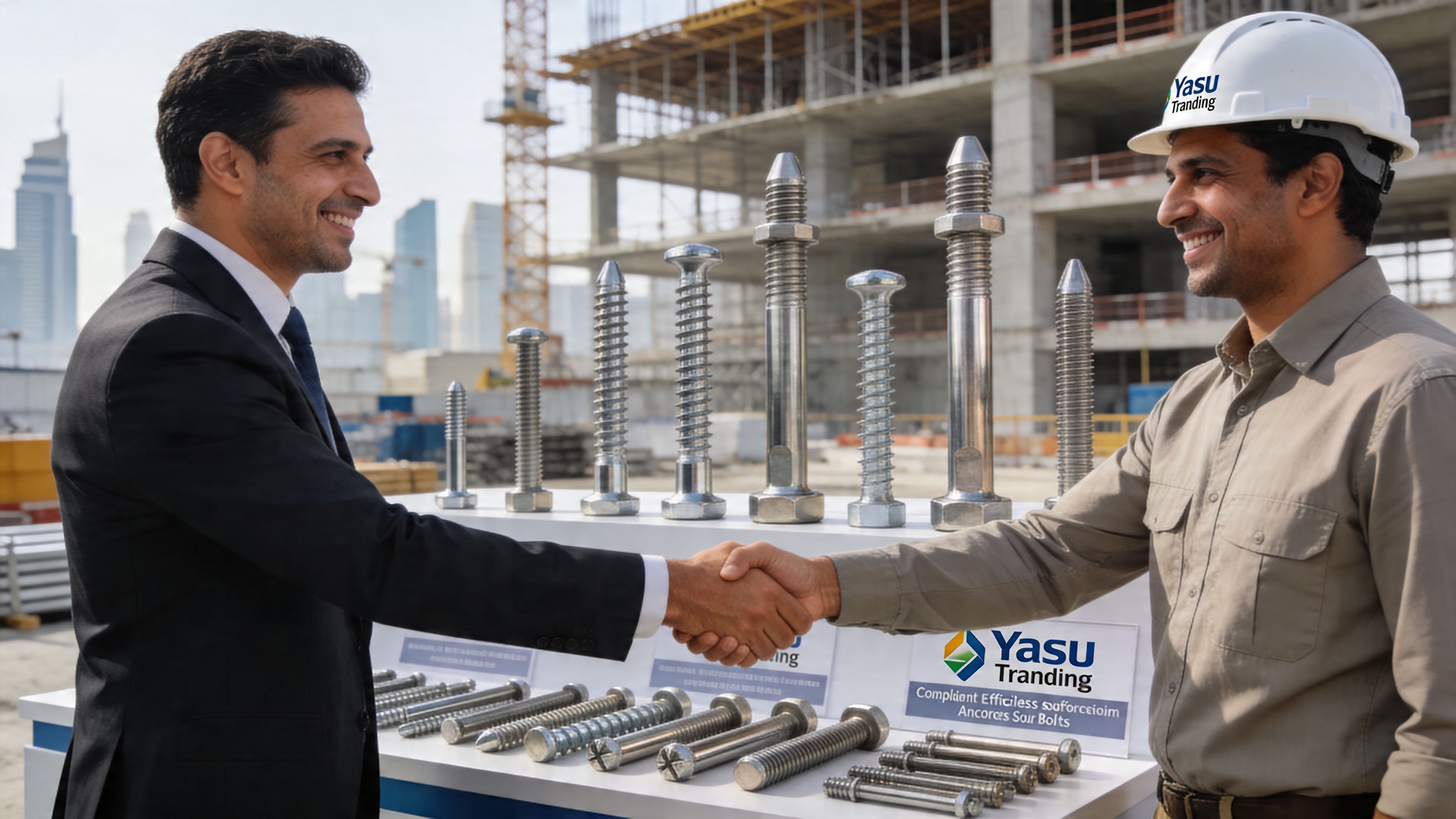
For contractors buying from fasteners manufacturers in uae, the practical challenge is rarely access alone. It’s filtering the market down to approved, traceable, correctly specified stock that can be delivered in the sequence the project needs. A supplier relationship becomes useful when it reduces checking work for procurement, consultant coordination for submittals, and emergency chasing from site.
What a useful supply partner should actually do
A reliable sourcing partner should help with more than quotation turnaround. In practice, the support should include:
Specification matching
Reviewing whether the requested grade, material, and finish suit the application and the approved submittal.Document readiness
Making it easier for the buyer to gather the paperwork needed for consultant and authority review.Consolidated ordering
Reducing fragmented purchases across bolts, anchors, screws, threaded rods, and related hardware.Site-aligned logistics
Dispatching in the format and timing that suits installation, not just warehouse convenience.
Where this saves money
The biggest savings usually don’t come from a lower per-piece cost. They come from avoiding the hidden spend that follows poor sourcing:
- rejected materials,
- idle labour,
- duplicate transport,
- over-ordering “just in case”,
- and late corrective purchases at retail rates.
That’s why the most useful fastener supplier isn’t merely the one with shelves full of stock. It’s the one that helps the project buy cleanly, prove compliance quickly, and keep materials moving without confusion.
Frequently Asked Questions about UAE Fasteners
What’s the difference between fastener material and fastener grade
Material tells you what the fastener is made from, such as carbon steel or stainless steel. Grade tells you about its mechanical performance class, especially strength. A buyer can’t assume a high grade automatically means better corrosion resistance, and can’t assume stainless automatically means it meets the structural strength required for every application.
What should a Material Test Certificate help me verify
An MTC should help the project team confirm that the supplied batch matches the specified product. In practical terms, buyers usually review whether the certificate aligns with the ordered item description, relevant standard, grade or material details, and traceability to the delivered goods. A certificate that can’t be linked back to the actual batch on site is much less useful during inspection.
How should fasteners be stored on a humid UAE construction site
Keep cartons off the slab, under cover, and segregated by type and batch. Don’t open more boxes than the crew needs for immediate work. Mixed loose stock in damp site conditions creates identification problems first, then corrosion problems. Stainless and carbon steel items should also be kept organised so site teams don’t accidentally combine them in the wrong application.
If you need help sourcing compliant fasteners, anchors, bolts, threaded rods, and related construction hardware for projects in Dubai or across the UAE, contact Yasu Trading Co. LLC. The team supports contractors with practical specification guidance, municipality-compliant materials, consolidated procurement, and site-direct delivery that helps keep work moving.