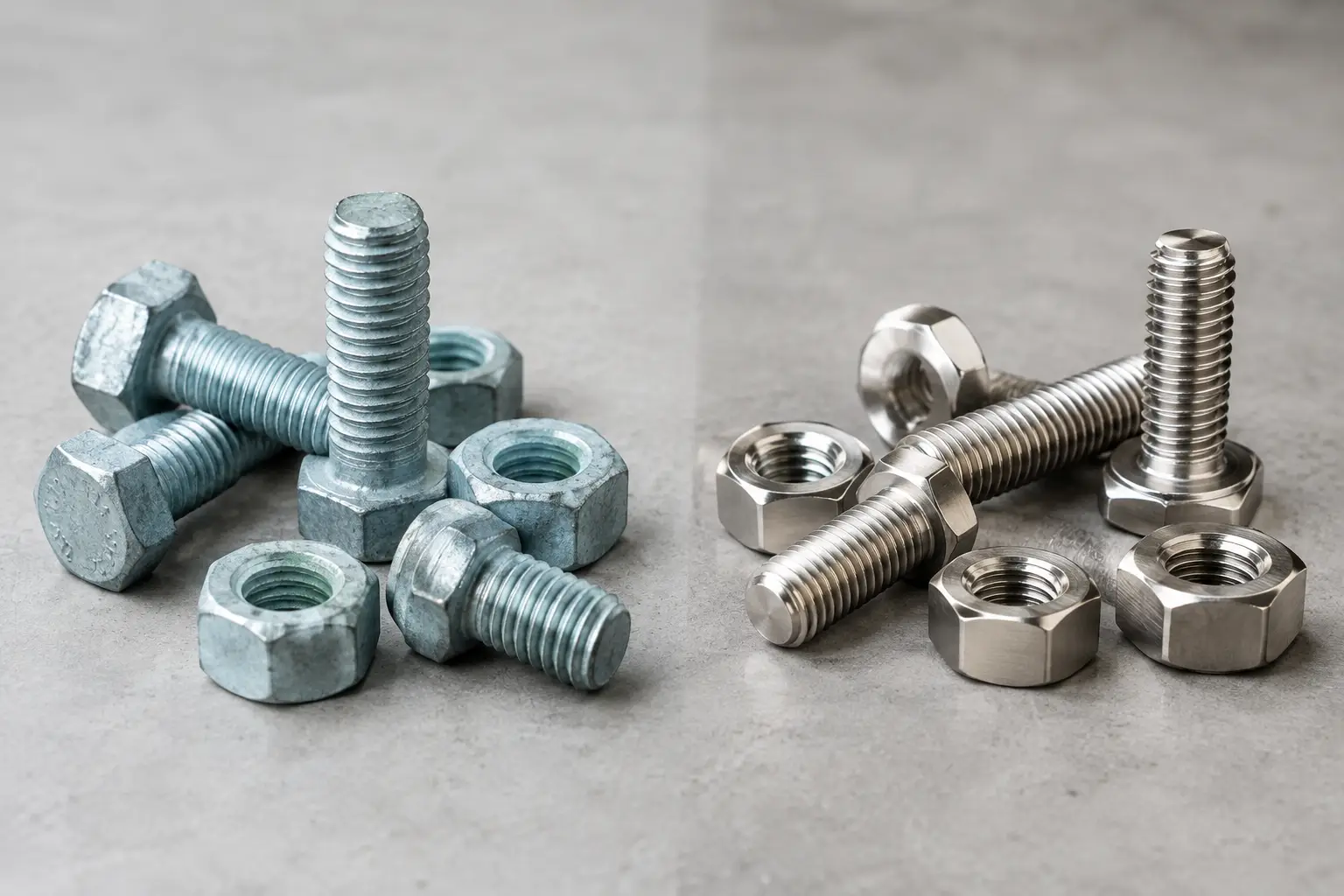
Galvanized Versus Stainless Fasteners Compared
A failed fastener rarely looks like a major procurement issue when it is ordered. Months later, it can become a rust stain on a facade, a seized anchor during maintenance, a rejected handover item, or a replacement package that interrupts site access. Choosing galvanized versus stainless fasteners is therefore not simply a price comparison. It is a decision about exposure, design life, compatibility, and whether the supplied material matches the approved project specification.
For contractors and MEP buyers, the practical question is not which material is universally better. It is which fastener will deliver the required performance in its installed environment without adding unnecessary cost or creating a compliance risk.
Galvanized Versus Stainless Fasteners: The Core Difference
Galvanized fasteners are carbon-steel fasteners protected by a zinc coating. The zinc acts as a sacrificial layer: it corrodes before the steel beneath it. This makes galvanized bolts, nuts, washers, threaded rods, screws, and anchors an economical choice for many general construction applications.
Stainless fasteners are made from corrosion-resistant steel alloys. Their protection comes primarily from a thin passive chromium oxide layer that reforms when the surface is exposed to oxygen. Rather than relying on an exterior coating, the corrosion resistance is built into the material itself.
That difference affects how each option behaves after installation. A galvanized surface can eventually lose protection as the zinc coating wears or is consumed. Stainless steel usually maintains its resistance longer in suitable conditions, but it is not immune to staining, chloride attack, thread galling, or corrosion caused by unsuitable grade selection.
When Galvanized Fasteners Are the Right Purchase
Galvanized fasteners often provide the best value for dry or moderately exposed construction work where the project specification permits them. They are widely used for structural supports, light steel assemblies, pipe supports, cable tray installations, fencing, brackets, and general exterior fixing work.
The type of galvanizing matters. Electro-galvanized fasteners have a relatively thin zinc coating and are generally better suited to indoor, dry environments. Hot-dip galvanized fasteners have a substantially thicker coating and are normally preferred for outdoor steelwork, external supports, and higher-exposure applications.
For procurement teams, hot-dip galvanized products can be a sensible middle ground: stronger corrosion protection than electro-galvanized stock at a lower initial cost than stainless steel. They are especially practical when a project uses large quantities of bolts, nuts, washers, or threaded rod and exposure is not severe enough to justify stainless throughout.
However, zinc coatings can be damaged by repeated abrasion, poor storage, aggressive chemicals, and cutting or drilling after galvanizing. Thread fit also deserves attention. Thick hot-dip galvanizing changes thread dimensions, so nuts and bolts must be supplied as compatible galvanized sets. Mixing a standard nut with a hot-dip galvanized bolt may lead to binding, incomplete engagement, or installation delays.
Where Stainless Fasteners Earn Their Higher Cost
Stainless fasteners are typically selected when corrosion resistance must remain reliable over a long service life or when replacement access will be difficult and costly. Common examples include coastal buildings, exterior architectural features, water-related installations, food-service areas, sanitary applications, chemical exposure zones, and visible finishes where rust staining is unacceptable.
In the UAE, this matters most near the coast and in areas exposed to salt-laden air. The higher chloride levels in these environments can rapidly shorten the useful life of standard zinc-coated fasteners. For these applications, stainless steel is often a lifecycle decision rather than a premium upgrade.
Grade selection is critical. Type 304 stainless steel, often referred to as A2, offers good general corrosion resistance and is suitable for many indoor and non-marine applications. Type 316 stainless steel, commonly referred to as A4, includes molybdenum for improved resistance to chlorides. It is generally the stronger choice for coastal, marine-adjacent, and high-moisture conditions.
A 304 stainless screw may look similar to a 316 stainless screw on a delivery pallet, but the difference can be significant after years of coastal exposure. Request material identification, grade confirmation, and manufacturer documentation before approving substitutions. “Stainless” alone is not a complete specification.
Stainless also needs correct installation practice. Stainless-on-stainless threaded connections can gall or seize under friction, particularly with high-speed installation or dry assembly. Suitable anti-seize compounds, correct torque, and compatible nuts and bolts help prevent this problem. Stainless steel can also stain or corrode in stagnant, oxygen-poor crevices, so water-trapping details should not be ignored.
Cost Should Be Measured Beyond the Unit Price
Galvanized hardware usually costs less at the point of purchase. On a large package of general supports or noncritical external fixings, that difference can materially affect the procurement budget. If the exposure is controlled and the project design life supports it, galvanized is a disciplined commercial choice.
Stainless costs more upfront, especially in 316 grade. Yet unit price is only one part of the decision. Replacement labor, access equipment, shutdowns, facade repairs, corrosion claims, and handover defects can exceed the original fastener cost many times over.
The right comparison is installed lifecycle cost. A galvanized bolt in a sheltered plant room may perform exactly as required. The same bolt on an exposed coastal rooftop, near a pool plant, or on an outdoor facade bracket could become a predictable maintenance issue. Paying for stainless where it is technically justified protects the program later.
Check Material Compatibility Before Ordering
Fasteners do not operate alone. They connect steel, aluminum, copper, stainless components, concrete inserts, and coated brackets. Dissimilar metals in the presence of moisture can create galvanic corrosion, where one metal corrodes faster than it otherwise would.
A common concern is stainless steel fasteners used with aluminum. In wet or coastal conditions, the aluminum may be at risk unless the connection is detailed with isolation washers, sleeves, sealants, or other approved separation methods. The same review applies to copper systems, galvanized steel supports, and mixed-metal facade elements.
For MEP work, confirm the material of the pipe clamp, channel, bracket, anchor, and threaded rod together. Specifying a stainless threaded rod while retaining a plain steel nut, washer, or channel fitting creates a weak point in the assembly. Matching the corrosion-resistance level across the connection is usually the safer route.
Concrete exposure also deserves consideration. Fasteners near wet areas, water tanks, external slabs, and chemically treated zones may see conditions that differ sharply from the rest of the building. The installed location, not the project’s general description, should guide the selection.
A Practical Specification Check for Site Buyers
Before releasing a fastener order, review four points with the project engineer or approved submittal. First, identify the exposure: dry internal, external urban, coastal, wet, chemical, or submerged. Second, confirm the required grade and coating, such as electro-galvanized, hot-dip galvanized, 304, or 316 stainless.
Third, verify the mechanical requirement. Diameter and length are not enough. Check strength class, thread type, pull-out or shear requirements for anchors, and any torque requirements. Stainless is not automatically stronger than carbon steel. The selected grade and property class must meet the load design.
Finally, check the complete fixing assembly and supporting documentation. This includes bolts, nuts, washers, anchors, rods, clamps, channels, and accessories, as well as manufacturer certificates where the project requires them. Municipality-compliant materials and approved brands reduce the chance of late substitution disputes or inspection failures.
Avoid the Most Common Fastener Mistakes
The recurring errors are familiar: using electro-galvanized hardware outdoors because it is immediately available, specifying generic stainless without stating 304 or 316, mixing incompatible metals, and treating fasteners as a minor line item after support layouts are already finalized.
Another frequent issue is inadequate storage. Keep galvanized and stainless fasteners dry, covered, and separated from materials that may contaminate them. Do not leave cartons on wet slabs or allow stainless hardware to collect grinding dust from carbon steel work. Clean handling protects the finish and makes material identification easier during inspection.
For project procurement, standardizing approved fastener families early is more efficient than sourcing bolts, anchors, threaded rod, and support accessories from separate vendors at the last minute. Consolidated supply also helps ensure that the delivered hardware is consistent in grade, finish, and documentation across multiple work fronts.
When schedule pressure is high, fasteners should still be bought to the exposure class, approved submittal, and full assembly requirement - not just the nearest available size. A correct fixing delivered to site on time is cheaper than a rushed replacement after corrosion, noncompliance, or installation failure has already affected the work.